Verify a Peptide Documentation Package in 6 Steps for Procurement

A peptide documentation package is the batch-specific bundle of records that proves what’s in the vial: a Certificate of Analysis (COA), the raw HPLC chromatogram, mass spectrometry identity confirmation, and traceability fields tying that paperwork to a physical lot. Procurement teams should treat a supplier’s refusal to provide this bundle, matched to the shipped batch, as disqualifying. Without it, purity and identity claims are marketing copy, not evidence.
TL;DR:
Verifying lot number consistency across the vial label, packing slip, and COA is crucial to confirm the shipment’s authenticity.
Mass spectrometry data should match the theoretical peptide mass to confirm identity beyond just purity percentage.
Endotoxin and sterility test results must include numeric values and test dates, not vague claims, especially for injectable peptides.
Building a standardized recordkeeping workflow for each lot improves traceability and prevents reconstruction issues during disputes.
Reused or suspiciously perfect documentation patterns, such as identical COAs for different batches or missing chromatograms, indicate potential fraud or lapses.
Table of Contents
What Goes Into a Complete Peptide Documentation Package
How Do You Verify a COA Matches Your Shipment?
Endotoxin and Sterility Records for Injectable-Use Peptides
Building a Traceable Recordkeeping Workflow
Documentation Red Flags Procurement Teams Should Never Ignore
Why Complete Documentation Changes How Research Actually Runs
Requesting Batch-Matched COAs From PeptidesFromChina
Sources
What Goes Into a Complete Peptide Documentation Package
Most COAs look similar at a glance: a header, a purity percentage, a signature block. The differences that matter live in the fields procurement teams tend to skim past.
The header should carry a lot or batch number that matches the vial label and the packing slip exactly, along with the report issue date, the test date, and the name and location of the testing laboratory. A COA with no lab name, or one that lists only a generic “quality control department,” gives you nothing to verify against.
The HPLC chromatogram is the purity evidence. It needs to show a clean, labeled peak with a retention time, and the report should disclose the method parameters behind it, including column type, mobile phase composition, gradient profile, flow rate, and detection wavelength. Change any of those variables and the apparent purity shifts, sometimes significantly, which is why a bare percentage with no method attached is close to meaningless.
Mass spectrometry data confirms identity rather than purity. A credible report lists the observed mass against the theoretical mass for the peptide’s molecular formula, and higher-end reports include MS/MS fragmentation for extra confidence. A COA package should also carry, when relevant to the compound:
Endotoxin (LAL) results reported in EU/mg or EU/mL, not a pass/fail claim alone
Sterility assay outcomes for anything positioned for injectable use
Residual solvent and trifluoroacetic acid (TFA) content, which affects both purity math and downstream research use
A batch statement from the manufacturer confirming synthesis route and lot size
How Do You Verify a COA Matches Your Shipment?
Verification is a sequence, not a glance. Skipping steps is how mismatched paperwork slips through procurement review.
Match the lot number everywhere. Cross-check the batch or lot number on the vial label, the packing slip, the invoice, and the COA itself. Any inconsistency, even a single digit, is a stop condition until resolved.
Confirm the lab is real and contactable. Search the laboratory’s name and address independently of the supplier’s paperwork. A credible peptide COA identifies a traceable lab with a report ID and a test date you can reference if you call them.
Read the chromatogram, not just the summary line. Look for a single dominant peak, a labeled retention time, and disclosed method parameters. A cropped image with no axis labels or method note is not usable evidence.
Check the mass spec numbers against theory. Compare observed mass to theoretical mass for the specific peptide sequence. HPLC purity alone can’t rule out co-eluting impurities that share a retention time with your target compound; mass spectrometry is required to confirm the peak is actually the intended molecule.
Validate sterility data for sterile-use lots. Endotoxin and sterility results should appear as raw numeric outputs, not a seller’s summary sentence.
Escalate to independent testing when anything doesn’t reconcile. If the batch number is off, the lab won’t confirm the report, or the chromatogram looks reused, submit a retention sample to a third-party lab before the material enters active research use.
Pro Tip: Keep a running spreadsheet of lot numbers, COA report IDs, and test dates across every supplier you use. It takes five minutes per order and turns a documentation dispute six months later into a two-minute lookup instead of a scramble.
Endotoxin and Sterility Records for Injectable-Use Peptides
Any peptide destined for parenteral or injectable research use needs safety documentation beyond a purity number. This is where documentation gaps carry the most practical risk, and where vague language does the most damage.
The expected test is a Limulus Amoebocyte Lysate (LAL) assay reported in endotoxin units per milligram or milliliter, not a checkbox marked “endotoxin free.” Sterility should come as an assay result tied to a specific test date and method, not a claim in seller marketing copy. For sterile-use materials, procurement teams should request the raw numeric output rather than accept a summary line.
Watch for these gaps specifically:
“Endotoxin tested” with no unit, no numeric value, and no method named
Sterility claims with no assay type or test date attached
No mention of cold-chain handling between lyophilization, vialing, and shipment, which affects sterility integrity on arrival regardless of what the original test showed
COAs dated well before the shipment date with no confirmation the tested lot is the one that shipped
A sterility result from six months before a shipment date tells you almost nothing about the vial that arrived at your facility unless the chain of custody between test and delivery is documented.
Building a Traceable Recordkeeping Workflow
Every lot you accept should generate a small, consistent paper trail, stored the same way every time. Ad hoc filing is how teams lose the ability to reconstruct what happened when a research result doesn’t reproduce.
At minimum, retain per lot: the purchase order, the packing slip, a photo of the vial label, the COA, any independent test results you commissioned, and the supplier correspondence around that order. A shared drive folder named by lot number works fine; the format matters less than the consistency.
Keep an archive of every COA received, organized by supplier and lot, not just the most recent one
Retain a small physical sample from each batch when storage conditions allow, so a later dispute has material to retest
Set explicit acceptance criteria before the order arrives (minimum purity threshold, required MS confirmation, endotoxin ceiling for sterile lots)
Define a quarantine step for any lot that fails a check, so it’s physically and procedurally separated from active research stock
Pro Tip: Grant reviewers and internal audit teams ask for batch documentation more often than researchers expect. An archive you can pull in minutes, rather than reconstruct from email threads, saves real time during renewal cycles.
Retention timeframes should track your institution’s data retention policy, but a practical floor is the life of the associated research project plus one full audit cycle. Reproducibility claims are only as strong as the paperwork behind the batch that produced them.
Documentation Red Flags Procurement Teams Should Never Ignore
Certain patterns show up again and again in fabricated or recycled documentation, and they’re worth memorizing rather than relearning the hard way.
Purity values that are suspiciously round, like an even 99% across multiple unrelated batches; real measurements vary batch to batch
Identical COAs reused across different lot numbers, sometimes with only the date field changed
A missing chromatogram image or a chromatogram with no axis labels, retention time, or method note
Mass spec data absent entirely, leaving purity as the only claim with nothing confirming identity
A lab name that returns no verifiable address, phone number, or website when checked independently
When any of these appear, the immediate move is to request raw data files rather than the summary PDF, contact the named laboratory directly, and compare the new COA against prior batches from the same supplier for suspicious similarities. If the discrepancy doesn’t resolve, quarantine the lot, document the incident with dates and screenshots, and route a retention sample to independent testing before the material touches active research work.
Why Complete Documentation Changes How Research Actually Runs
Most documentation failures I’ve seen in peptide sourcing aren’t dramatic fraud. They’re a supplier reusing last quarter’s chromatogram because getting a fresh one costs time and money, or a reseller who never actually saw the API manufacturer’s raw data and is just relaying a summary line someone handed them.
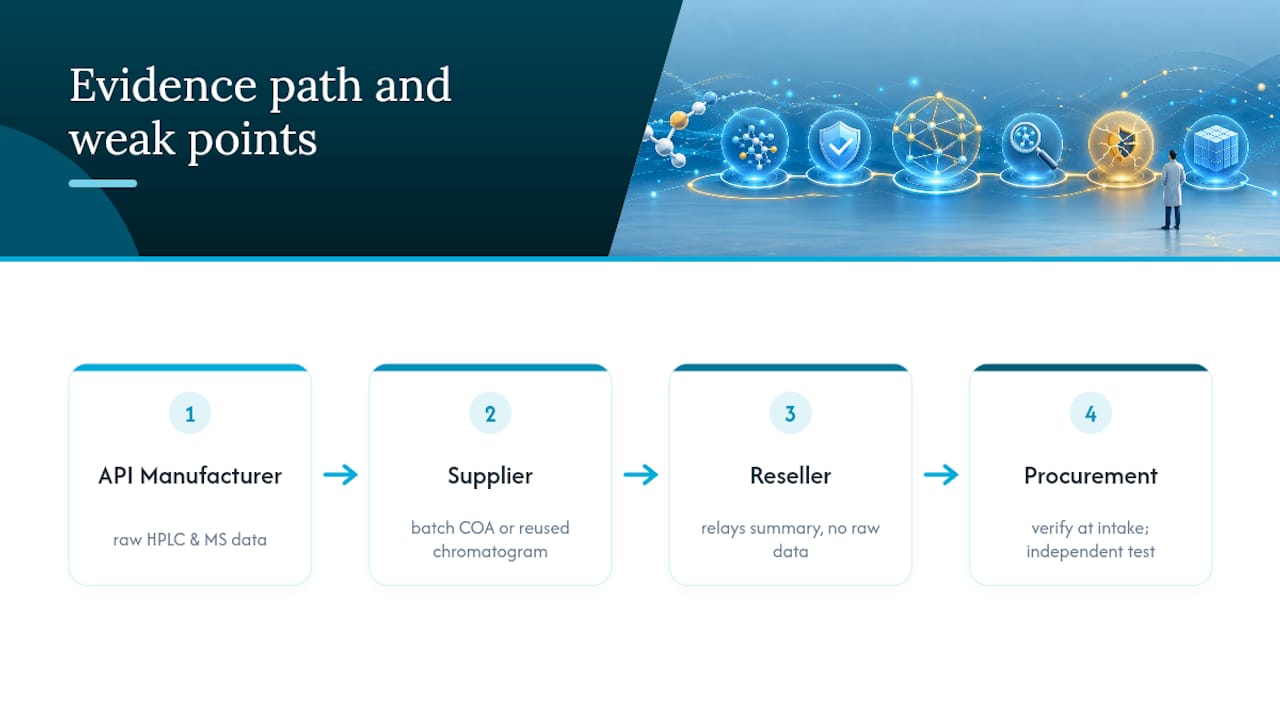
That gap between a reseller’s claim and a manufacturer’s actual test data is the entire reason batch-matched documentation matters more than a purity number on its own. Buyers requiring independent verification may arrange third-party analytical testing.
Adopt the verification checklist above as a standard intake step, not a one-off audit. A batch that takes five extra minutes to verify at intake is far cheaper than a research result that has to be thrown out three months later.
— Sam Levin
Requesting Batch-Matched COAs From PeptidesFromChina
Buyers requiring independent verification may arrange third-party analytical testing.
Documentation requirements should be confirmed during order processing. Products are subject to the manufacturer’s applicable quality-control procedures and specifications. Manufacturer-side analytical documentation may be available depending on the product and batch. PeptidesFromChina is not an independent analytical testing laboratory. Buyers requiring independent verification may arrange third-party analytical testing. See the Epithalon catalog for current product information.
Sources
For deeper technical grounding, review PeptidesFromChina’s guides on reading a peptide COA, molecular weight verification, and the characterization reporting checklist.