P21 Nasal Spray for Researchers and Biohackers
P21 nasal spray is a research-grade, CNTF-derived tetrapeptide formulation used experimentally to support neuroprotection and cognitive function via nose-to-brain delivery. Preclinical evidence from rodent Alzheimer’s models shows meaningful effects on BDNF upregulation, GSK-3β inhibition, and hippocampal neurogenesis. No human clinical trials have been completed, which means P21 remains strictly a research compound in the United States.
For researchers evaluating this peptide, the practical position is straightforward: the preclinical signal is credible and mechanistically coherent, but translational uncertainty is high. Use it within a formal research framework, source it with full batch documentation, and do not extrapolate rodent outcomes to human therapeutic claims.
Key facts before going further:
P21’s sequence is Ac-DGGLAG-NH2, with a molecular weight of approximately 578.3 Da and an adamantyl modification that increases lipophilicity and mucosal absorption.
Community-reported intranasal doses typically are in a low microgram daily range, with experimentally reported cycles lasting several weeks on and off.
P21 is not FDA-approved for any therapeutic indication. Human experimental use requires IRB oversight in the U.S.
Table of Contents
What P21 (P021) is and how it works at the cellular level
What the preclinical evidence actually shows
Why intranasal delivery is the preferred route for P21
Reported dosing ranges and how to administer P21 intranasally
Safety profile, drug interactions, and U.S. regulatory status
How to source research-grade P21 and what to verify
What community reports say and why they are limited as evidence
Key Takeaways
A note on responsible research use
PeptidesFromChina supports P21 for research procurement
Useful sources for further research
What P21 (P021) is and how it works at the cellular level
P21, also designated P021, is a synthetic tetrapeptide derived from a functional region of ciliary neurotrophic factor (CNTF). The amino-acid sequence Ac-DGGLAG-NH2 carries an N-terminal acetyl group and a C-terminal amide, both of which improve metabolic stability compared to unmodified peptides. The adamantylated glycine residue is the structural feature that most distinguishes P21 from simpler CNTF fragments: it raises lipophilicity, which matters both for mucosal absorption during intranasal delivery and for membrane permeability in CNS tissue.
The pharmacologic rationale centers on three interconnected pathways. First, P21 upregulates brain-derived neurotrophic factor (BDNF), a growth factor that supports neuronal survival, synaptic plasticity, and the maturation of new neurons in the dentate gyrus. Second, it inhibits glycogen synthase kinase-3 beta (GSK-3β), an enzyme whose overactivation drives tau hyperphosphorylation, one of the hallmarks of Alzheimer’s pathology. Third, it promotes adult neurogenesis in the hippocampus, a process that correlates with learning and memory consolidation in rodent models.
P021 has been shown to increase BDNF expression, promote neurogenesis, inhibit GSK-3β, and reduce tau hyperphosphorylation in preclinical Alzheimer’s models, supporting a disease-modifying rather than purely symptomatic mechanism of action.
That mechanistic profile is what separates P21 from acute cognitive stimulants. The compound is not designed to produce immediate alertness or working-memory spikes. Its proposed effects accumulate over weeks as new neurons mature and integrate into hippocampal circuits.
Two important caveats apply to any mechanistic inference from rodent data. Rodent GSK-3β and BDNF signaling differ from human pathways in regulatory detail, and dose-scaling from mice to humans is not linear. Human pharmacodynamics for P21 remain entirely unstudied, so the cellular mechanisms described above are preclinical observations, not confirmed human biology.
What the preclinical evidence actually shows
The strongest published data on P21 comes from studies using the 3xTg-AD mouse model, a triple-transgenic line that develops both amyloid plaques and tau tangles, making it one of the more clinically relevant rodent models for Alzheimer’s research. Across multiple studies, intranasal P21 administration improved performance on spatial memory tasks, increased markers of hippocampal neurogenesis, and reduced tau phosphorylation at disease-relevant epitopes.
The International Peptide Society monograph summarizes these findings as evidence of a disease-modifying effect rather than symptomatic masking. That distinction matters for study design: if the mechanism is genuinely neurogenic and anti-tau, researchers should expect effects to emerge gradually over weeks, not days.
Where the evidence is thinner: most published studies used small sample sizes, and independent replication across separate laboratories is limited. Study durations rarely exceeded 8–12 weeks, leaving questions about sustained efficacy and any adaptive downregulation of BDNF signaling unanswered. The behavioral endpoints used (Morris water maze, novel object recognition) are well-validated in rodents but do not map cleanly onto human cognitive assessments.
Pro Tip: When interpreting behavioral endpoints from P21 rodent studies, account for the neurogenic lag. New dentate gyrus neurons require roughly 4–6 weeks to mature and functionally integrate. Studies measuring cognition before that window may underestimate the compound’s effect, while studies that measure too late without controls for spontaneous recovery may overestimate it.
For researchers designing translational studies, the preclinical data provides a credible mechanistic hypothesis and a reasonable dose-range starting point. It does not provide a validated human protocol.
Why intranasal delivery is the preferred route for P21
The nose-to-brain route bypasses two major barriers that limit CNS drug delivery: hepatic first-pass metabolism and the blood-brain barrier (BBB). When a peptide is administered intranasally, a fraction of the dose travels along olfactory and trigeminal nerve pathways directly into the CNS, reaching the cerebrospinal fluid and brain parenchyma without entering systemic circulation first.
For P21 specifically, the adamantyl modification is not incidental to this route. Lipophilic modifications increase mucosal absorption across the nasal epithelium and improve membrane permeability in olfactory neurons, both of which enhance the efficiency of nose-to-brain transport. A more hydrophilic peptide with the same sequence would likely show lower CNS bioavailability via the same route.
Subcutaneous administration remains an alternative used in some research protocols, but practitioners note that it produces slower central exposure. The peptide must cross the BBB from systemic circulation, which reduces the fraction reaching CNS targets. For local vs. systemic delivery comparisons in CNS-targeted peptide research, intranasal generally offers a more direct pharmacokinetic profile.

Practical constraints exist. Mucosal absorption is not complete: the nasal epithelium presents a surface area limit, mucociliary clearance removes unabsorbed peptide within minutes, and formulation pH affects both stability and tolerability. Delivery device selection also matters. Bi-directional nasal devices and atomizers that deposit aerosol in the upper nasal cavity, near the olfactory cleft, produce better CNS targeting than standard pump sprays that deposit primarily in the lower turbinates.
Pro Tip: For research protocols using intranasal P21, position the subject supine or in a “Kaiteki” head-back position during administration. This increases contact time between the formulation and the olfactory epithelium, which is the primary entry point for nose-to-brain transport.
Reported dosing ranges and how to administer P21 intranasally
Community and protocol sources report the following dose ranges for research use. These figures are not derived from clinical trials and carry the uncertainty that entails.
Route Reported Range Cycle Pattern Notes Intranasal 500 mcg–1 mg/day 4–6 weeks on, 2–4 weeks off Most common community protocol Intranasal (escalated) 2–4 mg/day Short-term acute use Less common; higher irritation risk Subcutaneous 500 mcg–1 mg/day Similar cycle structure Slower CNS onset vs. intranasal
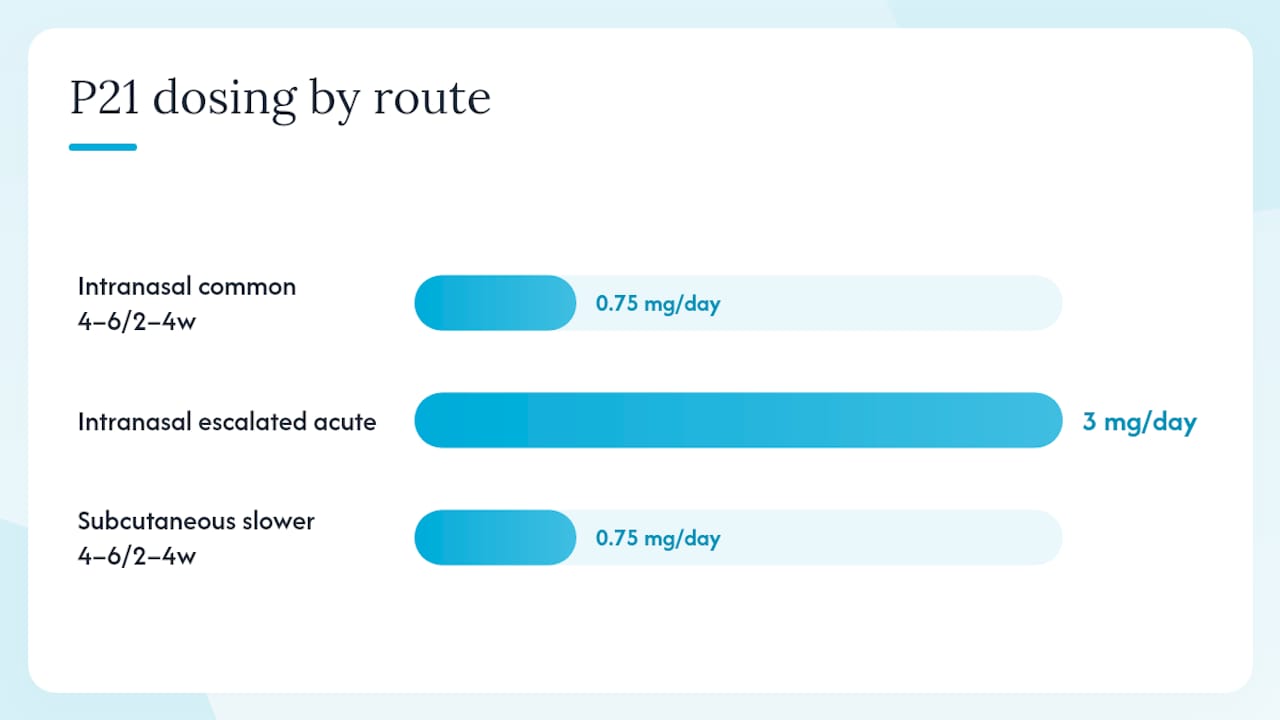
The Peptide Initiative protocol documents the 500 mcg–1 mg daily intranasal range as the most widely circulated community starting point, with some researchers escalating to 2–4 mg for short-term periods. No dose-response data from controlled human studies exists to validate these figures.
For intranasal administration, the following stepwise protocol reflects community practice:
Reconstitute lyophilized P21 with sterile bacteriostatic water or sterile saline. Use a volume that produces the target concentration per spray (commonly 100 mcg per actuation).
Transfer the reconstituted solution to a calibrated nasal atomizer or pump spray bottle rated for the intended volume per actuation.
Prime the device with 2–3 actuations before first use to clear dead volume.
Tilt the head slightly forward, insert the tip into one nostril, and actuate while inhaling gently through the nose.
Alternate nostrils across doses or within a single dosing session to reduce localized mucosal irritation.
Remain in a head-back or supine position for 1–2 minutes post-administration to maximize contact time with the olfactory epithelium.
Avoid blowing the nose for at least 10 minutes after dosing.
Storage and stability: reconstituted P21 spray should be refrigerated at 2–8°C and used within 14–21 days. Lyophilized (unreconstituted) peptide stores at -20°C for longer-term stability. Avoid repeated freeze-thaw cycles of the reconstituted solution, as these degrade peptide integrity. Formulations exposed to temperatures above 25°C for extended periods show accelerated degradation.
Short-term adverse effects reported in community contexts include mild nasal irritation, transient headache, and fatigue. These are the most commonly noted P21 nasal spray side effects, though they remain anecdotal in the absence of controlled safety data.
Safety profile, drug interactions, and U.S. regulatory status
The honest summary of P21’s safety profile is that short-term adverse events appear mild and transient in the available community reports, but long-term human safety data does not exist. Headache, mild nasal mucosal irritation, and fatigue are the most frequently mentioned effects. No serious adverse events have been documented in published preclinical studies at doses used in rodent models, but rodent safety data does not predict human tolerability with confidence.
Peptide monographs and reviews consistently note the absence of human clinical trials and long-term safety data for P021, underscoring that all human use remains experimental and outside any regulatory approval framework.
Drug interaction data is essentially nonexistent for P21 in humans. Based on its mechanism, researchers should apply precaution in the following contexts:
Co-administration with anticoagulants: GSK-3β inhibition has downstream effects on platelet function in some models; the clinical significance for P21 at research doses is unknown.
Concurrent use of potent CNS-acting compounds (antidepressants, antipsychotics, stimulants): BDNF upregulation can modulate synaptic plasticity in ways that may interact with serotonergic or dopaminergic pharmacology.
Immunocompromised subjects: intranasal administration of any peptide carries a theoretical risk of mucosal immune activation; this is a precautionary consideration, not a documented P21-specific effect.
Regulatory status in the United States is unambiguous. P21 is not approved by the FDA for any therapeutic indication. It is not classified as a dietary supplement. Any human research use requires Institutional Review Board (IRB) approval and must comply with 21 CFR Part 312 if an IND application is warranted. Importation of research peptides for laboratory use falls under FDA and CBP jurisdiction; researchers should confirm current importation rules with their institution’s regulatory affairs office before procurement.
Pro Tip: Before initiating any human experimental protocol with P21, consult your institution’s IRB and regulatory affairs team. The absence of FDA approval does not mean the compound is unregulated for human research purposes. IRB oversight is legally required for human subjects research in the U.S., regardless of the compound’s approval status.
For researchers interested in the broader peptide clinical translation process, the gap between preclinical efficacy and human trial readiness for P21 is substantial. No IND has been publicly filed for P21 as of the time of writing.
How to source research-grade P21 and what to verify
Sourcing quality is where most research programs introduce preventable risk. The peptide supply chain between synthesis facility and end researcher involves multiple handoffs, and each one is an opportunity for batch contamination, mislabeling, or degradation. For a CNS-active compound like P21, the stakes of poor QC are higher than for many other research peptides.
A practical sourcing checklist:
Red flags that indicate a supplier should not be used: missing or undated COA, batch numbers that do not appear on the COA, HPLC traces without axis labels or retention time data, no endotoxin result, vague synthesis parameters (“custom synthesis” with no further detail), and unexpected peaks on the MS spectrum that the supplier cannot explain.
PeptidesFromChina works directly with a limited network of verified manufacturing facilities and coordinates international logistics. Manufacturer-side analytical documentation may be available depending on the product and batch. The MiniAp-4 peptide page at Mayflower Bioscience offers an example of specification detail that researchers can consider when evaluating suppliers.
Pro Tip: When evaluating a new P21 supplier, request a small sample batch with full COA before committing to a larger order. Run your own HPLC or send it to an independent lab. The cost of a single analytical run is trivial compared to the cost of a failed study built on impure material.
What community reports say and why they are limited as evidence
Community threads and self-reported protocols are the primary source of human-equivalent dosing and experiential data for P21, given the absence of clinical trials. The most common reported patterns include perceived improvements in verbal recall and working memory appearing after 3–6 weeks of consistent intranasal dosing, mild nasal irritation in the first week that often resolves, and a general preference for morning dosing to avoid reported fatigue effects later in the day.
Evidence Type Strengths Limitations Community self-reports Real-world dosing patterns; adverse event signals No controls, high placebo effect, selection bias Vendor product summaries Format and concentration data Commercial framing; not clinical evidence Preclinical rodent studies Mechanistic rigor; controlled conditions Species differences; no human pharmacodynamics Peptide society monographs Synthesizes published literature Summarizes preclinical data; no clinical trials
The methodological problems with community data are well-documented. Placebo effects in cognitive self-assessment are substantial, particularly for compounds with a strong community narrative around them. Most self-reporters are using multiple compounds simultaneously, making attribution to P21 alone impossible. Reporting bias skews toward positive outcomes, since researchers who see no effect are less likely to post detailed protocols. Sample sizes in any given thread are small, and follow-up periods rarely extend beyond a single cycle.
Community protocols are useful as one input among several. They can inform starting dose selection, flag common adverse effects worth monitoring, and suggest cycle structures that have been tolerated without serious incident. They are not a substitute for controlled outcome measurement. Researchers using P21 in any formal context should define objective endpoints before dosing begins, whether that means standardized cognitive batteries, biomarker panels, or imaging protocols. For guidance on designing those outcome measures, peptide biomarker research methodology provides a practical framework.
Key Takeaways
P21 nasal spray shows credible preclinical neuroprotective effects via BDNF upregulation and GSK-3β inhibition, but no human clinical trials exist, making research-only use with full batch verification the only defensible approach in the U.S.
Point Details Preclinical signal is real but limited Rodent Alzheimer’s models show neurogenesis and tau reduction; human translation remains unvalidated. Intranasal route is pharmacokinetically preferred Nose-to-brain transport via olfactory pathways delivers faster CNS exposure than subcutaneous dosing. Community dosing starts at 500 mcg–1 mg/day Cycles of 4–6 weeks on and 2–4 weeks off are the most widely reported intranasal research pattern. Regulatory status is research-only in the U.S. P21 is not FDA-approved; human experimental use requires IRB oversight under U.S. regulations. PeptidesFromChina supports verified procurement Products are subject to the manufacturer’s applicable quality-control procedures and specifications. Manufacturer-side analytical documentation may be available depending on the product and batch. PeptidesFromChina is not an independent analytical testing laboratory.
A note on responsible research use
The preclinical case for P21 is genuinely interesting. The mechanistic rationale is coherent, the animal data is consistent enough to warrant further investigation, and the nose-to-brain delivery strategy is pharmacologically sound. What the field does not yet have is a controlled human trial, and that gap should shape how researchers approach this compound.
Sourcing decisions have direct consequences for research integrity. A batch with undocumented endotoxin levels or an unverified purity profile does not just risk a failed experiment; it risks confounded results that get published or circulated as evidence. The peptide supply chain from Chinese synthesis facilities to U.S. research labs involves real variability in lyophilization quality, vialing sterility, and batch consistency. Treating procurement as a secondary concern is a methodological error.
The ethical dimension is equally direct. Any human experimental use of P21 in the U.S. requires IRB approval. That is not a bureaucratic formality. It is the mechanism by which research subjects are protected and by which findings gain scientific credibility. Researchers who bypass that process are not just taking personal risk; they are generating data that cannot be used.
Products are subject to the manufacturer’s applicable quality-control procedures and specifications. Manufacturer-side analytical documentation may be available depending on the product and batch. PeptidesFromChina is not an independent analytical testing laboratory.
PeptidesFromChina supports P21 for research procurement
Researchers who have worked through the preclinical literature and designed a protocol now face the sourcing problem: finding a supplier whose documentation holds up to institutional scrutiny. Most of the P21 available in the U.S. market comes through resellers with limited visibility into the original synthesis batch, no independent endotoxin data, and COAs that cannot be traced to a specific manufacturing run.
Products are subject to the manufacturer’s applicable quality-control procedures and specifications. Manufacturer-side analytical documentation may be available depending on the product and batch. PeptidesFromChina is not an independent analytical testing laboratory.
For researchers sourcing P21 or related neuropeptides, the peptide catalog is the starting point. Submit a sourcing inquiry with your batch documentation requirements, and the team will confirm stock, provide COA previews, and coordinate any additional testing before final payment.
Useful sources for further research
The following primary references underpin the claims in this article and provide starting points for deeper investigation.
P21 (P021) Dosage, Half-Life & Research — Peptide Reference: Documents the amino-acid sequence (Ac-DGGLAG-NH2), molecular weight (~578.3 Da), and community-reported intranasal and subcutaneous dose ranges. Useful for chemical identity verification and dose-range context.
P21 Monograph — The International Peptide Society: The most authoritative publicly available synthesis of P21’s preclinical evidence base, covering BDNF upregulation, GSK-3β inhibition, neurogenesis, and tau pathology findings. Researchers should treat this as the primary reference for mechanistic claims.
Nose-to-Brain Delivery of Therapeutic Peptides — PMC/NCBI: Peer-reviewed review of intranasal peptide delivery mechanisms, olfactory and trigeminal pathways, and device considerations. The pharmacokinetic rationale for intranasal P21 administration rests substantially on the principles documented here.
P21 Peptide Protocol — Peptide Initiative: Community-derived protocol document covering reconstitution, intranasal administration steps, reported dose ranges (500 mcg–1 mg daily), and storage practices. Useful as a reference for community practice patterns, not as clinical guidance.
P21 Cerebrolysin-Derived Peptide Research Summary — FormBlends: Public-facing research summary describing preclinical benefits and common dosing conventions. Illustrates how vendors present P21 to research buyers; useful for market context but should not be cited as clinical evidence.
For procurement of research-grade P21 with full batch documentation, the PeptidesFromChina catalog provides direct sourcing access with traceability from synthesis facility to final shipment.
This article is general scientific information for research purposes only, not medical or therapeutic advice. Researchers should confirm current U.S. regulatory requirements with their institution’s IRB and regulatory affairs office before initiating any human experimental use of P21.