Where to Buy Nootropics: Wholesale Procurement Guide

Place a wholesale order for research-grade nootropics only after you have three things confirmed: a specific lot number tied to the vials that will ship, a method-disclosed COA showing HPLC chromatogram and mass spectrometry data, and a written plan for independent third-party verification before final payment clears. That sequence is the minimum for any compliant procurement of research-use-only (RUO) compounds in the United States.
Before submitting an RFQ to any nootropic website or supplier, run through this checklist:
Lot number match: the lot on the COA must correspond exactly to the vials being shipped
HPLC chromatogram with column type, gradient, and detection wavelength disclosed
Mass spectrometry confirmation with instrument class and ppm error stated
Endotoxin result (LAL method, units in EU/mg) and sterility screening status
Lyophilization and vialing documentation (SOP reference or certificate)
MOQ, lead time, and deposit schedule confirmed in writing
Table of Contents
What does “nootropic buy” mean for research procurement?
What documents must you demand before placing a wholesale order?
Why a single purity number is not enough: manufacturing lifecycle risks
How do you validate a COA for research-grade nootropics?
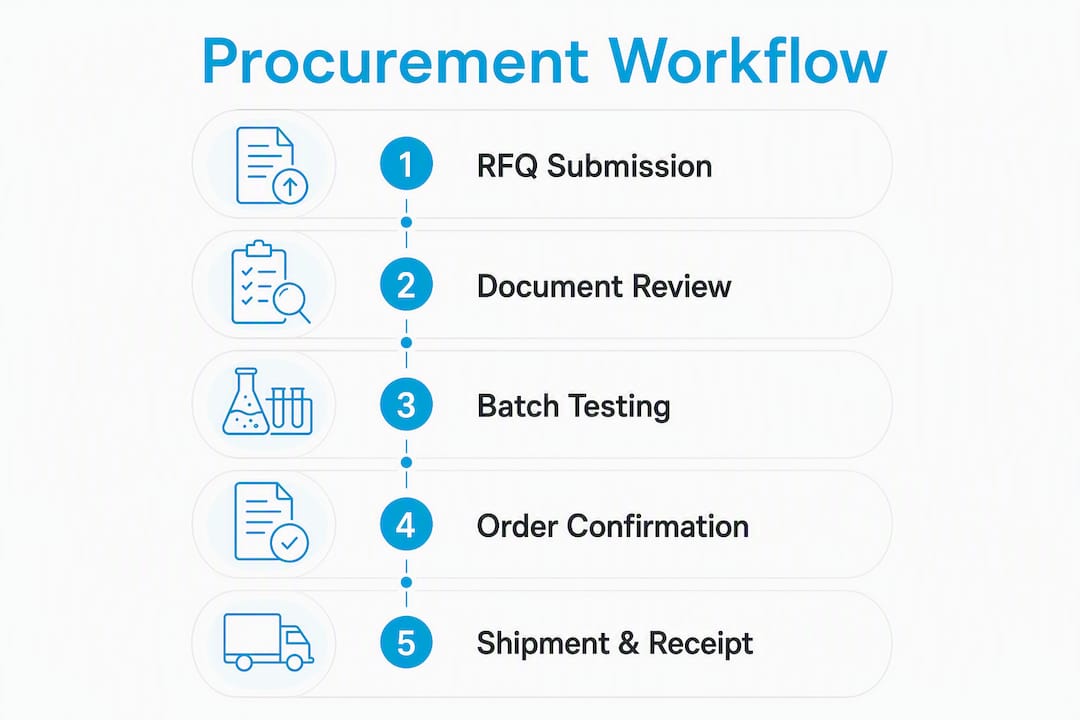
How does the wholesale purchasing workflow run?
What drives the price of wholesale research nootropics?
U.S. import and compliance considerations for research compounds
PeptidesFromChina: direct-from-manufacturer access for U.S. research buyers
Key Takeaways
The procurement discipline most buyers skip
Useful sources for procurement teams
What does “nootropic buy” mean for research procurement?
This guide covers wholesale procurement of research-grade cognitive and longevity compounds sold for laboratory use under RUO classification. That scope includes peptide-based nootropics, mitochondrial agents, and signaling peptides such as SNAP-8, 5-Amino-1MQ, Cerebrolysin, and NAD+ research materials. It does not cover retail consumer supplements, OTC brain-health capsules, or finished-dose pharmaceutical products.
RUO compounds differ from clinical APIs in documentation expectations. Buyers should expect:
Batch-level COAs with method disclosure, not just a summary purity certificate
Traceability from synthesis batch to lyophilized vial, not a single-page spec sheet
No implied therapeutic claim or clinical-grade release testing unless explicitly contracted
The distinction matters operationally. A nootropics store selling consumer capsules operates under different documentation obligations than a direct-from-manufacturer platform supplying wholesale research peptides. Procurement teams need to know which category they are dealing with before issuing a purchase order.
What documents must you demand before placing a wholesale order?
The pre-purchase checklist below functions as both an RFQ minimum and contract language. Each item maps to a real failure mode in peptide supply chains.
Lot availability confirmation with the explicit lot number that will ship
Method-disclosed COA: column type, gradient, mobile phase, detection wavelength, chromatogram image, and integration table with percent area
MS identity confirmation: instrument class (e.g., Q-TOF, Orbitrap) and mass accuracy in ppm
Counterion/salt form declared (TFA vs. acetate); TFA content typically varies depending on basic residue count and affects cell-based assays
Independent third-party testing plan: agreed test panel (HPLC + HR-MS + endotoxin), lab name, and timeline before final payment
Chain-of-custody documentation from synthesis batch to lyophilized vial, including manufacturing dates and any pooling or splitting justification
Sterile lyophilization evidence and vialing SOP or certificate
Commercial terms: MOQ, deposit schedule, acceptance criteria, and remediation terms for nonconforming lots
Pro Tip: Require method disclosure (column type, gradient, detection wavelength) on the COA as a pass/fail RFQ criterion. Without it, there is no way to judge whether the HPLC method could resolve epimers or deletion sequences specific to that peptide.
Why a single purity number is not enough: manufacturing lifecycle risks
Peptide synthesis produces complex mixtures; purification and impurity characterization are what convert crude product into a reproducible research material. A reported purity of 98% on a COA is only meaningful if the analytical method could actually separate the target from its nearest impurities.
Three sequence-specific degradation mechanisms create the most procurement risk:
Impurity mechanism How it appears analytically Procurement acceptance check Oxidation (Met, Trp residues) +16 mass shift; may coelute with target on shallow gradients HR-MS confirmation + chromatographic resolution ≥ 2.0 between main peak and oxidized form Deamidation (Asn, Gln residues) +1 Da mass shift; near-identical retention time High-resolution MS (ppm-level accuracy); method must use shallow gradient to resolve Epimerization (Cys, His, select residues) Same mass as target; coelutes unless method is optimized for chiral resolution Chiral or orthogonal HPLC method; supplier must disclose column and gradient
Purification yield and cycle time are the primary cost drivers in peptide manufacturing, and they determine whether a supplier can scale reliably. Platforms that standardize resins, mobile phases, and gradients reduce tech-transfer friction when column or reagent changes occur.
What to request from suppliers beyond the COA: validated purification platform details, column families used, mobile-phase additives, and comparability data for any method changes. Regulatory guidance expects traceability from synthesis to final active substance, including justification for batch pooling or splitting and comparability strategies when analytical methods improve.
Pro Tip: Prioritize suppliers who provide comparability logic for column or mobile-phase changes. That documentation reduces tech-transfer friction and signals a supplier who manages the purification lifecycle rather than just reporting a final number.
How do you validate a COA for research-grade nootropics?
Require HPLC purity with full method disclosure, mass confirmation by HR-MS, LAL endotoxin testing, and sterility screening when applicable. An HPLC purity number alone is insufficient evidence of compound identity or impurity profile.
Test What it proves Minimum supplier reporting RP-HPLC Purity and impurity profile Chromatogram image + method parameters + integration table HR-MS Molecular identity and mass accuracy Instrument class (Q-TOF/Orbitrap) + measured vs. theoretical mass + ppm error LAL endotoxin Bacterial contamination level Method (gel-clot or kinetic turbidimetric) + result in EU/mg Sterility screening Absence of viable microorganisms Method reference + test date ICP-MS heavy metals Elemental impurity profile Elements tested + limits applied
USP <621> benchmarks provide a useful baseline for evaluating HPLC system suitability: tailing factor 0.8–1.8, theoretical plates ≥ 2,000, resolution ≥ 2.0 between the main peak and nearest impurity, and injection precision ≤ 2.0% RSD.
COA red flags to reject immediately:
Missing chromatogram or method parameters
Lot number on COA does not match the lot on the packing list
Retest date already past or not stated
MS data absent or instrument class not disclosed
No endotoxin result for injectable-grade or sterile-vialed material
Standardized QC panels combining HPLC, endotoxin, rapid sterility screening, and heavy metals deliver faster turnaround and consolidated reporting under ISO/IEC 17025 systems, which simplifies procurement recordkeeping.
How does the wholesale purchasing workflow run?
A practical procurement workflow begins with a clear request for quote and stock confirmation. At PeptidesFromChina, the $10 deposit initiates manual request processing and real-time stock verification and is credited toward the final invoice; documentation availability and any buyer-arranged independent testing are separate considerations.
Typical timelines:
Sample or pilot lot delivery: 1–3 weeks from order confirmation
Lot production or availability confirmation: 2–6 weeks depending on synthesis backlog and vialing capacity
Third-party testing turnaround: 3–10 business days for a standard panel
Shipment after final payment: varies by MOQ and cold-chain logistics
Contractual terms to include in every purchase order:
Defined acceptance criteria (purity floor, endotoxin limit, mass accuracy tolerance)
Retest window: maximum time between COA date and shipment date
Remedies for nonconforming lots: replacement, credit, or partial refund schedule
Storage and transport conditions required during transit
Insurance and title transfer point (ex-works vs. delivered)
For teams managing multiple active compounds, safety stock planning should account for the 2–6 week production window plus testing turnaround, particularly for compounds with short retest intervals.

What drives the price of wholesale research nootropics?
Purification complexity, method specificity, salt form conversion, and independent testing account for most per-unit price variance. Sequence length and the presence of difficult residues (Cys, Met, His) directly affect purification yield and therefore cost.
Key cost drivers:
Sequence length and purification difficulty (epimers, deletions, oxidation-prone residues)
Scale: gram vs. kilogram runs have different yield economics
Salt form: TFA-to-acetate conversion requires additional ion-exchange steps and separate quantitation
Sterile lyophilization and vialing: adds cost but is non-negotiable for injectable-grade research materials
Third-party testing fees: budget separately from the compound price
MOQ discounts: larger committed volumes typically reduce per-unit cost
Negotiation levers worth pursuing: pooled vs. dedicated synthesis runs, locked column and mobile-phase comparability agreements, and a pre-agreed sampling plan for independent tests that avoids retesting entire lots on minor method deviations.
U.S. import and compliance considerations for research compounds
Classify every shipment clearly as research use only and confirm that HS codes, MSDS documents, and commercial invoices match the product’s identity, salt form, and intended use. Mismatches between the COA and the commercial invoice are the most common cause of U.S. Customs holds.
Compliance checklist for inbound shipments:
RUO declaration on all shipping documents
Correct HS code for research chemicals (not pharmaceutical APIs)
MSDS and technical dossier included with shipment
Import permits where applicable for controlled or scheduled analogs
Carrier paperwork complete for lyophilized biologicals or hazardous materials
Lot number on commercial invoice matches COA and packing list
Counterion (TFA vs. acetate) and recommended storage temperature declared on label
A customs hold that extends beyond the retest window on a COA effectively invalidates the lot for time-sensitive research programs. Cold-chain failures during extended holds compound that risk.
Pro Tip: Require the supplier to provide an export-grade packing declaration and a pre-shipment checklist before the carrier picks up. That single document reduces the probability of a U.S. Customs hold that expires the retest window.
PeptidesFromChina: direct-from-manufacturer access for U.S. research buyers
Products are subject to the manufacturer’s applicable quality-control procedures and specifications. Manufacturer-side analytical documentation may be available depending on the product and batch. PeptidesFromChina is not an independent analytical testing laboratory.
Submit an RFQ specifying the compound, quantity, and relevant requirements. At PeptidesFromChina, the $10 deposit initiates manual request processing and real-time stock verification and is credited toward the final invoice. Compounds available for research procurement include Cerebrolysin and NAD+ research materials, SNAP-8, 5-Amino-1MQ, and other catalog peptides.
Submit a wholesale RFQ or request a pilot lot through the PeptidesFromChina catalog to receive batch documentation and a confirmed lot number before committing to full volume.
This article provides general procurement guidance for research-use-only compounds. It is not legal, regulatory, or medical advice. Confirm current import rules, classification requirements, and applicable regulations with a qualified professional or the relevant U.S. authority before placing an order.
Key Takeaways
Wholesale procurement of research-grade nootropics requires method-disclosed COAs, independent third-party verification, and lot traceability before any payment is released.
Point Details Method disclosure is pass/fail Require column type, gradient, and detection wavelength on every COA before accepting a lot. Independent testing protects the buyer Arrange third-party HPLC, HR-MS, and LAL endotoxin testing before final payment on any new lot. Lifecycle risks exceed purity numbers Oxidation, deamidation, and epimerization require chromatographic resolution data, not just a percent purity figure. Lead times require planning Budget 2–6 weeks for production plus 3–10 business days for third-party testing in every procurement timeline. PeptidesFromChina Offers direct-from-manufacturer access with method-disclosed COAs, lot traceability, and a pilot-batch sampling program for U.S. research buyers.
The procurement discipline most buyers skip
The peptide supply chain has a persistent problem: buyers accept a purity number without asking how it was measured. A COA that reports 98.5% purity using a 15-minute gradient on a C18 column with no method parameters disclosed is not evidence of quality. It is evidence that the supplier ran a fast screen and stopped there. Epimers, deletion sequences, and oxidized variants can coelute with the target under generic gradient conditions and never appear as separate peaks. The purity number looks clean. The compound is not.
The procurement discipline that actually protects a research program is insisting on method disclosure as a non-negotiable RFQ criterion, building independent verification into the payment schedule rather than treating it as optional, and requiring traceability documentation that connects the synthesis batch to the specific vials being shipped. Suppliers who resist any of those three requests are telling you something about their process. Budget for verification upfront. The cost of a failed experiment or a reformulation cycle is substantially higher than a third-party testing panel.
Useful sources for procurement teams
Source What it covers How to use it USP <621> Chromatography System suitability benchmarks for HPLC (tailing factor, plate count, resolution, RSD) Set minimum COA acceptance criteria for HPLC data ICH Q7 Active Pharmaceutical Ingredients GMP context for API manufacturing, batch records, and traceability Use as a reference framework when auditing supplier documentation practices EMA Guideline on Synthetic Peptides Batch traceability, pooling/splitting justification, comparability strategies Apply to batch record requests and method-change comparability requirements BiologicsGuide: Peptide Purification Purification lifecycle, impurity characterization, cost drivers Understand what to request beyond the COA from a manufacturing partner ILS Laboratories: Peptide QC Panels Standardized QC panels under ISO/IEC 17025 (HPLC, endotoxin, sterility, heavy metals) Source for independent third-party testing with consolidated reporting Nootropic peptide research overview Technical overview of nootropic peptide classes and research-use considerations Background reference for procurement teams evaluating compound scope