N-Acetyl Semax Amidate: Researcher’s Guide to Dosing and QC

N-Acetyl Semax Amidate (NASA) is a dual-terminally modified heptapeptide with the sequence Ac-Met-Glu-His-Phe-Pro-Gly-Pro-NH2, catalogued in PubChem under CID 172638603, and is classified strictly as a research-use-only (RUO) compound not approved for human administration. The core seven-residue sequence is identical to parent Semax; the N-terminal acetyl group and C-terminal amide together confer substantially greater proteolytic resistance than either modification alone. That stability advantage is also the primary safety concern: researchers switching from Semax without adjusting dose frequently report overstimulation, because the same microgram amount delivers a meaningfully higher effective exposure. Before any experiment begins, verify an independent certificate of analysis (COA) with HPLC and mass spectrometry (MS) data for each batch.
Key facts at a glance:
RUO status: not for human use, not FDA-approved, not a licensed therapeutic in the United States
Potency relative to Semax: substantially greater per microgram due to dual terminal protection
COA requirement: HPLC purity and MS identity confirmation are minimum acceptable documentation before use
PubChem CID: 172638603; molecular formula C39H54N10O10S
Table of Contents
How does N-Acetyl Semax Amidate differ from Semax structurally and functionally?
What are the chemical identifiers and physical properties researchers need?
What mechanisms drive the neurobiological effects of this analog?
What does the preclinical and clinical evidence actually show?
What dosing heuristics and safety signals should researchers apply?
How should labs procure and verify research-grade material in the US?
What are the essential references and databases for this compound?
Key Takeaways
The gap between stability and certainty in NASA research
Research-grade N-Acetyl Semax Amidate procurement through PeptidesFromChina
Useful sources and databases for further research
How does N-Acetyl Semax Amidate differ from Semax structurally and functionally?
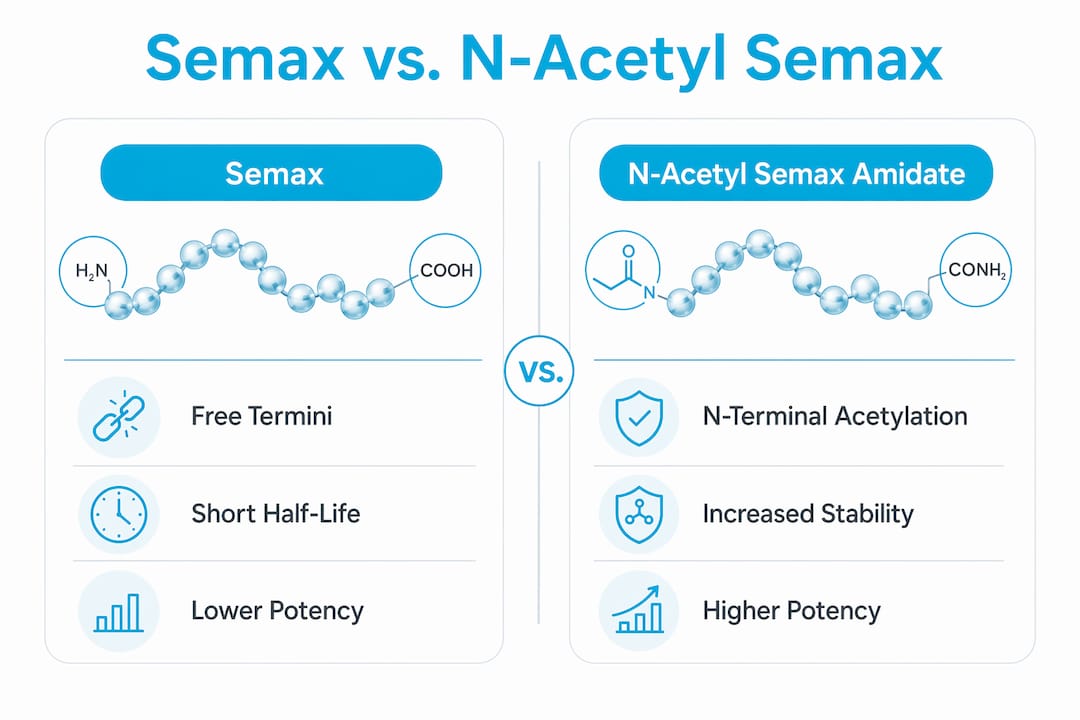
The parent peptide Semax (Met-Glu-His-Phe-Pro-Gly-Pro) carries free termini and is susceptible to both aminopeptidases and carboxypeptidases. N-Acetyl Semax adds only an acetyl cap at the N-terminus, blocking aminopeptidase cleavage. The dual-modified analog adds a C-terminal amide as well, blocking carboxypeptidase attack simultaneously. The result is a stability hierarchy: Semax < N-Acetyl Semax < N-Acetyl Semax Amidate, with the dual form showing maximum enzymatic resistance among the three variants.
That increased half-life and area under the curve (AUC) have direct experimental consequences. Lower doses are needed to achieve equivalent receptor exposure, onset may be slower as the compound resists rapid clearance, and washout periods must be extended when designing crossover protocols. Researchers choosing between variants should match the choice to the experimental question: Semax carries deeper clinical evidence from Russian trials and is appropriate when direct translation to that literature is needed; the amidated analog suits studies specifically examining proteolytic stability, extended exposure windows, or intranasal bioavailability under enzymatic challenge conditions.
Dimension Semax N-Acetyl Semax Amidate Structural modification Free N- and C-termini N-terminal acetylation + C-terminal amidation Proteolytic stability Moderate Maximum among Semax variants Relative potency per µg Reference (1×) significantly greater than Semax Expected duration Shorter Extended (longer half-life, higher AUC) Mechanistic overlap BDNF/NGF, MC3R/MC4R, monoaminergic Shared; magnitude extrapolated Primary research models Ischemic stroke, cognitive impairment Same models; PK/stability studies Clinical evidence depth Russian RCT data available Limited; mostly preclinical and community-reported COA/sourcing implications Standard HPLC/MS Terminal modifications require side-product screening
Pro Tip: When switching a protocol from Semax to N-Acetyl Semax Amidate, start at a reduced fraction of the Semax microgram dose and track at least two objective endpoints (e.g., reaction time and a validated learning task) before any escalation. Document baseline values for a sufficient period before introducing the compound.
What are the chemical identifiers and physical properties researchers need?
The compound is also listed under the alternate names Acetyl Semax Amidate, NASA, and Ac-Semax-NH2. Its molecular formula is C39H54N10O10S. The CAS number 2920938-90-3 is associated with this structure in supplier documentation, though researchers should confirm against the PubChem entry, which provides InChI and SMILES strings for identity verification.
Identifier Value Systematic name Ac-Met-Glu-His-Phe-Pro-Gly-Pro-NH2 Alternate names Acetyl Semax Amidate, NASA, Ac-Semax-NH2 Molecular formula C39H54N10O10S Molecular weight ~866.97 g/mol PubChem CID 172638603 CAS 2920938-90-3 Physical form White to off-white lyophilized powder Solubility Aqueous; slightly acidic pH improves solubility
Storage and reconstitution essentials:
Store lyophilized vials at −20°C or lower; avoid repeated freeze-thaw cycles
Protect from light and moisture; desiccant in the secondary container is standard practice
Reconstitute with sterile water or 0.9% saline; for lower-solubility batches, dilute acetic acid (0.1–1%) can improve dissolution
Prepare working solutions at the lowest concentration needed to minimize adsorption to container walls
Aliquot immediately after reconstitution and store at −80°C for long-term stability; use within 30 days at −20°C
Lyophilization failure signs: cake collapse, discoloration, or visible particulate after reconstitution — reject the vial and request a replacement with a new COA
What mechanisms drive the neurobiological effects of this analog?
The mechanistic profile attributed to N-Acetyl Semax Amidate is largely extrapolated from Semax research, with the assumption that the shared heptapeptide core engages the same receptor systems. The primary pathways cited in the literature involve BDNF upregulation and TrkB signaling, NGF increases with associated GAP-43 changes, modulation of melanocortin receptors MC3R and MC4R, and downstream effects on dopaminergic and serotonergic neurotransmission. Neuroprotection and synaptic plasticity claims rest on this mechanistic framework.

What researchers should hold clearly in mind is that most of this evidence comes from Semax studies, many conducted in Russian clinical settings. Direct measurement of these pathways specifically in response to the dual-modified analog is sparse. The acetyl and amide modifications are not expected to alter receptor binding affinity at the core sequence, but the pharmacokinetic differences mean that equivalent receptor occupancy occurs at a lower administered dose and over a longer time window.
Practical endpoints worth building into experimental designs:
BDNF mRNA and protein (ELISA or qPCR in hippocampal tissue or plasma)
Behavioral assays: Morris water maze, novel object recognition, elevated plus maze for anxiety signals
Electrophysiology: long-term potentiation (LTP) recordings in hippocampal slices
Monoamine metabolite profiling (DOPAC/HVA, 5-HIAA) in prefrontal cortex and striatum
Reaction time and processing-speed tasks in human observational contexts
Effect emergence in preclinical models typically follows days of consistent dosing rather than single-administration responses. Researchers should plan sampling time points accordingly and avoid interpreting acute single-dose data as representative of the compound’s full profile. The melanocortin receptor component is worth tracking separately; for labs already working with melanocortin research peptides, the MC3R/MC4R overlap with Semax variants provides a useful mechanistic cross-reference.
One limitation that cannot be overstated: no independent, large-scale randomized controlled trials specific to N-Acetyl Semax Amidate have been published. Extrapolating pharmacodynamic claims from Semax RCT data to this analog without direct evidence introduces meaningful uncertainty into any efficacy interpretation.
What does the preclinical and clinical evidence actually show?
The evidence base for Semax variants is uneven across the modification spectrum. Semax itself has the strongest published record, including Russian clinical trials in ischemic stroke patients and studies examining attention and processing speed. N-Acetyl Semax Amidate sits at the other end: its direct evidence is limited to preclinical models and community-reported observations, with no head-to-head clinical validation against the parent compound.
Model Primary endpoints Evidence strength Key limitations Rodent focal ischemia Infarct volume, neurological deficit score, BDNF Moderate (Semax data) Not replicated for dual-modified analog Rodent cognitive models Morris water maze, NOR, passive avoidance Moderate (Semax data) Dose extrapolation required for analog Small human Semax studies Attention, processing speed, BDNF plasma Limited (Russian literature) Analog-specific human data absent N-Acetyl Semax Amidate preclinical Stability, PK parameters Preliminary No published RCT; community-reported only
The practical implication for study design is that researchers using the dual-modified analog cannot simply cite Semax RCT data as direct support for their experimental rationale. The evidence gap between Semax and its amidated analog is real and should be acknowledged in any protocol or publication. Cognitive effects, when observed, tend to be subtle and emerge over days of consistent administration rather than acutely, which means objective performance tracking is not optional — it is the only reliable way to distinguish compound effect from baseline variation.
Suggested experimental design considerations:
Include a Semax arm alongside the analog arm to generate within-study comparative PK/PD data
Use dosing windows that account for the analog’s extended half-life (longer inter-dose intervals than Semax)
Select outcome measures sensitive to the expected effect magnitude: reaction time, learning efficiency, and validated neuropsychological instruments rather than gross behavioral screens
Power calculations should account for the expected small-to-moderate effect sizes seen in Semax literature
What dosing heuristics and safety signals should researchers apply?
Community and practitioner consensus places N-Acetyl Semax Amidate at an estimated 3–5× greater potency than standard Semax per microgram. The practical translation: if a Semax protocol uses a certain dose intranasally, a reduced starting dose for the dual-modified analog is recommended, not the same dose. Applying parent-peptide dosing to the amidated analog is the single most common error reported in practitioner literature and is a reliable source of adverse event reports.
Titration protocol (sequential steps):
Establish a documented baseline using at least two objective cognitive or behavioral measures over five days before introduction.
Begin at 1/5 of the intended Semax microgram dose; do not exceed this on day one regardless of prior Semax tolerance.
Hold the starting dose for a minimum of five days and record endpoint measures daily.
Escalate by no more than 20% per step, with a minimum five-day hold between escalations.
Stop escalation at the first sign of overstimulation (see safety signals below) and return to the prior dose.
Document each dose, timing, and endpoint value in a structured log; this data is necessary for any reproducible reporting.
Plan washout at twice the estimated half-life of the analog before any crossover or cessation assessment.
For labs referencing Semax dosage and vial reconstitution protocols, the same reconstitution math applies, but the per-dose volume will be smaller given the potency difference.
Safety signals to monitor and exclusion criteria for research populations:
Overstimulation: heightened irritability, anxiety, insomnia, or restlessness within hours of dosing
Mood instability: disproportionate emotional reactivity, particularly in subjects with any history of anxiety disorders
Serotonergic interactions: caution when research subjects are concurrently using serotonergic compounds; the monoaminergic modulation profile creates a theoretical interaction risk
Seizure risk: BDNF upregulation has established links to neuronal excitability; subjects with any seizure history should be excluded from research protocols
Cardiovascular monitoring: blood pressure and heart rate at baseline and after each dose escalation step
Populations to exclude from research protocols: individuals with personal or family history of seizure disorders, bipolar disorder, active anxiety disorder, or concurrent use of MAOIs or serotonin-modulating agents.
How should labs procure and verify research-grade material in the US?
Procurement quality for terminally modified peptides like N-Acetyl Semax Amidate requires more scrutiny than for standard linear peptides. The acetylation and amidation steps introduce additional synthetic complexity, and side-products from incomplete terminal modification are not always visible on a basic purity screen. Independent COA verification with HPLC and MS data is the minimum acceptable standard; vendor label claims alone are insufficient.
Procurement checklist:
Confirm RUO labeling on all documentation and packaging
Request the full COA including HPLC chromatogram (not just a purity percentage), MS identity confirmation, and synthesis batch number
Ask for the synthesis method summary: solid-phase peptide synthesis (SPPS) route and resin type affect impurity profiles
Verify that the COA was generated by a third party, not the same facility that synthesized the batch
Check for common terminal-modification side-products: des-acetyl impurity (incomplete N-acetylation) and C-terminal acid form (incomplete amidation)
Storage/handling parameter Recommendation Long-term storage (lyophilized) −20°C or lower; −80°C preferred for >6 months Working solution storage −20°C; use within 30 days Humidity control Desiccant in secondary container; avoid humid environments during handling Reconstitution solvent Sterile water or 0.9% saline; 0.1–1% acetic acid for difficult batches Reconstitution volume Minimum volume needed; avoid over-dilution Freeze-thaw cycles Maximum 3; aliquot to avoid repeated cycling Vial inspection Reject collapsed cake, discoloration, or particulate post-reconstitution
QC checklist before use:
Identity: MS confirmation matching the theoretical mass of C39H54N10O10S (MW ~866.97 g/mol)
Purity: HPLC ≥95% by area; request the chromatogram, not just the reported number
Water content: Karl Fischer titration; high water content inflates apparent mass and skews dose calculations
Endotoxin: LAL test for any in vivo rodent work; endotoxin contamination confounds neuroinflammation endpoints
Batch traceability: the COA batch number should match the vial label exactly
On the sourcing side, direct-from-manufacturer procurement reduces the number of handling steps between synthesis and the lab, which matters for lyophilized peptides sensitive to moisture and temperature excursions. Resellers who cannot provide batch-specific chromatograms or who offer only a generic purity certificate without a batch number are a reliability risk. Supply-chain transparency, specifically the ability to trace a vial back to a specific synthesis run, is a more meaningful quality signal than any marketing language about manufacturing standards.

What are the essential references and databases for this compound?
Researchers building a citation foundation for N-Acetyl Semax Amidate protocols should anchor their documentation in primary chemical databases and peer-reviewed Semax literature, supplemented by supplier datasheets for handling and PK parameters.
PubChem CID 172638603: primary chemical identity record; provides molecular formula (C39H54N10O10S), InChI, SMILES, and cross-database links. Use this as the canonical structural reference in methods sections.
PMC3987924: peer-reviewed review of Semax and related peptides; covers mechanisms and neuroprotective evidence relevant to the analog’s extrapolated profile.
PubMed 16996037 and PubMed 16996699: Semax clinical and mechanistic studies; foundational for any protocol citing BDNF or ischemic stroke endpoints.
PubMed 19633950: Semax effects on monoaminergic systems; relevant when designing dopaminergic or serotonergic endpoint assays.
PubMed 22772900 and PubMed 26924987: additional mechanistic and neuroprotection data from Semax literature.
PubMed 11550013 and PubMed 30255741: cognitive and neurological endpoints in Semax research; useful for designing behavioral assay batteries.
Supplier datasheets: request batch-specific documentation from your supplier; these should include synthesis route, HPLC chromatogram, and storage specifications. Cite the batch number and supplier in methods sections.
Citation practice: always prefer primary peer-reviewed sources over secondary summaries when reporting experimental rationale. When citing PK or stability parameters specific to the dual-modified analog, note explicitly that the data is extrapolated from Semax literature or derived from supplier characterization rather than independent clinical measurement.
Key Takeaways
N-Acetyl Semax Amidate is the most proteolytically stable Semax variant, estimated at 3–5× the potency of the parent Semax per microgram, and requires conservative dose titration, independent COA verification, and careful experimental design before any research use.
Point Details RUO status is non-negotiable NASA is research-use-only in the US; no FDA approval or licensed therapeutic status exists. Potency requires dose reduction The dual-modified analog is estimated at 3–5× greater potency per microgram than Semax, so dose escalation should be conservative. COA must include chromatograms HPLC purity percentage alone is insufficient; request the full chromatogram and MS identity data for each batch. Evidence is largely extrapolated Direct clinical RCT data for the dual-modified analog does not exist; mechanistic claims derive from Semax literature. PeptidesFromChina for procurement Products are subject to the manufacturer’s applicable quality-control procedures and specifications. Manufacturer-side analytical documentation may be available depending on the product and batch. PeptidesFromChina is not an independent analytical testing laboratory.
The gap between stability and certainty in NASA research
The appeal of N-Acetyl Semax Amidate is straightforward from a pharmacokinetic standpoint: maximum terminal protection, extended half-life, and reduced dosing frequency. Those are real advantages for certain experimental designs, particularly studies examining prolonged receptor engagement or intranasal bioavailability under enzymatic challenge. The problem is that the research community has largely treated these pharmacokinetic advantages as evidence of proportionally greater efficacy, and that inference is not well-supported.
Semax has decades of Russian clinical literature behind it, including controlled trials in stroke and cognitive impairment. The dual-modified analog has community reports and preclinical stability data. That is a meaningful gap, and labs that cite Semax RCT outcomes as direct support for NASA protocols are misrepresenting the evidence base. The honest framing is that the analog is expected to share Semax’s mechanistic profile at lower doses and over longer exposure windows, but that expectation has not been rigorously tested in controlled human studies.
The procurement side of this problem is equally underappreciated. Terminal modifications add synthetic steps, and each step is a potential source of impurity. A batch with incomplete N-acetylation will contain a mixture of Semax and the acetylated form, effectively delivering an undefined ratio of two compounds. Standard purity screens may not flag this if the total peptide content is high. Requesting MS fragmentation data and checking specifically for the des-acetyl and C-terminal acid impurities is not excessive caution; it is basic QC for a terminally modified peptide.
Pro Tip: Archive a 10–20 µg aliquot from every batch in a separate −80°C storage location before beginning any experiment. If results are anomalous, that archived sample can be sent for independent re-testing without disrupting the active protocol.
The neuroscience peptide research field moves faster than its QC infrastructure. Labs that build rigorous batch documentation habits now will have reproducible data when the field eventually demands it.
Research-grade N-Acetyl Semax Amidate procurement through PeptidesFromChina
PeptidesFromChina coordinates sourcing through a limited network of verified manufacturing facilities. Products are subject to the manufacturer’s applicable quality-control procedures and specifications. Manufacturer-side analytical documentation may be available depending on the product and batch, while buyers requiring independent verification may arrange third-party testing.
Manufacturer-side analytical documentation may be available depending on the product and batch. It is not guaranteed with every order and is not independent verification by PFC. Buyers may arrange third-party analytical testing when required.
Useful sources and databases for further research
PubChem CID 172638603: canonical structural record for N-Acetyl Semax Amidate; provides InChI, SMILES, molecular formula, and cross-database links. Query this first for identity verification and to locate spectral data.
PMC3987924 — Semax review: peer-reviewed overview of Semax mechanisms and neuroprotective evidence; the most accessible single source for grounding analog claims in primary literature.
PubMed search strategy: query “Semax” AND “BDNF” or “Semax” AND “neuroprotection” to locate the primary mechanistic studies; filter for Russian-language trials with English abstracts for the clinical evidence base.
Supplier datasheets: request batch-specific COA, HPLC chromatogram, and synthesis route documentation from any supplier before ordering; these are the primary source for PK and handling parameters specific to a given batch.
Community dosing reports: practitioner forums and observational logs provide the most current heuristics on dose conversion and titration, but treat these as hypothesis-generating rather than evidence-based; always cross-reference against the PubMed literature before incorporating into a protocol.