
If you relied on Apex Peptides, your immediate problem is practical: the storefront is not operating normally, product listings are unavailable, and there is no clear public timeline for a return.
On September 23, 2026, federal agents searched a North Sioux City property used by Apex-linked businesses. Local reporting identified the U.S. Postal Inspection Service as the lead agency, with the FBI, IRS Criminal Investigation, and local law enforcement present. A related residence was searched at the same time. By the following day, the Apex Peptides storefront was marked temporarily closed and most products had been removed.
That is what is confirmed. What the authorities were investigating, what was seized, and whether any allegations concern Apex Peptides specifically have not been made public. No public charge or agency statement currently establishes that the search was about peptides.
For research buyers, however, the operational lesson does not require speculation: a domestic storefront can disappear from the supply chain overnight. If one reseller is your only source, your research program inherits that reseller’s regulatory, banking, inventory, and business-continuity risks.
The stronger response is not to chase the next identical storefront. It is to build a sourcing model with fewer hidden layers and less dependence on a single domestic intermediary.
Need continuity for an active research program? Browse the PFC research compound catalog — https://peptidesfromchina.co/catalog/ or review how manufacturer-side sourcing works — https://peptidesfromchina.co/how-it-works/.
What happened to Apex Peptides?
The narrow, evidence-based answer is:
Federal agents searched the Apex Waste Management address at 503 Prosperity Way in North Sioux City on September 23, 2026.
Public business records and local reporting connect multiple Apex-named companies—including Apex Peptides—to the wider business network.
The Apex Peptides online store is currently unavailable for normal ordering.
Federal authorities have not publicly disclosed the purpose of the searches or tied Apex Peptides to a specific offense.
That distinction matters. A federal search is a serious business-continuity event, but it is not proof of guilt. Buyers should avoid rumor and make procurement decisions from verified operating status, documented order terms, and current supplier availability.
The larger lesson: “Research Use Only” is not a regulatory force field
The Apex event arrived during a broader enforcement shift affecting online peptide sellers in the United States and other Western markets.
In March 2026, the U.S. Food and Drug Administration warned Gram Peptides that an RUO label did not override website content that the agency viewed as evidence of intended human use. The FDA pointed to benefit-oriented product claims and the sale of bacteriostatic water alongside injectable products. Its conclusion was based on the complete presentation of the business—not the disclaimer in isolation.
This principle is not new. U.S. enforcement cases have long treated “for research use only” language as ineffective when the surrounding facts indicate a different intended use. In practical terms, regulators can look at product claims, instructions, customer communications, related products, advertising, and the way a seller actually operates.
The same direction is visible outside the United States. In 2026, Health Canada obtained a permanent injunction preventing a company from selling unauthorized injectable peptides. Australia’s Therapeutic Goods Administration also made unapproved peptide products a compliance priority after detecting unlawful importation, supply, and advertising.
The useful conclusion is precise:
RUO is a legitimate product-use category, but the letters “RUO” do not protect a business whose conduct tells a different story.
For sellers, a disclaimer cannot repair human-use marketing. For research buyers, a seller’s disclaimer alone is not evidence of stability, documentation, or a durable supply chain.
Why replacing one U.S. reseller with another may not solve the problem
Most domestic research-peptide stores make purchasing feel simple because they keep the complexity upstream. The buyer sees a familiar website, local payment options, and a domestic parcel. Behind that storefront may be multiple manufacturers, relabeling, batch substitutions, changing payment processors, and inventory that is difficult to trace back to its source.
That model can work—until the intermediary stops operating.
Moving to another domestic reseller may restore short-term access, but it can preserve the same structural weaknesses:
Single-company concentration. One closure can interrupt every compound in the order pipeline.
Limited source visibility. The brand on the vial may not identify the synthesis facility or current production batch.
Stale catalog inventory. A product can appear available before upstream stock is confirmed.
Documentation detached from the shipment. A generic or old analytical report may not describe the proposed batch.
Reseller pricing layers. Domestic warehousing, relabeling, marketing, and retail overhead are added to the original manufacturing cost.
The answer is not “China is outside the rules.” It is not. Import, customs, product, and intended-use requirements still apply in the destination country.
The advantage of manufacturer-side sourcing is different: it reduces dependency on a single Western retail intermediary and makes the actual procurement chain easier to examine.
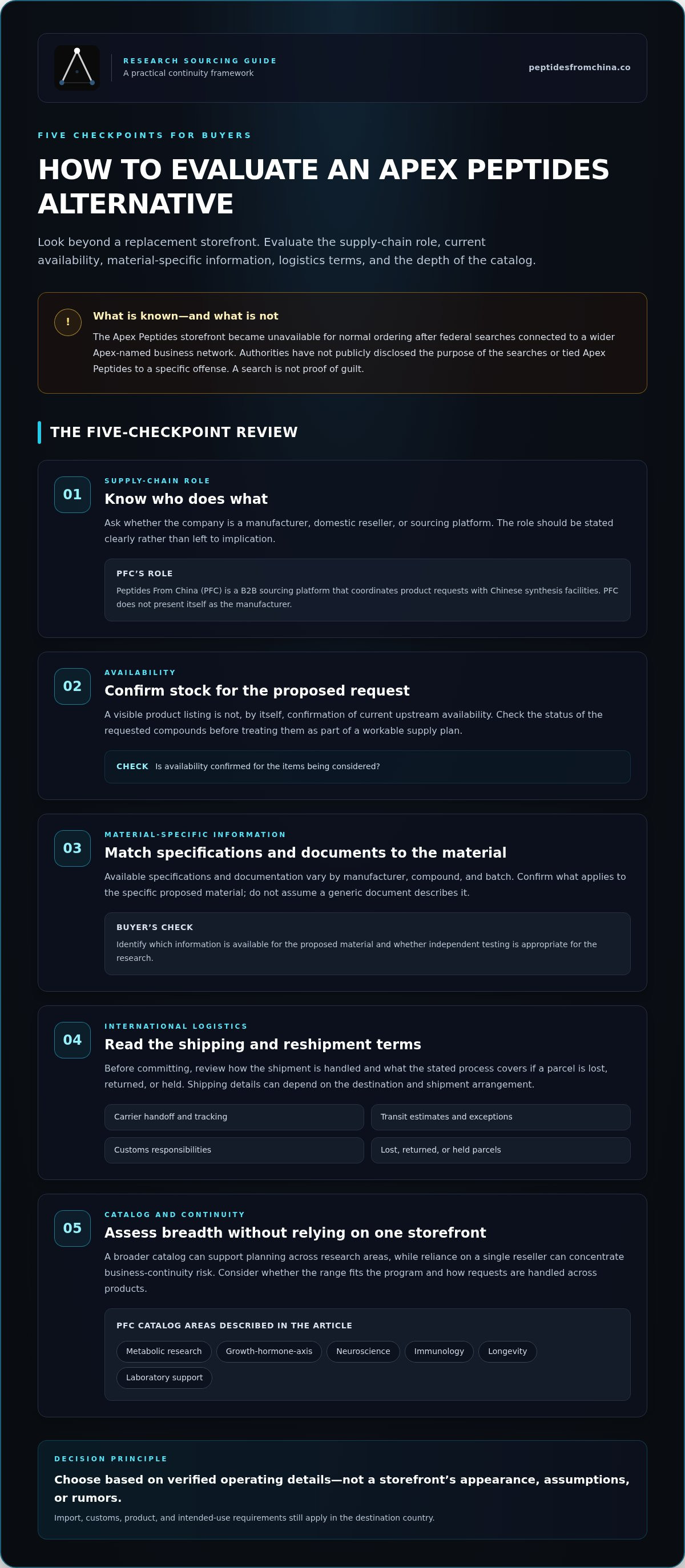
What a credible Apex Peptides alternative should provide
Former Apex customers should evaluate alternatives on operating substance, not just a replacement coupon code.
1. A clearly defined role in the supply chain
Ask whether the company is the manufacturer, a domestic reseller, or a sourcing platform. Each model can be legitimate, but the answer should be explicit.
Peptides From China is a B2B sourcing platform. We connect research buyers with established Chinese synthesis facilities and coordinate product requests, stock confirmation, invoicing, and international shipment. We do not present PFC as the manufacturer when it is not.
2. Stock confirmation before the final invoice
Inventory should not be treated as confirmed simply because a product card is visible. PFC uses a request-first process: the buyer submits the required compounds, the relevant facility confirms current availability, and the final invoice reflects what can actually be supplied.
This adds a verification step, but it prevents a catalog promise from being mistaken for live factory stock.
3. Batch-specific language instead of universal purity slogans
“99% pure” is not meaningful without a method, sample, date, and connection to the batch being offered. Analytical documentation and available specifications can vary by manufacturer, compound, and batch. Buyers should confirm what documentation applies to the proposed material and commission independent testing when the research requires it.
Read the PFC guide to peptide quality and verification — https://peptidesfromchina.co/peptide-quality/.
4. A written international-shipping and reshipment process
International procurement requires a clear description of carrier handoff, transit estimates, customs responsibility, tracking, and what happens if a parcel is lost, returned, or held. These terms should be available before the buyer commits to the final invoice.
PFC publishes its ordering and shipping process instead of treating logistics as an afterthought. Review the full process here — https://peptidesfromchina.co/how-it-works/.
5. A catalog designed for real research procurement
A useful alternative should support more than one trending compound. PFC provides a broad catalog across metabolic, growth-hormone-axis, neuroscience, immunology, longevity, and laboratory-support categories, with custom sourcing available when a standard catalog item does not fit the project.
How switching from Apex Peptides to PFC works
The process is designed for B2B and research buyers rather than one-click consumer retail:
Open the research compound catalog — https://peptidesfromchina.co/catalog/ and add the required items to a sourcing request.
Submit the request with the destination and project requirements.
Pay the $10 processing deposit, which is credited to the final invoice.
PFC verifies availability with the relevant synthesis facility.
Review and approve the confirmed final invoice before the order proceeds.
The shipment is handed to the international carrier with tracking under the applicable shipping terms.
Standard catalog requests are subject to the platform’s $600 total minimum order. That makes PFC a better fit for laboratories, resellers, private-label operators, and research buyers consolidating multiple items than for a customer seeking a single retail vial.
The strategic difference: replace dependency, not just a vendor
The Apex disruption is not a reason to make unverified accusations. It is a reason to stop treating a domestic URL as the supply chain.
A resilient research-procurement strategy should know:
who is coordinating the order;
which facility is being asked to supply it;
whether stock is currently confirmed;
which specifications and documents apply to the proposed batch;
how the shipment moves;
what happens when a route or supplier fails;
and what the buyer must do to keep the transaction lawful in the destination market.
Peptides From China does not promise that international sourcing removes regulatory or customs risk. It offers something more useful: direct access to the manufacturing ecosystem, a defined verification process, published commercial terms, and less dependence on one domestic reseller’s continuity.
If Apex Peptides was part of your research supply chain, now is the right time to build a stronger replacement.
Start with current availability: Browse the catalog — https://peptidesfromchina.co/catalog/ and submit a sourcing request. For non-standard sequences, formulations, or private-label requirements, review custom peptide services — https://peptidesfromchina.co/custom-peptide-services/.
Frequently asked questions
Is Apex Peptides closed?
The Apex Peptides storefront is currently not operating as a normal online store. Local reporting described it as temporarily closed after federal agents searched an address tied to multiple Apex businesses on September 23, 2026. Apex has not published a confirmed permanent-closure notice or reopening date.
Was Apex Peptides raided because it sold peptides?
That has not been established publicly. Federal agents searched an Apex-linked business address and a related residence, but authorities have not publicly disclosed the purpose of the investigation or announced charges connecting the search specifically to Apex Peptides.
Does an RUO label protect a research peptide seller from FDA action?
Not by itself. FDA evaluates intended use from the full context, including claims, instructions, product presentation, related products, advertising, and other evidence. A research-use label must be consistent with how the seller actually markets and distributes the product.
What is the best Apex Peptides alternative for bulk research orders?
The best fit depends on required compounds, order size, documentation needs, destination, and procurement timeline. PFC is designed for B2B and research buyers who want manufacturer-side sourcing from China, manual stock confirmation, a broad catalog, and published international-order terms.
Can U.S. buyers order research peptides directly from China?
International availability does not automatically make every import lawful. Requirements depend on the compound, intended use, buyer, shipment, and destination. Buyers are responsible for confirming that procurement, importation, possession, and use comply with applicable rules.
Does PFC guarantee the same documentation for every compound?
No. Specifications and available analytical documentation vary by manufacturer, compound, and batch. PFC confirms the applicable information during sourcing, and buyers should use independent testing when their study or quality system requires it.
Sources
KTIV, “Five more Apex-tied businesses found at non-operational building,” September 25, 2026: https://www.ktiv.com/2026/09/25/five-more-apex-tied-businesses-found-non-operational-building/
KCAU/AOL, “Federal investigators remain tight-lipped after Wednesday’s raid,” September 25, 2026: https://www.aol.com/articles/federal-investigators-remain-tight-lipped-021917000.html
U.S. FDA, Gram Peptides warning letter, March 31, 2026: https://www.fda.gov/inspections-compliance-enforcement-and-criminal-investigations/warning-letters/gram-peptides-721806-03312026
U.S. Department of Justice, “Illinois Man Charged With Illegally Distributing Peptides,” March 27, 2013: https://www.justice.gov/usao-wdpa/pr/illinois-man-charged-illegally-distributing-peptides
Health Canada, permanent injunction against Canlab Research, July 29, 2026: https://www.canada.ca/en/health-canada/news/2026/07/health-canada-obtains-permanent-injunction-preventing-canlab-researchs-illegal-sale-of-injectable-peptides-in-canada.html
Australian TGA, compliance focus on unapproved peptides, June 10, 2026: https://www.tga.gov.au/news/media-releases/tga-strengthens-compliance-focus-unapproved-peptide-products-part-evolving-risk-response