Limitless Supplements: Procurement Checklist for Research Teams

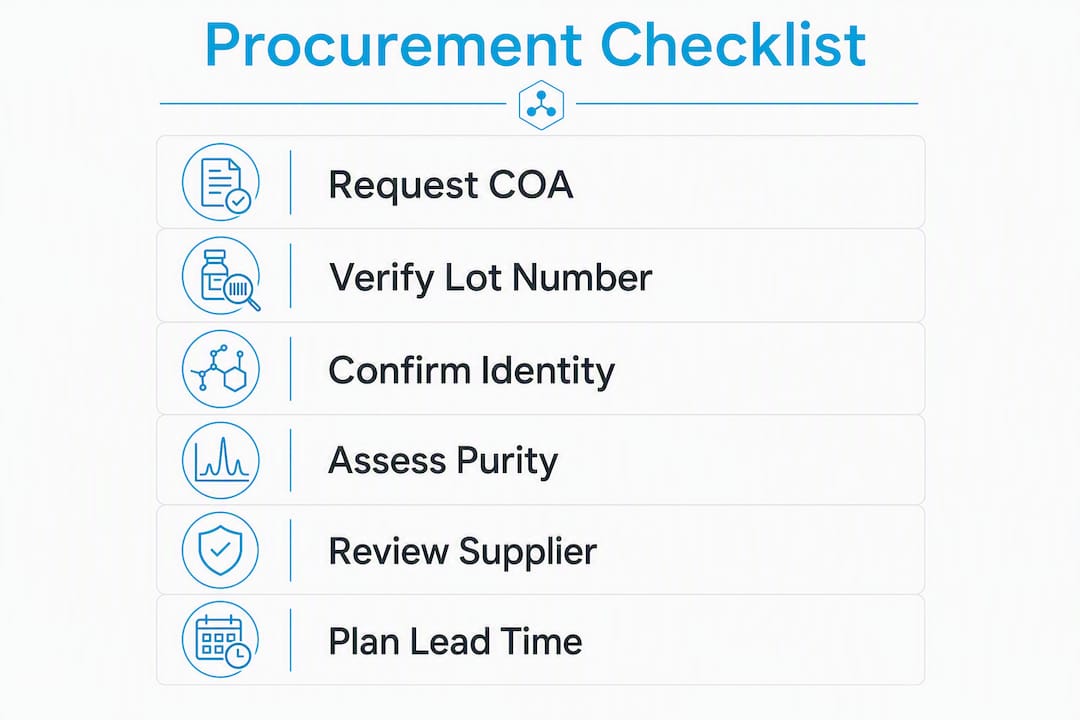
In research procurement, “limitless supplements” refers to wholesale research-grade peptides, GLP-1 analogs, mitochondrial compounds, and longevity research materials — not retail consumer products. The first action before any purchase is to demand a lot-specific Certificate of Analysis (COA) that includes an HPLC chromatogram and mass spectrometry identity data. A headline purity percentage without those documents is not a COA; it is a marketing claim.
Key procurement requirements at a glance:
Require a lot/batch-specific COA naming the testing laboratory and matching the vial label
Confirm the analytical package includes both HPLC and LC-MS/HRMS identity data
Apply a minimum research purity threshold of ≥98% as the common benchmark for research-grade material
Cross-reference batch traceability against EMA synthetic peptide manufacturing guideline expectations when reproducibility is critical
Treat PeptidesFromChina as a verified wholesale option with lot-specific documentation and direct-from-manufacturer sourcing
Table of Contents
What should you request before placing a wholesale research peptide order?
Why peptide manufacturing traceability differs from small-molecule APIs
How to read a COA and analytical package for research peptides
How do you vet a peptide supplier beyond the documentation?
When does research procurement need to transition to a CDMO?
What are the realistic lead times, MOQs, and cost drivers?
Key Takeaways
The documentation gap most procurement teams discover too late
PeptidesFromChina: verified wholesale sourcing with lot-specific documentation
Useful sources and further reading
What should you request before placing a wholesale research peptide order?
A structured pre-purchase checklist reduces the most common procurement failures: receiving material that cannot be traced, verified, or reproduced.
COA with lot/batch number: The lot number on the COA must match the number printed on the vial or packing label. A COA that lacks this match makes root-cause analysis and reproducibility impossible.
Named, verifiable testing laboratory: Generic “third-party tested” language is not sufficient. The COA must name the specific lab, and procurement should confirm that lab is accredited.
HPLC chromatogram and LC-MS identity data: Many suppliers provide HPLC but omit mass spectrometry; insisting on both is the primary differentiator between Tier-1 and lower-tier vendors.
Impurity profiling and endotoxin (LAL) data: Required when material is intended for injectable or cell-culture applications.
Manufacturing traceability: Request SPPS synthesis steps, cleavage and purification points, and defined commercial batch sizing.
Shipping and storage controls: Confirm lyophilized state, cold-chain availability, insulated packaging, and expedited options — especially for GLP-1 analogs and fatty-acid conjugates, which are particularly temperature-sensitive.
Vendor responsiveness and replacement policy: Prompt documentation provision and a clear returns policy for mismatched COAs are high-value trust signals.
Pro Tip: Insist on a COA PDF that includes the lab’s letterhead, analyst signature, and report date that aligns with the lot number on packing. A COA that lacks any of these three elements should be treated as unverified.
Why peptide manufacturing traceability differs from small-molecule APIs
Peptides are synthesized by solid-phase peptide synthesis (SPPS), a stepwise process where each amino acid coupling introduces sequence-specific failure modes. Deletion sequences, truncated fragments, and racemization can occur at any step, and these impurities may be structurally similar enough to the target sequence that standard HPLC alone cannot resolve them.
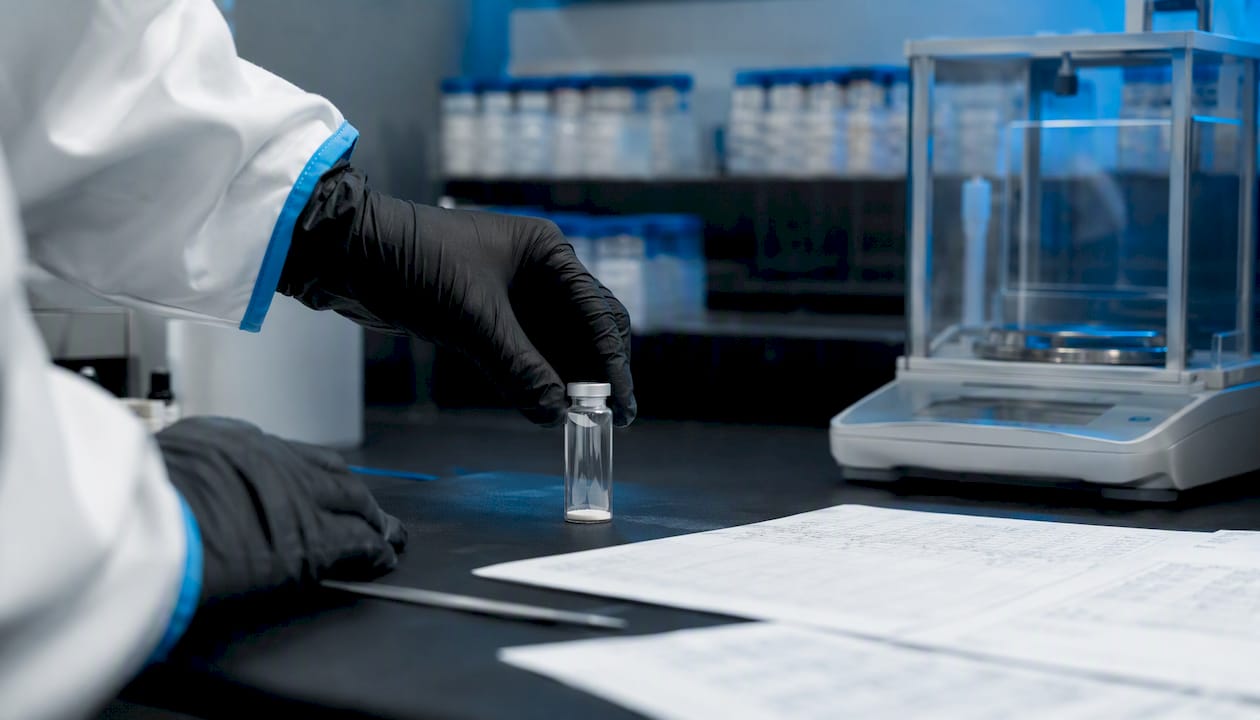
The EMA guideline on the development and manufacture of synthetic peptides addresses this directly: it requires documentation of SPPS process steps, justification for splitting or combining sub-batches, and an unambiguous definition of commercial batch size. These are not administrative formalities. They are the analytical framework that makes a batch traceable when a result cannot be reproduced.
Procurement teams accustomed to small-molecule API sourcing often request only a final purity percentage. For peptides, that approach misses the step-specific quality picture. The question to ask suppliers is not just “what is the purity?” but “what analytical checks were performed post-cleavage and post-purification, and what impurities were identified at each stage?”
How to read a COA and analytical package for research peptides
A complete COA covers product name, CAS number or sequence, explicit lot/batch number, manufacture and expiry dates, appearance, and test results tied specifically to that lot. The following table summarizes what to verify in each document component.
Document element What to check Red flag Lot/batch number Matches vial label exactly Missing, generic, or mismatched HPLC chromatogram Baseline resolution, main peak ≥98% area, annotated impurity peaks Purity stated without raw chromatogram image Mass spectrometry Expected molecular weight confirmed, isotope pattern present, spectrum image or table included Identity claim based on HPLC alone Sterility / endotoxin (LAL) Stated result for injectable or cell-culture use Absent when sterile application is intended Testing laboratory Named, accredited, with letterhead and analyst signature “Third-party tested” with no lab name
HPLC establishes purity by peak area; it does not confirm molecular identity. Mass spectrometry is the identity confirmation method, and omitting it is the most common documentation gap among vendors. For sequences where isobaric impurities could confound results, HPLC-only identity claims should not be accepted.
Analytical packages that include orthogonal methods — HPLC combined with LC-MS, capillary electrophoresis, or qNMR when available — provide better impurity resolution and support publication-quality results. For interpreting HPLC and LC-MS outputs in practice, procurement teams benefit from reviewing method-specific guidance before evaluating vendor submissions.
Pro Tip: When reviewing a COA for a longer or modified peptide (lipidated, PEGylated), request peptide mapping data in addition to standard HPLC and MS. Mapping identifies sequence coverage and locates modification sites — information a single HPLC run cannot provide.
How do you vet a peptide supplier beyond the documentation?
Documentation is the starting point, not the endpoint. Supplier due diligence requires active verification steps.
Documents to request from every supplier:
Lot-specific COA with raw HPLC and MS files or high-resolution images
Material traceability flowchart covering starting materials and reagents
Batch records and purification step documentation
Stability or accelerated-aging data where available
Shipping protocol specifying temperature controls and packaging materials
Verification actions beyond document review:
Confirm the named testing lab is accredited and search for its published accreditation scope
Cross-check the lot number in the COA against the number on received packing
Ask for references from research groups or published studies citing the supplier’s material
Review the supplier’s vetting checklist criteria against your internal quality requirements
Red flags that warrant disqualification: a single COA reused across multiple lots, evasive responses about purification steps, implausibly low pricing relative to peptide length and modification complexity, and absent contact or address information.
Supplier accountability terms worth negotiating: a documented replacement policy for mismatched COAs, written cold-chain responsibility during transit, and agreed sample-retention periods for dispute resolution.
Evaluation dimension Tier-1 signal Lower-tier signal COA completeness Lot-specific, named lab, HPLC + MS Generic, no lot number, HPLC only Analytical methods HPLC + LC-MS, impurity profiling Purity percentage only Traceability SPPS steps, batch records, flowchart No process documentation Shipping controls Cold-chain options, insulated packaging Standard courier, no temperature data Responsiveness Prompt documentation, named contacts Delayed or incomplete responses
When does research procurement need to transition to a CDMO?
Four conditions typically trigger the move from research-supply purchasing to a contract development and manufacturing organization (CDMO):
cGMP traceability is required for regulatory filing or clinical development
Batch-to-batch consistency must meet validated specifications for a private-label product
Analytical methods need formal validation rather than research-grade qualification
Scale-up beyond research quantities requires industrial SPPS or hybrid synthesis platforms
What changes at the CDMO level: batch definition becomes formalized and auditable, analytical methods are validated, raw material supplier lists are documented in detail, and ALCOA+ data-integrity expectations apply throughout. CDMO selection also requires matching the synthesis platform — SPPS, liquid-phase peptide synthesis (LPPS), or hybrid — to the target sequence and scale.
CDMO transition stage Typical timeline Initial vendor qualification 1–3 months Technology transfer plan 2–4 months Pilot batches 3–6 months Process validation 3–6 months Commercial batch production Ongoing
Technology transfer and scale-up combined typically require 12–24 months. Procurement teams that underestimate this timeline create supply gaps when research programs advance faster than the CDMO pipeline.
What are the realistic lead times, MOQs, and cost drivers?
Lead times vary significantly by order type. Stock SKUs from established research suppliers can ship within days. Custom sequences or longer peptides commonly require 2–8 weeks from synthesis to dispatch. CDMO transitions add 3–24 months depending on the stage above.
MOQs follow peptide complexity. Standard short sequences carry lower MOQs; long peptides, highly modified sequences (lipidated, PEGylated), and lyophilized vial formats with sterile filling all raise both MOQ and unit cost. GLP-1 analogs and fatty-acid conjugates also require cold-chain shipping, which adds to landed cost.
Primary cost drivers:
Peptide length and modification type (lipidation and PEGylation are the most cost-intensive)
Purification level and yield targets
Analytical package scope — HRMS, qNMR, and peptide mapping add cost relative to standard HPLC + MS
Expedited or temperature-controlled shipping
Cost-management approaches that work in practice: request purity-adjusted $/mg pricing rather than flat per-gram quotes, negotiate the analytics scope for recurring orders (full HRMS on first lot, HPLC + MS on subsequent confirmed lots), and maintain buffer stock for long lead-time items to avoid expedite premiums.
Key Takeaways
Verified lot-specific documentation, named testing laboratories, and HPLC plus mass spectrometry data together form the non-negotiable foundation of defensible research peptide procurement.
Point Details Lot-specific COA required The COA lot number must match the vial label; generic certificates prevent traceability and reproducibility. HPLC + MS both required HPLC establishes purity; mass spectrometry confirms identity — neither alone is sufficient for research-grade verification. EMA traceability standard Apply EMA synthetic peptide manufacturing guideline expectations for batch definition and SPPS step documentation when reproducibility is critical. CDMO transition timeline Technology transfer and scale-up typically require 12–24 months; plan procurement schedules accordingly. PeptidesFromChina option Products are subject to the manufacturer’s applicable quality-control procedures and specifications. Manufacturer-side analytical documentation may be available depending on the product and batch. PeptidesFromChina is not an independent analytical testing laboratory.
The documentation gap most procurement teams discover too late
The most consistent failure pattern in research peptide procurement is not fraud — it is incomplete documentation accepted under time pressure. A team receives material, runs an experiment, gets an anomalous result, and then discovers the COA has no lot number, no named lab, and no mass spectrum. At that point, there is no path back to the supplier for root-cause analysis, and the experiment cannot be reproduced.
The practical shortcut that prevents this: maintain a vetted-vendor file scored on COA quality, named testing lab, and typical lead times. When an emergency reorder is needed, the file eliminates re-vetting time and reduces the temptation to accept incomplete documentation because a deadline is close.
One caution that does not appear in most procurement guides: never accept HPLC-only identity claims for sequences where isobaric impurities are plausible. Deletion sequences one amino acid shorter than the target can co-elute on reversed-phase HPLC and produce a clean-looking chromatogram. Mass spectrometry resolves this; HPLC alone does not. For procurement teams sourcing longer or modified peptides, this is the single most important analytical gap to close before accepting a lot.
PeptidesFromChina: verified wholesale sourcing with lot-specific documentation
PeptidesFromChina coordinates sourcing from established Chinese manufacturing facilities together with international logistics.
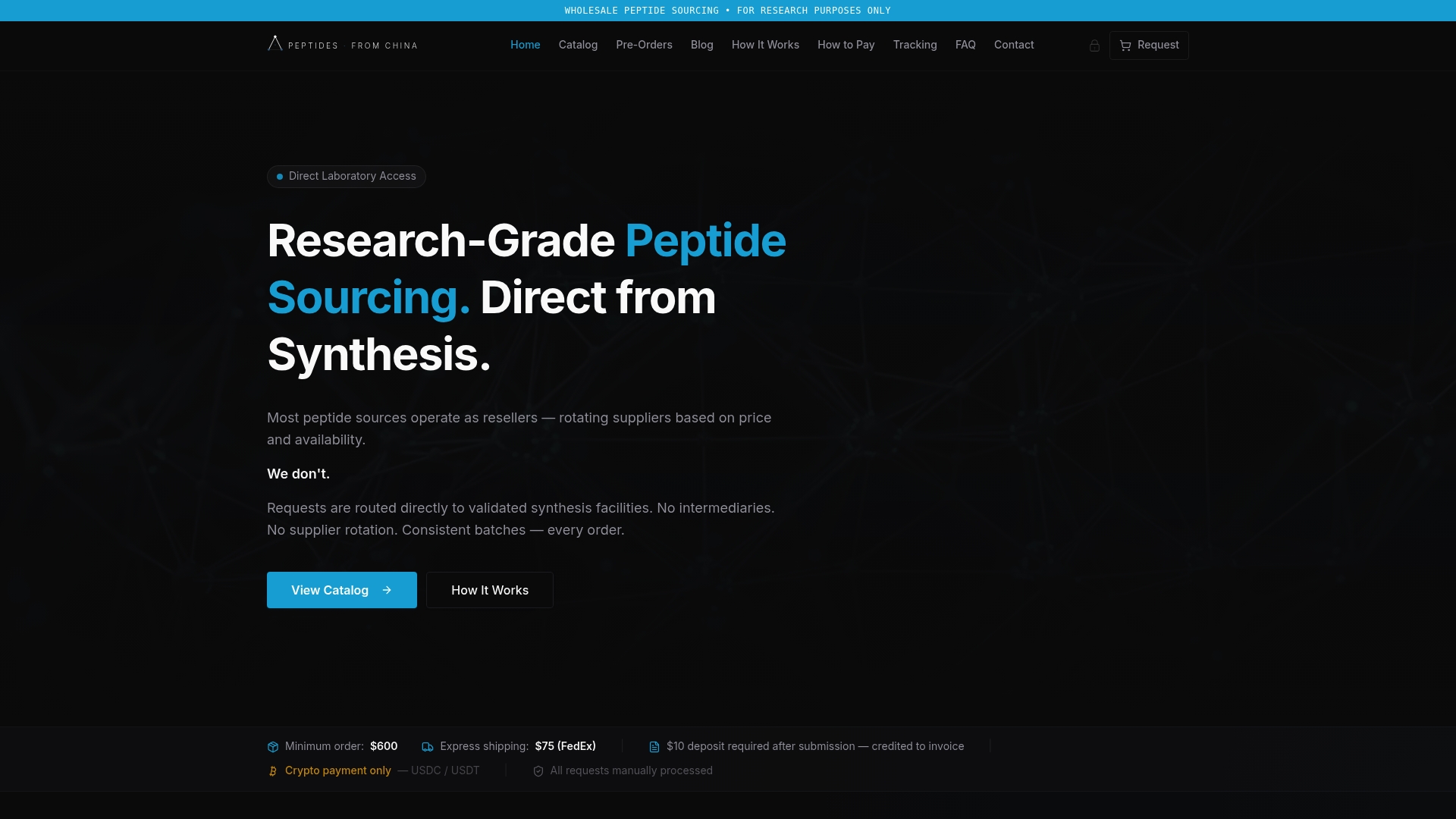
Cold-chain shipping options are available for temperature-sensitive compounds including GLP-1 analogs and fatty-acid conjugates. The wholesale ordering workflow supports bulk quantities with defined MOQs, and the replacement policy for mismatched COAs is documented rather than discretionary. For private-label brands and research labs that need reproducible sourcing across multiple lots, the direct-from-manufacturer model removes the reseller layer that most commonly introduces traceability gaps.
Browse the research peptide catalog to review available compounds and analytical package details, or submit a sourcing request through the VIP wholesale ordering path to begin the verification and stock confirmation process.
This article is general procurement information, not regulatory or legal advice. Confirm current FDA import requirements and applicable regulations with a qualified professional before placing orders.
Useful sources and further reading
EMA Guideline on the Development and Manufacture of Synthetic Peptides — primary traceability and batch definition standard for synthetic peptide active substances
How to Choose a Peptide Supplier: 6-Point Quality Checklist — tiered supplier scoring framework covering COA completeness, HPLC, MS, endotoxin, and shipping
Research Peptide Buying Guide for Beginners — COA checklist and common procurement traps including non-lot-specific certificates
How to Choose a Peptide CDMO in the US — synthesis platform selection, tech transfer timelines, and analytical capability matching
COA Verified Peptides Supplier: How to Authenticate Research Purity — practical COA authentication guide from PeptidesFromChina
How to Read a Peptide COA: A Researcher’s Guide to HPLC and MS Reports — step-by-step COA interpretation for lab scientists and procurement teams
Vetting Peptide Suppliers: A Professional 2026 Checklist — vendor vetting playbook for laboratory purchasing teams