U. S. Peptide HS Codes: 4 HTS Headings and 5 Documents CBP Requires

There is no single HS code for peptides. Depending on chemical structure and how the product is prepared, U. S. Customs and Border Protection places peptide shipments under Chapter 29 headings like 2937 (polypeptide hormones), 2930, 2933, or 2934, or under 3822 for prepared laboratory reagents. CBP classifies based on molecular structure, preparation state, and the General Rules of Interpretation (GRIs), not on marketing terms like “research use only.” When in doubt, importers should request a binding ruling before shipping at volume.
TL;DR:
Peptides are classified based on their chemical structure and preparation, not on marketing terms like “research use only,” and require detailed documentation for proper classification.
Customs usually determines the correct HTS heading by analyzing molecular formulas, synthesis methods, and purity data, with the most common categories being Chapter 29 subheadings and 3822.
A batch-specific certificate of analysis, detailed structural formula, and synthesis route are essential for smooth import clearance and defending classification in audits.
Requesting a binding ruling is advisable for large-volume imports or ambiguous structures, with rulings binding at all ports and valid for ongoing shipments of the same product.
Relying solely on general HTS codes like 2937 without supporting chemistry and documentation often leads to reclassification delays and customs issues.
Table of Contents
Which HTS Headings Apply to Peptide Imports
How U. S. Customs Decides Classification
Precedents Worth Citing in Your Classification File
Building an Importer Checklist That Survives Audit
Requesting a CBP Binding Ruling
What Supply-Chain Documentation Actually Supports a Classification Claim
Where to Verify HTS Codes and Rulings Directly
Why the “One Correct Code” Question Is the Wrong Question
Sources
Which HTS Headings Apply to Peptide Imports
Peptide classification starts with a structural question, not a functional one: what is the molecule actually made of, and how is it packaged for entry? CBP does not accept “peptide” as a self-defining commercial term. Four headings come up repeatedly in practice.
Heading 2937 covers hormones and their derivatives, including polypeptide hormones. It applies only when the molecule has hormone-like structure and the principal use is hormonal. A growth-hormone-releasing peptide analog might qualify; a generic signaling peptide sold for lab research often does not, because it fails the “principal use” test built into the heading’s explanatory notes.
Chapter 29 organic subheadings (2930 for sulfur-containing compounds, 2933 for nitrogen heterocycles, 2934 for other heterocyclic compounds) apply when specific chemical features, aromatic rings, sulfur bridges, or nitrogen heterocycles, determine the classification instead. This is where most bulk research peptides actually land.
2942 functions as a basket category for organic compounds that don’t fit elsewhere in Chapter 29.
3822 applies to prepared diagnostic or laboratory reagents, meaning finished kits or formulated products rather than raw active pharmaceutical ingredient (API) powder.
A lyophilized peptide vial sold as a bare compound tends to sit in Chapter 29. The same peptide packaged with buffer, diluent, and instructions as a testing kit often shifts to 3822.
How U. S. Customs Decides Classification
CBP applies the General Rules of Interpretation in strict sequence: GRI 1 looks at the heading text and chapter/section notes first; GRI 2 and 3 only come into play when GRI 1 doesn’t resolve the question, covering incomplete goods and mixtures. For peptides, this almost always means GRI 1 settles the case once the actual chemical structure is known.
CBP typically expects to see:
A structural formula or molecular diagram identifying the peptide sequence.
A Certificate of Analysis (COA) confirming purity and identity.
Analytical data, usually mass spectrometry (MS) or HPLC results, supporting the stated structure.
A description of the synthesis route (solid-phase vs. liquid-phase synthesis).
Rulings like NY B81132 confirm that labeling something “for research use only” carries no weight in classification. Composition and documentation do the work.
Pro Tip: Never submit a commercial invoice that just says “peptide, 10mg vial.” Add a one-line chemical descriptor (sequence or CAS number) and reference the COA directly on the paperwork. This single habit prevents most of the reclassification delays importers run into at the port.
Precedents Worth Citing in Your Classification File
Peptide classification is inconsistent across shipments, and that inconsistency is documented, not anecdotal. CBP ruling W563169 classified individual polypeptides across three different Chapter 29 subheadings (2930, 2933, and 2934) based purely on chemical structure, despite all of them being marketed under the generic “polypeptide” label. NY B81132 went further, placing synthetic peptides into narrow subheadings like 2930.90.2900 and 2930.90.9050 depending on sulfur content and side-chain composition.
Trade-data records compiled by Datamyne show peptide-related imports entering the U. S. under 2937, multiple Chapter 29 subheadings, and 3822 simultaneously, with no single heading dominating the commodity class.
That spread matters for compliance strategy. If your product line includes several peptide variants, assume each one may require its own classification determination rather than applying one heading across the catalog. The WCO’s customs laboratory guidance is built around exactly this problem, mapping amino acid composition to HS placement so customs chemists can make structure-based calls rather than guessing from a product name.
Building an Importer Checklist That Survives Audit
Documentation quality determines whether a shipment clears smoothly or gets flagged for a laboratory review. The checklist below reflects what actually shows up in CBP rulings and audit requests, not a generic compliance template.
Structural identification. Attach the amino acid sequence or structural formula, not just a trade name.
Certificate of Analysis. Include batch-specific COA data covering purity percentage and identity confirmation, tied to a batch or lot number.
Analytical backup. Keep MS or HPLC reports on file even if not submitted with every entry, since CBP can request them during a post-entry audit.
Synthesis method disclosure. Note whether the peptide was produced via solid-phase synthesis, since this affects impurity profiles that show up in structural review.
Consistent invoice language. Use the same chemical descriptor across the invoice, packing list, and COA. Mismatched terminology between documents is one of the more common triggers for a customs hold.
Whether you present a peptide as a raw API or as a finished lab reagent changes which heading applies. A bare lyophilized powder generally points toward Chapter 29. Add buffer, diluent, or packaging designed for direct lab use, and the classification conversation shifts toward 3822. PeptidesFromChina’s guidance on why documentation matters in peptide shipping covers sample invoice language importers can adapt directly.
Pro Tip: If your supplier can’t produce a batch-specific COA on request, before shipment, treat that as a documentation gap, not a formality. CBP audits look for batch traceability, and a generic “typical purity” sheet doesn’t hold up the same way a lot-specific COA does.
Requesting a CBP Binding Ruling
A binding ruling makes sense when you’re importing a new peptide variant at commercial volume, when a broker and an internal compliance team disagree on the correct heading, or when the chemical structure sits ambiguously between 2937 and a Chapter 29 subheading. It is not worth the process for a one-time small sample shipment.
To request one:
Submit through CBP’s Customs Rulings Online Search System (CROSS) portal with a complete structural description.
Include the amino acid sequence, molecular weight, COA, and intended commercial use.
Specify the proposed HTS subheading and your reasoning, referencing comparable rulings like W563169 if applicable.
Expect a response window of roughly 30 to 90 days depending on complexity and CBP’s current caseload.
A favorable ruling is binding for future entries of that identical product at any port, and it becomes strong evidence in a protest if a different port official challenges the classification later. Keep the ruling number attached to every subsequent entry for that SKU.
What Supply-Chain Documentation Actually Supports a Classification Claim
The chemical evidence CBP wants overlaps almost exactly with the quality documentation a serious peptide supplier should already be generating. A COA with lot-specific purity data, independent third-party purity verification, and batch records tracing a vial back to a specific synthesis run give an importer something concrete to attach to a customs entry, rather than a generic spec sheet copied across every batch.
Products are subject to the manufacturer’s applicable quality-control procedures and specifications. Manufacturer-side analytical documentation may be available depending on the product and batch. PeptidesFromChina is not an independent analytical testing laboratory.
A batch-specific COA tied to a lot number, not a generic product-level spec sheet.
Documentation of the synthesis method used for that specific batch.
Independent purity verification results, separate from the manufacturer’s own internal testing.
A clear chain of custody from API manufacturer to finished, vialed product.
Retaining these records in a per-SKU classification log, alongside the proposed HTS code and supporting rationale, turns a customs audit from a scramble into a five-minute document pull.
Where to Verify HTS Codes and Rulings Directly
Don’t take any secondhand summary, including this one, as the final word on a specific SKU. Check primary sources directly:
The U. S. Census Bureau’s Chapter 29 schedule for the current HTSUS text governing organic chemicals.
CBP ruling W563169 and NY B81132 for actual precedent on polypeptide and synthetic peptide classification.
WCO’s polypeptide classification guidance for how customs laboratories map amino acid composition to HS categories.
Datamyne’s trade-data records for real import activity showing how similar products have cleared under different headings.
For deeper procurement-side context, PeptidesFromChina’s guide to research peptide customs clearance walks through how these primary sources connect to sourcing decisions.
Why the “One Correct Code” Question Is the Wrong Question
Most importers ask which HS code is correct for peptides as if there’s a lookup table somewhere with the answer. There isn’t, and the CBP rulings prove it: identical marketing labels split across three or four different Chapter 29 subheadings depending on sulfur content, ring structure, and preparation state. Treating “peptide” as a classification category rather than a chemistry problem is the single most common mistake compliance teams make, and it’s an expensive one when a port officer disagrees with a self-filed entry after the fact.
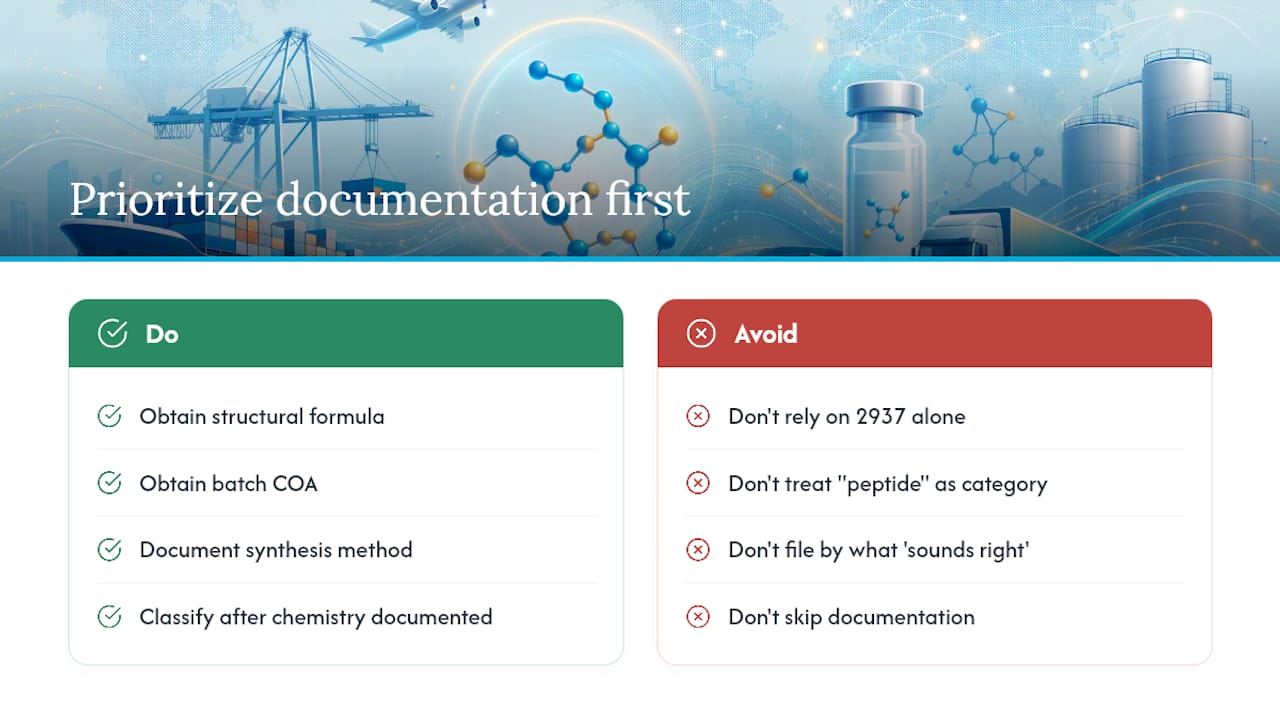
The conventional advice, “just use 2937, it’s a hormone,” falls apart the moment you read the heading’s own explanatory notes, which require both structure and principal hormonal use. Most research peptides fail that second test entirely.
What should come first is not the code, but the documentation. Get the structural formula, the batch-specific COA, and the synthesis method nailed down before you worry about which four-digit heading applies. The classification tends to follow naturally once the chemistry is on paper. Importers who skip that step and back into a heading based on what “sounds right” are the ones filing protests eighteen months later.
— Sam Levin