Before You Accept a Batch: HPLC vs LC‑MS for Peptides

HPLC gives you purity, the percentage of your sample that elutes as the main peak. LC-MS gives you identity, confirmation that the molecule in that peak is actually the sequence it’s labeled as. Reversed-phase HPLC with UV detection at 220 nm produces the area% purity figure on most certificates of analysis, while LC-MS/MS fragmentation maps the amino acid sequence through b and y ions. Neither method alone gives you a defensible COA. Together, they do.
TL;DR:
HPLC purity reports are based on UV peak area, but alone cannot confirm peptide sequence or detect certain impurities.
LC-MS/MS provides crucial sequence confirmation by analyzing fragmentation ions, catching impurities UV detection might miss.
Combining HPLC and LC-MS/MS in one run offers a comprehensive validation method for both purity and identity, especially for modified peptides.
A trustworthy certificate of analysis should include detailed chromatograms, purity percentages with method details, and annotated spectral data.
Relying solely on HPLC purity without independent mass verification can lead to accepting batches with incorrect sequences or undetected modifications.
Table of Contents
Manufacturer-Side QC and Buyer-Arranged Verification
HPLC vs LC-MS for Peptides: How Reversed-Phase HPLC Measures Purity
Reversed-phase HPLC, or RP-HPLC, separates peptides by hydrophobicity. The sample travels through a column packed with a nonpolar stationary phase, typically C18-bonded silica, while a mobile phase gradient (usually water and acetonitrile with a trace of trifluoroacetic acid) becomes progressively less polar. Peptides that are more hydrophobic cling to the column longer and elute later. The result is a chromatogram: a series of peaks, each representing a chemically distinct species in the sample.
Purity gets calculated from peak area, not peak height. If your target peptide’s peak accounts for 98.5% of the total integrated area under UV detection at 220 nm, the COA reports 98.5% purity. This wavelength detects the peptide backbone amide bond directly, which is why it has become the default for peptide UV work rather than the 280 nm used for proteins with aromatic side chains.
RP-HPLC does more than QC. It’s the workhorse for preparative purification, where scaled-up columns process sample loads reaching hundreds of milligrams. It also drives impurity profiling and real-time stability studies, tracking degradation products as a lyophilized peptide ages or as a reconstituted vial sits at room temperature.
The technique has real blind spots, though:
Co-eluting impurities with similar hydrophobicity can hide inside what looks like a single clean peak.
Retention time shifts with column age, temperature, and mobile phase composition, making cross-lab comparisons unreliable without matched methods.
UV absorbance cannot distinguish your target peptide from a truncated or deamidated variant that happens to co-elute at nearly the same time.
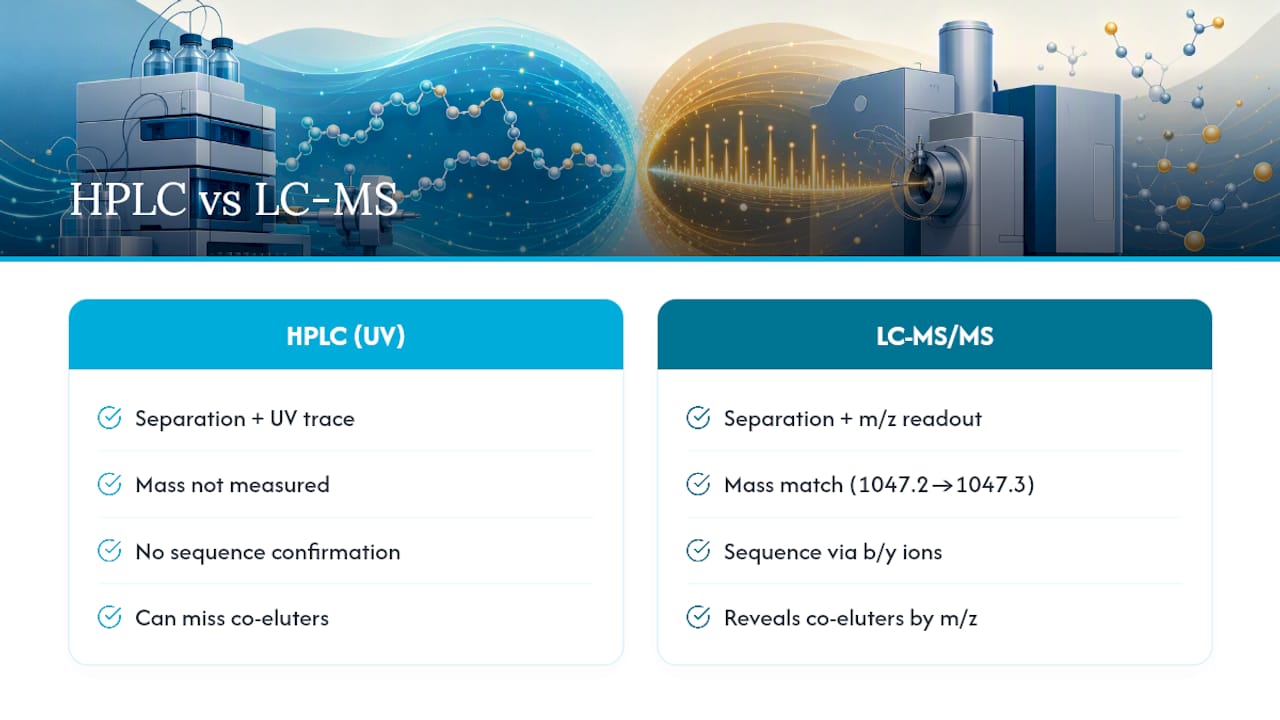
HPLC has no mechanism to confirm amino acid sequence. It reports quantity, not identity.
That’s the gap LC-MS exists to close.
HPLC vs LC-MS for Peptide Identification: Reading Mass and Sequence
LC-MS couples the same chromatographic separation to a mass spectrometer instead of, or in addition to, a UV detector. As each peak elutes, the mass spectrometer measures its mass-to-charge ratio (m/z), which gets converted to a molecular weight. If your peptide’s theoretical mass is 1,047.2 Da and the instrument reads 1,047.3 Da, that’s a mass match, strong evidence the right molecule is present.
Mass alone isn’t sequence confirmation. That’s what LC-MS/MS (tandem mass spectrometry) adds. The instrument isolates a precursor ion, fragments it along the peptide backbone, and records the resulting pieces. Fragmentation produces two families of ions, b-ions (containing the N-terminus) and y-ions (containing the C-terminus). Mapping the observed b/y ion ladder against the expected sequence confirms residue-by-residue identity, not just overall mass. This is also how LC-MS/MS catches co-eluting impurities that HPLC’s UV trace missed entirely: a second species with nearly identical retention time but a different mass shows up as a distinct m/z signal even when the chromatogram shows one peak.
Labs run this in different acquisition modes. Data-dependent acquisition (DDA) selects the most intense ions for fragmentation in real time; data-independent acquisition (DIA) fragments broader mass windows regardless of intensity, capturing more of the sample at the cost of more complex data. Search engines then match fragment spectra against theoretical sequences, and postprocessing tools have gotten considerably better at this. MSBooster, integrated with the FragPipe pipeline, uses deep learning to predict retention time, ion mobility, and expected spectral patterns, then rescores peptide-spectrum matches against those predictions. That measurably raises identification confidence, especially for weak or ambiguous spectra that a search engine alone might reject or misassign.
Pro Tip: Ask whether a lab’s LC-MS/MS report includes an actual annotated fragmentation spectrum, not just a summary line saying “mass confirmed.” A single MS1 mass match can occur by coincidence with isobaric contaminants; a full b/y ion map cannot.
LC-MS has its own tradeoffs. Ionization efficiency varies by peptide sequence, so MS signal intensity doesn’t translate cleanly into concentration the way HPLC peak area does, and instrument time plus operator expertise cost more per sample.
HPLC or LC-MS: Matching the Method to the Research Question
The mapping is straightforward once you separate the two questions. HPLC answers “how much of this is the right thing?” LC-MS answers “is this actually the right thing?” Most procurement decisions need both answers, not one.
HPLC alone can be acceptable for well-characterized, frequently reordered peptides from a supplier with a long batch history and no reported sequence issues, where the research use is low-stakes and reproducibility risk is already understood. It is not acceptable as the sole evidence for a new peptide, a modified or unusual sequence, or any batch where identity has never been independently confirmed.
LC-MS or LC-MS/MS becomes essential when:
The peptide is synthetic with post-translational modifications, cyclization, or non-standard residues that are easy to get subtly wrong during synthesis.
A prior batch from the same or a different supplier showed unexplained results in downstream research use.
The COA reports a rounded or suspiciously clean purity number with no accompanying method detail.
Reproducibility across labs or over time matters more than a fast turnaround.
Operationally, HPLC-only workflows run faster and cost less: shorter method development, simpler sample prep, and interpretation any trained technician can handle. Full LC-MS/MS work demands more expensive instrumentation, more specialized staff, and heavier data interpretation, particularly when spectra need manual review. The efficient middle path is a single LC-MS run that captures both a UV or total-ion chromatogram for quantification and mass data for identity, peak by peak, in one injection. That combined approach is what a rigorous COA should be built on, not two disconnected reports run on different days by different methods.
What a Trustworthy COA Should Actually Contain
Before accepting any batch, request the following from a supplier or in-house lab, and treat vague answers as a warning sign rather than a formality:
A full RP-HPLC chromatogram with stated method, including column type (commonly C18), gradient profile, flow rate, and detection wavelength, ideally 220 nm.
An area% purity figure tied to that chromatogram, not a bare number with no trace attached.
Measured mass data, including the instrument type and resolution, so you can judge how tight a “mass match” actually is.
An MS/MS summary or annotated spectrum showing b/y ion coverage across the sequence, not just a single confirmed mass.
Digestion and sample prep notes when the peptide required enzymatic cleavage for mapping, since chromatography conditions and digestion protocol both affect how a chromatogram should be read.
Reject or push back on any COA that reports HPLC purity with zero method detail, an unexplained mass shift from theoretical, or a purity number that never changes batch to batch, which usually signals a template report rather than a fresh run. An HPLC-only COA is one of the more common shortcuts in the peptide resale market, because purity testing is cheaper and faster to fake convincingly than mass data.
Pro Tip: If a supplier can’t produce raw chromatogram files or spectra on request, and only offers a finished PDF summary, ask why. A lab running real per-batch testing usually has no problem sharing the underlying trace.
The decision logic is simple: quantitative HPLC tells you the batch is clean enough to use; qualitative LC-MS tells you it’s the molecule you think it is. Accept a batch only when both boxes are checked, and treat a supplier’s willingness to supply raw data, not just conclusions, as part of the evaluation.
Manufacturer-Side QC and Buyer-Arranged Verification
HPLC and mass spectrometry answer different analytical questions: chromatographic homogeneity and molecular identity. Products are subject to the manufacturer’s applicable quality-control procedures and specifications. Manufacturer-side analytical documentation may be available depending on the product and batch. PeptidesFromChina is not an independent analytical testing laboratory. Buyers who require paired independent results may arrange third-party testing after receipt.
Verification in practice draws on:
Molecular-weight verification against theoretical mass when independently arranged by the buyer
Method comparisons across HPLC, LC-MS, and NMR so procurement teams understand what each technique can and can’t tell them.
Documented COA-reading guidance built for procurement teams evaluating unfamiliar supplier reports.
Batch traceability and lyophilization consistency matter just as much as the analytical report itself, since a technically correct COA tied to a poorly controlled vialing process still leaves reproducibility exposed.
Why Identity Confirmation Changes How You Source
Supplier onboarding fails most often on identity, not purity. A resale channel can produce a clean HPLC trace fairly easily; matching sequence identity across every batch, over time, is a harder operational commitment. That’s the real test of supply chain stability, not the purity number on page one.
Insist on paired HPLC and mass spec evidence before you accept a batch into any research workflow.
— Sam Levin