How Peptide Protocols Get Standardized in Verified Labs

What standardizing peptide protocols actually requires
Peptide protocol standardization in verified laboratories depends on a defined sequence of analytical, procedural, and documentation controls applied consistently across every batch. The process is not a single test but a layered system where each component addresses a specific failure mode in synthesis or characterization.
Key elements include:
Orthogonal identity confirmation: At least two analytical methods are required for peptide identification at release, typically RP-HPLC for purity quantification paired with MALDI-TOF or ESI-MS for molecular weight confirmation.
Purity assessment beyond chromatography: The USP mass balance approach accounts for residual solvents, counterions, and moisture, providing a more accurate peptide content figure than RP-HPLC peak area alone.
Method validation under ICH Q2: All analytical procedures used for batch release must be validated to confirm they detect relevant impurities and perform consistently across instruments and operators.
Batch traceability and documentation: Records covering in-process controls, deviations, corrective actions, and raw material provenance are mandatory under EMA/Ph. Eur. guidance and form the backbone of supply chain transparency.
Sterility and stability testing: Sterility testing confirms microbiological quality; stability protocols establish shelf-life under defined storage conditions.
Equipment calibration and personnel competency: Instruments must be maintained on documented schedules, and personnel must demonstrate verified competency before conducting release testing.
Deviation and corrective action handling: Any out-of-specification result triggers a documented investigation, preventing compromised batches from advancing through the supply chain.
Table of Contents
Manufacturer-Side QC and Buyer-Arranged Verification
How labs verify peptide identity and purity in practice
The analytical core of any laboratory peptide protocol rests on two complementary techniques. RP-HPLC separates peptide components by hydrophobicity and quantifies purity from UV absorbance at 214 nm. Mass spectrometry, whether MALDI-TOF or ESI-MS, confirms the molecular weight and flags synthesis impurities that co-elute with the target peptide on HPLC. Neither method is sufficient alone.
Purity figures reported as RP-HPLC area percentage can overstate actual peptide content when residual counterions and moisture are not accounted for. The USP mass balance method corrects for this by measuring all non-peptide components and subtracting them from the total mass. For procurement teams evaluating certificates of analysis, a purity figure without a stated methodology should prompt further inquiry.
Combining RP-HPLC with LC-MS or amino acid analysis addresses the limitations of any single technique. Amino acid analysis using standard acid hydrolysis can miss acid-labile protecting groups, making it unreliable as a standalone structural confirmation. Automated LC-UV/MS workflows with software such as ProMass improve impurity profiling throughput and data reproducibility across batches.
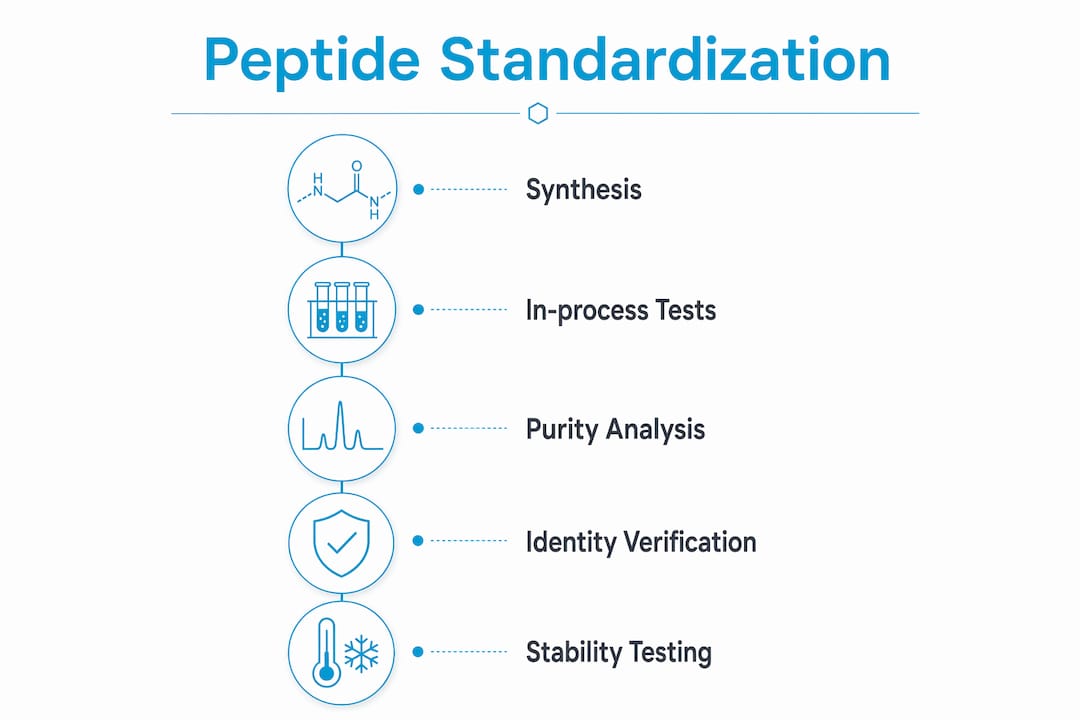
Controlled synthesis steps matter as much as final testing. In-process monitoring tests like the Kaiser test verify deprotection and coupling efficiency during solid-phase peptide synthesis, catching failures before they propagate through the sequence. Validated synthesis controls reduce impurity load at the source rather than relying on downstream purification to compensate.
Pro Tip: When reviewing a certificate of analysis, check whether purity is stated as RP-HPLC area percent or as a mass balance figure. The latter is the more defensible number for research applications where peptide content accuracy affects dosing calculations.
Stability testing and shelf-life determination close the loop by confirming that a batch meeting release specifications will remain within those specifications through its stated storage period. Without this data, a purity figure at manufacture tells only part of the story.
Manufacturer-Side QC and Buyer-Arranged Verification
Procurement teams that have worked through the verification requirements above know how quickly supplier documentation falls short. PeptidesFromChina coordinates sourcing from established Chinese manufacturing facilities together with international logistics. Manufacturer-side analytical documentation may be available depending on the product and batch.
The research-grade peptide catalog covers signaling peptides, GLP-1 agonists, longevity compounds, and mitochondrial peptides, each supported by documented quality control processes consistent with the standards outlined here. For teams that need verified sourcing without navigating gray-market resellers, reviewing available batches and their accompanying documentation is the practical next step.
Key Takeaways
Peptide protocol standardization requires orthogonal analytical verification, validated methods under ICH Q2, and complete batch documentation to produce reproducible, research-grade results.
Point Details Orthogonal identity methods EMA/Ph. Eur. guidance requires at least two analytical techniques, typically RP-HPLC plus mass spectrometry, for peptide release. Mass balance over peak area USP mass balance purity accounts for counterions, solvents, and moisture, giving a more accurate peptide content figure. ICH Q2 method validation All release testing procedures must be validated to confirm they detect relevant impurities consistently across batches. In-process synthesis controls Kaiser test monitoring during solid-phase synthesis catches coupling failures before they affect final purity. PeptidesFromChina sourcing Manufacturer-side analytical documentation may be available depending on the product and batch. Buyers requiring independent verification may arrange third-party analytical testing.