How Peptide Modifications Affect Activity: Lab & Procurement Guide

Peptide modifications change activity by altering three-dimensional conformation and physicochemical properties such as charge, hydrophobicity, amphiphilicity, and isoelectric point. Before scaling work with a modified peptide, define the required analytical and functional checks, run a pilot stability study and bioassay, and follow the applicable research protocol. PeptidesFromChina-sourced products are subject to manufacturer QC and product specifications; buyers requiring independent verification may arrange third-party testing.
Table of Contents
How do physicochemical properties control peptide behavior?
What does each common modification actually do?
When should you combine modifications?
Which assays confirm that a modification worked?
Formulation and handling pitfalls with modified peptides
What should procurement require from suppliers?
Safety and U.S. regulatory considerations
Worked example: designing a cyclic lipopeptide
Key Takeaways
The sourcing problem most researchers underestimate
Start with a verified pilot before committing to bulk
Useful sources for further reading
How do physicochemical properties control peptide behavior?
Physicochemical factors predict biological behavior before any assay is run. Understanding each property gives researchers a practical filter for anticipating problems at the design stage.
Charge: Positively charged peptides interact with negatively charged bacterial membranes, which is why cationic sequences dominate antimicrobial peptide (AMP) research. Shifting net charge through modification directly shifts selectivity and potency.
Hydrophobicity: Higher hydrophobicity generally improves membrane insertion but reduces aqueous solubility. Small changes — a single residue swap or a lipid chain addition — can push a peptide past its solubility threshold.
Amphiphilicity: The spatial arrangement of hydrophilic and hydrophobic faces determines how a peptide orients at a membrane or receptor interface. Disrupting amphiphilicity through random modification often reduces activity even when charge is preserved.
Isoelectric point (pI): Working near a peptide’s pI in solution drives aggregation and precipitation. Knowing the calculated pI before formulation lets researchers choose a buffer pH that keeps the peptide in solution.
Pro Tip: Calculate pI and log P before ordering. Flag any sequence with a pI within one unit of your intended formulation pH — aggregation risk at that pH is high and will confound assay results.
Selectivity also tracks these properties closely. Researchers studying charge and conformation effects on selectivity will find that small physicochemical shifts can redirect a peptide toward or away from a target entirely.
What does each common modification actually do?
Each modification carries predictable mechanistic benefits and equally predictable trade-offs. The table below maps the most common chemical and structural modifications to their typical effects and the lab red flags to watch for, based on mechanistic insights without specific quantified figures.
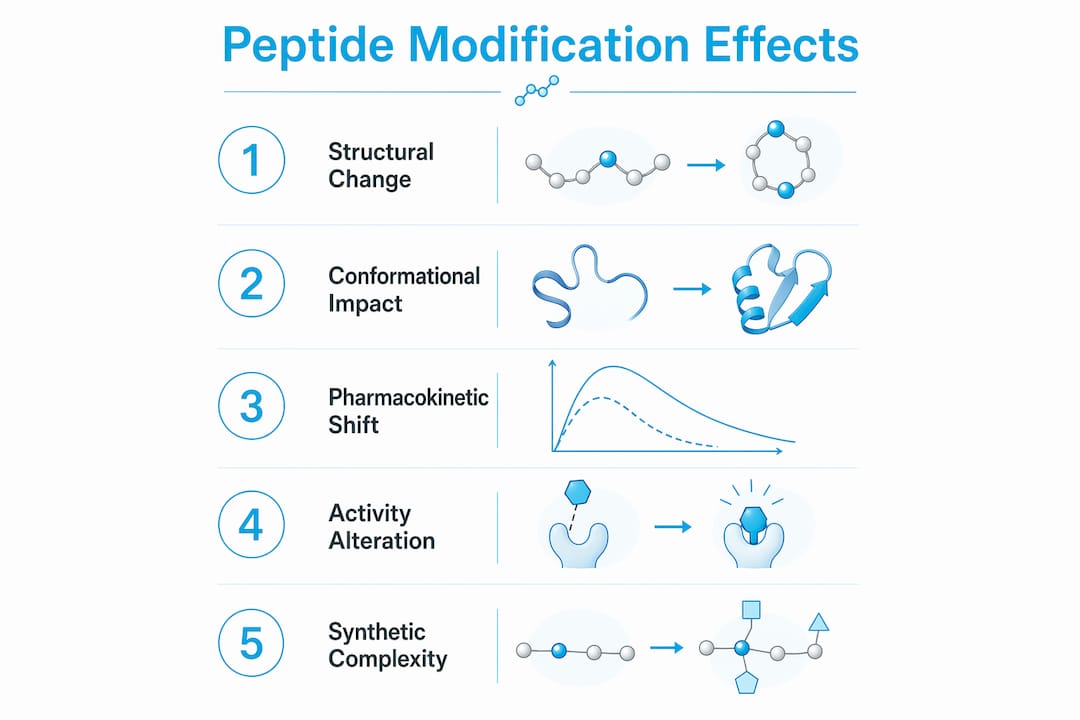
Modification Typical effect on activity / half-life Lab trade-offs and red flags Lipidation Extends half-life via albumin binding and membrane interaction Aggregation and hemolysis risk when lipid chain is excessive; solubility drops sharply Cyclization Constrains conformation, improves receptor targeting and protease resistance Opening a ring can abolish activity; CD confirmation required Stapling Locks alpha-helical structure; improves cell penetration and protease resistance Synthesis complexity; heterogeneous staple placement reduces reproducibility PEGylation Increases solubility and reduces clearance Steric hindrance can reduce membrane or target affinity depending on chain length Glycosylation Improves solubility and reduces immunogenicity May reduce receptor binding; glycan heterogeneity complicates batch consistency D-amino acid substitution Strong proteolytic resistance Can shift native conformation and reduce receptor binding; test both stability and binding N-methylation / backbone modification Proteolytic resistance; modulates membrane permeability Conformational disruption possible; non-additive effects when combined Acetylation / amidation Removes terminal charges; improves stability and membrane permeability Modest effect alone; most useful combined with other strategies
Key points from the literature:
Lipidation improves albumin binding and circulating half-life, but excessive lipidation raises aggregation risk and reduces solubility in biological contexts.
Cyclization fixes conformation, enhancing receptor targeting and protease resistance — octreotide and cyclosporine are the canonical examples.
PEGylation reduces cytotoxicity and clearance, but can reduce membrane and target affinity depending on chain length.
D-amino acid substitution gives strong proteolytic resistance but can change native conformation and reduce receptor binding; balance stability against structural fit and test both.
Backbone modifications rank for proteolytic protection as: D-AA > Cα-Me > β3 > N-Me, with combined substitutions showing synergistic but non-additive effects.
For a broader classification of modification patterns by peptide class, the therapeutic peptide classification guide provides useful context.
When should you combine modifications?
Combinations can be synergistic, but they are not additive and always require targeted testing. A cyclic lipopeptide, for example, can deliver better bactericidal activity and combined stability and membrane penetration than either cyclization or lipidation alone. The mechanistic logic is straightforward: cyclization locks conformation while lipidation extends half-life and improves membrane interaction. Together they address two separate failure modes simultaneously.
Common combinations and their rationale:
Cyclization + lipidation: Addresses both protease susceptibility and short half-life; the primary risk is compounded hydrophobicity and aggregation.
PEGylation + glycosylation: Stacks solubility and immunogenicity benefits but can compound steric interference with target binding.
Backbone N-methylation + stapling: Combines proteolytic resistance with helical stabilization; synthesis complexity and byproduct heterogeneity increase substantially.
The trade-offs compound as well. Each additional modification adds synthesis steps, raises the probability of heterogeneous byproducts, and complicates purification. A batch that looks clean by UV absorbance may still contain partially modified species that behave differently in assays.
Pro Tip: Run a small pilot series with site-specific variants rather than ordering a random mixture. Tag-and-modify and proximity-driven chemistries avoid heterogeneous populations that cause irreproducible data — ask suppliers explicitly whether they offer these options.
Which assays confirm that a modification worked?
Run orthogonal checks covering purity, identity, conformation, and function before assuming a modification behaves as described. The recommended minimal panel, in procedural order:
HPLC — purity confirmation; a single main peak is the acceptance threshold.
LC-MS — identity and mass confirmation; detects partially modified or degraded species.
Circular dichroism (CD) — conformation check; the CD signature should be consistent with the intended secondary structure (e.g., helical for a stapled peptide, constrained for a cyclic).
SPR or ITC — binding affinity; confirms the modification did not abolish target interaction.
Functional bioassay — cell-based or enzymatic; the only direct measure of activity change.
Serum stability — incubate in human or rodent serum and monitor by LC-MS to evaluate stability over a relevant period.
DLS — dynamic light scattering for aggregation; low count rates and a monomodal size distribution are the acceptance flags.
Multiple sources recommend this orthogonal approach; CD and structural assays are critical to confirm intended conformations, particularly for cyclic and stapled peptides where conformation is often the primary determinant of bioactivity. Researchers working with quantification methods can find acceptance criteria guidance in the LC-MS quantification methods overview.
Formulation and handling pitfalls with modified peptides
Formulation choices often determine whether an active modified peptide performs in assays or fails due to aggregation and precipitation. The modification type directly dictates solvent strategy.
Key decisions and common failures:
Solvent selection: Highly hydrophobic or lipidated peptides require a co-solvent (typically low-percentage DMSO, up to 10%) before dilution into aqueous buffer. Reconstituting directly in aqueous buffer without a co-solvent causes immediate aggregation.
pH and pI: Formulate at least one pH unit away from the peptide’s pI. Ignoring this drives precipitation even at low concentrations.
Excipients: Low-concentration surfactants (e.g., polysorbate 20 at 0.01–0.05%) stabilize lipidated peptides in solution. Salts can shift effective pI and should be chosen deliberately.
Lyophilization: Lyophilized material is stable during transport and storage, but reconstitution protocol matters. Use the supplier’s recommended solvent sequence and concentration.
Freeze-thaw cycles: Repeated freeze-thaw degrades many modified peptides. Aliquot immediately after reconstitution.
Pro Tip: For lipidated or highly hydrophobic peptides, aliquot lyophilized material into single-use vials before reconstitution, and include a validated surfactant concentration in the reconstitution buffer. This prevents aggregation-driven activity loss between experiments.
For a detailed breakdown of how modified peptides interact with specific formulation bases, the peptide-formulation interaction guide covers solubility and aggregation scenarios at lab scale.
What should procurement require from suppliers?
Require site-specific modification details and an independent COA with HPLC and LC-MS traces before purchase. Supplier purity claims without raw trace data are insufficient — impure batches contain partially modified or degraded peptides that supplier-side testing may miss.
Procurement checklist:
Specification of the exact modification site (not just modification type)
Synthesis method: solid-phase vs. solution-phase, and whether site-specific chemistry was used
Reported purity with the assay method stated (HPLC at which wavelength, which column)
Batch traceability from raw API through lyophilization and vialing
Lyophilization and vialing details: vial size, fill weight, headspace gas
Storage and transport conditions: temperature, desiccant, cold-chain documentation
Available stability data: real-time or accelerated
Questions to ask suppliers directly: What is the PEG chain length distribution for PEGylated peptides? What lipid chain identity and attachment chemistry was used for lipidated peptides? Do you offer tag-and-modify or proximity-driven site-specific synthesis? What is the heterogeneity profile of the modification across the batch?
Sam Levin at PeptidesFromChina recommends requiring a sample aliquot for internal QC before committing to bulk quantities. Site-specific modification reduces heterogeneity and improves reproducibility — procurement should treat this as a baseline requirement, not an upgrade.

Safety and U.S. regulatory considerations
For research use, follow institutional biosafety and procurement rules and avoid therapeutic claims or unapproved human use. Modified peptides are research reagents, not approved therapeutics, and their use must stay within the scope of institutional and regulatory approvals.
Key compliance points:
Obtain institutional biosafety committee (IBC) review where the peptide’s mechanism or target warrants it.
Use Material Transfer Agreements (MTAs) when sending or receiving peptides for external testing.
Follow hazardous materials handling protocols for cytotoxic peptides (e.g., certain AMPs or membrane-disrupting sequences).
Maintain lab SOPs covering storage conditions, disposal, and exposure response.
Do not make therapeutic or clinical efficacy claims based on research-use data without appropriate regulatory review.
This section is general information. Consult your institutional compliance office or legal counsel for project-specific regulatory guidance.
Worked example: designing a cyclic lipopeptide
A cyclic lipopeptide can extend half-life and improve membrane interaction, but careful site selection and pilot testing are required before the design is viable.
Choose cyclization strategy and site. Head-to-tail, side-chain-to-tail, or disulfide cyclization each constrain conformation differently. Select based on the target receptor geometry and confirm with CD.
Select lipid chain and attachment site. Fatty acid chain length and attachment position (N-terminus, Lys side chain) determine albumin binding efficiency and aggregation risk. Shorter lipid chains aggregate less than longer ones, making chain length an important factor in aggregation risk.
Order site-specific synthesis. Request tag-and-modify or proximity chemistry. Specify both the cyclization and lipidation sites explicitly in the RFQ.
Request full COA. Require HPLC purity trace, LC-MS mass confirmation, and batch traceability documentation before accepting the shipment.
Run the minimal assay panel. HPLC and LC-MS for identity and purity, CD for conformation, DLS for aggregation, serum stability over 24 hours, and a functional bioassay.
Evaluate acceptance flags. Single main HPLC peak, mass consistent with the fully modified sequence, CD signature matching the constrained conformation, DLS showing monomodal distribution, and functional activity within the expected range.
Red flags requiring redesign or supplier rejection: multiple LC-MS peaks indicating incomplete modification, DLS showing high aggregate counts, CD signature inconsistent with cyclization, or functional activity below the linear analog baseline.
Key Takeaways
Peptide modifications affect activity through conformational and physicochemical changes. Researchers should select appropriate analytical and functional assays for their specific experiment before scaling it.
Point Details Conformation drives activity Opening a ring or disrupting a constrained scaffold can abolish activity even with an identical sequence. Run orthogonal assays The minimum panel is HPLC, LC-MS, CD, SPR or ITC, functional bioassay, serum stability, and DLS. Require site-specific synthesis Heterogeneous modifications cause irreproducible data; always ask suppliers for tag-and-modify or proximity chemistry options. Formulate away from pI Working within one pH unit of the isoelectric point drives aggregation; choose buffer pH deliberately. PeptidesFromChina sourcing Manufacturer-side analytical documentation may be available depending on the product and batch. PeptidesFromChina is not an independent analytical testing laboratory.
The sourcing problem most researchers underestimate
Sourcing is where reproducibility fails most often, and it rarely announces itself. A batch arrives with a purity claim on the label, the HPLC trace looks clean at 214 nm, and the researcher proceeds to scale. Three months later, the data does not replicate. The culprit, in a significant share of cases, is a heterogeneous modification population that the supplier’s own QC did not catch.
The real issue is that many suppliers test purity by UV absorbance alone, which does not distinguish between a fully modified peptide and a partially modified analog with nearly identical mass. LC-MS is not optional for modified peptides. Neither is a functional pilot assay on the first batch from any new supplier.
Small test orders before bulk commitment are not just a cost-control measure. They are the only way to confirm that what the supplier claims matches what the peptide actually does in an assay. Raw API traceability matters here too. A supplier who cannot tell you which synthesis facility produced the API, or who cannot provide lyophilization and vialing batch records, is a supplier whose QC chain has gaps.
The procurement teams that avoid reproducibility failures share one practice: they treat independent verification as a fixed cost of doing business, not an optional upgrade.
Start with a verified pilot before committing to bulk
Researchers who need modified peptides with documented batch consistency have a practical starting point with PeptidesFromChina. The platform coordinates sourcing from established Chinese manufacturing facilities together with international logistics.
For pilot orders, small cyclic peptides, PEGylated controls, and lipidated test peptides are the most informative starting points. Each covers a different modification class and gives procurement teams real QC data before scaling. Manufacturer-side analytical documentation may be available depending on the product and batch. Browse the research-grade peptide catalog to identify pilot candidates, or start with a specific modified peptide such as KPV to run your internal QC workflow against a well-characterized sequence.
Useful sources for further reading
Getting in Shape: Controlling Peptide Bioactivity and Bioavailability Using Conformational Constraints — The primary reference for conformation-driven design; covers how ring opening abolishes activity and why CD is required for cyclic peptides.
Chemical Modification of Bioactive Peptides and Their Advances in Drug Innovation — Covers lipidation, cyclization, and combination strategies with mechanistic detail; the source for cyclic lipopeptide data cited in this article.
Residue-Specific Peptide Modification: A Chemist’s Guide — Detailed reference for site-specific chemistry options by amino acid residue; essential reading before specifying modification sites in an RFQ.
Therapeutic Peptides: Chemical Strategies for Enhanced Disease Treatment — Covers PEGylation and D-amino acid substitution trade-offs in depth; use this when evaluating chain-length decisions for PEGylated peptides.
Bioconjugation and Site-Specific Modification Advances — The key reference for tag-and-modify and proximity-driven chemistry; supports the sourcing checklist and heterogeneity risk discussion.
Modified Synthetic Peptides: From Therapeutics to Chemosensors — Covers backbone modification strategies and the proteolytic resistance ranking; useful for D-AA and N-methylation decisions.
Biochemistry, Peptide — StatPearls, NCBI Bookshelf — Foundational reference for post-translational modifications and AMP biology; useful background for researchers new to peptide modification effects.