
For years, the obesity-drug race has revolved around one question: how many incretin receptors can a molecule activate at once? Eloralintide changes the conversation.
Developed by Eli Lilly under the code LY3841136, eloralintide is a long-acting, selective amylin receptor agonist. It does not activate GLP-1, GIP or glucagon receptors. Instead, it follows a different biological route—one involved in satiety, meal termination and the brain’s response to rewarding stimuli.
That distinction matters. In a 48-week Phase 2 trial, eloralintide produced dose-dependent weight reduction reaching 20.1% in the highest-dose group. Lilly has since moved the molecule into the Phase 3 ENLIGHTEN program and is also studying it in combination with tirzepatide.
But weight loss is only part of the story. Amylin-receptor research has also produced a provocative preclinical signal in alcohol-related behavior. Eloralintide itself has not been shown to treat addiction in humans, but the pathway it targets may eventually extend beyond metabolic disease.
Eloralintide at a glance
Developer: Eli Lilly and Company
Development code: LY3841136
Drug class: long-acting selective amylin receptor agonist
Current status: investigational; not FDA-approved
Lead indication: obesity and overweight
Phase 2 result: up to 20.1% mean weight reduction at 48 weeks
Phase 3 program: ENLIGHTEN
Additional strategy: combination development with tirzepatide as eloraTZP
Addiction relevance: biologically plausible and supported by animal studies of amylin-receptor agonism, but not established clinically for eloralintide
What makes eloralintide different?
Amylin is a peptide hormone normally co-secreted with insulin by pancreatic beta cells after a meal. Its job is not simply to make a person “less hungry.” It participates in a coordinated satiety system that helps bring a meal to an end, moderates gastric emptying and affects post-meal glucagon signaling.
Native amylin is difficult to turn into a convenient medicine because it is short-lived and prone to aggregation. Eloralintide was engineered for longer exposure and once-weekly clinical dosing.
Its other defining feature is receptor selectivity. Amylin receptors are formed when the calcitonin receptor associates with receptor activity-modifying proteins. Eloralintide was designed to favor the AMY1 receptor over the calcitonin receptor. That may help separate the desired metabolic signal from some of the off-target pharmacology associated with less selective amylin and calcitonin agonists.
The practical implication is important: eloralintide is not another GLP-1 drug with a slightly altered sequence. It represents a distinct therapeutic approach that could be used alone or layered onto incretin pharmacology.
What the Phase 2 trial actually showed
The strongest published evidence comes from a multicenter, randomized, double-blind Phase 2 trial reported in The Lancet in 2025.
The study enrolled 263 adults with obesity, or overweight with at least one weight-related complication, without type 2 diabetes. Participants received once-weekly eloralintide or placebo for 48 weeks. Weight reduction was dose-dependent and reached 20.1% in the 9 mg group, compared with 0.4% in the placebo group.
That headline number is impressive, but three details are just as important.
First, the response had not clearly plateaued by week 48 in the higher-dose groups. That does not prove that weight would continue falling indefinitely; it tells us that the full time-response curve was not yet defined.
Second, the result came from a controlled clinical trial—not from retail “research use” material. The trial data cannot be used to infer the performance of an unverified product sold under the same compound name.
Third, tolerability still matters. Gastrointestinal adverse events occurred and were generally described as mild to moderate, but eloralintide has not eliminated the trade-offs seen across centrally acting weight-management drugs. Claims that it is essentially nausea-free or automatically better tolerated than every GLP-1 drug go beyond the evidence.
Phase 3: the ENLIGHTEN program
Lilly has advanced eloralintide into the ENLIGHTEN Phase 3 program. ENLIGHTEN-1 is evaluating the efficacy and safety of eloralintide against placebo in adults with obesity or overweight without type 2 diabetes. Additional studies broaden the program into populations with metabolic disease and obesity-related complications.
This is the point at which several questions should become clearer:
Can the Phase 2 magnitude of weight loss be reproduced in larger and more diverse populations?
What does the longer-term safety and discontinuation profile look like?
How much of the lost weight is fat mass versus lean mass?
Does selective amylin agonism offer a meaningful tolerability advantage over incretin-based therapy?
Which patients respond best to amylin monotherapy rather than an incretin or combination approach?
Until Phase 3 data mature, eloralintide should be described as a highly promising investigational candidate—not as an approved successor to current obesity drugs.
EloraTZP: why Lilly is combining eloralintide with tirzepatide
The most strategically interesting development may be eloraTZP, Lilly’s combination of eloralintide and tirzepatide.
The rationale is straightforward. Tirzepatide activates GIP and GLP-1 receptors, while eloralintide activates the amylin pathway. Combining them may create a broader satiety and metabolic signal without simply pushing one mechanism to a higher dose.
In Phase 1 data announced by Lilly in September 2026, adding 3 mg eloralintide to 5 mg tirzepatide produced approximately 17% weight loss over 16 weeks, versus about 10% with tirzepatide 5 mg alone. These are early combination data, not a head-to-head Phase 3 verdict, but they explain why Lilly sees amylin as a complement to its incretin portfolio rather than a replacement for it.
The combination strategy also places Lilly directly into the next stage of competition with Novo Nordisk, whose CagriSema program combines the amylin analog cagrilintide with semaglutide.
Could the amylin pathway matter for addiction?
This is the most intriguing—and most easily overstated—part of the eloralintide story.
Food and addictive substances do not produce identical reward signals, but their neural circuits overlap. Preclinical research has linked amylin signaling to mesolimbic dopamine pathways involved in reinforcement and reward.
In rodent studies, activation of amylin receptors with compounds including salmon calcitonin reduced several alcohol-related behaviors. Researchers reported lower alcohol intake, reduced alcohol reward and attenuation of alcohol-induced effects on the mesolimbic dopamine system. Later work found that repeated amylin-receptor activation continued to reduce alcohol consumption in animal models. A 2025 study also reported a synergistic-like reduction in alcohol intake when an amylin agonist was combined with the GLP-1 agonist dulaglutide in male rats.
This creates a legitimate research hypothesis: a selective, long-acting amylin agonist might influence not only caloric intake but also aspects of reward-driven consumption.
It does not establish that eloralintide treats alcohol use disorder, nicotine dependence, opioid use disorder or compulsive behavior. The cited experiments were preclinical, used other amylin-receptor agonists and cannot be translated directly into a human indication. As of September 2026, the registered clinical program for eloralintide is centered on obesity and related metabolic conditions—not addiction treatment.
The correct conclusion is therefore more interesting than either hype or dismissal: addiction is a credible future research direction for the amylin pathway, but it remains an open question for eloralintide.
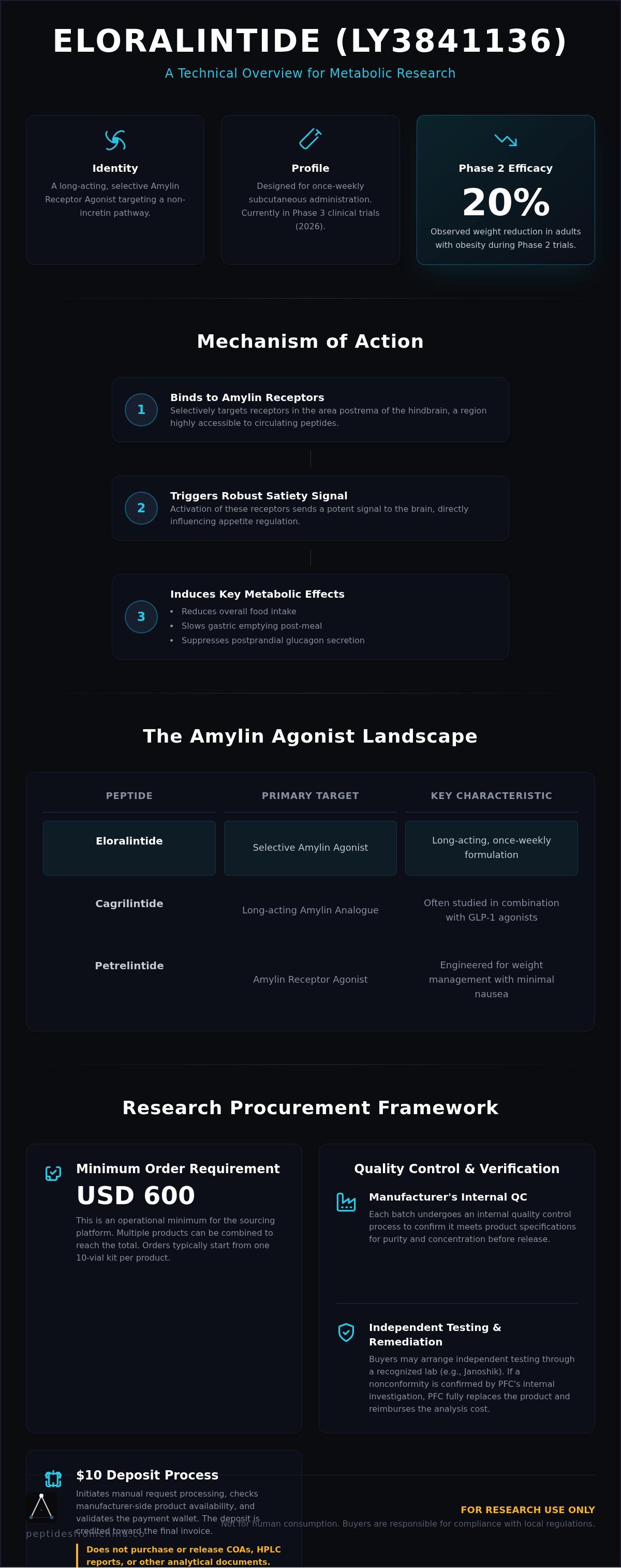
Eloralintide versus cagrilintide and petrelintide
The three names are often grouped together, but they are not interchangeable.
Eloralintide
Lilly’s molecule is designed as a selective amylin receptor agonist and has produced up to 20.1% mean weight reduction as monotherapy in Phase 2. Lilly is developing it both independently and with tirzepatide.
Cagrilintide
Novo Nordisk’s long-acting amylin analog is best known through CagriSema, its fixed-dose combination with semaglutide. That program tests the same broad strategic idea as eloraTZP: pairing an amylin signal with incretin pharmacology.
Petrelintide
Developed by Zealand Pharma and partnered with Roche, petrelintide is positioned around a potentially differentiated tolerability profile. Its clinical program will help determine whether a more amylin-focused drug can achieve meaningful weight loss with a different balance of gastrointestinal adverse events.
Cross-trial percentages should be treated carefully. Trial duration, population, estimand, dose escalation and background interventions differ. A leaderboard assembled from headline numbers is not a substitute for a controlled head-to-head study.
What researchers should watch next
Eloralintide now has enough human evidence to be taken seriously, but the decisive questions remain ahead:
Phase 3 replication. The 20.1% Phase 2 result must hold up in larger trials.
Body composition. Claims of superior lean-mass preservation need direct, adequately powered evidence.
Tolerability at effective exposure. Selectivity is promising, but clinical discontinuation and adverse-event data matter more than receptor diagrams.
Combination durability. EloraTZP must show that its early advantage persists beyond a short Phase 1 study.
Reward biology. Human studies are needed before the addiction hypothesis can move from pathway science to a therapeutic claim.
Research sourcing without invented guarantees
Interest in a clinical candidate often reaches the research market before the clinical evidence is complete. That makes identity and batch-specific documentation especially important.
PFC coordinates access to research compounds through manufacturing partners. Availability, specifications and supporting documentation can vary by product and batch, so they should be confirmed for the exact material under consideration rather than assumed from a generic article or compound name.
For eloralintide inquiries, researchers can request current availability and the documentation associated with the proposed batch through the PFC contact page (https://peptidesfromchina.co/contact/). PFC materials are offered for research use only and are not substitutes for Lilly’s investigational clinical product.
The bottom line
Eloralintide is one of the strongest arguments that the next generation of obesity medicines will not be built on incretin biology alone. Its Phase 2 result puts selective amylin agonism into serious competition with leading metabolic programs, while eloraTZP shows how Lilly intends to combine the pathway with tirzepatide.
The addiction angle deserves attention for a different reason. Animal data suggest that amylin signaling can influence alcohol-related reward and consumption, giving the pathway a plausible role beyond weight management. But that science has not yet established eloralintide as an addiction medicine.
The honest story is already compelling: a clinically advanced amylin drug, a major Phase 3 program, a powerful combination strategy and a reward-pathway hypothesis that could open an entirely new field of research.
Frequently asked questions
What is eloralintide?
Eloralintide, also known as LY3841136, is Eli Lilly’s investigational long-acting selective amylin receptor agonist. It is being studied primarily for obesity and overweight.
Is eloralintide approved by the FDA?
No. Eloralintide remains investigational and is not FDA-approved as of September 2026.
How much weight loss did eloralintide produce in Phase 2?
In a 48-week randomized Phase 2 trial, the highest-dose group had a mean weight reduction of 20.1%, compared with 0.4% in the placebo group. Results varied by dose.
Is eloralintide a GLP-1 drug?
No. Eloralintide targets the amylin receptor pathway. It does not act as a GLP-1, GIP or glucagon receptor agonist.
Is Lilly testing eloralintide with tirzepatide?
Yes. The combination is called eloraTZP. Early Phase 1 data suggest that adding eloralintide can increase weight reduction compared with tirzepatide 5 mg alone, but longer and larger trials are required.
Is eloralintide being developed to treat addiction?
Not as an established clinical indication. Animal studies using other amylin-receptor agonists have reduced alcohol-related reward and consumption, which makes addiction a plausible research direction. Human evidence for eloralintide in addiction is not yet available.
How does eloralintide differ from cagrilintide?
Both target amylin biology, but they are different molecules with different receptor profiles and development programs. Eloralintide is being studied as monotherapy and with tirzepatide; cagrilintide is best known in Novo Nordisk’s CagriSema combination with semaglutide.
Primary sources
Billings LK, et al. Eloralintide, a selective amylin receptor agonist for the treatment of obesity: a 48-week phase 2 trial. The Lancet, 2025. PubMed PMID 41207310 (https://pubmed.ncbi.nlm.nih.gov/41207310/)
ClinicalTrials.gov. ENLIGHTEN-1: Eloralintide in adults with obesity or overweight without type 2 diabetes. NCT07321886 (https://clinicaltrials.gov/study/NCT07321886)
Eli Lilly and Company. Lilly to present new data on Foundayo, retatrutide and eloraTZP at EASD 2026. September 15, 2026. Lilly investor news (https://investor.lilly.com/)
Kalafateli AL, et al. Activation of amylin receptors attenuates alcohol-mediated behaviours in rodents. British Journal of Pharmacology, 2019. Publisher record (https://onlinelibrary.wiley.com/doi/10.1111/bph.14566)
Kalafateli AL, et al. Effects of sub-chronic amylin receptor activation on alcohol-related behaviours in rats. Psychopharmacology, 2020. Publisher record (https://link.springer.com/article/10.1007/s00213-020-05515-3)
Aranäs C, et al. Synergistic-like decreases in alcohol intake following combined pharmacotherapy with GLP-1 and amylin receptor agonists in male rats. British Journal of Pharmacology, 2025. PubMed search (https://pubmed.ncbi.nlm.nih.gov/?term=Synergistic-like+decreases+in+alcohol+intake+following+combined+pharmacotherapy+with+GLP-1+and+amylin)