
Peptide synthesis rarely fails in one dramatic moment. More often, small losses accumulate across dozens of deprotection, coupling, washing, cleavage and purification steps. The final material may still look normal, yet contain deletion sequences, epimers, oxidized species or residual counterions that matter to a sensitive assay.
That is why a useful quality review begins with the sequence and ends with orthogonal analytical data. A single purity percentage is informative, but it cannot answer every question about identity, content or suitability for a particular research design.
This guide explains the most common peptide synthesis failure points, how they appear in analytical results and what a research buyer should request before committing a batch to an experiment.
The short version
Every SPPS cycle creates another opportunity for incomplete coupling or incomplete deprotection.
Long, hydrophobic and aggregation-prone sequences are usually harder than short, soluble peptides.
Aspartimide formation, racemization and oxidation are sequence-dependent risks, not universal defects.
HPLC estimates chromatographic purity; mass spectrometry supports molecular identity. Neither measurement alone establishes peptide content, sterility or biological activity.
A good specification is sequence-specific. “99% pure” without a method, chromatogram and identity result is not a complete quality package.
The best procurement question is not “Is this supplier good?” but “Does the evidence for this exact batch fit the intended laboratory use?”
Why solid-phase peptide synthesis accumulates errors
Most synthetic research peptides are produced by solid-phase peptide synthesis, or SPPS. The first protected amino acid is attached to a resin. The process then repeats a cycle: remove the temporary protecting group, activate and couple the next amino acid, wash, and continue until the chain is complete.
The method is powerful because excess reagents can drive each step toward completion and soluble by-products can be washed away. Its weakness is equally clear: the chemistry is repeated many times.
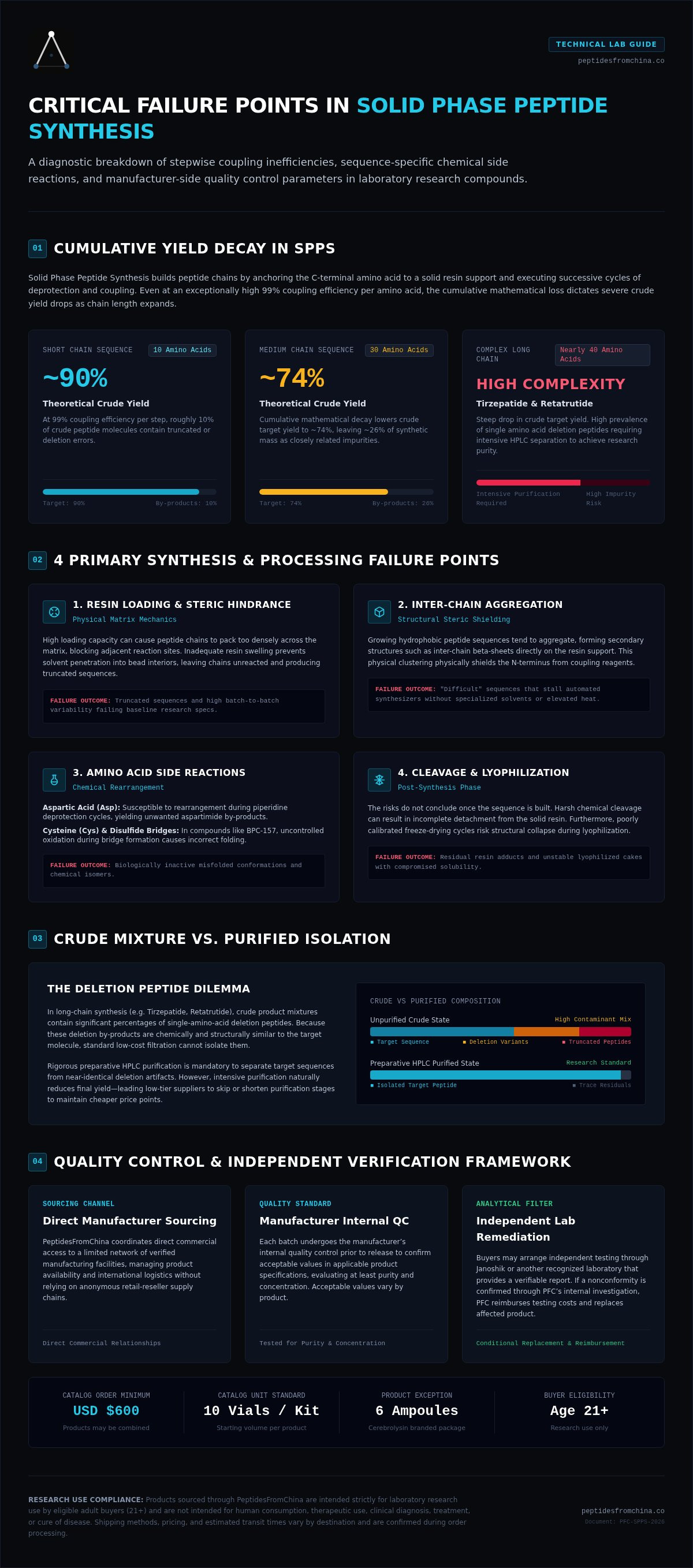
Even excellent stepwise efficiency compounds across a long sequence. If each of 29 couplings in a 30-residue peptide reached 99% conversion, the simple theoretical fraction of full-length chains would be about 75% before purification. Real syntheses are more complex, but the calculation illustrates why a small per-cycle loss can produce a complicated crude mixture.
The dominant impurity is not always the same. A missed coupling can create a deletion sequence. Incomplete deprotection can prevent the next residue from attaching. Side-chain chemistry can create a product with the correct nominal length but a different structure. Purification must separate these closely related species without sacrificing too much recoverable target material.
Failure point 1: incomplete coupling and deletion sequences
During coupling, an activated amino acid reacts with the free N-terminus of the resin-bound chain. If the reaction does not go to completion, some chains advance and others do not. Later cycles can continue on both populations, leaving a final impurity that is missing one residue.
Deletion peptides can be difficult to remove because they may have retention behavior similar to the target. Risk increases when:
the growing chain aggregates on the resin;
the reactive terminus becomes sterically crowded;
resin loading is poorly matched to the sequence;
the resin does not swell adequately in the chosen solvent;
reagent delivery, mixing or activation is inconsistent.
Manufacturing responses can include repeat coupling, lower resin loading, alternative coupling chemistry, different solvents, elevated temperature, backbone protection or a redesigned fragment strategy. There is no single rescue method that is best for every sequence.
Failure point 2: aggregation on the resin
Some growing chains interact with one another through hydrophobic contacts and backbone hydrogen bonding. When the resin-bound peptide forms persistent secondary structure, coupling reagents may no longer reach every reactive site efficiently.
This is the classic “difficult sequence” problem. Warning signs during development can include slower deprotection kinetics, incomplete coupling tests and a crude chromatogram dominated by closely related truncated species.
Hydrophobicity matters, but length alone does not predict difficulty. Two peptides of similar length can behave very differently because the order of residues changes aggregation, steric accessibility and side-reaction risk. A realistic feasibility review should therefore examine the exact sequence rather than relying on a generic rule such as “under 40 residues is easy.”
Failure point 3: aspartimide and other sequence-specific side reactions
Aspartic acid can undergo base-promoted cyclization during Fmoc chemistry, producing an aspartimide intermediate. Subsequent reactions may generate a mixture of alpha- and beta-linked products and stereoisomers. The risk depends strongly on the neighboring residue, protecting groups, base exposure and synthesis conditions.
Other recurring side reactions include:
racemization during activation or coupling, which changes stereochemistry at an amino-acid center;
oxidation of methionine, cysteine or tryptophan-containing sequences;
disulfide scrambling in peptides whose activity depends on a defined disulfide pattern;
incomplete side-chain deprotection;
alkylation or other adduct formation during cleavage;
pyroglutamate or diketopiperazine formation in susceptible sequences.
These are not reasons to distrust peptide synthesis. They are reasons to use sequence-aware methods and to interpret analytical data against plausible impurities for that specific molecule.
Failure point 4: cleavage and global deprotection
After chain assembly, the peptide is released from the resin and most side-chain protecting groups are removed. A cleavage cocktail must be strong enough to complete both tasks while limiting damage to sensitive residues.
Incomplete cleavage can reduce recovery or leave protected species. Overly aggressive or poorly scavenged conditions can generate adducts and oxidation products. The correct cocktail, time and temperature depend on the resin, linker, protecting groups and sequence.
This stage is also where process history matters. A clean-looking final chromatogram does not describe how much material was lost during cleavage or purification. Yield and purity are different attributes: a difficult process can deliver a highly purified final product at modest overall yield.
Failure point 5: purification that hides rather than solves the problem
Preparative reversed-phase HPLC is commonly used to separate the target peptide from truncated and modified species. The challenge is resolution. Closely related impurities may co-elute with the main peak, especially if the analytical method is not sufficiently selective.
A reported purity value is therefore meaningful only in the context of the method. Useful supporting information includes:
the full chromatogram rather than a cropped peak;
column chemistry and dimensions;
mobile phases and gradient;
detection wavelength;
integration approach;
sample concentration and injection conditions;
whether the analytical method differs from the preparative method.
A second chromatographic method, or a different stationary phase, can reveal impurities that the first method does not resolve. For high-consequence experiments, orthogonal analysis is more valuable than repeatedly measuring the same property with the same technique.
What HPLC can — and cannot — tell you
Analytical HPLC estimates the fraction of detected chromatographic signal associated with the main peak under a defined method. It is well suited to comparing related organic species when the separation and detector response are appropriate.
It does not, by itself, prove molecular identity. It also does not directly measure the amount of peptide in the vial. Water, counterions and non-UV-active components can affect net peptide content without appearing as peptide-related peaks at the selected wavelength.
This distinction is easy to miss:
Chromatographic purity asks how much of the detected peptide-like signal belongs to the principal component.
Identity asks whether that component has the expected molecular mass and, where needed, sequence.
Content asks how much target peptide is present by mass or mole in the material.
Those are three different questions.
What mass spectrometry adds
Mass spectrometry can show whether the principal component has a mass consistent with the intended peptide. High-resolution data may also help identify deletion sequences, oxidation products or adducts.
Mass agreement is powerful evidence, but it is not automatically complete structural proof. Isomers and epimers can share the same nominal mass. A disulfide-rich peptide can have the expected mass while containing the wrong connectivity. When structure is critical, the test package may need additional methods such as peptide mapping, tandem MS, amino-acid analysis or disulfide mapping.
For routine research procurement, a sensible minimum is often an analytical chromatogram paired with an identity spectrum for the same batch. More complex sequences may justify more.
Lyophilization, water and counterions
After purification, peptide solutions are commonly lyophilized. The resulting cake or powder is a formulation state, not a visual purity test. Appearance can vary with concentration, salts, excipients and freeze-drying conditions.
Residual water and counterions matter because they contribute mass. A vial labeled with a gross powder weight does not necessarily contain that same weight of peptide base. Where accurate molar concentration is important, ask how peptide content was assigned and whether water and counterion contributions were evaluated.
Salt form also affects interpretation. Trifluoroacetate may remain after TFA-based purification; acetate exchange is possible but should be verified rather than assumed. The appropriate form depends on the experimental system, analytical requirements and sequence behavior.
A practical batch-review checklist
Before using a peptide in a sensitive experiment, review the exact batch rather than a generic product page.
1. Confirm the molecular definition
Record the sequence, terminal modifications, salt or counterion form, expected molecular formula and theoretical mass. For conjugated or lipidated peptides, specify the modification site and structure.
2. Match the certificate to the batch
The lot number on the vial and analytical report should agree. Confirm that the report identifies the same sequence and modification state you ordered.
3. Read the chromatogram, not only the headline number
Check that the trace is legible, the integration table is present and the method is described well enough to interpret the result. A purity percentage without its chromatographic context is incomplete.
4. Confirm identity separately
Look for mass-spectrometric evidence consistent with the expected molecular mass. If the sequence has structural features that mass alone cannot distinguish, define the additional test before ordering.
5. Decide whether content testing is needed
For concentration-sensitive work, consider a content assay such as amino-acid analysis or another validated quantitative approach. Do not equate HPLC area percentage with milligrams of peptide in a vial.
6. Plan independent verification where it matters
Independent testing can be built into the study budget for new suppliers, new sequences, large lots or experiments where a batch failure would be especially costly. Retain an unopened sample from the same lot if repeat or dispute testing may be needed.
How PFC fits into a careful sourcing workflow
Peptides From China coordinates research-compound sourcing, availability confirmation and international logistics. For standard catalog materials, buyers can review the research catalog and the site’s quality information. Sequence-specific or modified projects can be discussed through custom peptide services.
The useful starting point is a clear specification: exact sequence, modification state, target quantity, desired analytical package and the intended laboratory context. That gives the manufacturing side a real technical brief instead of a vague request for “high purity.”
PFC is a sourcing platform rather than an independent analytical laboratory. Batch documents should be evaluated on their actual content, and buyers remain free to commission independent analysis when their research design calls for it. If you need help defining a sourcing request, contact the PFC team with the sequence and required tests.
The bottom line
The most common peptide synthesis failures are understandable chemical events: incomplete reactions, aggregation, sequence-specific side reactions, cleavage artifacts and insufficient separation. None can be ruled out by appearance or by a supplier’s reputation alone.
The reliable approach is simple: define the molecule precisely, request batch-specific evidence, use complementary analytical methods and match the depth of testing to the cost of a wrong result. That turns peptide procurement from a trust exercise into a documented laboratory decision.
Frequently asked questions
What is the most common peptide synthesis failure?
Incomplete coupling is one of the most common problems in SPPS and can create deletion sequences. In practice, aggregation, incomplete deprotection and sequence-specific side reactions may be equally important depending on the peptide.
Does a 99% HPLC result prove the peptide is correct?
No. It indicates that the principal peak accounts for approximately 99% of detected chromatographic signal under that method. Identity should be supported separately, commonly by mass spectrometry, and HPLC purity does not equal peptide content.
Why are long peptides harder to synthesize?
They require more repeated reaction cycles, so small per-step losses accumulate. Longer chains may also aggregate on the resin and generate truncated impurities that are difficult to separate from the target.
Can mass spectrometry detect every synthesis error?
No. It is excellent for confirming mass and detecting many modified or truncated species, but some isomers, epimers and disulfide-connectivity errors can share the expected mass. Additional methods may be needed.
What should a peptide certificate of analysis include?
At minimum, it should identify the product and batch, report the analytical method and provide evidence for purity and identity. Complex or concentration-sensitive studies may also require content, water, counterion, residual-solvent or structural tests.
Is independent testing always necessary?
Not for every exploratory experiment. It is most valuable for unfamiliar suppliers, custom sequences, large lots and studies where a wrong batch would invalidate substantial work. The testing plan should reflect experimental risk.
Does a sticky or collapsed lyophilized cake prove degradation?
No. Appearance can be influenced by residual water, salts, excipients and the freeze-drying cycle. It is a reason to investigate with appropriate analytical data, not a diagnosis by itself.
Technical references
Coin I, Beyermann M, Bienert M. Solid-phase peptide synthesis: from standard procedures to the synthesis of difficult sequences. Nature Protocols. 2007;2:3247–3256. https://pubmed.ncbi.nlm.nih.gov/18079725/
Behrendt R, White P, Offer J. Advances in Fmoc solid-phase peptide synthesis. Journal of Peptide Science. 2016;22:4–27. https://pmc.ncbi.nlm.nih.gov/articles/PMC4745034/
Paradís-Bas M, Tulla-Puche J, Albericio F. The road to the synthesis of “difficult peptides.” Chemical Society Reviews. 2016;45:631–654. https://pmc.ncbi.nlm.nih.gov/articles/PMC7064641/
Palasek SA, Cox ZJ, Collins JM. Limiting racemization and aspartimide formation in microwave-enhanced Fmoc solid phase peptide synthesis. Journal of Peptide Science. 2007;13:143–148. https://pubmed.ncbi.nlm.nih.gov/17121420/