
Most HPLC reports provided by domestic resellers in 2026 are little more than static reference sheets, often reused across dozens of unrelated batches to mask a lack of true traceability. When you're attempting to secure COA verified peptides wholesale, you're likely encountering the same frustrations: inflated markups, supply chain opacity, and documentation that doesn't actually match the vial in your hand. It's a systemic issue where paperwork is frequently treated as a marketing asset rather than a technical record.
A PDF is only a baseline reference, not a final guarantee of purity or identity. This guide provides a framework for evaluating analytical documentation, planning independent verification where required, and managing international procurement. It also explains PeptidesFromChina’s role as a sourcing bridge and its $600 total minimum order.
Key Takeaways
Learn why standard HPLC reports should be treated as baseline technical references rather than definitive proof of quality in a landscape of reused documentation.
Discover a methodical framework for cross-referencing manufacturer-issued papers with raw data files to improve batch traceability and reduce supply chain uncertainty.
Analyze the economic layers of the peptide market to understand how COA verified peptides wholesale pricing differs from domestic reseller markups.
Establish a protocol for independent laboratory verification to ensure operational consistency and product identity before finalizing bulk procurement.
Understand the logistics of utilizing a transparency-focused B2B bridge, including the $600 minimum order requirement for professional research sourcing.
Table of Contents
The Reality of Peptide Quality Documentation in 2026
Understanding Manufacturer-Direct COA Verification
Reseller Markups vs. Direct Wholesale Sourcing
How to Verify Wholesale Peptide Batches Independently
Peptides From China: A Transparency-Focused B2B Bridge
The Reality of Peptide Quality Documentation in 2026
A Certificate of Analysis (COA) is often presented as a definitive seal of approval, yet within the professional sourcing landscape, it functions only as a baseline technical reference. It's a snapshot of a single sample's performance under specific laboratory conditions. For those seeking COA verified peptides wholesale, relying solely on a PDF provided by a vendor is a significant operational risk. True verification requires an understanding that documentation is the beginning of the quality control process, not the conclusion.
"Guaranteed purity" is a phrase frequently used in retail marketing, but it has little standing in a professional synthesis environment. Peptide synthesis is a complex chemical process where batch-to-batch variation is an inherent reality. Claiming a universal purity level across all inventory ignores the technical nuances of HPLC testing. Instead of chasing absolute claims, sophisticated buyers focus on reducing supply chain uncertainty by moving closer to the manufacturer.
Common Flaws in Wholesale Documentation
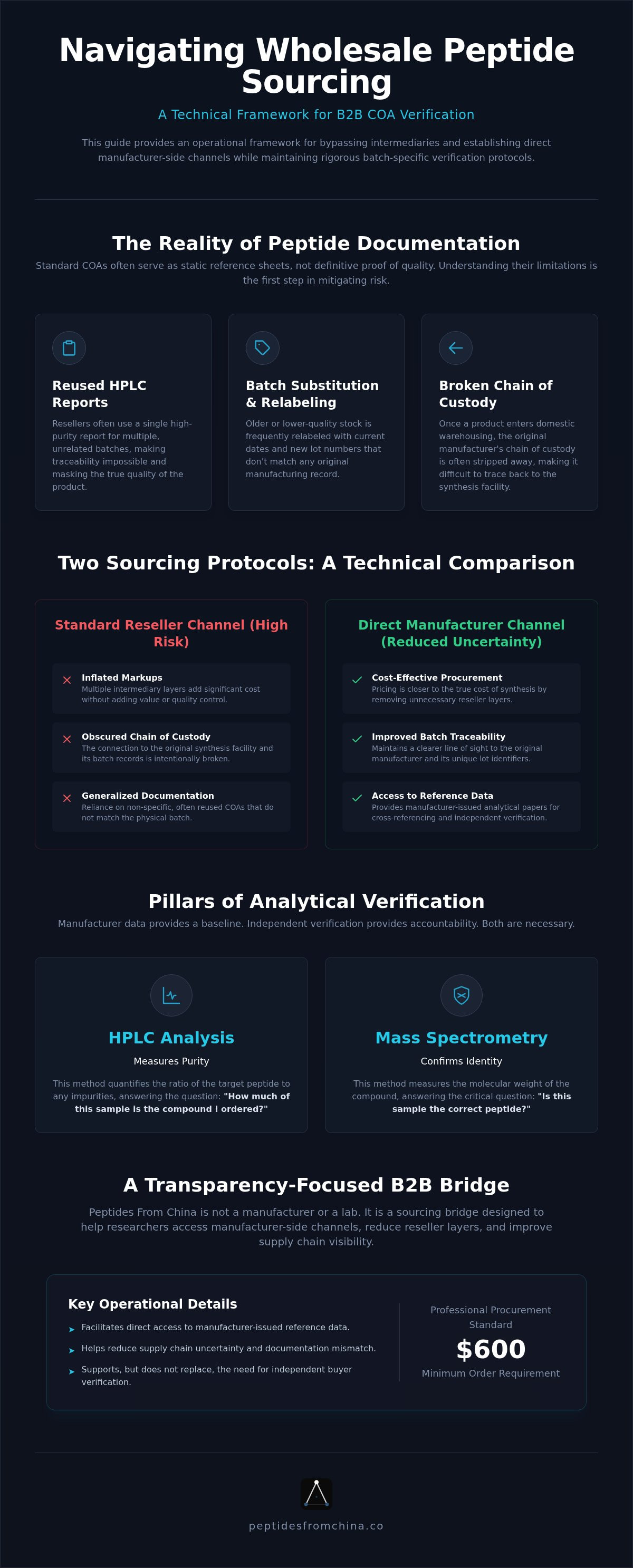
The primary challenge in the domestic market is the widespread reuse of HPLC and Mass Spectrometry reports. Resellers often purchase a large lot, obtain a single high-quality report, and then continue to use that same document for subsequent, unrelated batches. This practice, known as batch substitution, makes it nearly impossible for a buyer to know if the documentation matches the vial.
Relabeled Batches: Older stock is frequently relabeled with current dates to suggest freshness.
Lack of Lot-Matching: Reports often lack specific lot numbers that correlate directly to the physical packaging.
Domestic Opacity: Warehousing in the US or EU often strips away the original manufacturer's chain of custody, making it difficult to trace the product back to its synthesis facility.
Reference Analytical Data vs. Final Verification
Professional procurement requires distinguishing between manufacturer-issued reference data and independent, third-party verification. Manufacturer papers show what the facility intended to produce and what their internal QC detected. However, independent testing provides the necessary layer of accountability. It's the difference between looking at a blueprint and inspecting the finished building.
HPLC Analysis: This measures the purity of the peptide by identifying the ratio of the target molecule to impurities. It tells you how much of the substance is the peptide you want.
Mass Spectrometry: While HPLC shows purity, Mass Spec confirms the molecular weight and identity. This ensures the substance is actually the intended peptide and not a substituted compound.
By utilizing a transparency-focused bridge like Peptides From China, researchers can access manufacturer-side data directly. This helps reduce the layers of obfuscation added by middlemen. While the $600 minimum order requirement for wholesale procurement reflects a professional standard, it allows for a more direct line of sight into the synthesis process and the associated analytical documentation. This directness is the most effective way to manage the inherent risks of the global peptide market.
Understanding Manufacturer-Direct COA Verification
Sourcing COA verified peptides wholesale requires a technical understanding of the synthesis facility's internal workflow. At the manufacturer level, a Certificate of Analysis is generated immediately following the purification stage of a specific batch. This document serves as the primary record of the synthesis outcome. By accessing these reports directly from the source, researchers can maintain a clear chain of custody that is often lost when products pass through multiple domestic resellers. Direct sourcing helps reduce supply chain uncertainty by ensuring the documentation remains tethered to the original lot.
High-volume research operations rely on lot-matched reporting to ensure consistency across multiple studies. When a batch is synthesized, it is assigned a unique identifier that follows the material from the reaction vessel to the final vacuum-sealed vial. Intermediaries often obscure this connection to hide their sources or to relabel older stock. Direct manufacturer access significantly reduces the risk of such tampering. While research-grade peptides operate outside the clinical sphere, adhering to the spirit of FDA guidelines for peptide products regarding thorough characterization helps establish a professional standard for quality assessment.
Key Metrics in a Professional HPLC Report
A professional HPLC report provides a visual and mathematical representation of a peptide's purity profile. Analysts examine the primary peak's retention time and area under the curve to calculate the purity percentage. It's equally important to scrutinize the baseline noise and any secondary peaks, which indicate synthesis byproducts or residual solvents. HPLC is the industry standard for determining the purity of synthesized peptides. Understanding these metrics allows procurement professionals to identify batches that meet their specific research requirements before the material ever leaves the facility.
Mass Spectrometry: Confirming Compound Identity
Purity reports are functionally meaningless without confirmed identity metrics. While HPLC tells you how much of a substance is present, Mass Spectrometry (MS) confirms exactly what that substance is. MS measures the mass-to-charge ratio of the ionized peptide to verify its molecular weight against the theoretical target sequence. If the molecular weight does not align with the expected value, the purity percentage is irrelevant because the compound itself is incorrect. Wholesale batches must include both HPLC and MS data to provide a complete analytical picture.
Establishing a direct line to these synthesis facilities allows for greater operational consistency. Utilizing a transparency-focused B2B bridge like Peptides From China helps researchers bypass the opacity of the retail market. This direct-to-manufacturer approach requires a professional commitment, typically involving a $600 minimum order, but it provides the necessary traceability for rigorous laboratory work.
Reseller Markups vs. Direct Wholesale Sourcing
Domestic peptide distribution is characterized by significant price inflation that rarely correlates with a meaningful increase in product quality. When procurement professionals seek COA verified peptides wholesale, they often encounter domestic entities that function primarily as marketing and fulfillment hubs rather than synthesis facilities. These organizations maintain expensive domestic warehousing, local staff, and high-touch customer support teams. While these services provide a sense of security, the associated overhead is directly passed to the buyer. Bypassing these layers allows for a more efficient allocation of research budgets, prioritizing material volume and analytical verification over domestic branding.
Transparency in the supply chain is fundamentally more valuable than a domestic label. A domestic warehouse often obscures the original synthesis date and the specific facility of origin, creating a "black box" in the chain of custody. By moving closer to the source, buyers gain visibility into the manufacturing timeline and the raw analytical data. This directness helps reduce supply chain uncertainty and ensures that the provided documentation is not just a marketing asset, but a technical record of the specific batch in transit.
The Economic Logic of Direct Procurement
The pricing structure of the retail peptide market is often disconnected from the actual cost of synthesis. Domestic resellers frequently apply markups ranging from substantially over manufacturer rates to cover their operational costs and profit margins. By shifting to direct wholesale peptides sourcing, laboratories can significantly reduce their cost-per-milligram for research compounds. This economic shift enables higher-volume procurement within the same budget, which is essential for long-term studies that require consistent material availability. Reducing the number of intermediaries minimizes the financial friction that typically characterizes the peptide market.
Mitigating Risks of International Sourcing
Moving closer to the point of synthesis introduces logistical variables that domestic warehousing typically abstracts away. Successful international procurement relies on methodical logistics, including the use of neutral packaging and reliable global tracking systems. Professional sourcing agents act as an analytical filter; they vet manufacturers and ensure that the documentation provided is batch-specific rather than a reused template. This methodical approach is critical for maintaining operational consistency.
Addressing customs and regulatory considerations for research-grade materials requires a structured, non-nonsense approach to documentation. Peptides From China facilitates this transition by acting as a transparency-focused B2B bridge. By maintaining a $600 minimum order requirement, the focus remains on serving professional laboratories and research institutions that value technical integrity over retail convenience. This model ensures that the logistical process is optimized for high-volume research needs while maintaining a direct line to the synthesis facility.
How to Verify Wholesale Peptide Batches Independently
Verification is an active operational process rather than a passive review of paperwork. While manufacturer-issued papers provide a baseline, independent validation is the only way to ensure the material received matches the specific research requirements. For those procurement professionals handling COA verified peptides wholesale, establishing a rigorous internal verification protocol helps reduce supply chain uncertainty. This process starts before the material ever leaves the synthesis facility.
The first step involves requesting raw data files, such as the original HPLC chromatograms and Mass Spectrometry data files, rather than just the summarized PDF report. Raw data is significantly harder to manipulate and allows your internal team or a third-party consultant to verify that the integration of peaks was handled correctly. Once received, cross-reference the manufacturer's COA with known analytical standards for that specific peptide sequence. If the retention times or molecular weight peaks deviate from established reference data, it's a clear indicator that the batch requires further scrutiny.
Independent validation through a third-party laboratory is the final pillar of a professional sourcing strategy. This involves sending a representative sample from your wholesale order to an unbiased facility for HPLC/MS analysis. Once the batch is cleared, implement internal batch-tracking protocols. Assigning internal lot numbers to every incoming shipment ensures long-term research consistency, allowing you to trace any variables in your data back to a specific synthesis event. This level of detail is what separates professional laboratories from retail-level buyers.
Selecting a Third-Party Testing Laboratory
Choosing the right facility is critical for accurate peptide testing and analysis. Professional analytical facilities differ significantly from retail-focused "community" labs that often lack the sophisticated equipment or standardized methodologies required for B2B verification. A professional lab should provide a detailed breakdown of their equipment calibration and use standardized methods that are reproducible. While testing adds a cost layer to your procurement, the cost-benefit of verifying a $1,000+ wholesale order far outweighs the risk of using unverified material in a critical study.
Red Flags in Wholesale Documentation
Analytical reports should be viewed with a high degree of skepticism. Altered PDF reports are common; look for inconsistent fonts, misaligned text, or "Photoshopped" signatures. Generic COAs that lack specific batch or lot numbers are functionally useless for traceability. Perhaps the biggest red flag is a "perfect" 100% purity report. In a realistic synthesis environment, a 100% purity reading is statistically improbable and often suggests that the baseline noise has been intentionally suppressed or the chromatogram has been truncated to hide impurities.
Establishing these protocols ensures your laboratory operates with the highest standards of integrity. If you're ready to move beyond the limitations of the retail market, you can source wholesale research peptides through Peptides From China. By acting as a transparency-focused B2B bridge, we help you access manufacturer-side channels with a $600 minimum order requirement, providing the necessary data to support your independent verification efforts.
Peptides From China: A Transparency-Focused B2B Bridge
Peptides From China (PFC) operates as a dedicated B2B sourcing bridge, specifically designed for researchers who require direct manufacturer access without the inflated overhead of domestic resellers. We don't function as a retail vendor, a testing laboratory, or a pharmaceutical manufacturer. Instead, we act as a methodical filter and logistical partner for laboratories that prioritize technical integrity and batch traceability. By facilitating a direct connection to synthesis facilities, we help researchers secure COA verified peptides wholesale and the associated reference analytical data that is often obscured in the retail market.
Accessing manufacturer-side channels requires a shift from retail habits to professional procurement standards. PFC maintains a $600 minimum order requirement to ensure that our resources are focused on high-volume research needs rather than single-vial sales. The process begins with a transparent $10 sourcing deposit. This commitment initiates the verification and manufacturer stock approval process. It signals that the buyer is a professional operator ready to engage with manufacturer-side supply chains while reducing the unnecessary layers of domestic middlemen.
The PFC Sourcing Workflow
The workflow is designed for efficiency and clarity. The $10 deposit initiates manual request processing and real-time stock verification and is credited toward the final invoice. Manufacturer-side analytical documentation may be available depending on the product and batch but is not released or purchased by the deposit. This process can support planning for projects involving BPC-157.
Logistics and Quality Assurance Protocols
Maintaining a secure chain of custody extends beyond the synthesis facility. PFC utilizes international shipping standards that prioritize neutral packaging and comprehensive global tracking. This ensures that materials arrive discreetly and can be monitored throughout the transit process. For B2B buyers, we manage batch traceability and documentation archives, providing a reliable reference point for future independent verification. Our role is to provide the transparency you need to conduct your own due diligence with confidence.
Start your manufacturer-direct sourcing process with a PFC deposit to bypass the reseller layers and establish a more transparent research supply chain. By moving closer to the point of synthesis, you gain the traceability and cost-efficiency required for sophisticated laboratory operations.
Establishing a Technical Standard for Peptide Procurement
Securing COA verified peptides wholesale in 2026 requires more than just reviewing a PDF; it demands a shift from retail convenience to professional sourcing standards. We've analyzed how manufacturer-direct access helps reduce supply chain uncertainty by maintaining batch-specific traceability that domestic warehouses often obscure. By treating manufacturer papers as baseline reference analytical data and following up with independent laboratory validation, you protect the integrity of your research projects. This methodical approach ensures that your data remains grounded in factual accuracy rather than vendor marketing claims.
The transition to a direct synthesis channel is an operational decision that prioritizes data over branding. It's about moving closer to the source to eliminate the markups and opacity added by middlemen. If your laboratory is ready to implement a methodical procurement strategy, we can facilitate the transition through our transparency-focused B2B bridge. We focus on providing the technical framework you need to maintain operational consistency across long-term studies.
Frequently Asked Questions
What does 'COA verified' actually mean for wholesale peptides?
It means a specific batch has been analyzed by the synthesis facility to provide baseline reference analytical data. For COA verified peptides wholesale, this document serves as an initial record of purity and molecular identity. While it helps reduce supply chain uncertainty, professional buyers treat these papers as technical references rather than absolute guarantees, necessitating further independent validation.
How do I know the HPLC report matches the batch I received?
You can't rely on paperwork alone; you must cross-reference lot numbers and request raw data files directly from the manufacturer. Professional procurement involves auditing the chromatogram's retention times against known standards. If the documentation lacks specific identifiers or the data appears generic, it's a clear indicator that the batch traceability has been compromised during the resale process.
Why is direct sourcing from China more cost-effective than domestic warehouses?
Direct sourcing eliminates the significant markups that domestic resellers apply to cover their local warehousing, marketing, and staffing costs. By bypassing these intermediaries, you access manufacturer-side pricing and a more transparent chain of custody. This efficiency allows research institutions to procure significantly higher volumes of material while maintaining a direct line to the synthesis facility.
Can I trust manufacturer-issued COAs for research purposes?
Manufacturer COAs should be viewed as baseline technical reference material rather than definitive proof of quality. They represent the facility's internal assessment at the time of synthesis. To ensure operational consistency, researchers should use these reports as a starting point for their own independent verification, confirming that the material meets the specific requirements of their laboratory protocols.
What is the minimum order requirement for wholesale peptide procurement?
Professional wholesale procurement through Peptides From China requires a minimum order amount of $600. This threshold is established to ensure that our logistical resources are dedicated to B2B buyers, laboratories, and research institutions. Maintaining this standard allows us to provide the level of batch-specific documentation and traceability required for sophisticated, high-volume research operations.
How does Peptides From China handle international shipping and customs?
PeptidesFromChina coordinates sourcing from established Chinese manufacturing facilities together with international logistics.
What should I look for in a third-party peptide testing laboratory?
Prioritize analytical facilities that use standardized, reproducible methodologies and provide detailed equipment calibration data. You should avoid retail-focused labs that lack the technical depth required for B2B verification. A professional laboratory will offer comprehensive HPLC and Mass Spectrometry services, allowing you to cross-reference your COA verified peptides wholesale order against the manufacturer's original reference data.
Are HPLC and Mass Spectrometry reports enough to guarantee purity?
No single document can fully guarantee product identity or purity in the current market landscape. While HPLC and MS are vital for identifying purity levels and confirming molecular sequences, they are baseline snapshots. True quality assurance requires a commitment to independent testing and the minimization of intermediaries to ensure that the material's chain of custody remains intact from synthesis to delivery.