
The domestic reseller you rely on for research compounds is often just a high-margin middleman hiding behind a polished website and a stack of photocopied HPLC reports. Finding the best B2B peptide source in 2026 requires moving past the facade of "local stock" to understand the reality of the global synthesis floor. You're likely tired of the opacity that leads to batch inconsistency and the 400 percent markups on essential compounds like Semaglutide or BPC-157. It's a systemic issue where three or four layers of intermediaries separate your lab from the actual manufacturer, often resulting in reused analytical data and questionable chain of custody.
This guide helps you navigate these complexities by prioritizing direct-to-manufacturer transparency over reseller convenience. You'll learn how to evaluate sourcing partners that act as a bridge to production facilities rather than just another inventory holder. We'll examine the impact of China's April 2026 export tax rebate removals on wholesale pricing and why the industry benchmark for purity has shifted to 99 percent. By focusing on methodical verification, a $10 deposit model for manufacturer routing, and a $600 minimum order threshold for serious procurement, you can finally reduce supply chain uncertainty and secure reliable reference analytical data for your research.
Key Takeaways
Learn how to identify the best B2B peptide source by bypassing domestic reseller markups and establishing a direct line to manufacturing synthesis facilities.
Understand the 2026 technical standards for purity and molecular identity, moving beyond outdated 98 percent benchmarks to more rigorous 99 percent analytical requirements.
Navigate the logistical requirements of international procurement, including the $600 minimum order threshold and the use of neutral packaging to improve shipping success rates.
Utilize the PFC bridge model and its $10 deposit verification process to gain manufacturer-side transparency and reduce the layers of intermediaries in your supply chain.
Implement a robust quality control protocol that treats manufacturer COAs as reference data rather than absolute proof, emphasizing the necessity of independent laboratory verification.
Table of Contents
The Evolution of the B2B Peptide Supply Chain in 2026
Technical Verification Standards for High-Volume Peptide Sourcing
Comparing Sourcing Models: Direct Manufacturing vs. Domestic Resellers
Operational Logistics: Managing Large-Scale Peptide Procurement
Implementing a Transparency-First Sourcing Strategy with Peptides From China
The Evolution of the B2B Peptide Supply Chain in 2026
The landscape for research procurement has undergone a fundamental shift over the last year. Small-scale "peptide shops" designed for retail consumers are being replaced by professionalized B2B channels that cater to the rigorous demands of modern laboratories. For a research institution, finding the best B2B peptide source no longer means searching for the fastest domestic shipping. It requires a strategic pivot toward identifying the actual point of production. Most domestic resellers act as the third or fourth layer in a supply chain that begins in specialized synthesis facilities, often located in China. This hub remains the global center for high-purity peptide synthesis due to its massive manufacturing infrastructure and specialized chemical expertise.
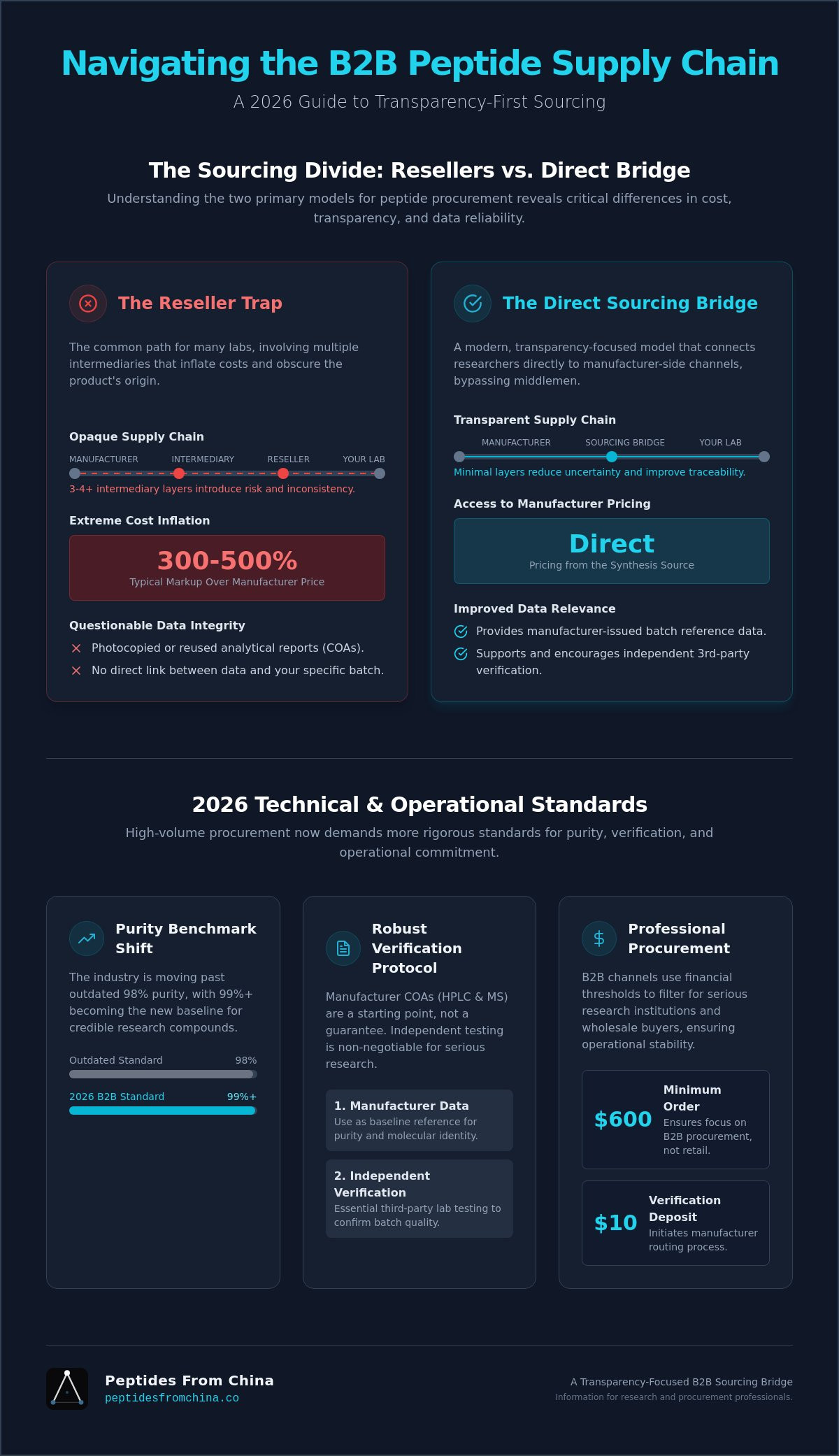
The "Reseller Trap" is a common pitfall for procurement officers. When you purchase from a domestic warehouse, you're often paying for the overhead of a middleman who has little to no influence over the manufacturing process. These intermediaries frequently inflate costs by 300 to 500 percent while providing batch documentation that may be months old or even reused across different lots. This opacity degrades traceability and introduces significant risk into your research. A professionalized B2B approach bypasses these layers, focusing on direct manufacturer routing to ensure that the analytical data you receive actually corresponds to the batch in your hands.
The Rise of Direct-to-Manufacturer Sourcing
Direct sourcing is becoming the standard for institutions that prioritize transparency over convenience. By eliminating redundant middlemen, labs improve batch-to-batch consistency and gain a clearer view of the synthesis timeline. Peptides From China (PFC) operates as a transparency-focused bridge in this new model. Instead of claiming to be a manufacturer, PFC helps researchers access manufacturer-side channels directly. This model utilizes a $10 deposit for verification, allowing buyers to initiate the sourcing process with a commitment to factual integrity. It's a methodical shift that helps reduce supply chain uncertainty by connecting the buyer to the source without the typical retail markup.
Why Traditional Peptide Distributors are Faltering
Domestic distributors are struggling to maintain pace with the technical requirements of 2026. Many rely on domestic warehousing that creates logistical bottlenecks during global supply surges for compounds like Tirzepatide or BPC-157. These resellers often provide HPLC reports as definitive proof of quality, yet these documents should only be viewed as baseline technical reference material. Because resellers don't control the synthesis environment, they cannot guarantee the identity or purity of the product once it leaves the factory. To filter out non-professional entities, the best B2B peptide source now utilizes a $600 minimum order requirement. This threshold ensures the channel remains dedicated to serious research and wholesale procurement rather than single-vial retail sales.
Technical Verification Standards for High-Volume Peptide Sourcing
High-volume procurement requires more than a casual glance at a PDF. For those seeking the best B2B peptide source, technical verification must be approached as an active process rather than a passive receipt of documents. High-Performance Liquid Chromatography (HPLC) serves as the industry baseline for purity, measuring the percentage of the target peptide against synthesis byproducts. However, purity data is functionally useless without Mass Spectrometry (MS) to confirm molecular identity. MS ensures that the substance in the vial is exactly what the label claims. Together, these reports provide reference analytical data that helps reduce supply chain uncertainty, but they aren't a definitive proof of quality.
A Certificate of Analysis (COA) should be viewed as a manufacturer’s statement of intent, not a final verdict. The peptide industry is plagued by reused reports and batch substitution. Serious labs treat these documents as starting points for their own independent, third-party verification. This is especially critical given the current Research Peptides & FDA Regulations 2026, which place increased scrutiny on the documented chain of custody for research compounds. When sourcing via a bridge like Peptides From China, you gain access to manufacturer-side data that supports independent verification without the obfuscation common among retail resellers.
Reading HPLC and MS Reports Like a Professional
A professional analysis looks beyond the final percentage. You must examine peak integration and baseline stability. A clean HPLC report shows a sharp, isolated peak with a flat baseline. High baseline noise or "shoulders" on the main peak suggest the presence of truncated sequences or residual solvents. Common red flags include cropped report headers, non-matching batch numbers, or analytical dates that precede the synthesis of the current lot. For a detailed breakdown of these indicators, consult our guide on peptide testing and analysis.
The Limitations of Single-Vial Testing
Testing a single vial from a large shipment is a statistically insignificant method of verification. In B2B procurement, where orders meet the $600 minimum threshold, you're dealing with hundreds of vials. Batch variability can occur during the lyophilization or filling process. Professionals use randomized sampling, pulling vials from different sections of the shipment for independent lab analysis. This approach improves traceability and ensures the entire lot meets the 99 percent purity benchmark now expected in 2026 research. Maintaining a library of this reference data allows your lab to track manufacturer consistency over time, which is the only way to truly identify the best B2B peptide source for long-term projects.
Comparing Sourcing Models: Direct Manufacturing vs. Domestic Resellers
The decision between sourcing from a domestic warehouse or a direct manufacturer defines the operational integrity of your lab. Many researchers find themselves caught in the reseller trap, where domestic companies purchase synthesis batches from international facilities, relabel them, and apply a 300 to 500 percent markup. While the perceived convenience of local stock is a strong selling point, industry professionals recognize that this model often obscures the true chain of custody. When you identify the best B2B peptide source, you're usually looking for a partner that provides a direct line to the synthesis floor rather than a middleman managing old inventory.
Direct manufacturing offers technical advantages that domestic distributors cannot match. Lyophilized peptides have a shelf life, and receiving newly synthesized batches ensures maximum stability for your research. When you bypass the reseller, you gain the ability to request custom sequences or specific concentrations that aren't available in standard retail catalogs. This direct oversight improves traceability, allowing you to track a compound from the initial amino acid coupling to the final vial sealing. This level of detail is essential for maintaining consistent experimental parameters across long-term studies.
The Strategic Advantage of a Sourcing Agent
Managing manufacturer relationships requires linguistic and logistical expertise that most research labs don't possess internally. Understanding the difference between a peptide sourcing agent vs platform is critical for high-volume procurement. A platform is often just a marketplace with varying standards; an agent like Peptides From China (PFC) acts as a transparency-focused bridge. PFC utilizes a $10 deposit model for manufacturer-side verification, which serves as a filter for serious research entities. This methodical approach ensures that your lab is connected to verified synthesis facilities without the typical retail markup or supply chain opacity.
Risk Mitigation in International Procurement
The argument that domestic sourcing is inherently safer is a common industry myth. In reality, domestic stock is often older and less traceable than direct-from-factory shipments. Risk mitigation in 2026 relies on operational realism rather than geographic proximity. By using neutral packaging and international tracking, professional sourcing agents maintain high delivery success rates while protecting the privacy of the procurement process. These protocols, combined with a $600 minimum order requirement for wholesale procurement, help reduce supply chain uncertainty. This structure ensures that only professional-grade batches of compounds like BPC-157 or Tirzepatide enter your facility, backed by reference analytical data rather than empty marketing claims.
Operational Logistics: Managing Large-Scale Peptide Procurement
Managing the movement of bulk research compounds across international borders requires more than just a tracking number. Identifying the best B2B peptide source involves evaluating a partner's logistical competence as much as their synthesis quality. Professional procurement in 2026 is built on a foundation of operational realism, where the $600 minimum order requirement acts as a necessary filter. This threshold ensures that the sourcing channel remains dedicated to laboratories and institutional buyers rather than retail consumers. It also allows for the cost-effective use of neutral packaging and specialized international logistics that smaller orders can't support.
Lead times are a critical variable in this process. A newly synthesized batch doesn't appear overnight. The timeline includes the chemical coupling of amino acids, purification via chromatography, and the final lyophilization into a stable powder. This sequence typically takes 10 to 14 days before the product even leaves the facility. Once shipped, international transit involves navigating customs checkpoints that require precise "research use only" documentation to improve traceability and minimize delays. Proper storage is equally vital; bulk research powders should be kept at -20°C upon arrival to maintain the integrity of the reference analytical data provided with the batch.
Optimizing Wholesale Order Structures
Labs can improve their operational efficiency by bundling their requirements into a single procurement cycle. When you source wholesale peptides, it's often more effective to balance inventory for high-demand compounds like BPC-157 and Semaglutide in one shipment. This approach reduces the per-vial cost of shipping and simplifies the documentation process. The $600 minimum order threshold is a financial logic that supports this consolidation, ensuring that every shipment is worth the regulatory and logistical effort required for international transit.
Ensuring Successful Customs Clearance
The "last mile" of international delivery is where many sourcing attempts fail. Professional sourcing agents manage this by utilizing neutral packaging that avoids the hyperbolic labeling found in retail environments. Accurate documentation is essential. Every shipment must be clearly labeled for laboratory research use to comply with international trade standards. While seizures or logistical delays are infrequent in a well-managed chain, a transparency-focused bridge like PFC maintains protocols for addressing these issues. If a shipment is delayed at a customs hub, having a partner that understands the specific documentation requirements for research powders helps reduce supply chain uncertainty.
To begin streamlining your lab's procurement and bypassing the reseller markup, you can secure your wholesale supply chain through our verified manufacturer routing.
Implementing a Transparency-First Sourcing Strategy with Peptides From China
Selecting the best B2B peptide source in 2026 isn't about finding a salesperson; it's about identifying an analytical filter. Peptides From China (PFC) functions as a strategic bridge, facilitating direct access to synthesis facilities for high-demand compounds like BPC-157, TB-500, and various GLP-1s. Unlike domestic resellers, we don't hold inventory or relabel vials. Instead, we manage the manufacturer-side verification process to help your lab bypass the inflated costs of traditional middlemen. Our model is built on operational realism, acknowledging the complexities of international synthesis rather than masking them with marketing hype.
The PFC verification process begins with a $10 deposit. This small commitment serves as a filter to separate serious research procurement from retail inquiries. Once initiated, this deposit triggers the routing process to a verified facility, providing you with the necessary manufacturer-side data to begin your evaluation. Because we require a $600 minimum order for wholesale procurement, we can dedicate logistical resources to ensuring your batch moves through a transparent, documented chain of custody. This structure is designed for professional laboratories that prioritize factual integrity over the superficial convenience of domestic stock.
Starting Your Procurement Journey
Initiating a sourcing request through PFC is a methodical process. After the initial verification, you receive manufacturer-issued papers and batch-specific HPLC and MS reports. You should treat these as baseline technical reference material. Evaluating this data is the first step in establishing a long-term peptide sourcing platform relationship. By viewing the synthesis facility's output directly, your procurement team can make informed decisions based on technical traceability rather than reseller claims. This direct line helps reduce supply chain uncertainty and ensures that the compounds entering your lab have a clear, documented origin.
The PFC Commitment to B2B Excellence
PFC prioritizes technical traceability over "guaranteed purity" language. We recognize that in the peptide industry, no single document can provide an absolute guarantee of identity or purity. Our role is to provide the transparency required for your lab to conduct its own independent verification. By removing the three or four layers of intermediaries that typically inflate costs and degrade data, we improve the reliability of your supply chain. We provide the bridge; your lab provide the final analytical verdict. This partnership is the most realistic way to navigate the global market. Secure your direct sourcing channel today to begin optimizing your laboratory's procurement for 2026.
Optimizing Your 2026 Peptide Procurement Strategy
Finding the best B2B peptide source requires moving beyond the convenience of domestic warehouses and addressing the systemic flaws in the global supply chain. You've seen how the transition to a transparency-first model helps reduce supply chain uncertainty by prioritizing direct-to-manufacturer routing over opaque reseller layers. By treating manufacturer COAs as technical reference data rather than absolute guarantees, labs can secure newly synthesized batches that support rigorous independent verification. This shift in perspective is essential for maintaining experimental consistency in an increasingly complex regulatory environment.
Peptides From China provides the methodical bridge needed to access these manufacturer-side channels while eliminating unnecessary reseller markups through our $600 wholesale minimum. Every research order includes COA-verified batches and is shipped using neutral packaging with worldwide tracking to ensure consistent delivery. It's time to align your procurement with the technical standards of 2026 and move past the limitations of domestic middleman stock. Access Direct-to-Manufacturer Peptide Sourcing and establish a more reliable, data-driven foundation for your laboratory's future research.
Frequently Asked Questions
How do I verify the purity of a B2B peptide source?
Verification requires cross-referencing manufacturer-issued HPLC data with independent, third-party laboratory testing. You shouldn't rely solely on the provided Certificate of Analysis (COA), as these documents are baseline technical reference materials rather than definitive proof of quality. The best B2B peptide source will provide batch-specific data that helps reduce supply chain uncertainty, but the final responsibility for identity and purity verification always rests with the buyer’s own randomized sampling protocols.
Why is there a $600 minimum order for wholesale peptides?
The $600 minimum order threshold acts as a necessary filter to ensure the sourcing channel remains dedicated to professional research and laboratory procurement. This requirement supports the logistical overhead associated with high-volume international shipping, neutral packaging, and the provision of batch-specific documentation. It prevents the channel from becoming congested with small-scale retail inquiries, which helps maintain operational efficiency and lower costs for serious B2B buyers.
Is it safe to source research peptides directly from China?
Direct sourcing from China is safe when you utilize a transparency-focused bridge that prioritizes manufacturer-side verification and neutral packaging. China is the global hub for peptide synthesis, but risks often arise from opaque middleman structures that relabel old stock. By bypassing domestic resellers and using agents that provide direct routing to synthesis facilities, you improve traceability and ensure you're receiving newly lyophilized batches rather than aged inventory from a domestic warehouse.
What is the difference between a peptide reseller and a sourcing agent?
A reseller holds domestic inventory and applies a 300 to 500 percent markup while often obscuring the true origin of the compound. In contrast, a sourcing agent like Peptides From China acts as a bridge to the manufacturing floor. The agent facilitates direct routing and provides manufacturer-side reference analytical data without taking ownership of the product or relabeling the vials, ensuring a shorter and more transparent chain of custody for the best B2B peptide source.
How do I read an HPLC report for a bulk peptide order?
You should look for a sharp, isolated peak on the chromatogram with a stable baseline and minimal electronic noise. The report must include an integration table showing the area under the main peak as a percentage of the total. Always ensure the batch number and analytical date match your specific lot. Treat these reports as a manufacturer’s statement of intent; they're the starting point for your own independent verification rather than a final guarantee of purity.
What happens if my wholesale peptide order is delayed in customs?
Customs delays are managed through precise "research use only" documentation and the use of neutral packaging to minimize unnecessary scrutiny. If an infrequent delay occurs, a professional sourcing agent provides international tracking data and works to resolve documentation requests from the carrier. While no entity can guarantee a perfect chain of custody through every border, a transparency-first approach helps reduce supply chain uncertainty during the "last mile" of international delivery.
Can I request custom peptide synthesis through a sourcing agent?
Direct manufacturer routing allows you to request custom sequences, specific concentrations, or unique salt forms that aren't available in standardized retail catalogs. Because the sourcing agent connects you directly to the synthesis facilities, you can provide specific technical parameters for your research needs. This level of customization is a primary benefit of bypassing domestic resellers who only offer off-the-shelf inventory with limited traceability.
Why does Peptides From China require a $10 deposit for sourcing?
The $10 deposit is a methodical commitment that separates serious research entities from casual retail inquiries. This deposit initiates the manufacturer-side verification process and allows PFC to dedicate technical resources to routing your specific procurement request. It’s a transparency-first protocol that ensures our sourcing bridge remains efficient and focused on providing high-volume reference analytical data for professional laboratories and institutional buyers.