Direct Synthesis Sourcing: Benefits for Procurement Teams

Market pricing and availability can vary substantially by supplier, product, order size, and current conditions; exact comparisons require current, like-for-like data.
Direct materials often represent 50–70% of COGS for manufacturers, making supplier decisions strategically consequential rather than purely transactional.
Procurement teams gain direct access to certificates of analysis (COAs), impurity profiles, and raw analytical data, which shortens nonconformance investigations and reduces defect risk.
Faster sample-to-bulk scale-up and technical collaboration with synthesis facilities compress R&D timelines.
Coupa analyst summaries cite AI-enabled direct procurement functions generating greater ROI and lower cost-to-spend versus conventional approaches.
PeptidesFromChina coordinates manufacturer-side sourcing and international logistics for research procurement teams. Products are subject to the manufacturer’s applicable quality-control procedures and specifications. Manufacturer-side analytical documentation may be available depending on the product and batch. PeptidesFromChina is not an independent analytical testing laboratory. Buyers requiring independent verification may arrange third-party analytical testing.
Market pricing and availability can vary substantially by supplier, product, order size, and current conditions; exact comparisons require current, like-for-like data.
Key Takeaways
Direct synthesis sourcing delivers its strongest returns when procurement teams treat it as a TCO and resilience program, not a unit-price negotiation.
Market pricing and availability can vary substantially by supplier, product, order size, and current conditions; exact comparisons require current, like-for-like data.
Table of Contents
What is direct synthesis sourcing, and how does it differ from distributor models?
What are the core benefits of direct synthesis sourcing for procurement teams?
Operational advantages specific to peptide and chemical intermediate sourcing
How to implement direct synthesis sourcing: a six-step playbook
When direct synthesis sourcing is not the right choice
Which KPIs should you track for a direct synthesis sourcing program?
Which platforms and tools support direct synthesis sourcing at scale?
U. S. regulatory considerations for direct synthesis sourcing
Direct synthesis sourcing as a strategic capability, not just a cost project
PeptidesFromChina supports your direct sourcing program for research peptides
Sources
What is direct synthesis sourcing, and how does it differ from distributor models?
Direct synthesis sourcing generally means establishing a procurement relationship with the manufacturer of a synthesized input rather than buying through an anonymous reseller chain. PFC is not the manufacturer; it works directly with a limited network of verified manufacturing facilities as a specialized sales and sourcing channel, while international delivery may involve logistics partners.
The contrast with distributor-mediated procurement is operational, not just commercial:
Distributors hold local buffer stock, manage import logistics, and consolidate orders from multiple suppliers, which simplifies procurement management but adds a markup and removes direct visibility into manufacturing data.
In a direct model, the buyer manages packaging specifications, requests specific analytical tests, and receives COAs generated at the source rather than repackaged documentation.
Distributors typically offer standardized pack sizes; direct manufacturers commonly provide flexible packaging from 25 g R&D samples to bulk industrial orders, which matters for scale-up planning and inventory strategy.
Technical collaboration, such as adjusting synthesis routes, troubleshooting impurity profiles, or requesting stability data, is only practical in a direct relationship.
For synthesis-heavy categories, that control over analytical data and manufacturing specifications is often the primary driver, not cost alone. A detailed comparison of direct sourcing versus reseller models for peptide quality illustrates how these structural differences affect batch consistency and traceability in practice.
What are the core benefits of direct synthesis sourcing for procurement teams?
Cost savings and TCO
Market pricing and availability can vary substantially by supplier, product, order size, and current conditions; exact comparisons require current, like-for-like data.
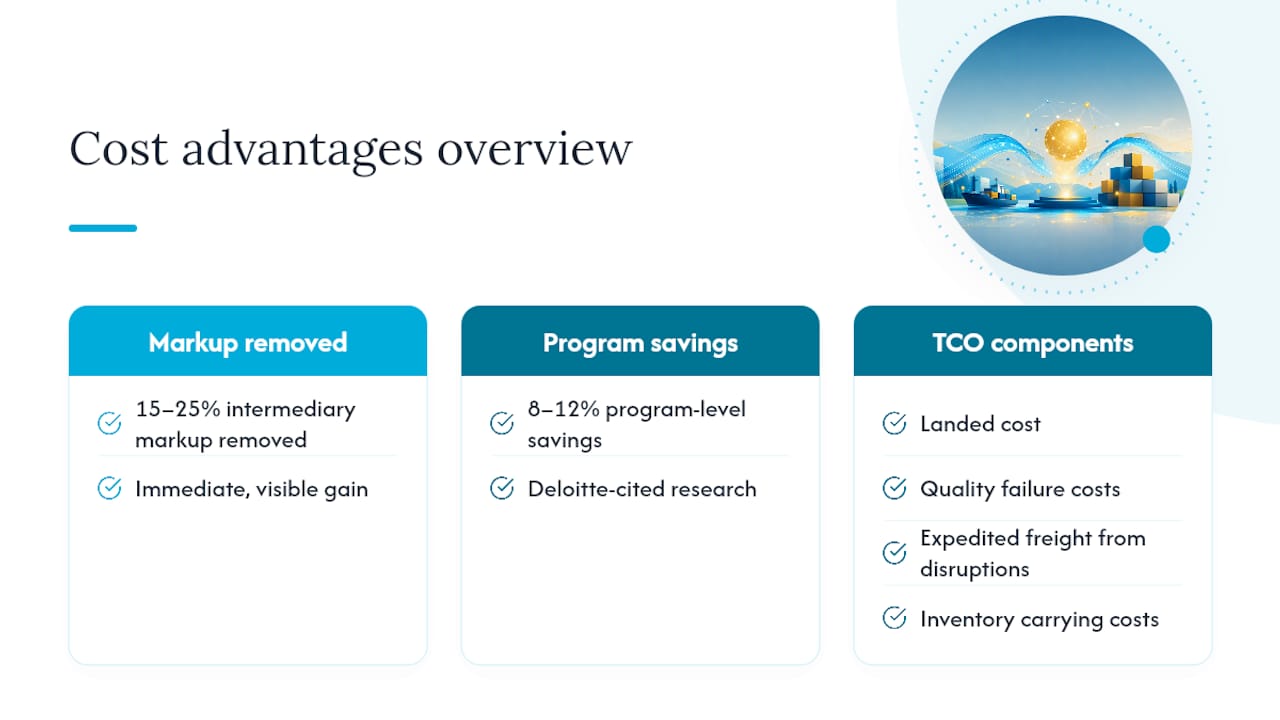
TCO accounting should include landed cost, quality failure costs, expedited freight from supply disruptions, inventory carrying costs, and production availability impact. Unit price is one input, not the output.
Quality control and batch traceability
Direct sourcing gives procurement teams access to source COAs, raw analytical data, and the ability to specify QC tests before order acceptance. This matters most for synthesis categories where impurity profiles affect downstream research validity or production yield. Nonconformance investigations that might take weeks through a distributor, waiting for documentation to travel back through the supply chain, can be resolved in days when the buyer has a direct line to the synthesis facility.
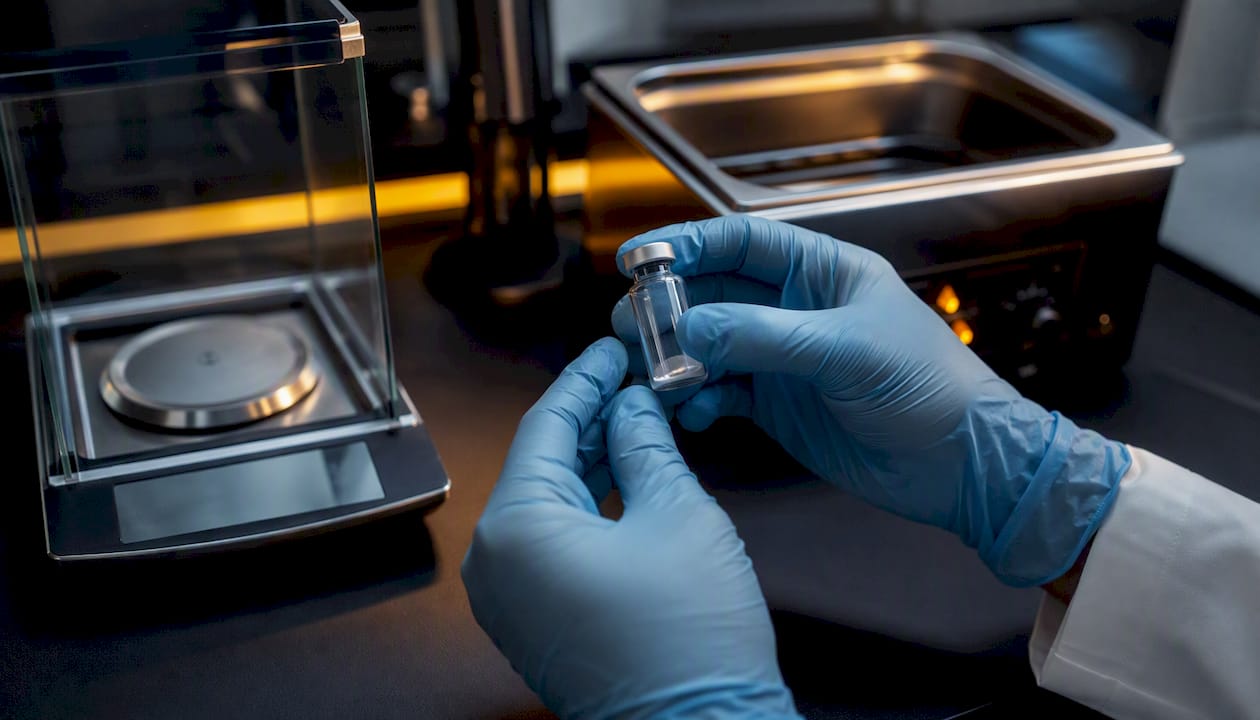
Pro Tip: Request HPLC chromatograms and mass spectrometry data alongside the COA for every new batch from a direct supplier. These raw files are far harder to falsify than a summary certificate and give your QA team independent verification capability.
Faster R&D and time-to-market
Direct technical collaboration with synthesis facilities shortens development cycles. Custom synthesis adjustments, purity optimization, and stability testing can be coordinated without a distributor intermediary interpreting or filtering technical requirements. Sample-to-bulk scale-up is faster because the buyer communicates directly with the production team.

Supply resilience and risk visibility
Direct supplier relationships provide earlier signals of supply disruptions. When a synthesis facility faces a raw material shortage or capacity constraint, a direct buyer typically learns about it before a distributor’s customers do. This information velocity allows procurement teams to activate contingency inventory or alternative sourcing before a disruption reaches production. Gartner-sourced research, cited in Zycus industry analysis, notes that a high percentage of companies experienced supplier risk events while lacking continuous risk assessment frameworks, a gap that direct relationships help close.
Supplier-driven innovation
Manufacturers of specialized intermediates often treat direct customers differently, offering technical lab support, flexible minimum order quantities, and production-priority scheduling. Co-development conversations, joint cost reduction, and early access to new synthesis capabilities are practical only when a direct relationship exists.
Operational advantages specific to peptide and chemical intermediate sourcing
For peptide and specialized chemical procurement, the direct synthesis sourcing advantages are more granular than general procurement literature typically describes.
Manufacturers serving both R&D and production customers routinely offer packaging from 25 g research samples through 100 g, 500 g, and bulk industrial quantities. This range matters because it allows a procurement team to qualify a supplier at R&D scale before committing to bulk inventory, and to transition packaging formats without changing suppliers as a program moves from discovery to production.
Direct COA access eliminates the analytical ambiguity that accumulates through reseller chains. A COA reissued by a distributor may omit raw chromatographic data, aggregate results from multiple production batches, or reflect testing performed on a representative sample rather than the specific lot shipped. Direct access to source documentation removes each of those failure modes.
Batch-level traceability supports regulatory audit trails and internal quality records without requiring the buyer to reconstruct documentation after the fact.
Technical collaboration on custom synthesis, such as modifying protecting group strategies or adjusting lyophilization parameters, is only possible when the buyer communicates directly with the synthesis team.
Troubleshooting purity or impurity profile issues is faster when the buyer can share HPLC data directly with the facility’s analytical chemist rather than routing questions through a distributor’s customer service function.
Direct sourcing does require internal bandwidth. Managing supplier QA, import compliance, and logistics for synthesis-grade materials from overseas manufacturers is not a passive activity. Procurement teams that lack dedicated technical QA resources or import compliance experience often find that the operational overhead offsets early cost gains. PeptidesFromChina addresses this by coordinating manufacturer-side sourcing and international logistics, reducing the internal burden for research procurement teams.
Pro Tip: Before committing to a direct supplier, request a qualification sample at your target purity specification and run it through your own analytical method. Supplier-provided COA data and in-house HPLC results should align within your acceptance criteria before any commercial order is placed.
How to implement direct synthesis sourcing: a six-step playbook
Step 1: Supplier discovery and capability mapping
Identify manufacturers with demonstrated capacity in your synthesis category, regulatory familiarity relevant to U. S. import requirements, and packaging MOQs that match your volume profile. For peptide procurement, this means confirming solid-phase synthesis capability, lyophilization infrastructure, and experience with the specific sequence complexity or modification type you require. The 2026 B2B procurement guide for U. S. buyers sourcing from China covers supplier identification criteria in detail.
Step 2: Technical qualification and sampling plan
Define your analytical acceptance criteria before requesting samples. Specify HPLC purity thresholds, mass confirmation requirements, residual solvent limits, and any stability data you need. Run qualification samples through your own methods, not just the supplier’s COA. Document the results in a supplier qualification record that can support regulatory audit if needed.
Step 3: Contract structure and commercial terms
Contracts for direct synthesis sourcing should address lead times, minimum order quantities, quality penalties for out-of-specification batches, and re-testing rights. For synthesis categories with long production lead times, include provisions for rolling forecasts and safety stock commitments. Quality agreements separate from commercial contracts are standard practice for regulated or research-grade materials.
Step 4: ERP and BOM integration
Link sourcing events to production schedules and bill-of-materials (BOM) data. When engineering changes a specification, procurement needs to know before the next purchase order is issued. A single source of truth that connects BOM revisions to active supplier contracts prevents the common failure mode where a synthesis facility produces to an outdated specification because the buyer’s internal systems were not synchronized.
Share demand signals with direct suppliers on a rolling basis, not just at order placement.
Integrate COA receipt and review into your quality management system so batch acceptance is documented before material enters inventory.
Step 5: Scale-up and packaging transitions
Plan the transition from R&D sample quantities to pilot and production packaging before it becomes urgent. Suppliers need lead time to prepare bulk packaging, and your internal inventory and handling procedures may need to change as pack sizes increase. For peptides, lyophilized bulk material in larger containers requires different handling and reconstitution protocols than vial-format R&D samples.
Step 6: Supplier development and risk controls
Conduct annual financial health checks on direct suppliers, particularly for single-source categories. Establish contingency inventory levels based on supplier lead time and your production exposure. For high-criticality synthesis inputs, evaluate dual-sourcing options even if the second source carries a higher unit cost, since the cost of a supply disruption typically exceeds the premium.
Pro Tip: For peptide categories, maintain at least one qualified backup supplier at R&D qualification status, even if all commercial volume goes to the primary. Requalifying a backup under supply pressure takes longer and costs more than maintaining the qualification proactively.
When direct synthesis sourcing is not the right choice
Direct sourcing underperforms in specific situations, and recognizing them prevents procurement teams from applying the model where it adds cost rather than reducing it.
Low-volume, fragmented categories with many small orders across multiple specifications are poor candidates. The supplier management overhead exceeds the markup savings.
Highly commoditized items where distributor-held buffer stock provides genuine supply security, and where the manufacturer offers no meaningful technical differentiation, often belong in an indirect model.
Categories where import compliance complexity is high and internal logistics expertise is limited carry real operational risk when moved to direct sourcing without adequate preparation.
The tradeoffs between direct and indirect purchasing are well documented: distributors provide local stock buffers, simplified logistics management, and access to a wider supplier range. Moving to direct sourcing transfers those responsibilities to the buyer, and not every procurement team has the bandwidth to absorb them across all categories simultaneously.
Concentration risk deserves explicit modeling. Calculate the cost of a 4-week supply disruption for each direct-sourced category and compare it against the annual savings from eliminating the distributor markup. For categories where the disruption cost exceeds two years of savings, a hybrid model or mandatory safety stock is the more defensible position.
Mitigations for direct sourcing risks include:
Hybrid models that maintain a distributor relationship for buffer stock while placing primary volume direct.
Safety inventory sized to cover supplier lead time plus a disruption buffer.
Supplier financial monitoring through credit rating services or annual financial statement review.
Contractual service-level agreements with defined remedies for late delivery or out-of-specification batches.
Which KPIs should you track for a direct synthesis sourcing program?
Measuring the right metrics separates programs that demonstrate ROI from those that generate activity without accountability.
Primary KPIs for direct synthesis sourcing programs:
Total cost of ownership (TCO): includes landed cost, quality failure costs, expedited freight, inventory carrying costs, and production availability impact.
Cost savings versus baseline: measured against the pre-direct-sourcing unit cost plus distributor fees, not just against the new unit price.
Defects per million (PPM) or nonconformance rate: tracks quality improvement over time and quantifies the cost of quality failures.
On-time in full (OTIF): measures delivery reliability, which directly affects production scheduling and inventory levels.
Lead time variability: average and standard deviation of supplier lead times, not just the quoted lead time.
Spend under management: the percentage of direct synthesis spend covered by qualified direct supplier contracts.
Benchmark context: Mature supplier relationship programs report 8–12% program-level savings versus transactional approaches, a figure that requires TCO accounting to capture fully.
For reporting cadence, OTIF and lead time variability warrant monthly review because they affect near-term production planning. TCO and supplier development metrics are more meaningful on a quarterly basis, where trends are visible and corrective actions have time to take effect. Assign ownership of each metric to a named individual; shared ownership produces inconsistent measurement.
Which platforms and tools support direct synthesis sourcing at scale?
Technology does not create a direct sourcing capability, but it determines whether that capability scales beyond a handful of manually managed supplier relationships.
Core platform capabilities that matter for synthesis procurement:
Supplier discovery and qualification portals with document vaults for COAs, analytical data, and qualification records.
BOM-linked sourcing that connects engineering specifications to active supplier contracts and flags specification changes before they reach the purchase order.
Supplier performance dashboards tracking OTIF, PPM, and lead time trends in one view.
Supply risk monitoring with live alerts on supplier financial health, geopolitical events, and raw material availability.
Ivalua’s procurement platform is designed around direct materials as a strategic capability, connecting procurement, engineering, and quality in a single workflow. Coupa’s approach, documented in their direct procurement guide, emphasizes AI-enabled award scenario modeling and integrated sourcing-to-contract-to-PO workflows that prevent data leakage between procurement events. The cited analyst metrics, 2.6x ROI and approximately 19% lower cost-to-spend, reflect programs where technology integration is mature, not early-stage implementations.
When evaluating platforms, prioritize data continuity over feature count. A system where COA data, supplier performance records, and contract terms live in separate databases requires manual reconciliation that erodes the analytical accuracy procurement leaders need for TCO modeling.
U. S. regulatory considerations for direct synthesis sourcing
Direct synthesis sourcing in the U. S. chemical and peptide sectors operates within a regulatory environment that affects supplier qualification, import compliance, and documentation requirements.
For research-grade peptides, the FDA’s oversight framework distinguishes between peptides intended for human use (subject to drug approval pathways under 21 CFR) and those sold strictly for research purposes. Research-use materials are not exempt from import scrutiny; U. S. Customs and Border Protection (CBP) enforces import admissibility, and the FDA may detain shipments of unapproved drug substances if labeling or documentation suggests therapeutic intent. Procurement teams sourcing peptides directly from overseas manufacturers need clear documentation of research-only use and should confirm that supplier labeling does not make drug claims.
For chemical intermediates, the EPA’s Toxic Substances Control Act (TSCA) requires that imported chemical substances be listed on the TSCA Chemical Substance Inventory or qualify for an exemption. Direct importers, rather than distributors, bear the compliance responsibility. The Chemical Facility Anti-Terrorism Standards (CFATS) administered by CISA may apply to facilities handling certain high-risk chemicals above threshold quantities.
DEA scheduling affects a subset of synthesis precursors and intermediates. Direct importers must verify DEA registration requirements for any controlled substance or listed chemical before establishing a direct sourcing relationship.
Practical documentation requirements for direct synthesis sourcing in the U. S. include:
Import entry documentation confirming chemical identity, quantity, and country of origin.
TSCA certification (positive or negative) for each chemical substance imported.
Supplier-issued COAs with batch-specific analytical data retained for audit purposes.
Records supporting research-only use for peptide materials subject to FDA import scrutiny.
Procurement teams new to direct international sourcing should engage a licensed customs broker with experience in chemical and research compound imports. The logistics and import compliance guide for U. S.-market peptide procurement covers these requirements in operational detail.
Direct synthesis sourcing as a strategic capability, not just a cost project
The procurement leaders who extract the most value from direct synthesis sourcing are not the ones who treat it as a one-time cost reduction exercise. They are the ones who build it as an organizational capability with defined governance, cross-functional integration, and measurable gates for expansion.
The case for treating direct sourcing as a capability rests on a straightforward observation: when direct materials represent 50–70% of COGS, supplier decisions are not procurement decisions alone. They affect product quality, production continuity, and R&D velocity. A procurement function that manages those relationships transactionally, through distributors and spot purchases, is operating below its strategic potential.
The tradeoffs are real and should not be minimized. Direct sourcing requires increased supplier governance, sustained cross-functional integration with engineering and quality teams and long-term investment in supplier development. These are not one-time costs; they are ongoing operational commitments. Leaders who underestimate them tend to expand direct sourcing coverage faster than their organization can absorb, which produces the opposite of the intended outcome: higher overhead, weaker supplier relationships, and supply disruptions that a distributor buffer would have absorbed.
A center-of-excellence approach, where a small team owns direct sourcing methodology, supplier qualification standards, and KPI governance, tends to produce more consistent results than distributing the responsibility across category managers without shared standards. Measurable gates before expanding coverage, such as demonstrated OTIF performance, completed financial health checks, and documented contingency inventory, prevent the program from outpacing its own governance.
PeptidesFromChina supports your direct sourcing program for research peptides
Research procurement teams building or scaling a direct synthesis sourcing program for peptides face a specific operational challenge: identifying manufacturers with verified batch consistency, navigating U. S. import compliance, and managing the documentation requirements that research-grade sourcing demands.
PFC coordinates sourcing from established Chinese manufacturing facilities together with international logistics. Products are subject to the manufacturer’s applicable quality-control procedures and specifications. Buyers requiring independent verification may arrange third-party analytical testing. Packaging is available from R&D sample quantities through bulk wholesale orders, supporting the full scale-up path from qualification to production volume. Logistics coordination for U. S.-market import compliance is part of the service, not an afterthought.
Procurement teams can review available compounds and request qualification samples through the peptide catalog, or contact the team directly to discuss supplier qualification documentation and wholesale ordering procedures.