
What if the primary risk in your procurement process isn't the geographic origin of the material, but the number of opaque layers between you and the synthesis lab? Most researchers and procurement professionals looking to buy peptides from china eventually realize that inflated retail markups rarely correlate with superior chemical integrity. You've likely encountered the systemic flaws of the current market: inconsistent batch results, recycled COAs, and the "black box" of reseller logistics that masks the true source of your compounds. These variables don't just increase costs; they introduce unacceptable levels of supply chain uncertainty into your work.
This guide provides a professional procurement framework designed to bypass the retail re-labeling cycle, offering a direct path to manufacturer-side sourcing that prioritizes operational transparency over marketing hype. We'll examine how to evaluate manufacturing data as a baseline rather than a guarantee, implement rigorous independent verification protocols, and utilize B2B bridges like Peptides From China (PFC) to access wholesale-side channels. By focusing on a professional minimum order threshold of $600, you can move away from volatile retail environments and toward a more predictable, traceable, and cost-effective sourcing model for your laboratory needs.
Key Takeaways
Identify the three distinct layers of the peptide supply chain to understand where retail markups occur and how to bypass them for direct manufacturing access.
Learn how to buy peptides from china using a professional procurement framework that prioritizes manufacturing transparency and batch-specific traceability.
Understand why HPLC and Mass Spectrometry reports are baseline technical references rather than absolute guarantees, requiring independent verification by the buyer.
Execute a realistic wholesale procurement strategy by defining specific purity requirements and requesting manufacturer-side documentation for large-scale research projects.
Utilize B2B sourcing bridges like Peptides From China (PFC) to access manufacturer-side channels for orders meeting the $600 minimum procurement threshold.
Table of Contents
The Landscape of Peptide Sourcing in 2026
Critical Criteria for Evaluating Peptide Companies
Direct Sourcing vs. Retail Distribution: A Comparative Analysis
How to Safely Execute a Wholesale Peptide Order
PFC: A Transparency-First Bridge to Manufacturing Channels
The Landscape of Peptide Sourcing in 2026
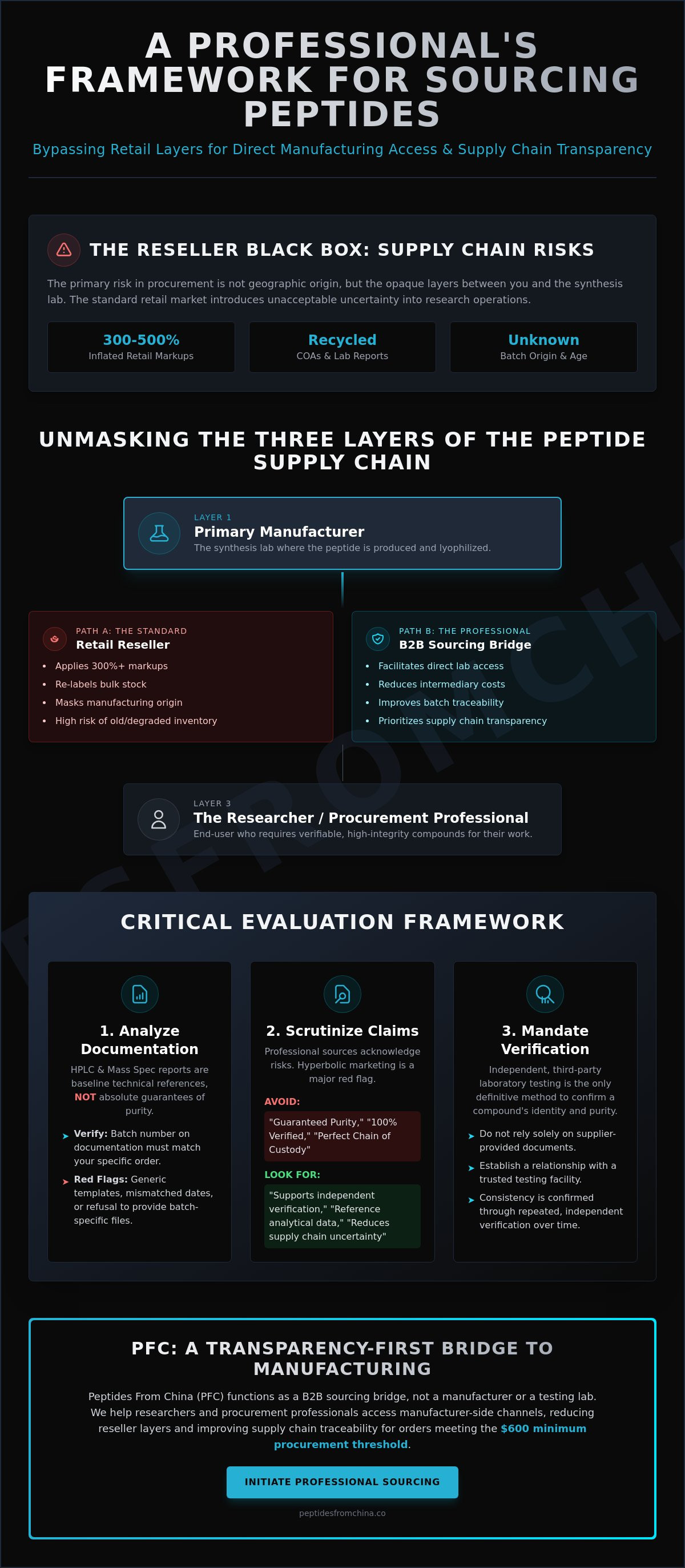
The 2026 sourcing environment favors structural transparency over aesthetic marketing. Many procurement professionals have moved away from high-traffic retail "peptide sites" that prioritize SEO over batch traceability. Instead, the focus has shifted toward professional B2B platforms that clarify the supply chain. To effectively buy peptides from china, one must distinguish between three distinct layers:
Primary Manufacturer: The facility where synthesis and lyophilization occur.
Sourcing Agent or B2B Bridge: Intermediaries that facilitate lab access and logistics.
Retailer: Entities that purchase bulk stock, relabel vials, and sell to the end user.
This transition toward transparency-first positioning is driven by a growing industry skepticism toward domestic warehousing promises. Researchers now understand that a local shipping address does not validate the chemical integrity of the product. By mapping the supply chain, buyers can identify where value is added and where markups are simply the result of unnecessary intermediaries. Sourcing directly from the manufacturing layer helps reduce supply chain uncertainty by eliminating the relabeling and batch substitution common in retail environments.
Manufacturer vs. Reseller: The Hidden Cost of Intermediaries
Intermediaries often justify their presence by offering "domestic convenience," but this service comes at a steep premium. It's common to see resellers apply 300% to 500% markups on standard synthesis batches. Understanding how peptides are chemically synthesized reveals that technical requirements are standardized. When you pay a reseller, you aren't paying for better chemistry; you're paying for a localized shipping label that often masks the original manufacturing origin.
The Reality of Domestic Warehousing
Domestic stock doesn't inherently guarantee manufacturing quality or batch identity. Facilities often lack the specialized climate control necessary for long-term stability, leading to risks of aged or degraded inventory. Direct sourcing models, such as those facilitated by Peptides From China (PFC), prioritize a direct-to-manufacturer route. When you buy peptides from china through these channels, you prioritize verifiable batch traceability over the convenience of domestic reseller stock, provided you meet the $600 wholesale minimum.
Critical Criteria for Evaluating Peptide Companies
A reputable partner doesn't rely on hyperbolic marketing. When you decide to buy peptides from china, you're entering a technical procurement process where operational realism is the only currency of trust. Phrases like "guaranteed purity" or "100% verified batches" are immediate red flags. In high-level synthesis, variables are a reality; a professional source acknowledges these risks rather than hiding behind absolute claims. True transparency involves admitting that no single document can provide a perfect chain of custody or an absolute guarantee of purity.
High-Performance Liquid Chromatography (HPLC) and Mass Spectrometry (MS) are the two pillars of technical evaluation. HPLC measures the purity level of the sample by separating components, while MS confirms the molecular weight to ensure the identity of the compound. While these tests are standard industry practices, the FDA guidance on peptide manufacturing illustrates the technical complexity involved in maintaining consistent quality across batches. These documents should be treated as baseline technical reference material rather than definitive proof of identity.
Analyzing HPLC and Mass Spectrometry Reports
Distributors often provide HPLC reports that are reused across multiple batches or faked entirely. You can often spot these fakes by looking for templated fonts, mismatched dates, or generic headers that don't align with the manufacturer's known documentation style. To mitigate this risk, you must verify that the batch number on the manufacturer papers matches your specific shipment. Independent laboratory testing remains the only way to validate these claims. Treat manufacturer-issued reports as reference analytical data. Consistency isn't a one-time event; it's confirmed through repeated, independent verification over time.
Manufacturer Audits and Verification Protocols
Transparency is the baseline requirement for any professional relationship. If a company refuses to provide manufacturer-side documentation or lacks a clear audit trail, they're likely a reseller masking their source. This opacity often leads to batch substitution, relabeling, or the sale of aged inventory. Utilizing a peptide sourcing platform helps reduce supply chain uncertainty by providing direct insight into production standards. For those looking to buy peptides from china at scale, Peptides From China (PFC) facilitates this by routing orders directly to verified facilities. PFC maintains a $600 minimum for wholesale procurement to ensure the focus remains on professional-grade volume and traceability. Establishing a transparent sourcing relationship is the most effective way to improve traceability and minimize the risks inherent in international logistics.
Direct Sourcing vs. Retail Distribution: A Comparative Analysis
The decision to buy peptides from china often forces a choice between the immediate availability of retail distribution and the structural transparency of direct manufacturing channels. Retailers function as localized inventory buffers, but they introduce multiple layers of supply chain opacity. Each intermediary represents a point where batch consistency can degrade through improper storage or intentional substitution. For professional buyers, the primary advantage of moving up the supply chain isn't just cost reduction; it's the ability to establish a verifiable line of sight to the synthesis facility.
The Economic Logic of Bulk Procurement
Retail sourcing models are designed for small-scale acquisition, often resulting in unit costs that are unsustainable for high-volume research. When you calculate the ROI of buying peptides in bulk, the economic disparity becomes clear. Direct sourcing allows laboratories to allocate budgets toward more extensive testing phases rather than paying for a reseller's marketing overhead. At Peptides From China (PFC), we maintain a $600 minimum for wholesale procurement. This threshold ensures that the focus remains on professional B2B operations, allowing for a direct synthesis pipeline that supports the validity of long-term research projects.
Logistical Nuances of International Sourcing
International logistics require a methodical approach to packaging and tracking that retail environments often overlook. Direct channels typically utilize neutral packaging to minimize domestic interference and ensure the focus remains on the technical contents. While resellers often promise "overnight" delivery, these short lead times usually indicate aged inventory that has been sitting in domestic warehouses without confirmed climate control. Following Official Regulatory Guidelines for Peptides regarding stability and quality control is easier when you source fresh batches directly from the lab.
Accepting a 10 to 14 day lead time for a fresh synthesis batch is an operational trade-off that prioritizes purity over convenience. This direct-to-manufacturer route helps reduce supply chain uncertainty by eliminating the "black box" of reseller warehousing. When you buy peptides from china through a transparent B2B bridge, you gain access to tracking data and manufacturer-side documentation that supports independent verification efforts. This methodical progression from production to delivery is essential for maintaining the integrity of the research compounds used in professional environments.
How to Safely Execute a Wholesale Peptide Order
Executing a wholesale order requires a shift from a retail mindset to a professional procurement cycle. When you decide to buy peptides from china at a B2B level, the process is defined by technical milestones rather than a simple digital checkout. This structured approach helps reduce supply chain uncertainty by ensuring that every variable is documented before capital is committed. Following a methodical framework allows researchers to move beyond the "black box" of reseller logistics and establish a direct line to manufacturing data.
Step 1: Define specific research requirements. Specify your required purity levels (e.g., >98%) and lyophilization parameters. Technical clarity at the start prevents batch substitution later.
Step 2: Request manufacturer-side documentation. Ask for reference analytical data, including HPLC and Mass Spectrometry reports for the current available batch.
Step 3: Utilize a platform to bridge the communication gap. Use a B2B bridge like Peptides From China (PFC) to route technical inquiries directly to the synthesis facility.
Step 4: Execute a verification deposit. A $10 processing fee secures batch-specific reports and confirms that the inventory is currently staged for procurement.
Step 5: Finalize procurement. Once technical documentation is approved, finalize the order meeting the $600 wholesale minimum.
Setting Up Laboratory Procurement Protocols
Integrating direct sourcing into your Standard Operating Procedures (SOPs) is essential for long-term consistency. Every batch should be treated as a unique chemical event. Researchers should maintain reference samples from every shipment to support independent verification. Establishing a relationship with a reputable peptide company that operates on a transparency-first model ensures that your recurring needs are met with batch-specific traceability rather than randomized reseller stock.
Managing Sourcing Deposits and Final Payments
The $10 processing deposit serves as a critical filter in the B2B workflow. This fee isn't a profit center; it's a mechanism that protects buyers from ghost inventory and unverified stock. By requiring a nominal deposit to pull current batch data, the platform ensures that the lab is actively holding the specific material you intend to purchase. This prevents the common industry flaw of distributors providing "representative" COAs from months or years ago. Once the documentation is approved, the deposit is applied to the final invoice, transitioning the order into a transparent fulfillment phase. To begin this verification process and buy peptides from china with improved traceability, you can access the manufacturer-side supply chain through our established B2B channels.
PFC: A Transparency-First Bridge to Manufacturing Channels
Peptides From China (PFC) operates as a dedicated B2B sourcing intermediary rather than a traditional retailer. By positioning itself at the intersection of production and procurement, PFC helps researchers buy peptides from china while bypassing the inflated markups typical of domestic resellers. This model routes orders directly to verified synthesis facilities, ensuring that the compounds you receive are fresh from the lab rather than aged inventory pulled from a distributor's shelf. This approach prioritizes factual accuracy and analytical data over the marketing hype prevalent in the retail supplement sector.
The PFC Sourcing Model: Direct and Verified
Accessing manufacturer-side channels is essential for high-volume research involving compounds such as BPC-157, Semaglutide, and Tirzepatide. The procurement process begins with a $10 processing deposit, which initiates a formal verification protocol. This step isn't a sales tactic; it's a procedural filter that confirms the facility is currently holding the specific batch you've requested. Once the deposit is placed, PFC retrieves the current reference analytical data for that batch. This allows you to review technical documentation before finalizing a larger commitment, which significantly helps reduce supply chain uncertainty.
Navigating Wholesale Requirements
Operational efficiency in 2026 requires a focus on volume and logistics. All procurement through PFC is subject to a $600 minimum order requirement. This threshold is a deliberate structural choice that aligns the platform with professional laboratories and B2B buyers rather than single-vial retail consumers. Consolidating your requirements into a single wholesale order helps optimize international shipping costs and improves traceability across your entire supply chain. It's a methodical way to buy peptides from china that treats procurement as a technical operation.
Transitioning to a Manufacturer-Side Procurement Strategy
The shift toward structural transparency in the peptide industry is a direct response to the systemic opacity of the retail reseller market. By choosing to buy peptides from china through direct manufacturing channels, you're prioritizing batch traceability over the marketing overhead of domestic distributors. It's essential to remember that documentation like HPLC reports should only be treated as reference analytical data. True research integrity is maintained through consistent, independent verification of every synthesis batch.
Establishing a direct-to-manufacturer pipeline through a B2B bridge like Peptides From China (PFC) allows you to bypass unnecessary intermediaries and secure bulk synthesis pricing. This methodical approach ensures that your laboratory procurement is grounded in operational realism rather than retail promises. By meeting the $600 wholesale threshold, you gain access to COA-verified batches from verified facilities without the significant markups common in the reseller sector.
Start your manufacturing-side sourcing request with Peptides From China to access specialized B2B sourcing for research laboratories. Moving toward a direct supply chain is the most effective way to stabilize your procurement workflow and ensure the long-term consistency of your research compounds.
Frequently Asked Questions
Is it legal to buy peptides for research purposes in 2026?
Peptides imported for research purposes are regulated by the FDA and require detailed customs declarations stating their research-use only status. As of June 2026, the gray market for these compounds has seen a significant surge, yet the legal framework remains focused on ensuring products aren't sold for human consumption. It's the buyer's responsibility to maintain all necessary documentation, including manufacturer-issued papers and certificates of analysis, to comply with current import regulations.
How can I verify the purity of a peptide batch from China?
Independent third-party laboratory testing using HPLC and Mass Spectrometry is the only reliable method for verification. While manufacturer-provided reports offer baseline reference analytical data, they shouldn't be viewed as definitive proof of quality. When you buy peptides from china, you should implement a protocol of blind testing random vials from your specific shipment. This practice helps confirm that the compound identity and purity levels align with your research requirements.
What is the difference between research-grade and pharmaceutical-grade peptides?
Research-grade peptides are synthesized for laboratory environments and don't undergo the clinical-grade manufacturing processes required for human therapeutics. Pharmaceutical-grade peptides are subject to strict regulatory oversight and standardized production protocols. Research compounds are intended for analytical and experimental use where the procurement professional assumes the responsibility for establishing quality control measures and conducting independent verification to ensure batch consistency for their specific projects.
Why do some peptide companies have a $600 minimum order requirement?
A $600 minimum order requirement, such as the one maintained by Peptides From China, ensures that the sourcing workflow remains focused on professional B2B procurement. This threshold allows manufacturers to prioritize high-volume synthesis and batch-specific traceability over fragmented retail sales. By consolidating orders to meet this minimum, laboratories can optimize international shipping costs and establish a more predictable, direct-to-manufacturer supply chain that supports long-term research validity.
What should I look for in an HPLC report to ensure it is not fake?
Inspect the HPLC report for font inconsistencies, generic headers, or dates that don't align with your specific synthesis timeline. Reused or templated reports often lack a unique batch number or display unrealistic, smoothed peaks that lack the expected analytical variance. To improve traceability, you should compare the manufacturer's raw data with the results from your own independent testing to identify any discrepancies in the chemical profile or purity percentage.
Can I buy single vials of peptides from a B2B sourcing platform?
B2B sourcing platforms do not offer retail single-vial sales because their operational model is built for wholesale volume and manufacturing efficiency. These channels are designed to help researchers buy peptides from china by providing direct access to the lab side of the supply chain. Platforms like PFC require a $600 minimum to support batch-specific documentation and direct synthesis pipelines, which aren't feasible for small-scale retail transactions.
How does neutral packaging work for international peptide shipping?
Neutral packaging involves shipping research compounds in plain, unbranded containers with technical labeling that prioritizes logistical efficiency and customs compliance. This method helps reduce domestic interference and maintains the focus on the technical nature of the contents. Professional B2B bridges use standardized international tracking and accurate customs declarations to ensure a clear audit trail from the synthesis facility directly to the destination laboratory or research facility.
What happens if a peptide batch fails independent laboratory testing?
If independent verification reveals a discrepancy in purity or identity, you must provide the raw analytical data to your sourcing bridge to initiate a resolution protocol. This inherent risk is why establishes a relationship with a transparency-focused partner is essential. While direct sourcing helps reduce supply chain uncertainty, the buyer's independent testing remains the final gatekeeper. A professional partner will use your data to investigate the synthesis batch and address the technical discrepancy.