
The document you rely on to verify your research material is often a reused digital artifact rather than a specific batch analysis. Most procurement professionals looking for where to buy peptides realize the domestic reseller market frequently hides a chain of inflated markups and recycled documentation. You've likely experienced the frustration of receiving one high-quality batch only to have the next one fail your internal identity tests due to supply chain opacity and batch substitution.
It's time to move beyond retail-style purchasing and adopt a strategic B2B sourcing model. This guide provides an operational roadmap for navigating the peptide supply chain by identifying the critical differences between domestic resellers and direct-to-manufacturer channels. We'll analyze the impact of the June 1, 2026 EMA guidelines and the recent May 22, 2026 China export control expansions. You'll learn how to reduce sourcing uncertainty by utilizing transparency-focused bridges like Peptides From China, which facilitate direct access to manufacturer-side channels for wholesale orders starting at $600, helping you establish a more reliable and technically grounded procurement protocol.
Key Takeaways
Identify how to bypass the opaque layers of domestic resellers to achieve better batch traceability. This helps reduce supply chain uncertainty.
Evaluate the trade-offs between retail convenience and manufacturer-side transparency when deciding where to buy peptides for professional research.
Understand why manufacturer-issued HPLC and Mass Spectrometry reports should be used as baseline references. They aren't absolute guarantees of purity.
Master the operational requirements of direct sourcing. This includes the $600 minimum for wholesale orders and the logistics of professional customs documentation.
Table of Contents
Navigating the Opaque Peptide Supply Chain in 2026
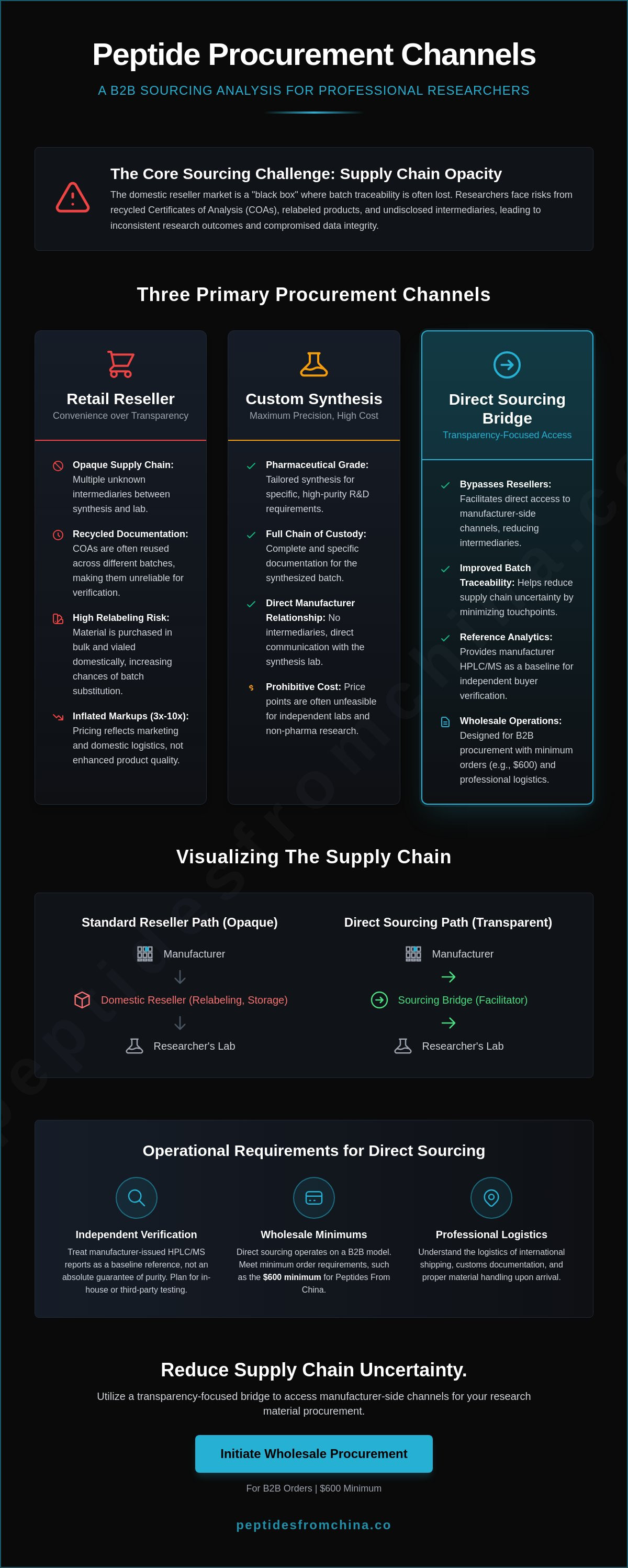
Comparing the Three Primary Peptide Procurement Channels
Technical Verification: Beyond the Certificate of Analysis (COA)
Operational Logistics: Sourcing Research Peptides from China
PFC: A Transparency-Focused Bridge for Professional Research
Navigating the Opaque Peptide Supply Chain in 2026
The global peptide synthesis market is valued at approximately $1.9 billion in 2026. While the demand for research materials has surged, the supply chain remains remarkably concentrated. China serves as the primary engine for global production, housing the specialized facilities capable of large-scale Chemical peptide synthesis. Most researchers looking for where to buy peptides encounter domestic websites that present themselves as manufacturers. In reality, these are often resellers who purchase bulk powder internationally, vial it locally, and apply a significant markup. This intermediary layer creates a "black box" where batch traceability is lost, and the risk of batch substitution or relabeling increases.
The Reality of Research-Grade Synthesis
Manufacturing standards aren't uniform across all synthesis facilities. Catalog peptides, which are produced in massive quantities for general stock, often differ in consistency compared to custom batch synthesis tailored to specific purity requirements. When procurement occurs through a domestic reseller, the buyer is often several steps removed from the actual production logs. This distance makes it difficult to verify if the material received matches the specific batch analyzed in the provided HPLC report. Reseller markups often consume a significant portion of laboratory research budgets without adding technical value to the product itself.
Identifying Supply Chain Intermediaries
Supply chain opacity remains the greatest risk to research consistency. When a reseller reuses a Certificate of Analysis (COA) across multiple batches, the data becomes a baseline reference rather than proof of quality. Direct sourcing doesn't eliminate all risks, but it provides the transparency needed to perform independent verification with confidence. By minimizing the number of hands a product passes through, you naturally improve traceability and reduce the likelihood of receiving aged or substituted material.
Comparing the Three Primary Peptide Procurement Channels
Choosing where to buy peptides requires an objective analysis of procurement goals. Most researchers operate within three distinct channels: retail resellers, custom synthesis houses, and direct sourcing platforms. Each offers a different balance of speed, cost, and traceability. While custom synthesis houses provide high-spec options for pharmaceutical R&D, their price points are often prohibitive for independent laboratories and professional researchers who require consistent access to materials like Tirzepatide or BPC-157.
The Retail Reseller Model
Retailers target small-scale users and hobbyist researchers who prioritize ease of use over technical transparency. These businesses typically operate domestic warehouses to offer fast shipping, but this convenience comes with significant trade-offs. You rarely get direct access to the manufacturer; instead, you're buying from an entity that has already relabeled the product. The batch data provided is often recycled from previous production runs rather than being specific to the vial in your hand. Economically, these entities often apply 3x to 10x markups over the original synthesis costs. This pricing structure compensates for their marketing overhead and domestic storage risks rather than product quality improvements.
While these sources are accessible, they often blur the lines between research-grade materials and regulated substances. Understanding FDA regulations on peptide compounding helps clarify why these retail "research only" labels exist and why they lack the rigorous chain of custody found in professional channels. For many, the lack of batch-to-batch consistency in the retail market eventually forces a shift toward more transparent sourcing methods.
The B2B Sourcing Platform Advantage
Professional peptide sourcing platforms act as a bridge to verified production facilities. These platforms move away from the "black box" retail approach by facilitating a more direct relationship with the synthesis lab. For instance, Peptides From China (PFC) uses a $10 processing deposit model. This small fee initiates the manufacturer-side verification process, ensuring the specific batch and current pricing are confirmed before a larger commitment is made. It's a methodical approach designed to alleviate the typical anxieties associated with international procurement.
This model requires a higher entry point, specifically a $600 minimum for wholesale orders. This threshold is necessary because it allows buyers to access manufacturer-side pricing without the reseller layers. It's an operational choice for those who value long-term consistency and reference analytical data over single-vial convenience. When determining where to buy peptides for scaled research, exploring direct manufacturer-side channels is the most logical step toward reducing supply chain uncertainty and improving overall traceability.
Technical Verification: Beyond the Certificate of Analysis (COA)
Researchers searching for where to buy peptides often treat a Certificate of Analysis (COA) as a definitive seal of quality. This is a significant operational error. In the current market, a COA functions as baseline technical reference material rather than a guarantee of the specific material in your shipment. Supply chain flaws like reused reports and batch-report mismatches are common occurrences. Relying solely on manufacturer-provided data creates a single point of failure for your research. Professional laboratories must implement independent third-party testing to support independent verification of every procurement lot.
Reading the HPLC Report
High-Performance Liquid Chromatography (HPLC) measures the purity of a sample based on the area under the primary peak. When reviewing these reports, look beyond the final percentage. Analyze the baseline noise and the presence of secondary peaks that might indicate synthesis impurities. A "99% purity" claim is often a measure of the peptide content relative to other organic impurities; however, it doesn't always account for residual salt content or moisture levels left over from the lyophilization process. HPLC serves as a critical tool for determining sample purity, though it cannot definitively confirm the molecular identity of the substance.
The Role of Mass Spectrometry (MS)
Mass Spectrometry (MS) is the necessary partner to HPLC. While HPLC tells you how pure the sample is, MS confirms what the sample actually is by measuring molecular mass. You should compare the observed mass against the theoretical sequence of the peptide. MS reports help identify synthesis byproducts or truncated sequences where the amino acid chain was not completed correctly during the synthesis phase. Integrating peptide testing into your standard procurement protocol is the only way to minimize the risks of batch substitution. This technical skepticism helps reduce supply chain uncertainty and ensures that your laboratory data remains grounded in factual accuracy rather than marketing claims.
Operational Logistics: Sourcing Research Peptides from China
Understanding where to buy peptides is only the first step in a professional procurement strategy. The second involves managing the logistical machinery that moves material from a synthesis facility in China to your laboratory. Unlike domestic retail purchases, international B2B sourcing requires a methodical approach to lead times and customs documentation. China's Ministry of Commerce expanded export controls on May 22, 2026, increasing the number of precursor chemicals requiring permits. This regulatory shift emphasizes why researchers must prioritize sources that provide professional customs documentation and neutral packaging to ensure consistent delivery.
To access manufacturer-side pricing and reduce supply chain uncertainty, procurement professionals must navigate the $600 minimum threshold for wholesale orders. This requirement serves as an operational filter, ensuring that the synthesis facility can dedicate the necessary resources to batch verification and professional handling. By routing orders directly through manufacturer-side channels, you eliminate the "black box" of domestic warehousing where products may sit for months without updated analytical data. This direct-to-manufacturer approach helps improve traceability and ensures you receive material from the most recent production cycles.
The Sourcing Timeline
Lead times are a critical variable in laboratory planning. While common compounds like BPC-157 or Tirzepatide are frequently in stock, fresh batch synthesis can require an additional 7 to 14 days depending on the facility's current queue. Once synthesis is complete and reference analytical data is generated, international transit typically takes 7 to 10 days via specialized logistics partners. To avoid research delays, many labs adopt a strategy for buying peptides in bulk. This protocol allows for a single round of independent verification to cover several months of inventory, ensuring that your data remains consistent across a long-term study.
Risk Mitigation in International Sourcing
Direct manufacturer access is the most effective way to reduce the risk of batch substitution. In a typical retail model, the buyer has no way to verify if the material in the vial actually matches the HPLC report provided. A sourcing bridge like Peptides From China (PFC) mitigates this by acting as a technical filter. The sourcing agent verifies facility stock and confirms current batch numbers before any significant payment is made. This verification process is supported by the $10 deposit model, which protects the buyer from committing to unavailable or aged stock. Establishing long-term manufacturer relationships through a transparent intermediary helps ensure that your lab receives consistent quality and technical support. If you're ready to transition to a more reliable procurement model, you can initiate the manufacturer-side verification process today.
PFC: A Transparency-Focused Bridge for Professional Research
Identifying where to buy peptides often leads researchers to a landscape of websites claiming to be direct manufacturers. Peptides From China (PFC) rejects this marketing tactic, instead positioning itself as a transparency-focused B2B sourcing bridge. We don't claim to be a pharmaceutical manufacturer or a testing laboratory. Our role is to act as a technical filter and procurement intermediary, helping professional buyers navigate the complexities of international synthesis facilities. By prioritizing operational reality over retail-style hype, we help reduce supply chain uncertainty for laboratories that require consistent access to compounds like BPC-157, Semaglutide, and Tirzepatide.
Our model is built on the $10 deposit system, a methodical step designed to initiate the manufacturer-side verification process. This small fee isn't a purchase price; it's an operational trigger that allows our team to confirm current facility stock, verify batch numbers, and secure real-time pricing before you commit to a larger order. This approach protects researchers from the "ghost stock" and batch substitution issues that plague the retail market. When you're evaluating where to buy peptides for scaled research, this level of front-end verification is the only way to ensure your procurement remains grounded in factual data.
The PFC Operational Model
We route orders straight to synthesis facilities to eliminate the unnecessary markups associated with domestic resellers. To support these direct-to-manufacturer logistics, we maintain a strict $600 minimum order requirement for all wholesale procurement. This threshold ensures that the production facilities can dedicate the resources necessary for professional handling and documentation. We provide manufacturer-issued COAs for every batch, but we present them only as baseline reference material. We explicitly encourage our clients to perform independent third-party testing, as no single document can fully guarantee product identity or purity in a globalized supply chain.
Direct Routing: Orders bypass domestic warehouses, improving batch traceability and reducing aging risks.
Wholesale Pricing: Accessing manufacturer-side rates by meeting the $600 minimum procurement threshold.
Technical Skepticism: Using HPLC and MS reports as reference analytical data rather than absolute proof.
Next Steps for Laboratory Procurement
Transitioning from retail-style buying to professional sourcing requires a shift in procurement mindset. Instead of clicking "add to cart," researchers initiate a dialogue by requesting a quote for specific sequences. This process allows you to approve the manufacturer's current stock and quality documentation before the final transaction occurs. Whether you're sourcing Retatrutide for a new study or maintaining inventory of TB-500, the goal is to establish a predictable, transparent pipeline. By minimizing intermediaries and focusing on batch-to-batch consistency, you can move away from the "black box" of the retail market and secure a more reliable foundation for your research data.
Establishing a Strategic Procurement Protocol
Transitioning from retail-style buying to a professional sourcing model is necessary for maintaining long-term research integrity. The decision of where to buy peptides determines the level of batch traceability your laboratory can maintain. By bypassing domestic reseller layers, you move away from recycled documentation and toward a system built on direct-to-manufacturer routing and B2B sourcing transparency. This shift requires adopting a technical filter that treats batch-specific HPLC and MS reports as baseline reference material rather than definitive proof, necessitating a commitment to independent verification.
Managing the operational logistics of international procurement through a $600 minimum wholesale structure ensures your lab receives material from the most recent production cycles. This methodical approach helps reduce supply chain uncertainty and protects your data from the inconsistencies of the retail market. Establishing a direct connection to synthesis facilities provides the clarity needed to scale your operations with confidence. You can Access Direct Manufacturer Sourcing for Your Lab today and begin the manufacturer-side verification process. We're ready to help you build a more reliable and technically grounded supply chain.
Frequently Asked Questions
Is it legal to buy peptides for research purposes in 2026?
Research-use-only peptides remain legal for laboratory and analytical use, provided they aren't intended for human consumption. The FDA's Pharmacy Compounding Advisory Committee meeting in July 2026 regarding the 503A Bulk Drug Substances List impacts compounding pharmacies, but it's distinct from the "research only" market. Researchers must maintain proper documentation to demonstrate that materials are used strictly for in-vitro or animal studies within a controlled setting.
How do I know if a peptide supplier is actually a manufacturer or just a reseller?
True manufacturers rarely offer retail single-vial sales or domestic US/EU warehousing. If a vendor provides fast domestic shipping and a polished consumer-facing website, they're almost certainly a reseller relabeling bulk powder. When evaluating where to buy peptides, look for entities that facilitate direct manufacturer-side communication and provide batch-specific synthesis logs rather than just a generic shopping cart interface.
What is the significance of the $600 minimum order for bulk peptides?
The $600 minimum is an operational threshold required to access manufacturer-side pricing and professional logistics. Synthesis facilities operate on scale; smaller orders aren't economically viable for direct routing from the lab. This minimum ensures the facility can prioritize batch-specific verification and professional customs documentation, which helps reduce supply chain uncertainty compared to low-volume retail purchases where to buy peptides is often a gamble.
Can I trust a Certificate of Analysis (COA) provided by the supplier?
A COA should be treated as baseline reference material, not definitive proof of purity or identity. In this industry, reports are frequently reused across multiple batches or forged by intermediaries. You should use the provided HPLC and Mass Spectrometry data as a starting point for your own independent verification to ensure the material matches the theoretical sequence and meets your specific research requirements.
How does the $10 sourcing deposit work at Peptides From China?
The $10 deposit initiates the manufacturer-side verification process before you commit to a full wholesale order. This fee allows our team to confirm real-time stock levels, current batch numbers, and updated pricing directly with the synthesis facility. It serves as a protective filter, ensuring you don't pay for material that is aged, substituted, or currently unavailable at the production level.
What happens if a batch fails independent laboratory testing?
Professional procurement protocols require a clear resolution path for failed batches. If independent testing through HPLC or Mass Spectrometry reveals purity levels significantly below the reference analytical data or an incorrect molecular weight, the sourcing bridge should facilitate a replacement from the manufacturer. This underscores why maintaining a direct relationship with the synthesis facility is critical for operational consistency and accountability.
Why do prices for peptides like Semaglutide vary so much between vendors?
Price variance is usually a reflection of the number of intermediaries in the supply chain. Domestic resellers apply significant markups to cover marketing, domestic warehousing, and the risks of holding stock. Direct sourcing platforms offer lower rates by removing these layers, though they require higher minimums and longer lead times. Synthesis quality and batch size also influence the base cost at the facility level.
How does neutral packaging help with international peptide logistics?
Neutral packaging helps streamline international logistics by reducing the likelihood of unnecessary customs delays. Professional documentation and discreet, standardized labeling ensure that shipments move through global checkpoints without the scrutiny applied to branded retail products. This is especially important given China's updated Export License Management Catalogue implemented on January 1, 2026, which increased oversight on chemical and peptide exports.