
Paying a massive premium for a branded peptide blend isn't a research necessity. It's a transparency tax paid to middlemen who often source from the same overseas facilities you can access yourself. You likely already suspect that the convenience of a pre-mixed vial comes at the cost of both your budget and your data integrity. Relying on a retail label makes it nearly impossible to verify the primary manufacturer or adjust individual peptide ratios to suit specific laboratory requirements. Finding a viable klow biotechnology alternative requires moving beyond the retail ecosystem and into the world of direct-to-manufacturer procurement.
This guide provides a strategic framework for bypassing branded reseller markups by sourcing the individual components of the Klow peptide stack directly from verified synthesis facilities. We'll explore how to navigate the complexities of international logistics, manage the $600 minimum order thresholds typical of wholesale channels like Peptides From China, and implement realistic verification protocols. You'll learn why relying on a manufacturer-issued COA is only a baseline and how independent testing helps reduce supply chain uncertainty. By the end of this article, you'll have a clear roadmap for lowering your cost-of-goods while improving batch traceability and operational consistency.
Key Takeaways
Deconstruct the lyophilized Klow stack into its constituent peptides to identify exactly where retail markups are applied within the reseller ecosystem.
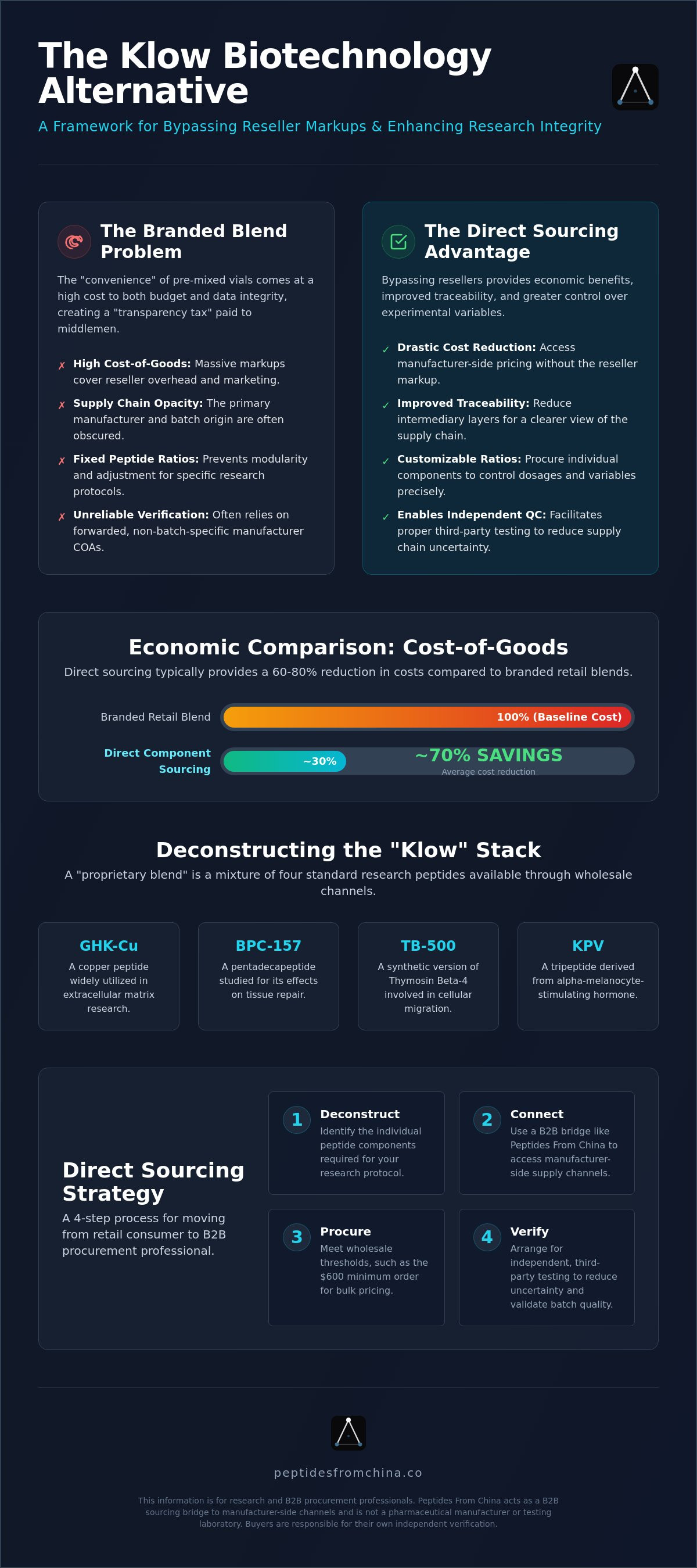
Evaluate the economic benefits of direct sourcing, which typically provides a 60-80% reduction in cost-of-goods compared to branded retail blends.
Implement a strategic klow biotechnology alternative by procuring individual components, allowing for precise ratio adjustments and simplified analytical verification.
Navigate the wholesale supply chain through Peptides From China, utilizing the $600 minimum order threshold to bridge the gap between synthesis facilities and professional labs.
Establish realistic quality control protocols by prioritizing independent third-party testing over manufacturer-issued reference documentation to help reduce supply chain uncertainty.
Table of Contents
Understanding the Klow Peptide Blend and the Reseller Ecosystem
The Limitations of Branded Blends: Why Researchers Pivot to Alternatives
Economic Comparison: Branded Stacks vs. Direct Component Sourcing
Navigating the Supply Chain: Verification Beyond the Reseller Label
Implementing a Direct Sourcing Strategy with Peptides From China
Understanding the Klow Peptide Blend and the Reseller Ecosystem
The Klow peptide blend is frequently presented as a proprietary innovation, yet from a technical procurement standpoint, it's simply a lyophilized mixture of four generic sequences. These compounds are manufactured through standard chemical peptide synthesis in industrial facilities before reaching the retail market. Identifying a klow biotechnology alternative starts with deconstructing the brand name into its fundamental chemical parts. Resellers don't typically own synthesis labs; they manage international logistics, domestic warehousing, and high-margin marketing campaigns.
Resellers frequently provide "verified" documentation, but these papers are often just copies of manufacturer-issued reference analytical data. They rarely conduct independent, third-party testing on every batch they move. This creates a layer of supply chain opacity where the buyer assumes the reseller has performed more due diligence than is actually the case. By seeking a klow biotechnology alternative, researchers can take control of the verification process themselves rather than relying on a brand's marketing claims.
The Four Pillars of the Klow Formulation
The technical value of the Klow stack rests on four specific peptides. GHK-Cu is a copper peptide widely utilized in extracellular matrix research. BPC-157 is a pentadecapeptide studied for its effects on gastric and musculoskeletal tissue repair. TB-500, or Thymosin Beta-4, is a synthetic version of a naturally occurring protein involved in cellular migration. Finally, KPV is a tripeptide derived from alpha-melanocyte-stimulating hormone. Individually, these are common research compounds available through wholesale channels.
Why Branded Stacks Command a Premium
Retailers justify significant price increases by offering the convenience of a single vial. This eliminates the need for researchers to calculate ratios or manage multiple containers. However, this convenience includes massive markups to cover domestic US or EU warehousing overheads and aggressive digital marketing. Many buyers pay this "convenience tax" because they lack a direct line to the manufacturing source or feel intimidated by international procurement protocols.
Moving beyond the brand label allows for better control over research variables. When you source these components individually, you gain the ability to adjust ratios based on specific experimental needs rather than accepting a fixed, pre-mixed formula. This shift from retail consumer to B2B procurement professional is the first step in optimizing a research budget. It also highlights the reality that the reseller's primary role is distribution, not scientific discovery. Professional buyers understand that a klow biotechnology alternative isn't a different "brand," but a more direct route to the same chemical sequences.
Sourcing through a B2B bridge like Peptides From China allows for a direct-to-manufacturer approach. This model requires a minimum order of $600, which reflects the operational reality of wholesale procurement. It's a strategic move for labs and technical readers who prioritize batch traceability and cost-efficiency over retail branding.
The Limitations of Branded Blends: Why Researchers Pivot to Alternatives
Branded blends like Klow offer a "plug-and-play" experience that often compromises the integrity of sophisticated research protocols. The primary issue is the lack of modularity. When four distinct peptides are lyophilized into a single vial, the researcher loses the ability to isolate specific variables or adjust dosages based on observed data. This rigidity is a significant reason why many are now seeking a klow biotechnology alternative that allows for component-level control. Fixed ratios prevent the fine-tuning necessary for complex longitudinal studies.
Verifying a multi-peptide stack is technically demanding and often yields less reliable data than testing single compounds. Standard HPLC (High-Performance Liquid Chromatography) protocols for a single compound are straightforward. However, a mixture of GHK-Cu, BPC-157, TB-500, and KPV requires more complex gradient elution to achieve clear peak separation. Mass Spectrometry (MS) also becomes noisier, as overlapping molecular weights or fragmentation patterns can obscure impurities in individual components. If one peptide in the blend begins to degrade, identifying the specific byproduct within the mixture is exponentially harder than in a single-vial environment.
The lack of transparency in the retail market often serves as a "black box" that hides the true origin of the material. Resellers frequently relabel products to obscure batch ages or synthesis facilities. This opacity is compounded by the evolving landscape of FDA regulation of research peptides, which has increased scrutiny on how these compounds are marketed and distributed. Every intermediary between the synthesis facility and your lab adds a layer of cost and a potential point of failure in the chain of custody.
Transitioning to a direct-to-manufacturer model helps reduce supply chain uncertainty by removing these unnecessary layers. For those ready to move past retail branding, sourcing individual components directly through a B2B bridge provides the transparency required for high-stakes research. This approach requires navigating wholesale procurement standards, such as the $600 minimum order threshold maintained by Peptides From China to ensure operational efficiency for the synthesis facilities.
It's common practice for retail vendors to reuse a single Certificate of Analysis (COA) for multiple batches over several months. This makes the document a baseline technical reference rather than proof of what is actually in the vial you received. Choosing a klow biotechnology alternative that involves independent testing of individual peptides is the only way to ensure your data remains reliable. For large-scale operations, accessing manufacturer-side channels allows for better batch traceability and consistent quality control across the entire research lifecycle.
Economic Comparison: Branded Stacks vs. Direct Component Sourcing
Analyzing the financial structure of branded research blends reveals a significant disparity between raw material costs and retail pricing. For a lab operating on a fixed budget, identifying a klow biotechnology alternative isn't just about chemistry; it's a fiscal necessity. When you calculate the total milligrams of GHK-Cu, BPC-157, TB-500, and KPV in a standard Klow vial, the price per milligram is often three to five times higher than the cost of the constituent peptides sourced through wholesale channels. This markup covers the reseller's profit margin rather than the quality of the synthesis itself.
Breaking Down the Cost-Per-Milligram
Direct-to-manufacturer sourcing typically facilitates a 60-80% reduction in total cost for the exact same amino acid sequences. While the upfront cost of international logistics and customs must be considered, these expenses are quickly amortized when procurement is handled at scale. Even when you factor in the essential cost of independent peptide testing, the savings remain substantial. Professional buyers understand that paying for laboratory verification is a strategic investment that pays for itself through reduced unit costs and increased data reliability. Bulk purchasing allows for consistent batch testing, which is more cost-effective than testing individual retail vials.
The "Reseller Tax" Explained
Peptides From China operates as a transparency-focused B2B sourcing bridge, connecting researchers with verified synthesis facilities. This model bypasses the reseller "black box" by requiring a minimum order of $600, a threshold that aligns with the operational needs of industrial manufacturers. This approach allows labs to implement a klow biotechnology alternative that prioritizes batch traceability and analytical consistency over retail packaging. By removing the middleman, you gain a direct line to the synthesis source and a clearer understanding of your material's origin.
Navigating the Supply Chain: Verification Beyond the Reseller Label
Establishing a reliable klow biotechnology alternative requires a shift in how researchers interpret technical documentation. In the retail market, a Certificate of Analysis (COA) is often presented as a definitive guarantee of quality. Professional procurement operators, however, view these documents only as baseline reference analytical data. A COA provided by a reseller is frequently a snapshot of a single sample from a historical batch, which may not reflect the current inventory's purity or identity. Relying solely on these papers without independent verification introduces significant risk into your research environment.
Independent, third-party testing by the buyer is the only method to confirm batch identity and purity with high confidence. While manufacturer-issued HPLC and Mass Spectrometry reports provide a starting point, they don't account for potential batch substitution or degradation during domestic relabeling. Verification should focus on the synthesis facility's actual capabilities. Requesting batch-specific manufacturing logs or details on their Solid Phase Peptide Synthesis (SPPS) protocols provides more insight into their quality control standards than any marketing badge or retail trust score could offer.
Reading Between the Lines of a COA
Analytical documents require a critical eye to identify red flags. You should always verify that batch numbers on the HPLC report match the physical vial labels exactly; discrepancies here often indicate relabeled old stock. Examine the HPLC chromatogram for consistent baseline noise. If the baseline appears too "clean" or lacks the expected minor peaks associated with peptide synthesis byproducts, the report may have been digitally altered. It's also vital to remember that these documents represent a specific sample at a specific point in time, not an entire production run. This is why lot-specific testing is the standard for professional labs.
Establishing a Professional Procurement Protocol
Direct communication with synthesis facilities improves traceability and helps reduce supply chain uncertainty. When you move beyond the reseller "black box," you gain the ability to request specific synthesis methods and verify the facility's operational history. Implementing a strategic peptide sourcing platform approach allows for a consistent supply of individual components like BPC-157 or GHK-Cu. This method prioritizes technical transparency and batch consistency over retail convenience.
Operational security is another factor often overlooked in the retail space. Professional sourcing channels utilize neutral packaging and secure international logistics to ensure that lab supplies reach their destination without the delays common to poorly labeled retail shipments. If you're looking to establish a more transparent supply chain, you can access verified manufacturer-side channels through our B2B sourcing bridge. This model supports independent verification by removing the intermediaries who often obscure the path from the synthesis lab to your facility. By maintaining a $600 minimum order, we ensure that your procurement process aligns with the logistical requirements of professional-grade manufacturing facilities.
Implementing a Direct Sourcing Strategy with Peptides From China
Middlemen thrive on a lack of options. Peptides From China (PFC) functions as a strategic B2B sourcing bridge, connecting professional researchers directly to verified synthesis facilities. This model is the logical endpoint for anyone seeking a klow biotechnology alternative that prioritizes manufacturing transparency over retail branding. We eliminate the layers of reseller markups by routing professional orders directly to the source, ensuring your research budget is spent on material rather than domestic marketing overhead.
The core of the PFC approach is a commitment to batch-level documentation and industrial-scale efficiency. We don't operate as a pharmaceutical manufacturer or a testing laboratory. Instead, we act as an analytical filter and logistical partner. This structure helps reduce supply chain uncertainty by providing a direct line to the facilities where the peptides are actually synthesized. For labs requiring consistent access to the sequences found in the Klow stack, moving to a direct sourcing model improves traceability and operational control.
The PFC Sourcing Model for Professional Labs
Our procurement process is designed to filter for serious research entities. A $10 processing deposit initiates the verification and sourcing process with our network of manufacturers. This small commitment allows us to dedicate resources to your specific inquiry, ensuring that the facility can meet your volume and purity requirements. Before any final invoicing occurs, researchers receive batch-specific reference analytical data, including HPLC and MS reports. This ensures you have baseline documentation to compare against your own independent testing results.
Direct-from-source logistics are essential for maintaining the integrity of the supply chain. By bypassing domestic resellers, you minimize the risks associated with relabeling, batch substitution, and improper long-term storage in domestic warehouses. All orders must meet a $600 minimum requirement, which is the standard threshold for accessing genuine wholesale pricing tiers at the manufacturer level.
Why Direct Sourcing Beats Reseller Alternatives
Professional labs require access to raw sequences for wholesale peptides like BPC-157, GHK-Cu, TB-500, and KPV. Sourcing these components individually through a klow biotechnology alternative allows for precise experimental design that retail blends cannot accommodate. It also reduces your reliance on the hyperbolic "guaranteed purity" claims often found in retail-focused marketing. Instead, you're empowered to conduct your own laboratory verification on materials sourced at a fraction of the retail cost.
This is a more sustainable procurement model for long-term, high-volume research projects. It shifts the focus from superficial sales tactics to factual verification and manufacturing standards. If your laboratory is ready to transition away from the reseller ecosystem and toward a transparent, manufacturer-side channel, we can facilitate that move. Initiate your direct sourcing request for Klow components here.
Optimizing Your Research Procurement Strategy
Transitioning to a klow biotechnology alternative isn't just a cost-saving measure; it's a strategic move toward reclaiming control over your experimental variables. By deconstructing branded stacks into their fundamental generic sequences, you eliminate the "convenience tax" and gain the necessary flexibility to adjust peptide ratios based on specific laboratory data. True supply chain integrity requires looking past the reseller's marketing label and engaging directly with the synthesis source. While manufacturer-provided reference analytical data serves as a vital technical baseline, independent laboratory verification remains the standard for any professional operation seeking to minimize risk.
Peptides From China facilitates this shift by acting as a transparency-focused B2B bridge. We provide direct synthesis facility verification, COA-backed batch sourcing, and neutral B2B international logistics for researchers ready to scale their operations. Accessing these wholesale tiers requires a $600 minimum order to align with the logistical requirements of industrial manufacturing facilities. Move beyond the limitations of retail branding and establish a more resilient, data-driven supply chain for your laboratory today.
Access Direct-to-Manufacturer Wholesale Pricing (Min. $600)
Frequently Asked Questions
Is it legal to source the Klow stack components directly from China for research?
How does the cost of the individual components compare to the branded Klow blend?
Direct-to-manufacturer sourcing typically results in a 60-80% reduction in cost per milligram compared to branded retail blends. By procuring a klow biotechnology alternative through wholesale channels, you stop paying for the reseller's marketing and domestic warehousing overhead. This allows more of your research budget to be allocated toward material and independent analytical verification rather than retail markups.
Can I adjust the ratios of GHK-Cu, BPC-157, TB-500, and KPV when sourcing through PFC?
Yes, you can fully customize your research stack because you're procuring individual components rather than a pre-mixed vial. Sourcing GHK-Cu, BPC-157, TB-500, and KPV separately allows you to isolate variables and adjust concentrations according to your specific protocol. This modular approach is a primary reason professional labs move away from proprietary retail blends that offer fixed, unchangeable ratios.
What is the minimum order for wholesale peptide sourcing?
The minimum order for wholesale procurement through Peptides From China is $600. This threshold is established to align with the operational requirements of industrial synthesis facilities and ensure access to genuine manufacturer-side pricing. Smaller orders are generally handled by retail resellers who add significant markups to cover their higher administrative and logistical costs per unit.
How do I verify the purity of peptides sourced directly from a manufacturer?
Independent third-party testing is the only reliable method to verify the identity and purity of your peptides. While manufacturer-issued HPLC and Mass Spectrometry reports provide reference analytical data, they should be treated as baseline documentation rather than a guarantee. Professional researchers send samples to an independent lab for lot-specific verification to help reduce supply chain uncertainty and confirm batch consistency.
Why do US-based resellers charge so much more for the Klow stack?
Domestic resellers charge higher prices to cover the costs of domestic warehousing, credit card processing fees, and aggressive digital marketing campaigns. They essentially act as a convenience layer for buyers who aren't ready to manage international logistics or meet wholesale minimums. This retail premium often triples or quadruples the price of the raw materials synthesized at the primary facility.
What happens if the HPLC report provided by the manufacturer does not match my independent test?
If an independent test contradicts the manufacturer's report, the independent data should be prioritized as your source of truth. Synthesis quality can vary between batches, and documentation can occasionally be reused or mislabeled within the broader industry. Identifying such discrepancies is exactly why independent verification is a critical component of any professional klow biotechnology alternative sourcing strategy.
Does Peptides From China provide domestic US warehousing for faster shipping?
No, Peptides From China doesn't provide domestic US or EU warehousing. We operate as a transparency-focused B2B sourcing bridge that routes orders directly from verified synthesis facilities to your laboratory. This model eliminates the middleman risk and relabeling issues associated with domestic storage, ensuring you receive material directly from the production source with improved traceability.