A standard Certificate of Analysis is often nothing more than a recycled PDF that masks the reality of a fragmented supply chain. In a market where multiple reseller layers obscure the actual synthesis source, relying on vendor-provided documents is an operational gamble you can't afford. You've likely dealt with the frustration of inconsistent batch quality or the risk of receiving cosmetic-grade powder when your project demands research-grade purity. Finding a reliable GHK-Cu wholesale supplier in 2026 requires moving beyond marketing claims and implementing a verification-first model that audits the manufacturer, not just the website.
This guide provides the professional protocols and logistical frameworks needed to secure direct-to-manufacturer sourcing. At Peptides From China (PFC), we act as a transparency-focused B2B bridge, helping you bypass intermediaries to access manufacturer-side channels. We'll detail how to implement independent testing and establish transparent batch traceability for procurement orders starting at a $600 minimum. You'll learn how to minimize supply chain uncertainty and ensure your GHK-Cu sourcing meets the technical standards required for professional use.
Key Takeaways
Identify how domestic resellers use relabeling to obscure the origin and age of peptide powder, which often results in significant price inflation.
Understand the role of lyophilization in maintaining GHK-Cu stability and why independent laboratory verification is required for every new batch.
Learn how to select a GHK-Cu wholesale supplier that provides direct access to synthesis facilities to reduce intermediary layers and improve traceability.
Navigate the logistical requirements of global procurement, including the $600 minimum order threshold and necessary cold-chain shipping protocols.
Implement a verification-first sourcing strategy that treats manufacturer-issued papers as baseline reference material rather than absolute proof of purity.
Table of Contents
The Reality of GHK-Cu Wholesale: Navigating the 2026 Supply Chain
Technical Specifications: Distinguishing Research-Grade GHK-Cu
Beyond the COA: Verifying Purity and Concentration
Strategic Procurement: Logistics for Global Sourcing
Direct-to-Manufacturer Sourcing: The PFC Framework
The Reality of GHK-Cu Wholesale: Navigating the 2026 Supply Chain
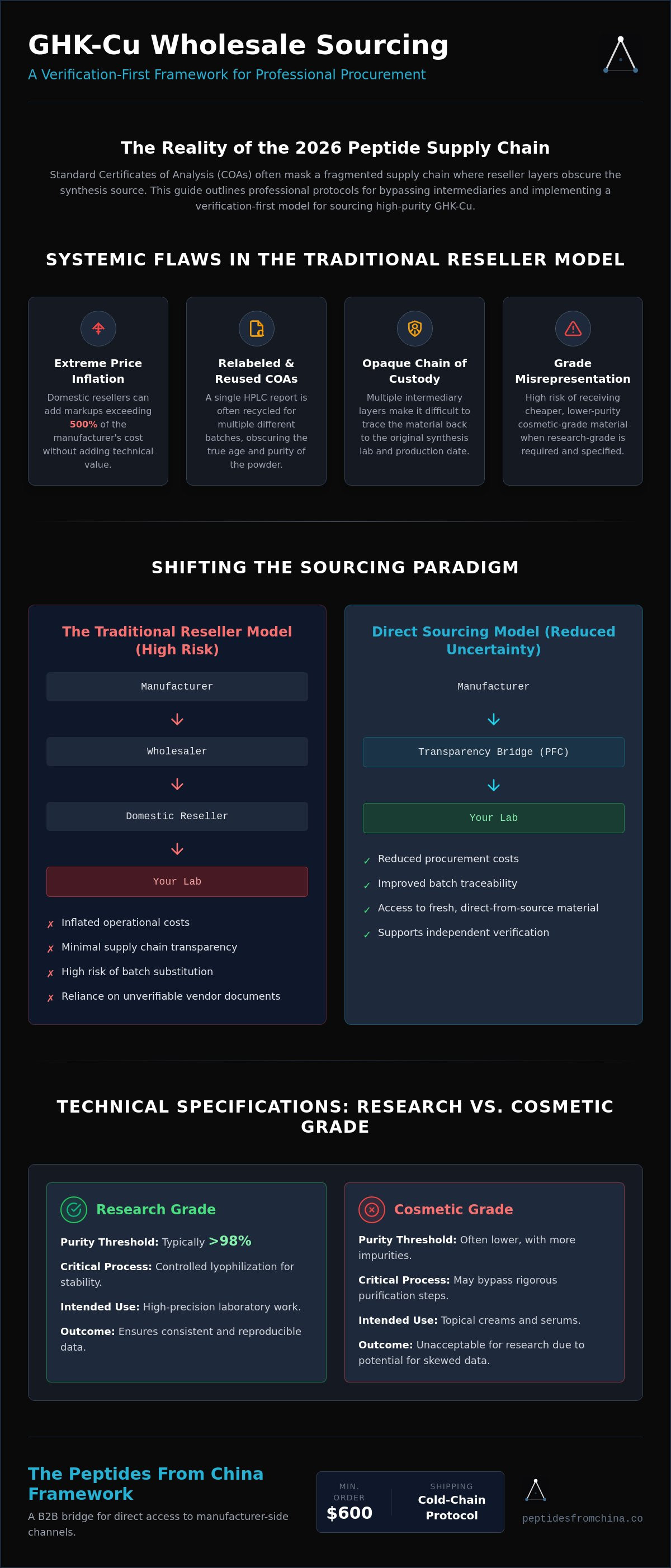
Sourcing peptides for institutional research has shifted away from the retail-centric models of the past decade. In 2026, professional buyers recognize that the traditional GHK-Cu wholesale supplier landscape is often cluttered with domestic resellers who add significant markups without adding technical value. These intermediaries typically purchase bulk quantities from Chinese synthesis facilities, repackage the powder into smaller units, and apply price increases that can exceed 500% of the original manufacturing cost. This practice doesn't just inflate budgets; it introduces unnecessary risks by adding more hands to the chain of custody.
The Copper peptide GHK-Cu is a sophisticated molecule that requires precise synthesis to remain effective. When procurement professionals encounter "cheap" bulk offers, it's often an indicator of cosmetic-grade material. While suitable for topical creams, cosmetic-grade powder frequently contains higher levels of residual solvents and impurities that are unacceptable for high-precision laboratory work. Reliable sourcing now favors a direct-to-manufacturer approach to ensure the material remains as close to the synthesis source as possible.
The Reseller Markup Problem
Domestic warehousing is often marketed as a convenience, but it functions primarily as a cost center for the buyer. Every layer between the synthesis lab and your facility represents a point where costs increase and transparency decreases. For orders exceeding the $600 threshold, the economic logic of bypassing these intermediaries becomes undeniable. By utilizing a transparency-focused bridge like Peptides From China (PFC), researchers can access wholesale peptides directly from the production source. This model eliminates the "reseller tax" and provides a clearer view of the production timeline, which is essential for maintaining a consistent supply of fresh material.
Industry Flaws: Relabeling and Reused Data
A systemic issue within the peptide industry is the use of "template" Certificates of Analysis (COAs). It's common for a GHK-Cu wholesale supplier to provide a single HPLC report for multiple different batches produced months apart. This relabeling practice obscures the true age and specific purity of the powder currently in the vial. You should view manufacturer-issued papers only as baseline technical reference material. Because batch substitution is a persistent risk in high-volume procurement, the necessity of peptide testing by the buyer remains the only way to support independent verification. Relying on a PDF from a vendor isn't a quality control strategy; it's a documentation formality that requires secondary validation.
Technical Specifications: Distinguishing Research-Grade GHK-Cu
High-purity sourcing begins with understanding the chemical identity of the material. GHK-Cu, or Copper Tripeptide-1, is a complex formed by the tripeptide Glycyl-L-Histidyl-L-Lysine and a copper(II) ion. While many retail-facing vendors treat it as a simple powder, a professional GHK-Cu wholesale supplier must provide material that has undergone controlled lyophilization. This freeze-drying process is critical for ensuring powder stability and long-term shelf life during transit. Without proper lyophilization, the peptide is susceptible to degradation when exposed to moisture or temperature fluctuations.
For institutional research, the purity threshold is typically set at 98% or higher. In the context of large-scale peptide production, achieving this involves rigorous purification steps to remove truncated sequences and residual reagents. Lower-grade "cosmetic" versions often bypass these steps. This results in material that may comply with basic FDA regulation of cosmetic ingredients but fails to meet the analytical requirements of a controlled laboratory environment. When purity drops below 98%, the presence of unknown impurities can skew research data and lead to inconsistent results across different batches.
Synthesis Methods and Purity Standards
Most high-purity GHK-Cu is produced via solid-phase peptide synthesis (SPPS), which allows for precise control over the amino acid sequence. Liquid-phase synthesis is sometimes used for massive volume, but it can lead to higher levels of residual solvents. Trifluoroacetic acid (TFA) levels are a primary concern here. High TFA concentrations can alter the pH of research solutions and compromise the integrity of the copper complex. Additionally, the choice of copper salt used in the complexing process, typically copper acetate or copper chloride, affects the final stability and solubility of the peptide. A reliable manufacturer will provide residual solvent analysis as part of their baseline documentation.
The "Blue Powder" Myth
The characteristic azure hue of GHK-Cu is the result of copper ions interacting with the peptide backbone. However, color is a deceptive metric. The exact shade varies based on the copper-to-peptide ratio and the pH level of the final batch. A darker blue doesn't necessarily indicate higher purity; it could simply reflect a different complexing protocol or, in worse cases, the presence of artificial dyes used to mask poor synthesis quality. Visual inspection should only serve as a secondary check. Identity and concentration must be verified through mass spectrometry and HPLC data. If you are evaluating a potential GHK-Cu wholesale supplier, you can view our current batch specifications to see how manufacturer-side data compares to retail marketing claims.
Beyond the COA: Verifying Purity and Concentration
A Certificate of Analysis (COA) is often presented by a GHK-Cu wholesale supplier as the final word on quality, but in professional procurement, it's merely a starting point. While a COA provides reference analytical data, it doesn't account for batch substitution or the potential for forged documentation. In an industry where relabeling is common, relying solely on vendor-provided papers exposes your research to significant uncertainty. High purity is required to replicate the findings seen in this scientific review of GHK-Cu's biological actions, where specific regenerative pathways are activated only when the peptide complex is correctly formed and free of competitive inhibitors.
Mass Spectrometry (MS) is essential because it confirms the molecular weight and identity of the complex. This ensures you aren't receiving a different blue copper salt or a degraded peptide chain. While High-Performance Liquid Chromatography (HPLC) measures the purity percentage, the MS report proves exactly what substance is being measured. Without both, a purity claim of 99% is technically meaningless because it doesn't identify the primary substance. Professional buyers treat these documents as baseline technical reference material rather than definitive proof of quality.
Analyzing HPLC and MS Reports
Reading a chromatogram requires looking beyond the main peak. The integration table should show all minor peaks, which represent impurities or residual reagents from the synthesis process. You must compare the experimental mass found in the MS report to the theoretical mass of the GHK-Cu complex to ensure they align within a narrow margin of error. You can identify a reused chromatogram by checking for identical noise patterns in the baseline of the graph, as random electronic interference ensures that no two authentic tests ever produce the same background signature. If the "noise" or jitter at the bottom of the graph looks identical across different batches, the report has likely been recycled or digitally altered.
Independent Third-Party Testing
Independent peptide testing is the only way to support independent verification of a batch. Professional laboratories should conduct their own internal verification or use a third-party lab to perform blind testing on every new shipment. This "trust but verify" protocol helps reduce supply chain uncertainty and ensures that the material matches the technical specifications required for your work. At Peptides From China (PFC), we operate as a transparency-focused B2B sourcing bridge that encourages this level of scrutiny. By facilitating direct access to synthesis facilities, we help you implement more realistic sourcing practices that prioritize data over marketing fluff.
Strategic Procurement: Logistics for Global Sourcing
Logistical management is the final hurdle in securing a reliable peptide supply. A professional GHK-Cu wholesale supplier must handle international transit with the same precision used during the synthesis process. Once you have verified the purity of a batch, the focus shifts to maintaining that integrity from the manufacturer to your facility. This requires a structured approach to shipping, customs documentation, and inventory planning to avoid costly research delays or material degradation.
At Peptides From China (PFC), we maintain a $600 minimum order requirement for all wholesale peptides. This threshold is not arbitrary; it's an operational necessity that allows us to utilize higher-tier international couriers and dedicated logistics channels. Consolidating procurement into larger orders helps reduce the cost-per-gram and ensures that each shipment receives the administrative oversight required for smooth transit. For most institutional laboratories, this minimum represents a baseline for maintaining a consistent quarterly inventory.
Managing Large-Scale Logistics
Temperature control is a frequent point of concern, but GHK-Cu is remarkably stable in its lyophilized form. While some peptides require strict cold-chain environments, lyophilized GHK-Cu can typically withstand ambient temperatures during short-term international transit without measurable degradation. The key to this stability is proper vacuum sealing. By removing oxygen and moisture from the vial, manufacturers extend the shelf-life of the powder and mitigate the risks of chemical breakdown during long-distance flights. We provide tracking protocols for every shipment, allowing you to monitor the progress of your material in real-time as it moves through global transit hubs.
Customs and Compliance
Navigating international customs requires a clear understanding of the distinction between "research use only" materials and commercial imports. Sourcing agents play a critical role here by managing the complex international documentation required to move technical substances across borders. Neutral packaging is the industry standard for reducing supply chain friction by minimizing unnecessary administrative scrutiny during customs clearance. This approach helps ensure that your shipment arrives without being flagged for secondary inspections that can last weeks. If you are ready to optimize your procurement, you can start your wholesale order through our verified manufacturer-side channels.
Lead times also vary significantly based on your specific requirements. While off-the-shelf manufacturer stock can often ship within 48 to 72 hours, large-scale custom synthesis for unique specifications may require 14 to 21 days for production and purification. Planning your procurement cycle around these timelines is essential for avoiding stockouts. A reliable GHK-Cu wholesale supplier will provide transparent communication regarding current production capacities and stock levels before you commit to a purchase.
Direct-to-Manufacturer Sourcing: The PFC Framework
The Sourcing Bridge Model
Supply chain opacity is a choice made by resellers to protect their margins. By contrast, our model prioritizes direct manufacturer communication to help reduce supply chain uncertainty. When you bypass the middleman, you gain access to manufacturer-side batch traceability, which is vital for long-term research consistency. This approach ensures that the reference analytical data you receive actually corresponds to the specific synthesis run you've purchased. PFC functions as a strategic partner that prioritizes operational consistency, allowing your procurement team to maintain a realistic understanding of sourcing dynamics without the interference of multiple reseller layers.
Getting Started with Wholesale Sourcing
Professional procurement requires a methodical verification process before any significant capital is committed. We utilize a $10 processing deposit to initiate a manufacturer audit and stock verification. This small commitment allows us to verify current inventory levels and synthesis timelines at the facility before you move forward. Once the manufacturer confirms availability and technical specifications, we provide a final invoice based on our transparent pricing structures for bulk GHK-Cu. This deposit ensures that we are only negotiating with verified stock, reducing the risk of batch substitution or delays.
The process follows these sequential steps:
Submit the $10 processing deposit to trigger the manufacturer audit.
Receive verification of current stock and synthesis timelines.
Review the final invoice, ensuring it meets our $600 minimum order requirement.
Finalize procurement and receive tracking protocols for international transit.
This framework supports independent verification and improves traceability across your entire supply chain. If you are ready to move beyond the limitations of the reseller market, you can initiate your GHK-Cu sourcing verification today through our verified B2B channels. By focusing on manufacturing standards and factual accuracy, we help you secure the material required for high-precision laboratory work while maintaining a streamlined, reliable bridge to production facilities.
Optimizing Your Peptide Procurement Strategy
Peptides From China (PFC) serves as the transparency-focused B2B bridge that connects your facility directly to verified synthesis labs. Our framework prioritizes operational consistency and factual accuracy, ensuring your procurement meets the standards of a professional laboratory environment. With our $600 minimum order requirement and methodical audit process, you can gain direct access to manufacturer-side channels while minimizing reseller layers. We invite you to start your $10 sourcing deposit for wholesale GHK-Cu to initiate the manufacturer verification protocol today. Establishing a direct and transparent supply chain is the most effective way to support your long-term research goals.
Frequently Asked Questions
How can I verify if a GHK-Cu wholesale supplier is a factory or a reseller?
You can distinguish a factory from a reseller by requesting a technical facility audit or evidence of direct synthesis capabilities. Resellers typically operate domestic warehouses and apply significant markups to imported material. A true GHK-Cu wholesale supplier that functions as a factory will have specific synthesis lead times rather than just off-the-shelf domestic stock.
What is the standard purity for research-grade GHK-Cu powder in 2026?
Research-grade GHK-Cu powder in 2026 should maintain a purity threshold of at least 98%. While many vendors claim 99% or higher, these figures often represent the best case scenario of a specific peak rather than the total batch average. Professional laboratories treat 98% as the baseline for ensuring that residual reagents don't interfere with experimental outcomes.
Why does the color of GHK-Cu powder vary between different wholesale batches?
The variation in azure hue is primarily caused by the copper-to-peptide complexing ratio and the pH level during the final precipitation step. A darker or lighter blue doesn't correlate directly with higher purity levels. You should use color only as a secondary visual check; identity must be confirmed through mass spectrometry to ensure the correct molecular weight is present.
What is the minimum order amount for wholesale procurement through Peptides From China?
The minimum order requirement for wholesale procurement through Peptides From China is $600. This threshold allows us to maintain the logistical oversight required for international transit and utilize high-tier couriers. It ensures that the administrative costs of manufacturer verification and customs documentation are effectively distributed across the order for maximum efficiency.
Can I trust the HPLC reports provided by the manufacturing facility?
You should treat manufacturer-provided HPLC reports as baseline reference material rather than definitive proof of quality. It's common in the industry for reports to be recycled across different batches or for template data to be used. You can often spot these by looking for identical electronic noise patterns in the baseline of the chromatogram graph, as random interference is never identical.
How should bulk GHK-Cu be stored to ensure long-term stability?
Bulk GHK-Cu should be stored in its lyophilized powder form at -20°C or -80°C for long-term stability. While the powder is stable at ambient temperatures during short-term transit, it's sensitive to moisture and light. Always ensure the vials are vacuum-sealed and kept in a desiccated environment to prevent the copper complex from degrading over time.
What are the typical lead times for custom GHK-Cu synthesis orders?
Typical lead times for custom synthesis orders range from 14 to 21 days depending on the purification requirements and batch size. If a GHK-Cu wholesale supplier claims immediate shipping for custom specifications, they're likely providing pre-existing stock that may not match your requirements. Standard manufacturer stock usually ships within 48 to 72 hours of invoice finalization.
Is independent third-party testing necessary if the supplier provides a COA?
Independent third-party testing is necessary because it's the only way to support independent verification of the material's identity and purity. A COA is a vendor's claim; a third-party lab report is your confirmation. Implementing a trust but verify protocol helps reduce supply chain uncertainty and ensures your research data remains reliable across different synthesis batches.