
With the global market for GHK-Cu projected to reach $211 million in 2026, the sheer volume of new suppliers entering the space has made it harder than ever to distinguish genuine synthesis facilities from high-markup resellers. If you've managed large-scale procurement, you've likely dealt with the frustration of batch-to-batch inconsistency or realized that your "direct" factory source is actually a trading company operating from a shared office. Sourcing GHK-Cu peptide china requires more than just a cursory glance at a PDF. It demands a technical understanding of the evolving regulatory landscape, including the implementation of the new NMPA YY/T 10005;2026 standards.
We understand that a standard COA is often just a baseline reference rather than a definitive guarantee of identity. This guide provides an insider's look at establishing a transparent supply line, reducing costs by removing unnecessary markups, and obtaining the documentation necessary for independent verification. You'll learn how Peptides From China (PFC) acts as a B2B sourcing bridge for wholesale orders starting at $600, helping you move past the opacity of the traditional market. We'll break down the logistics of manufacturer verification, the reality of HPLC reports, and how to secure a reliable pipeline for your 2026 operations.
Key Takeaways
Treat HPLC and Mass Spectrometry reports as baseline reference analytical data rather than definitive proof of product identity or purity.
Navigate the shifting regulatory landscape for GHK-Cu peptide china, specifically the implementation of new NMPA technical specifications for 2026.
Distinguish between direct synthesis facilities and high-markup trading companies to eliminate unnecessary reseller layers and improve batch consistency.
Leverage a $10 processing deposit to initiate manufacturer verification and secure documentation for wholesale orders starting at $600.
Build a direct-to-manufacturer procurement strategy that reduces supply chain uncertainty and supports your own independent verification protocols.
Table of Contents
The GHK-Cu Market in China: Synthesis Standards and Research Utility
Evaluating Purity: Decoding GHK-Cu Technical Documentation
Manufacturers vs. Trading Companies: A B2B Comparison
Procurement Protocols for GHK-Cu Wholesale Orders
Direct Sourcing: Reducing Supply Chain Uncertainty
The GHK-Cu Market in China: Synthesis Standards and Research Utility
China's chemical hubs have established themselves as the global epicenter for high-volume peptide production. This dominance is driven by an unmatched infrastructure for large-scale synthesis. For B2B buyers, navigating the GHK-Cu peptide china market requires a technical grasp of CAS 89030-95-5, the specific identifier for authentic copper tripeptide-1. This is especially relevant as the industry adapts to the new NMPA YY/T 10005-2026 standards, which establish stricter technical specifications for purity and identification. While retail blogs focus on superficial benefits, professional procurement focuses on the distinction between cosmetic-grade bulk powder and research-grade lyophilized vials. The former is typically produced in multi-kilogram batches for topical formulations, whereas the latter undergoes additional processing to ensure stability for laboratory utility.
The complexity of Copper peptide GHK-Cu lies in its complexation. It isn't just a peptide chain; it's a specific arrangement where a copper (II) ion is bound to the tripeptide. If this complexation step is handled improperly during manufacturing, the resulting product may lack the stability required for consistent research results. Peptides From China (PFC) serves as a transparency-focused bridge to these facilities, facilitating wholesale orders with a $600 minimum to ensure buyers access manufacturer-side pricing without the typical reseller layers.
Synthesis Pathways for Copper Peptides
Manufacturers generally choose between solid-phase peptide synthesis (SPPS) and liquid-phase synthesis. SPPS is the preferred method for high-purity research materials because it allows for easier purification of the peptide chain before the copper complexation occurs. Liquid-phase synthesis is often reserved for massive industrial runs where cost-efficiency is the primary driver. In 2026, the manufacturing scale heavily dictates the final price per gram. High-volume runs in Chinese facilities can significantly lower procurement costs, but they also increase the need for batch-specific verification to ensure the complexation remains uniform across the entire lot.
Common Market Misconceptions in 2026
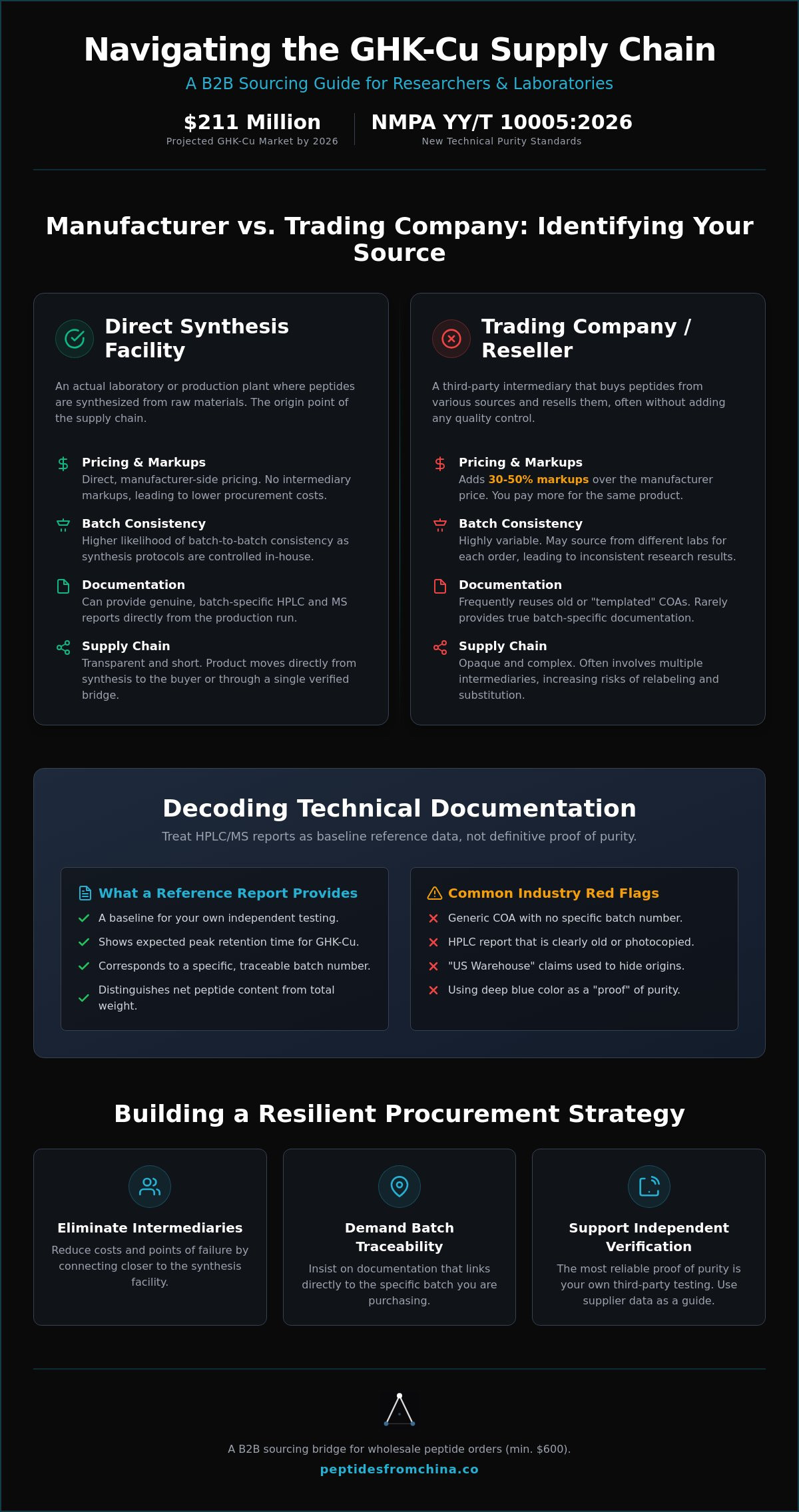
A persistent myth in the industry is that a deep blue color serves as a proxy for peptide concentration or purity. It doesn't. The color is simply a result of the copper complexation; it can be easily manipulated or mimicked by adjusting the copper salt ratios. Another common tactic involves "US Warehouse" claims. Many Chinese trading companies use these labels to hide the fact that they're relabeling stock from various sources. These resellers often add 30-50% markups without providing any additional quality control. B2B buyers should be wary of these structures. Direct sourcing helps minimize these risks, though it requires a realistic approach to supply chain uncertainty. Batch substitution remains a risk in high-volume markets, making independent testing a necessity for any serious laboratory operation.
Evaluating Purity: Decoding GHK-Cu Technical Documentation
In the B2B space, the "99% purity" label is often used as a marketing tool rather than a technical specification. When sourcing GHK-Cu peptide china, you shouldn't accept High-Performance Liquid Chromatography (HPLC) or Mass Spectrometry (MS) reports as definitive proof. These documents are baseline reference analytical data. They're often outdated or "templated" versions shared across multiple batches or even different suppliers. True batch-specific documentation is rare in the reseller market, where certificates of analysis (COAs) are frequently reused to move stock from various synthesis runs.
Understanding the Regenerative and Protective Actions of GHK-Cu requires a product that matches the specific molecular profile used in clinical literature. This means distinguishing between net peptide content and total powder weight. A vial might contain 50mg of powder, but if the net peptide content is only 80%, you're working with significantly less active material than your research protocol requires. If you need to verify these details before a large purchase, you can initiate manufacturer verification through our transparency-focused bridge.
Reading an HPLC Chromatogram for GHK-Cu
A legitimate HPLC report displays a primary peak representing the target molecule. You should look closely at the integration of smaller peaks, which indicate impurities such as residual solvents, salts, or uncomplexed GHK. Peptide purity is defined as the ratio of the target peak area to the total peak area on the chromatogram. High purity doesn't mean the absolute absence of impurities; it means they fall within acceptable reference ranges for research utility. Large-scale synthesis often leaves traces of trifluoroacetic acid (TFA) or other solvents that must be accounted for in your laboratory calculations.
The Role of Mass Spectrometry
Mass Spectrometry confirms the identity of the molecule by measuring its mass-to-charge ratio. For GHK-Cu, you're looking for a molecular weight of approximately 403.9 g/mol. This step is critical because it helps distinguish the authentic complex from cheaper blue-colored analogues that lack the same biological profile. While a COA is a useful starting point, independent testing remains the only way to support independent verification of purity. PFC helps reduce supply chain uncertainty by facilitating access to manufacturer-issued papers for batch traceability on wholesale orders starting at $600. Using a $10 processing deposit allows buyers to initiate the verification of these technical documents directly with the synthesis facility before committing to a full procurement cycle.
Manufacturers vs. Trading Companies: A B2B Comparison
To verify a supplier's true status, you must examine their Chinese business registration data. Legitimate synthesis facilities have a "scope of business" that explicitly includes chemical manufacturing or peptide synthesis. If the registration only lists "consulting" or "wholesale trade," you're dealing with a trading company. These entities often use "Audited Supplier" badges on major B2B platforms, but these labels frequently mask a total lack of internal synthesis capacity. A Scientific Overview of GHK-Cu Peptide confirms that the molecule's biological utility depends on precise complexation. Direct manufacturers control this process from start to finish, ensuring the copper-to-peptide ratio remains consistent across multi-kilogram runs. Trading companies, by contrast, pull from whichever factory is cheapest that week, leading to the batch-to-batch variability that plagues large-scale research projects.
Identifying Direct Synthesis Labs
Real synthesis labs prioritize B2B volume and technical integrity. Indicators of a legitimate facility include the availability of custom synthesis options and technical staff who can discuss amino acid sequencing rather than just sales reps following a script. You won't find these facilities selling single vials on retail platforms; the administrative overhead of retail is incompatible with a factory's operational model. Peptides From China (PFC) serves as an analytical filter in this landscape, routing buyers to these synthesis channels while maintaining a $600 minimum for wholesale orders.
Supply Chain Comparison
Direct Manufacturer: Offers factory-direct pricing and high transparency. You receive batch-specific reference analytical data directly from the source. Consistency is maintained through standardized synthesis protocols.
Trading Company: Prices are typically 30-50% higher. Transparency is low because they must hide their sources to prevent you from bypassing them. Traceability is variable and often relies on reused or templated COAs.
PFC acts as a transparency-focused B2B sourcing bridge rather than a manufacturer or a laboratory. By using a $10 processing deposit, buyers can initiate manufacturer verification and secure documentation directly from the synthesis facility. This approach helps reduce supply chain uncertainty by ensuring the material is routed through the most direct channels possible, minimizing the risks associated with relabelling and batch substitution.
Procurement Protocols for GHK-Cu Wholesale Orders
To help reduce this uncertainty, we utilize a $10 processing deposit system. This allows B2B buyers to initiate manufacturer stock and documentation verification without an immediate full capital commitment. It's a protective filter that ensures you're reviewing actual manufacturer-issued papers and reference analytical data for the specific batch in the synthesis queue. Managing lead times is equally critical. In 2026, synthesis queues can vary based on facility capacity and the complexity of the copper complexation step. Your procurement timeline must account for both production and the mandatory final analysis phase before international dispatch.
The PFC Sourcing Workflow
The process begins with a technical request for specific GHK-Cu volumes. Whether you're sourcing 500mg, 1g, or multi-kilogram bulk powder, the first step is requesting a quote that reflects current 2026 synthesis costs. Once a quote is issued, you can use the $10 deposit to initiate the verification of manufacturer-provided COAs and batch data. This reference material provides a baseline for your own independent testing protocols. For a broader look at this process, see our guide on Wholesale Peptides: A 2026 B2B Sourcing Guide for Research Institutions. Only after technical approval of the reference data do you finalize the $600+ wholesale order.
Payment and Shipping Security
Managing international laboratory logistics requires a realistic understanding of customs clearance. In 2026, research-grade compounds are subject to rigorous scrutiny. This makes neutral, discreet packaging a necessity for maintaining a streamlined logistics chain. While tracking numbers provide a baseline for logistics, they don't solve the inherent risks of international shipping. Professional buyers must balance payment methods that offer some level of protection with the standard requirements of high-volume synthesis facilities. Tracking the journey from the synthesis facility to your lab is the final step in a process that prioritizes traceability over marketing hype. To secure your 2026 supply chain, you can request a manufacturing verification to start the technical vetting process.
Direct Sourcing: Reducing Supply Chain Uncertainty
Direct sourcing represents the most effective method for minimizing the inherent risks of the 2026 market. When you bypass the common reseller layer, you significantly reduce the likelihood of encountering relabelled stock or batch substitution. The complexity of sourcing GHK-Cu peptide china lies in the opacity of the traditional supply chain. Most intermediaries don't have access to the original synthesis facility. They rely on third-party stock that may have been sitting in sub-optimal conditions for months. By establishing a direct manufacturer connection, you improve traceability and ensure the material is coming from a fresh synthesis run rather than aged inventory.
Peptides From China (PFC) functions as a protective, analytical filter for B2B buyers. We don't offer guaranteed purity or pharmaceutical-grade claims. Instead, we provide a transparency-focused bridge to synthesis facilities that typically ignore smaller professional inquiries. This shift toward transparency-first procurement is a hallmark of the 2026 research market. Buyers are moving away from "black box" suppliers and toward models that prioritize factual accuracy and direct routing. While we facilitate access to manufacturer-issued reference analytical data, we maintain that no single document replaces the necessity of buyer-side independent testing. Every batch should be verified in your own facility or a trusted third-party lab to confirm it meets your specific research requirements.
Why PFC is the Preferred Sourcing Bridge
Unlike many suppliers who claim to have domestic US or EU warehousing, PFC focuses on direct manufacturer channels. Domestic "warehouses" are often just high-markup resellers with limited knowledge of the original synthesis conditions. Our model prioritizes operational consistency through verified synthesis facility partnerships. We help you access the source directly, ensuring that the documentation you receive is actually tied to your specific lot. For a deeper analysis of these different procurement models, you can read our comparison of a Peptide Sourcing Agent vs. Platform: A 2026 Procurement Guide for Research Labs. This approach minimizes the risk of receiving uncomplexed GHK or unrelated blue-colored analogues.
Next Steps for Professional Procurement
The first step in procuring GHK-Cu peptide china through a direct channel is initiating a manufacturer verification. You can do this by submitting a $10 processing deposit, which allows us to pull current batch data and stock availability from the factory floor. This deposit is a technical vetting tool, not a sales tactic. It ensures that your lab is reviewing real-time reference data before you commit to a full wholesale order. Once the technical data is reviewed, you can finalize your procurement for orders starting at $600. Prepare your lab for independent verification of incoming batches to ensure your research protocols remain consistent. To begin this process, you should contact Peptides From China to verify current GHK-Cu manufacturer stock and initiate your technical request.
Securing Your 2026 GHK-Cu Supply Chain
The transition toward more stringent synthesis standards in 2026 requires a shift in how professional buyers approach the market. Navigating the procurement of GHK-Cu peptide china successfully depends on your ability to bypass the reseller layer and engage directly with synthesis facilities. We've established that manufacturer-provided documentation is a baseline for technical reference; it's not a substitute for your own independent testing protocols. By prioritizing transparency and direct routing, you reduce the risks of batch inconsistency and relabeling that often occur in the high-volume market.
Peptides From China (PFC) helps you manage these complexities by acting as a dedicated sourcing bridge. We provide direct-to-manufacturer routing and batch-specific COA verification to support your independent verification efforts. If you're ready to move past the markup of trading companies, you can secure direct manufacturer pricing for GHK-Cu with a $10 sourcing deposit. This small step initiates the verification of current manufacturer stock for wholesale orders starting at $600. Establishing a methodical, data-driven supply line is the most reliable way to ensure operational consistency for your research laboratory.
Frequently Asked Questions
Is GHK-Cu from China the same as GHK-Cu produced in Western labs?
Chemically, the molecule is identical if synthesized to the same CAS 89030-95-5 standards. China is the global hub for high-volume peptide synthesis, and many Western brands actually source their raw materials from Chinese facilities before relabeling. The primary difference isn't the geography of the lab, but the transparency of the supply chain and the rigour of the independent verification performed on each batch.
How much is the minimum order for GHK-Cu through Peptides From China?
The minimum order requirement for wholesale procurement is $600. This threshold is established to ensure that buyers can access manufacturer-side pricing and direct synthesis channels. By maintaining this minimum, we help B2B buyers and research institutions bypass the significant markups typically added by retail resellers and domestic trading companies.
Can I trust the HPLC reports provided by Chinese GHK-Cu manufacturers?
You should treat manufacturer-issued HPLC reports as baseline reference analytical data rather than absolute proof of quality. In the GHK-Cu peptide china market, it's common for documentation to be reused or templated across different batches. While these reports provide a technical starting point, they don't eliminate the necessity for independent testing by the buyer to support independent verification of purity.
What happens if the GHK-Cu batch does not meet my lab's purity requirements?
Independent verification is a critical step that every professional buyer should perform. PFC acts as a transparency-focused sourcing bridge to help you access direct manufacturer channels and reduce reseller layers. Because we aren't a testing laboratory or the manufacturer, we facilitate the routing of technical data to help you make informed procurement decisions. Any discrepancies found during your independent testing should be addressed through the specific manufacturer's batch resolution protocols.
How does the $10 deposit system work for peptide sourcing?
The $10 processing deposit is used to initiate manufacturer stock and documentation verification. This small fee allows us to pull real-time batch papers and reference analytical data directly from the synthesis facility. It serves as a technical filter, allowing you to review the manufacturer's current documentation before you commit to a full wholesale order of $600 or more.
What is the typical lead time for wholesale GHK-Cu orders from China?
Typical lead times for GHK-Cu peptide china range from 10 to 21 days from the synthesis queue to international tracking. This timeline accounts for the complexation process, the manufacturer's internal quality analysis, and the logistics of international dispatch. Lead times can fluctuate based on the specific synthesis facility's current capacity and the volume of the wholesale request.
Does Peptides From China provide human-grade pharmaceuticals?
No, we don't provide human-grade pharmaceuticals or retail single-vial sales. Our operations are strictly limited to B2B sourcing of research-grade compounds for laboratories, procurement professionals, and researchers. All materials sourced through our bridge are intended for laboratory utility and must be handled according to professional research protocols.
Why is GHK-Cu often referred to as 'Blue Copper' in manufacturing?
The name stems from the distinctive blue hue that occurs when the GHK tripeptide is complexed with copper (II) ions. In a manufacturing context, this color is a sensory characteristic of the copper tripeptide-1 complex. It's important to remember that color intensity isn't a definitive proxy for purity or concentration, as the visual appearance can be manipulated by adjusting copper salt ratios during the synthesis process.