
A Certificate of Analysis is often treated as a definitive guarantee of purity, but in the high-volume peptide market, it's frequently just a static reference point that fails to account for batch-to-batch variability. When analyzing CJC-1295 vs Ipamorelin, the technical distinction between a GHRH mimetic and a Ghrelin receptor agonist is only part of the equation. The more pressing concern for professional buyers is navigating a global supply chain where reseller mark-ups and recycled documentation are the industry standard. You've likely realized that while the physiological synergy of these compounds is well-documented, the transparency of their origin is often non-existent.
This article provides an operational framework for understanding these peptides beyond the marketing hype. You'll gain a technical breakdown of their biological mechanisms and a realistic strategy for verifying manufacturer-side quality. We'll explore the logistics of direct sourcing, the necessity of independent laboratory testing, and how professional procurement teams manage the $600 minimum order requirement to bypass the risks of the retail middleman. By the end, you'll have the data needed to secure more consistent, traceable supplies for your research requirements.
Key Takeaways
Differentiate between GHRH analogs and Ghrelin receptor agonists to understand the physiological synergy required for optimized pituitary stimulation.
Evaluate the technical specifications of Mod GRF 1-29 versus CJC-1295 with DAC to ensure your sourcing aligns with specific research rhythms and half-life requirements.
Develop a framework for comparing CJC-1295 vs Ipamorelin that prioritizes batch traceability and helps reduce supply chain uncertainty.
Implement manufacturer-side quality verification protocols to move beyond reliance on static, potentially recycled COAs provided by resellers.
Optimize professional-grade procurement through direct-to-manufacturer channels that require a $600 minimum order to eliminate unnecessary intermediary layers.
Table of Contents
Mechanisms of Action: GHRH Analogs vs. Ghrelin Receptor Agonists
CJC-1295 Technical Analysis: DAC vs. Mod GRF 1-29 (No DAC)
Ipamorelin Specifics: Selectivity and Laboratory Performance
Comparative Procurement: Synergy, Purity, and Batch Consistency
Strategic Wholesale Sourcing: Direct Manufacturer Access for CJC and Ipamorelin
Mechanisms of Action: GHRH Analogs vs. Ghrelin Receptor Agonists
The GH-IGF-1 axis acts as the primary metabolic target for these research compounds, serving as the central pathway for growth hormone regulation and cellular repair. In a clinical context, the management of these complex hormonal and internal medicine pathways is a specialty of institutions like Poliklinika Dr. Nabil. Understanding the mechanical differences between GHRH analogs and ghrelin receptor agonists is essential for any technical procurement strategy. These compounds don't just increase hormone levels; they interact with the pituitary gland through distinct, complementary biological signals.
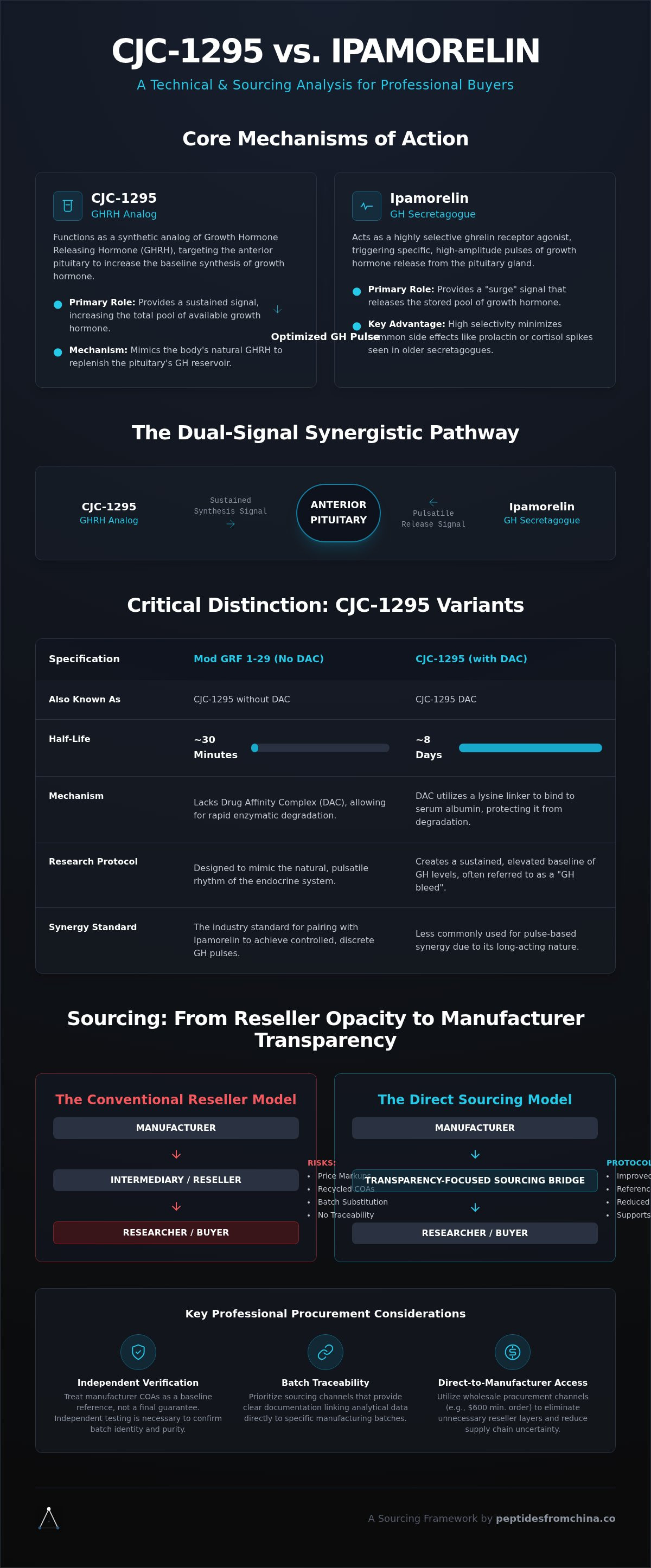
CJC-1295 functions as a synthetic analog of Growth Hormone Releasing Hormone (GHRH). It targets the anterior pituitary directly to stimulate the production and secretion of growth hormone. This mechanism provides a baseline signal that instructs the pituitary to maintain a higher level of GH synthesis. By mimicking the body's natural GHRH, it ensures that the "reservoir" of available growth hormone remains replenished.
Ipamorelin operates through a different pathway. It acts as a selective ghrelin receptor agonist, often classified as a secretagogue. Instead of focusing solely on baseline synthesis, it triggers specific, high-amplitude pulses of growth hormone. When evaluating CJC-1295 vs Ipamorelin, it's clear they're designed to complement one another. Utilizing these two distinct pathways helps researchers avoid pituitary exhaustion, which can occur when a single pathway is over-stimulated without the support of the other. This dual-signal approach more closely replicates the body's natural endocrine rhythms.
While laboratory research focuses on these complex signaling pathways, those interested in nutritional support for natural development can discover Tallori, which offers specialized supplements designed to optimize growth potential.
The Pituitary Signaling Pathway
The synergy between these compounds relies on how they manage pituitary signaling. GHRH analogs provide a sustained signal, effectively increasing the total pool of available growth hormone. Ghrelin mimics like Ipamorelin provide the "surge" signal that releases that pool into the system. Researchers must differentiate between signal sustain and signal surge to optimize laboratory outcomes. Without the baseline sustain from a GHRH analog, the surge from a secretagogue may diminish in intensity over time as the pituitary's immediate supply is depleted.
Selective vs. Non-Selective Secretagogues
Ipamorelin represents a technical evolution over older peptides like GHRP-2 and GHRP-6. Its status as a highly selective pentapeptide means it has a specific affinity for the ghrelin receptor. A critical metric for Ipamorelin research is the near-total absence of prolactin and cortisol spikes, which are common issues with non-selective secretagogues. This selectivity is vital for maintaining the integrity of long-term laboratory studies. When procurement professionals evaluate CJC-1295 vs Ipamorelin for high-volume orders, verifying this selectivity through independent analytical data is necessary to ensure the batch hasn't been substituted with cheaper, less selective alternatives that could skew research results.
CJC-1295 Technical Analysis: DAC vs. Mod GRF 1-29 (No DAC)
The distinction between CJC-1295 with DAC and Mod GRF 1-29, frequently labeled as CJC-1295 No DAC, is a primary source of confusion in the wholesale market. From a manufacturing perspective, the difference is defined by a covalent bond. The Drug Affinity Complex (DAC) utilizes a lysine linker to bind the peptide to serum albumin, protecting it from rapid enzymatic degradation. This modification isn't just a minor chemical tweak. It fundamentally alters the compound's pharmacokinetics and dictates how research protocols are designed.
Mod GRF 1-29 is the preferred choice for researchers aiming to mimic the natural pulsatile rhythm of the endocrine system. Because it lacks the DAC modification, its half-life is approximately 30 minutes. This allows for controlled, discrete surges of growth hormone when paired with a secretagogue. While Ipamorelin was developed as the first selective growth hormone secretagogue to provide clean pulses, Mod GRF 1-29 provides the necessary GHRH signal to support those pulses without overwhelming the pituitary for extended periods. When evaluating CJC-1295 vs Ipamorelin synergy, the version without DAC is almost always the standard for pulse-based studies.
Pharmacokinetics and Pulse Management
The half-life discrepancy between these two variants is massive: minutes for Mod GRF versus roughly eight days for the DAC version. This extended half-life leads to a phenomenon known as "GH Bleed." Constant signaling from the DAC-bound peptide causes the pituitary to release growth hormone continuously rather than in natural, high-amplitude pulses. This permanent signaling can lead to pituitary desensitization or reduced responsiveness over long-term studies. Most laboratories avoid DAC for this reason, favoring the precision of the non-DAC variant to maintain physiological relevance.
Sourcing DAC-Specific Compounds
Synthesizing high-purity DAC-bound peptides is significantly more resource-intensive for manufacturing facilities. The addition of the Drug Affinity Complex requires more complex purification steps and specialized equipment. If you encounter price parity between DAC and No DAC versions, it's a major red flag. Low-cost "DAC" is often just mislabeled Mod GRF 1-29. Procurement risks also include cross-contamination during large-scale synthesis runs, where traces of DAC can find their way into "No DAC" batches.
Verifying the chemical identity of your batch through independent Mass Spectrometry is the only way to confirm you've received the correct modification. Professional labs looking to reduce supply chain uncertainty often bypass resellers who might not even know which variant they're holding. Accessing manufacturer-side channels through a B2B bridge like Peptides From China helps ensure that technical specifications are met at the production level. For those managing professional-grade procurement, maintaining a $600 minimum order allows for direct routing to these facilities, ensuring that Mod GRF 1-29 and DAC orders remain distinct and accurately labeled from the source.
Ipamorelin Specifics: Selectivity and Laboratory Performance
Ipamorelin's status as a pentapeptide differentiates it from larger peptide chains, offering a highly specific affinity for the ghrelin receptor. This selectivity is the primary reason it has largely superseded earlier secretagogues like Hexarelin in modern laboratory research. While Hexarelin is known for high potency, it often triggers undesirable increases in ACTH and prolactin levels. Ipamorelin's lack of impact on ACTH or prolactin is its primary technical advantage. This allows researchers to isolate growth hormone pulses without the confounding variables of secondary hormonal responses, which is critical for maintaining the accuracy of data in metabolic studies. When analyzing CJC-1295 vs Ipamorelin, the secretagogue’s selectivity ensures that the observed physiological changes are directly attributable to GH secretion rather than a broad endocrine spike. Beyond hormonal signaling, those interested in how dietary choices influence metabolic outcomes can learn more about Eating Well on a GLP-1 Journey.
The impact of purity levels on these outcomes cannot be overstated. Low-grade synthesis often results in batches that contain residual solvents or truncated peptide sequences. These impurities can inadvertently trigger the very stress responses Ipamorelin is designed to avoid. For those managing high-volume procurement, relying on a single HPLC report is a baseline reference but not a guarantee of this selectivity. A comprehensive CJC-1295 Technical Overview helps illustrate how these synergistic compounds require precise synthesis to maintain their intended pharmacological profile. Verification through multiple analytical layers helps reduce supply chain uncertainty and ensures that the laboratory performance remains consistent across different research phases.
The Pentapeptide Synthesis Standard
Maintaining the integrity of Ipamorelin’s 5-amino acid sequence requires strict synthesis protocols. Common impurities found in lower-tier batches often include truncated sequences where one or more amino acids failed to couple correctly. Reading Mass Spectrometry (MS) data is the standard method for confirming identity. Researchers should look for the primary peak at approximately 711.9 g/mol. If the MS data shows significant secondary peaks, it suggests a lack of sequence integrity that could compromise the selectivity of the ghrelin receptor binding.
Research Applications and Consistency
Ipamorelin is widely considered the cleanest secretagogue for body composition and recovery studies due to its high selectivity index. Managing batch consistency is the biggest challenge when ordering 100+ vials for large-scale trials. Variations in synthesis purity between batches can lead to receptor desensitization or inconsistent GH pulse amplitudes. Accessing manufacturer-side channels via a B2B bridge like Peptides From China helps laboratories bypass the batch-substitution risks common among retail resellers. By adhering to a $600 minimum order, professional buyers can establish a direct sourcing route that prioritizes traceability and supports independent verification of every batch. For individuals looking to apply these metabolic insights to personal health goals, Dr. Harris Medical Weight Loss offers medically supervised weight management programs.
Comparative Procurement: Synergy, Purity, and Batch Consistency
The synergy between GHRH and GHRP compounds is a cornerstone of pituitary research. While CJC-1295 provides the necessary signal for growth hormone synthesis, Ipamorelin acts to inhibit somatostatin, the body's natural "off switch" for GH release. This biological amplification is why the CJC-1295 vs Ipamorelin pairing remains the industry standard. However, the technical challenge for procurement professionals isn't just understanding the biology; it's ensuring that both components of the stack meet identical purity thresholds. Traceability becomes complicated when these synergistic pairs are sourced through multiple intermediaries who may be pulling from different manufacturing batches.
The Logic of the CJC/Ipamorelin Pairing
This pairing works because of a two-pronged attack on the GH-IGF-1 axis. GHRH initiates the signal, while Ipamorelin clears the pathway by suppressing somatostatin. This results in a significantly higher GH pulse than either peptide could achieve in isolation. For high-volume research, sourcing these as separate vials is generally preferred over pre-mixed blends. Separate vials allow for precise titration and reduce the risk of peptide degradation that can occur in complex mixtures during transit. Buying both compounds from a single manufacturer helps improve traceability and ensures that the synthesis protocols for each batch are consistent.
Supply Chain Hazards for Synergistic Peptides
The retail reseller market is rife with relabeling and batch substitution. It's common for resellers to provide a single, months-old COA to cover dozens of subsequent batches. When sourcing a synergistic pair, the risk is doubled. A high-purity CJC-1295 batch is useless if paired with a low-grade, non-selective secretagogue that introduces cortisol spikes into your data. Some resellers even use "peptide stacks" as a mechanism to offload lower-purity components alongside a single high-quality vial. This practice obscures the true quality of the individual compounds and compromises the integrity of the research.
Independent peptide testing is the only operational method to verify synergy-grade purity. Relying on manufacturer-issued papers as definitive proof is a strategic error. Instead, professional labs use these documents as baseline reference material while conducting their own HPLC and Mass Spectrometry analysis. To minimize these risks, labs are increasingly moving toward direct-to-manufacturer channels. By maintaining a $600 minimum order, buyers can access production-side traceability that resellers simply cannot provide. If you're looking to secure manufacturer-direct peptide batches, establishing a bridge to the synthesis facility is the most effective way to ensure long-term batch consistency and reduce supply chain uncertainty.
Strategic Wholesale Sourcing: Direct Manufacturer Access for CJC and Ipamorelin
The standard peptide market operates through a network of retail resellers who prioritize domestic convenience over batch-level transparency. Much like the meticulous selection process for specialty beans at Caffeine Lab, professional sourcing requires a commitment to origin and quality that goes beyond simple convenience. For professional laboratories, this model is fundamentally flawed. Resellers typically purchase in bulk, relabel vials, and provide static COAs that may not correspond to the actual synthesis run currently in stock. Peptides From China coordinates manufacturer-side sourcing and international logistics without relying on anonymous retail-reseller supply chains. By bypassing the reseller mark-up, procurement professionals can access manufacturer-side pricing while maintaining a direct line of sight to the production source.
Direct Sourcing vs. Reseller Layers
The "domestic convenience" of local warehousing comes at a significant technical cost. Every intermediary that handles a peptide batch increases the risk of chain-of-custody gaps and batch substitution. When sourcing CJC-1295 vs Ipamorelin, maintaining the integrity of each compound’s synthesis profile is vital for research accuracy. PFC operates as a peptide sourcing platform rather than a traditional retail shop. This model ensures that your order is routed directly to the facility, which helps reduce supply chain uncertainty and improves traceability. Labs that move away from retail resellers often find that the slight increase in shipping time is a necessary trade-off for higher operational consistency and better data integrity.
Operational Logistics and Verification
Navigating international logistics requires a methodical, highly organized approach to ensure delivery reliability. All orders are shipped in neutral packaging with international tracking provided to US and EU labs. Upon completion of a synthesis run, HPLC and Mass Spectrometry reports are issued. It is essential to treat these documents only as baseline technical reference material. We explicitly state that no single report fully guarantees product identity or purity; therefore, we encourage all professional buyers to conduct their own independent laboratory verification once the shipment arrives.
To initiate a sourcing request for CJC-1295 vs Ipamorelin, a processing deposit is required to filter for serious B2B inquiries. This deposit is credited toward the final order once manufacturing is approved. Following our wholesale peptides procurement model requires a $600 minimum order. This threshold is an operational minimum for orders placed through the PFC sourcing platform and may include multiple catalog products. The $10 deposit initiates manual request processing and real-time stock verification and is credited toward the final invoice; shipping details are confirmed during order processing.
Optimizing High-Volume Research Through Direct Sourcing
Differentiating between CJC-1295 vs Ipamorelin is the first step toward building a reliable research protocol. Technical knowledge of these pathways is only as valuable as the supply chain supporting it. You've seen how Mod GRF 1-29 and Ipamorelin provide the necessary pulsatile rhythm, while the "GH Bleed" associated with DAC can compromise study outcomes. The primary challenge remains batch consistency and the removal of reseller-induced risks that often plague the international market.
Professional procurement requires moving beyond domestic convenience to establish a direct-to-manufacturer chain of custody. By utilizing manufacturer-side quality-control procedures and specifications and neutral international tracking, you can significantly reduce supply chain uncertainty. If you're ready to bypass reseller mark-ups and access production-side transparency, you can initiate a professional sourcing request for CJC-1295 and Ipamorelin today. Adhering to our $600 minimum wholesale requirement ensures your laboratory receives the priority and traceability required for large-scale studies. We look forward to facilitating a more transparent sourcing experience for your team.
Frequently Asked Questions
Is CJC-1295 or Ipamorelin better for GH secretion?
Neither compound is inherently better as they serve distinct, complementary roles within the endocrine system. CJC-1295 acts as a GHRH analog to stimulate the production of growth hormone, while Ipamorelin functions as a secretagogue to trigger its release. In a technical comparison of CJC-1295 vs Ipamorelin, researchers generally find that a combination of both yields a significantly higher GH pulse than either peptide used in isolation.
What is the primary difference between CJC-1295 with DAC and without DAC?
The primary difference is the half-life, which is extended from roughly 30 minutes to approximately eight days when the Drug Affinity Complex (DAC) is added. Mod GRF 1-29, or CJC-1295 without DAC, is designed for short, pulsatile surges that mimic natural rhythms. The DAC version provides a continuous signal that can lead to constant growth hormone elevation, a phenomenon often referred to as GH bleed.
Why are CJC-1295 and Ipamorelin almost always paired together in research?
These peptides are paired to maximize pituitary output by targeting two different pathways simultaneously. CJC-1295 provides the signal to produce more growth hormone, while Ipamorelin suppresses somatostatin, the body's natural inhibitor of GH release. This synergy effectively clears the biological path for a more intense hormone pulse, making it the industry standard for research focused on the GH-IGF-1 axis.
Can Ipamorelin cause a spike in cortisol or prolactin like other GHRPs?
Ipamorelin is highly selective and does not typically cause spikes in cortisol or prolactin. Unlike earlier generation secretagogues like GHRP-2 or GHRP-6, which are non-selective and can trigger secondary stress responses, Ipamorelin has a specific affinity for the ghrelin receptor. This selectivity is a major technical advantage for laboratories that require clean data without the confounding variables of secondary hormonal fluctuations.
How do I verify the purity of a wholesale peptide batch from China?
Independent laboratory testing using HPLC and Mass Spectrometry is the only definitive way to verify a batch's purity and identity. While manufacturer-issued COAs provide baseline reference data, they shouldn't be treated as a final guarantee of quality. Professional procurement teams use these documents as a starting point but rely on their own third-party testing to confirm that the synthesis meets their specific research standards.
What is the minimum order requirement for professional peptide sourcing through PFC?
The minimum order requirement for professional-grade procurement through Peptides From China is $600. This threshold is established to maintain a B2B sourcing model that bypasses retail reseller layers and connects laboratories through established Chinese manufacturing facilities with international logistics coordination. Multiple catalog products can be combined to reach this operational minimum, with orders starting from one 10-vial kit per product.
How does the 'GH bleed' associated with CJC-1295 DAC affect research outcomes?
'GH bleed' refers to the continuous release of growth hormone that lacks the high-amplitude pulses found in natural physiological rhythms. This constant signaling can lead to reduced pituitary responsiveness or receptor desensitization over the course of a long-term study. Most researchers favor Mod GRF 1-29 specifically to avoid this continuous release and to maintain better control over the timing and intensity of growth hormone surges.
Is it safer to source peptides from a domestic reseller or a direct manufacturer?
Direct manufacturer access is generally safer for professional labs because it improves traceability and reduces the risk of batch substitution. Domestic resellers often introduce supply chain opacity by relabeling vials and reusing old analytical reports for different batches. While direct sourcing involves international logistics, it eliminates the mark-ups and documentation risks associated with multiple intermediary layers, providing a more reliable chain of custody.