
The $1.9 billion global peptide synthesis market in 2026 has exposed a critical vulnerability in laboratory procurement: the high cost of convenience. Many research facilities find themselves trapped by domestic resellers who add significant markups while providing limited transparency regarding batch-to-batch consistency. It's understandable to prioritize speed, but the resulting wholesale peptide pricing often drains budgets that could be better allocated to actual research. Transitioning to a direct sourcing model requires a shift in perspective regarding order volume and logistical lead times.
This guide explains the operational logic behind manufacturer-direct minimum order quantities (MOQs) and how they serve as a gatekeeper to verified, high-purity batches. You'll learn how to optimize your laboratory budget by sourcing directly from synthesis facilities, eliminating the middleman layers that obscure quality data. We'll examine the economics of bulk sourcing for compounds like BPC-157, Semaglutide, and Tirzepatide. This overview provides a clear path to obtaining verified analytical data and achieving a lower cost per milligram through methodical procurement. We also detail the essential steps for peptide quality verification, answer common procurement questions, and explain how the sourcing process functions to mitigate risks in the 2026 market.
Key Takeaways
Learn why Minimum Order Quantities (MOQs) are structural requirements for synthesis facilities to cover fixed costs, such as reagent preparation and analytical equipment calibration.
Access competitive wholesale peptide pricing by establishing a direct link to manufacturing facilities, effectively bypassing the significant markups common with domestic resellers.
Maximize your $600 procurement window by strategically combining multiple research compounds, such as BPC-157 and TB-500, into a single bulk order.
Navigate the 2026 quality documentation landscape by understanding the role of batch-specific HPLC and Mass Spectrometry reports in verifying purity for large-scale sourcing.
Master the methodical procurement process, from the initial $10 stock verification deposit through to neutral international shipping and tracking.
Table of Contents
The Economics of Bulk Peptide Order Minimums
The Peptides From China 0 Procurement Protocol
Optimizing Your Research Budget Within Bulk Minimums
Quality Verification in Large-Scale Sourcing
Executing a Wholesale Order: From Deposit to Delivery
The Economics of Bulk Peptide Order Minimums
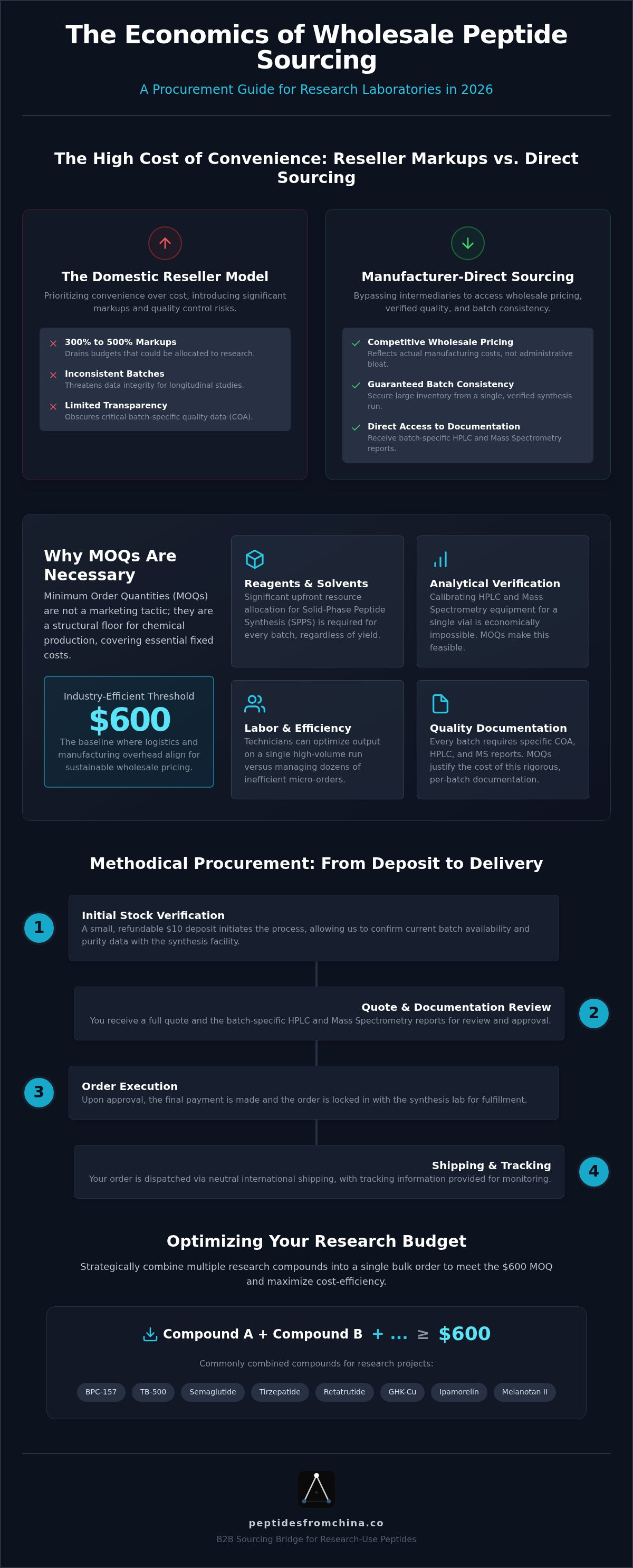
Minimum Order Quantity (MOQ) isn't a marketing tool; it's a structural floor for chemical production. In the context of professional peptide synthesis, MOQs represent the point where the cost of labor, reagents, and analytical verification aligns with commercial viability. Synthesis facilities don't operate like retail shops that pull vials from a shelf. Instead, they function on a synthesis-on-demand model where each run requires specific preparation. For 2026, a $600 baseline has emerged as the industry-efficient threshold for direct-to-manufacturer procurement. This figure ensures that the logistical overhead doesn't eclipse the value of the raw material itself.
The chemical framework for this production relies on Solid-phase peptide synthesis. This method requires significant upfront resource allocation for every batch, regardless of the final yield. When a facility initiates a run for compounds like BPC-157 or Tirzepatide, the reagents and solvents used are often the same for 100mg as they are for 10g. Lowering order volumes below a certain point doesn't reduce these fixed costs; it simply increases the price per milligram for the buyer. By maintaining a $600 minimum, we ensure that wholesale peptide pricing remains competitive and reflects actual manufacturing costs rather than administrative bloat.
Why Synthesis Facilities Require MOQs
Verification protocols are the most resource-heavy phase of professional sourcing. Every batch must undergo High-Performance Liquid Chromatography (HPLC) and Mass Spectrometry (MS) to verify sequence accuracy and purity levels. Calibrating this equipment for a single vial is economically impossible. Synthesis facilities also face substantial waste when using reagents in small-scale runs. Labor efficiency drops significantly when technicians must manage dozens of micro-orders instead of a single, high-volume production run. Bulk orders allow these facilities to optimize their output, passing the savings to the research laboratory.
Retail Markups vs. Direct Sourcing Efficiency
Resellers typically capitalize on a laboratory's need for convenience by offering single vials with no MOQs. However, this convenience carries a heavy cost. It's common to see markups of 300% to 500% compared to factory-direct rates. Beyond the financial drain, relying on resellers introduces risks regarding batch consistency. For longitudinal research, utilizing the same batch is critical for data integrity. Sourcing directly allows a lab to secure a larger inventory from a single, COA-verified run. This strategy stabilizes wholesale peptide pricing over the duration of a study and eliminates the variables introduced by multiple different reseller batches.
The Peptides From China $600 Procurement Protocol
Establishing a structured procurement protocol is essential for laboratories moving away from retail markups toward factory-direct sourcing. We facilitate this transition through a methodical $600 minimum requirement for all 2026 laboratory orders. This specific threshold isn't arbitrary. It represents the baseline where international logistics and manufacturing overhead align to provide sustainable wholesale peptide pricing. As a B2B sourcing bridge, we connect professional buyers directly to verified Chinese synthesis facilities, managing the complexities of stock verification and quality documentation.
Our role is strictly defined as a facilitator and logistical partner. We don't function as a pharmaceutical manufacturer or a third-party testing lab. Instead, we act as an analytical filter, ensuring that the facilities we work with meet the stringent documentation standards required for modern research. This model removes the ambiguity often found in the secondary market, providing a clear path from the synthesis laboratory to your facility. By centralizing the sourcing process, we allow procurement managers to focus on their research objectives rather than the intricacies of international supply chain management.
The $10 Verification Deposit Explained
The $10 sourcing deposit serves as a critical filter in our procurement cycle. In an industry often cluttered with non-professional inquiries, this nominal fee ensures that manufacturer resources are allocated only to serious researchers. Once the deposit is placed, we initiate a direct inquiry with the synthesis facility to verify current batch availability. This step triggers the release of manufacturer-issued documentation, including HPLC and Mass Spectrometry data for the specific lot. Transparency remains the priority; the $10 deposit is fully credited toward the final wholesale invoice once the order is confirmed. If stock cannot be verified to meet your specific requirements, the deposit is handled according to our established protocols. You can review our detailed sourcing process to understand these stages in depth.
Accessing Wholesale Tiers for BPC-157 and GLP-1s
The $600 minimum applies across our entire catalog, allowing procurement managers to access tiered pricing for high-demand research compounds. For instance, when sourcing BPC-157, Semaglutide, or Tirzepatide, the price-per-vial advantage becomes apparent as order volume scales. Moving from 10 units to 100 units often results in significant cost reductions that are impossible to achieve in a retail environment. For a deeper analysis of specific compound logistics, refer to our guide on Bulk BPC-157 Wholesale: The 2026 Research Guide to Direct Sourcing. Laboratories requiring specialized batch verification for longitudinal studies can request a customized quote to see how these tiers apply to their specific volume needs.
Optimizing Your Research Budget Within Bulk Minimums
Maximizing the utility of a $600 procurement window requires a strategic approach to inventory management. For many laboratories, the goal isn't just to hit a minimum, but to lower the total cost per milligram across all active research projects. To calculate the true wholesale peptide pricing, procurement officers must look beyond the unit price. You've got to factor in international shipping costs and the inherent value of batch-specific analytical verification. Spreading these fixed logistical costs over a larger, well-planned order significantly improves the overall budget efficiency. If you're only ordering a handful of vials, the shipping and processing fees can double your effective cost per milligram, making the direct-sourcing model less efficient than it should be.
Planning for long-term batch consistency is another critical factor in budget optimization. In the 2026 research environment, price volatility is often driven by reagent scarcity. By securing a larger inventory from a single synthesis run, a lab can eliminate the variables introduced by switching batches mid-study. This methodical approach to sourcing ensures that your data remains clean while your costs remain predictable. It's a shift from reactive buying to proactive procurement, which is the hallmark of a well-managed research facility.
The Multi-Compound Batch Strategy
The most effective way to optimize a budget is through compound diversification. Instead of over-purchasing a single peptide to meet the MOQ, labs can combine multiple compounds into a single shipment. Sourcing BPC-157 alongside TB-500 or GHK-Cu from the same synthesis run ensures that you're receiving consistent quality across your entire research portfolio. This approach is particularly useful for facilities running concurrent longitudinal studies where cross-compound interaction is being analyzed. Using a single sourcing bridge for multiple peptides reduces administrative friction and ensures that all compounds arrive with the same level of COA verification. For a deeper technical look at sourcing specific sequences, see our TB-500 Peptide Sourcing: A B2B Reference Guide.
Volume Scaling vs. Compound Diversification
Deciding between volume scaling and diversification depends on your project's timeline and the stability of the compound in question. High-volume scaling for a single peptide, such as a bulk order of 100 vials, yields the lowest possible per-unit cost. This is ideal for established protocols where batch consistency is paramount and the research is expected to span several months. Conversely, diversification supports a broader research scope without the high entry cost of individual bulk runs for every compound. With the 2026 aggregate stockout rate reaching 12.2% across common research peptides, securing larger inventories of critical compounds now protects your lab from future supply chain interruptions. International shipping remains a fixed variable; therefore, larger shipments naturally improve the product-to-shipping value ratio, making bulk procurement the most logical choice for professional operations that value long-term stability.
Quality Verification in Large-Scale Sourcing
In 2026, the documentation standard for research-grade peptides has evolved beyond simple purity claims. Professional procurement now requires a transparency-first approach to HPLC and Mass Spectrometry reports. While manufacturer-provided papers serve as essential baseline technical references, they're not absolute proof of purity on their own. For large-scale B2B orders, the potential for batch substitution or data reuse remains a significant industry challenge. This reality is why wholesale peptide pricing must always be evaluated alongside the rigor of the verification process. Direct-to-manufacturer sourcing reduces supply chain uncertainty by removing the opaque reseller layers that often obscure the original production data.
Interpreting Sourcing Documentation
When reviewing manufacturer-direct HPLC reports, procurement managers must look for specific batch numbers and run dates that align precisely with their procurement timeline. Red flags in the current market include reused COAs, generic purity stamps, and obscured manufacturer headers. A common tactic among low-tier vendors involves providing "representative" documentation rather than batch-specific data. This practice effectively invalidates the analytical integrity of the material. To understand the nuances of chromatography peaks and mass-to-charge ratios, consult our Peptide Testing and Analysis: A Professional Guide. Verifying the raw data is the only way to ensure the identity of the compound before it enters your laboratory workflow.
Managing Supply Chain Uncertainty
Direct sourcing effectively eliminates the risk of relabeling by domestic intermediaries. These middleman entities often purchase bulk powder and vial it themselves, which introduces contamination risks and breaks the original chain of custody. Our role involves auditing factory-side stock and quality documentation before any shipment leaves the facility. We act as a protective filter for the buyer, verifying that the physical inventory matches the provided analytical data. Building a robust chain of custody for research-grade materials requires this level of direct oversight. If your laboratory needs specific batch verification or a direct line to synthesis facilities, you can request a facility-direct quote here.
The 2026 market dynamics, characterized by an aggregate stockout rate of 12.2%, mean that quality verification is as much about availability as it is about purity. Securing a verified batch ensures that your longitudinal studies aren't interrupted by sudden supply shifts or vendor closures. By maintaining a direct link to the production source, you ensure that the wholesale peptide pricing you pay includes the security of verified identity and consistent synthesis protocols. This methodical approach to quality assurance is the only way to maintain high standards in a volatile global market.
Executing a Wholesale Order: From Deposit to Delivery
Transitioning from analytical verification to physical procurement requires a methodical logistical framework. For professional laboratories, securing competitive wholesale peptide pricing requires a structured approach that prioritizes stock accuracy over retail speed. Our procurement process is designed to eliminate the common friction points of international sourcing, moving from an initial inquiry to final delivery through a series of transparent, verifiable steps. This ensures that the compounds you receive, whether they're Semaglutide, Tirzepatide, or Retatrutide, match the exact batch data reviewed during the approval phase.
The process begins when a procurement officer identifies requirements from our catalog and submits a request. The $10 processing deposit acts as the catalyst for the entire operation. It signals a professional intent that allows us to engage synthesis facilities for real-time stock checks and the retrieval of batch-specific HPLC and Mass Spectrometry data. This initial phase protects the buyer from the "bait-and-switch" tactics sometimes seen in the secondary market, where resellers claim stock that hasn't been verified for months.
The Verification and Approval Phase
Once the $10 deposit is received, a 24-48 hour verification window begins. During this time, we coordinate with the production facility to confirm that the specific lot meets the purity and identity standards required for your research. Buyers receive a technical package containing the manufacturer's analytical reports for review. Only after the buyer approves this documentation is the final invoice for the $600 minimum balance generated. Payment is handled through secure B2B channels, ensuring a clear financial trail for laboratory accounting. This sequential protocol ensures that wholesale peptide pricing is only settled once the technical specifications are confirmed, reducing the financial risk associated with large-scale international orders.
Logistics, Tracking, and Neutral Packaging
International logistics for research-grade materials demand a high degree of discretion and organization. All bulk shipments from China utilize neutral packaging protocols to maintain the integrity of the compounds and ensure a streamlined transit process. We provide comprehensive tracking data as soon as the shipment clears the initial facility dispatch. For compounds like BPC-157 or TB-500, maintaining a stable environment during transit is a logistical priority. Our team monitors the progress of the shipment through various customs checkpoints, providing updates until the material reaches your facility. You can find more detail on these procedures in our sourcing guide or by reviewing our frequently asked questions. For a specific logistics assessment for your next batch, contact our sourcing desk to initiate a quote.
Strategic Procurement for 2026 Laboratory Operations
Minimum Order Quantities aren't arbitrary barriers; they represent the structural mechanism for securing batch-consistent material without the interference of domestic resellers. By utilizing a $600 procurement threshold, research facilities can stabilize their long-term budgets and ensure every milligram is backed by manufacturer-direct HPLC and mass spectrometry data. Reliability is non-negotiable.
This methodical approach ensures that wholesale peptide pricing remains tied to actual synthesis costs rather than inflated middleman markups. As a B2B-focused sourcing platform, we provide direct-to-manufacturer transparency that eliminates the uncertainty of the retail market. Moving toward a direct sourcing model allows procurement managers to regain control over their supply chain and analytical verification standards. The transition from retail convenience to professional sourcing is a necessary step for any facility prioritizing data integrity and cost-efficiency.
Initiate your $10 sourcing deposit to access manufacturer-direct pricing and secure your research inventory for the upcoming year. Establishing a direct link to production facilities is the most reliable way to protect your laboratory's research objectives.
Frequently Asked Questions
Why is there a $600 minimum order requirement for peptides?
The $600 minimum is established to align with the high fixed costs of professional chemical synthesis. Each production run requires specific reagent preparation, equipment calibration, and labor-intensive purification steps. Operating below this threshold increases the per-milligram cost to a point that is no longer commercially viable for a factory-direct model. This requirement ensures that we can offer sustainable wholesale peptide pricing while maintaining the rigorous analytical standards required by professional laboratories.
Can I mix different peptides to reach the $600 wholesale minimum?
Yes, laboratories can combine various compounds to meet the $600 procurement threshold. You can mix high-demand research sequences such as BPC-157, Semaglutide, and GHK-Cu. This flexibility allows researchers to support multiple project arms while accessing factory-direct rates. Every compound in the mixed order will still include batch-specific documentation from the synthesis facility to ensure consistent quality across your entire research portfolio.
What does the $10 sourcing deposit cover, and is it refundable?
The $10 deposit is a processing fee that initiates real-time stock verification with the synthesis facility. It covers the administrative cost of retrieving batch-specific HPLC and Mass Spectrometry data for your review. This deposit is fully credited toward your final wholesale invoice once the order is confirmed. If the facility cannot verify the specific stock requested, the deposit is handled according to our standard sourcing protocols to ensure transparency.
Are the peptides provided by Peptides From China pharmaceutical grade?
No, we don't provide human-grade pharmaceuticals or finished drugs. All materials sourced through our platform are for laboratory research use only. We strictly provide research-grade chemical compounds intended for in-vitro or animal studies within professional laboratory settings. We don't sell to clinics, pharmacies, or for human consumption. Our focus is on providing high-purity sequences with verified analytical data for the global research community as a B2B sourcing bridge.
How do I verify the purity of a bulk peptide order from China?
Purity is verified through manufacturer-issued High-Performance Liquid Chromatography (HPLC) and Mass Spectrometry (MS) reports. These documents provide a chemical fingerprint of the batch, confirming both the sequence identity and the percentage of target peptide. We recommend that laboratories perform independent third-party testing on a sample from large bulk orders to establish an absolute chain of custody. You can find more detail on our quality verification page regarding these technical standards.
What is the typical lead time for a manufacturer-direct peptide order?
Lead times vary based on current facility production schedules and compound complexity. For common research sequences like TB-500 or Tirzepatide, the verification and dispatch process typically takes 3 to 7 business days after invoice settlement. International shipping durations depend on the destination, but most labs receive their tracking data within 48 hours of shipment. Specific lead times for custom synthesis are confirmed during the initial deposit phase.
Do you provide HPLC and Mass Spectrometry reports for all batches?
Yes, batch-specific analytical reports are a standard requirement for every wholesale order. We don't rely on generic or outdated documents. Once the $10 deposit is placed, we secure the most recent HPLC and MS data from the production facility for that specific lot. This transparency is a core component of competitive wholesale peptide pricing, ensuring that the buyer reviews the technical specifications before the final $600 balance is paid for the order.
How does Peptides From China handle customs and international shipping?
We utilize neutral international shipping protocols designed to maintain the integrity of research-grade materials. Every bulk shipment includes tracking information and is routed through established logistical channels to global research facilities. While we monitor the progress of the shipment through various checkpoints, customs clearance is managed according to international shipping standards. For more information on logistics and payment, please refer to our FAQ page or our specific payment guide.