
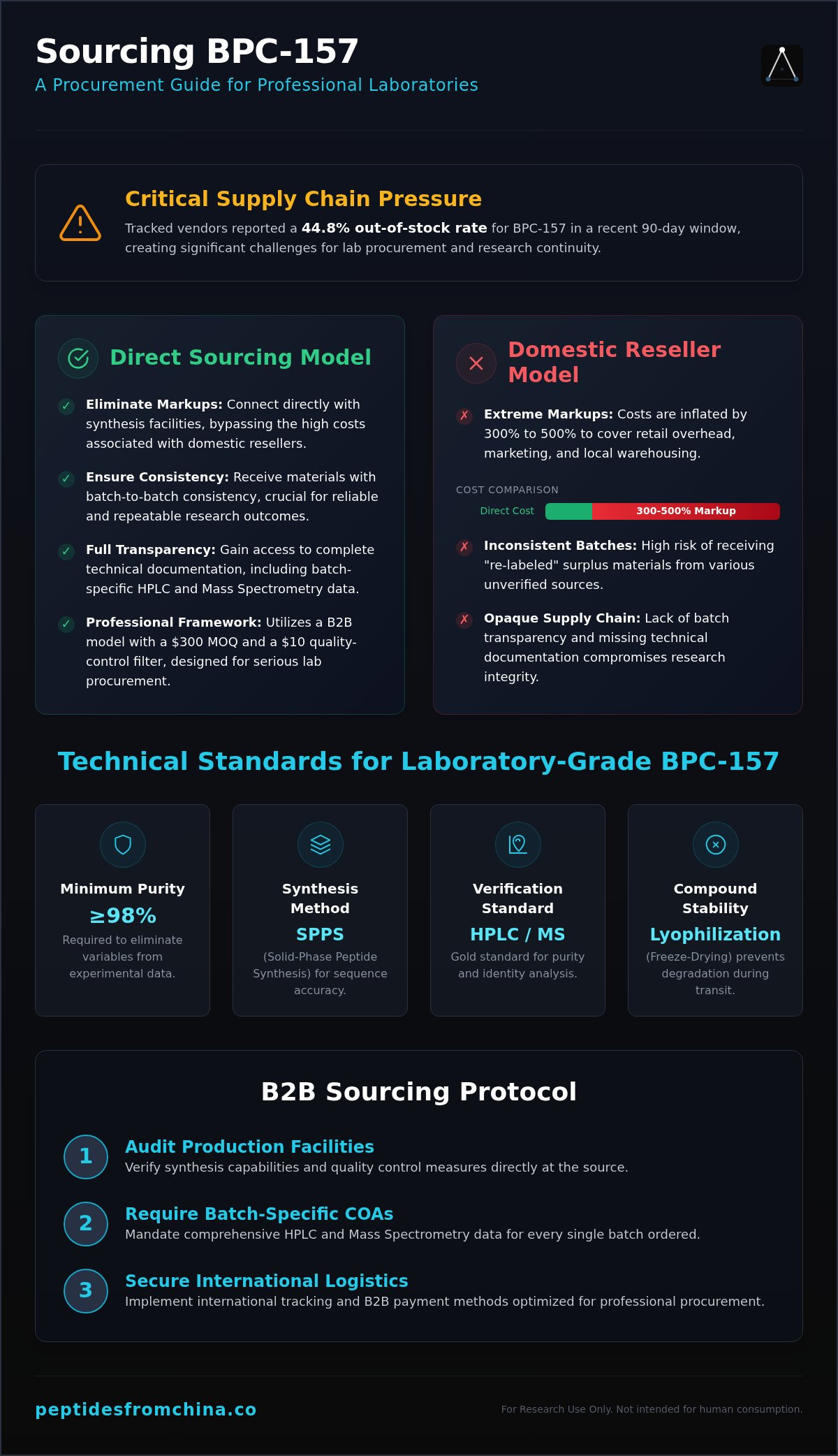
In a 90-day window during mid-2026, tracked vendors reported a 44.8% out-of-stock rate for BPC-157, illustrating the severe supply pressure currently facing the global research market. Procurement professionals often find themselves caught between these inventory shortages and the steep markups of domestic resellers who provide little in the way of technical transparency. It's a persistent challenge to source BPC-157 direct from manufacturer facilities without navigating a maze of intermediaries who obscure the origin of the material. You're likely familiar with the frustration of receiving inconsistent batches that lack the necessary HPLC or Mass Spectrometry documentation required to verify purity for laboratory standards.
This guide provides a strategic roadmap to secure laboratory-grade compounds while bypassing retail markups. By establishing direct relationships with verified synthesis facilities, you can ensure a consistent supply of high-purity BPC-157 backed by full technical transparency. We'll outline the methodical steps for auditing production facilities, the non-negotiable requirement for batch-specific COAs, and the logistical protocols that define a professional B2B sourcing operation in 2026. This approach moves beyond simple transactions to build a reliable, data-driven supply chain for professional buyers.
Key Takeaways
Eliminate domestic reseller markups by connecting directly to synthesis facilities for improved batch-to-batch consistency.
Identify the technical synthesis standards, including lyophilization and HPLC verification, required for laboratory-grade purity.
Evaluate the economic efficiency of a $300 MOQ wholesale structure compared to high-markup retail resellers.
Learn the professional protocols to source BPC-157 direct from manufacturer sites using a $10 quality-control filter.
Secure your supply chain with international tracking and B2B payment methods optimized for professional procurement.
Table of Contents
Why Sourcing BPC-157 Direct From the Manufacturer is Essential for Labs
Technical Synthesis Standards for High-Purity BPC-157
Comparing Direct Sourcing with Domestic Retail Resellers
Verification Protocols for Bulk BPC-157 Orders
Operational Logistics: Securing Your BPC-157 Supply Chain
Why Sourcing BPC-157 Direct From the Manufacturer is Essential for Labs
The current marketplace is saturated with domestic resellers operating as "vial shops." These entities cater to retail buyers rather than professional laboratories. For institutions conducting rigorous study on BPC-157 (Body Protection Compound 157), these intermediaries introduce unnecessary logistical and financial friction. Securing BPC-157 direct from manufacturer facilities isn't just a cost-saving measure; it's a fundamental requirement for maintaining experimental integrity. By bypassing the domestic markup, a lab can allocate resources toward higher sample sizes and more frequent testing protocols. This shift from retail-focused purchasing to professional procurement ensures that the technical needs of the researcher remain the priority.
Identifying Middleman Markups in the Peptide Market
Domestic warehousing operations frequently add 300% to 500% to research costs. These businesses must cover high overhead, including climate-controlled storage and retail marketing. They pass these costs directly to the buyer. While they offer faster shipping, the trade-off is a significant loss in batch transparency. High-volume research institutions prioritize the technical audit trail over off-the-shelf availability. When you source BPC-157 direct from manufacturer sites, you eliminate the "reseller tax." This approach allows for a $300 MOQ that reflects actual synthesis costs rather than retail speculation. Professional procurement requires moving beyond single-vial purchases to a wholesale model that favors consistency and data over convenience.
The Risks of Non-Verified Research Compounds
Relying on unverified sources carries the risk of receiving "re-labeled" batches. These are often surplus materials from various facilities aggregated by a broker and sold under a generic label. This practice compromises laboratory integrity because the accompanying documentation might not reflect the actual vial contents. Maintaining high standards requires direct-from-facility documentation, including HPLC chromatograms and Mass Spectrometry data for every batch. To ensure your research remains valid, learn about peptide quality standards that professional sourcing desks use to filter out sub-standard synthesis facilities. A $10 processing deposit acts as a quality-control filter. It ensures that only serious procurement requests reach the synthesis floor, thereby protecting the integrity of the entire supply chain.
Technical Synthesis Standards for High-Purity BPC-157
BPC-157 is a synthetic pentadecapeptide composed of a specific sequence of 15 amino acids. Synthesis protocols for research applications require absolute sequence accuracy to ensure the compound behaves predictably in a laboratory setting. Most procurement professionals seeking BPC-157 direct from manufacturer sources prioritize Solid-Phase Peptide Synthesis (SPPS). This method involves anchoring the first amino acid to a solid resin bead and adding subsequent residues in a step-by-step process. It's superior to liquid-phase synthesis for this specific chain length because it allows for the efficient washing away of excess reagents and byproducts at every stage. This level of precision is necessary to reach the high purity thresholds demanded by professional research institutions.
Purity thresholds for laboratory-grade BPC-157 generally start at 98%. Lower purity levels introduce unknown variables, such as residual trifluoroacetic acid (TFA) or truncated peptide sequences, which can compromise experimental data. Researchers should reference FDA guidance on synthetic peptide standards to understand the technical benchmarks used in manufacturing quality control. Lyophilization, or freeze-drying, is another critical standard. This process removes water through sublimation under a vacuum, leaving the peptide in a stable, porous solid state. It prevents the degradation that occurs in aqueous environments, ensuring the material remains viable throughout the logistics of international transit.
HPLC and Mass Spectrometry Analysis
HPLC is the gold standard for peptide purity verification.
During High-Performance Liquid Chromatography (HPLC), the compound is passed through a specialized column to separate the target peptide from any synthesis impurities. A high-purity batch displays a single, sharp, dominant peak on the resulting chromatogram. If the graph shows multiple smaller peaks or "shoulders" on the main peak, it indicates the presence of incomplete chains or residual solvents. Mass Spectrometry (MS) then confirms the identity of the compound by measuring its mass-to-charge ratio. For BPC-157, the molecular weight must align with the theoretical value of approximately 1419.5 Da. Without both analyses, the identity and purity of the batch remain unverified.
COA Verification Standards
A professional Certificate of Analysis (COA) must be batch-specific rather than a generic template. It should include the synthesis date, the specific batch number, and the raw HPLC and MS data. It's a common pitfall for buyers to accept a COA that lacks these primary data points. Identifying forged or outdated laboratory reports requires a methodical approach, as some resellers digitally alter dates on old documents to suggest fresh inventory. Technical auditing of the synthesis facility helps ensure that every order is accompanied by genuine, current documentation. For labs requiring high-volume consistency, understanding these verification protocols is essential for long-term supply chain security. You can contact our sourcing desk to verify the documentation status of current synthesis batches.
Comparing Direct Sourcing with Domestic Retail Resellers
Professional labs must distinguish between retail convenience and procurement efficiency. Domestic resellers typically buy in bulk and repackage these materials, adding a significant buffer to the final price. Sourcing BPC-157 direct from manufacturer facilities eliminates these hidden costs. While a retail shop might offer a single vial for immediate shipment, they rarely provide the technical oversight necessary for high-stakes research. In contrast, the direct-to-manufacturer model prioritizes batch consistency. This ensures that every milligram in your study matches the specifications defined in the initial synthesis protocol without the variations introduced by multiple intermediaries.
Quality assurance remains the primary differentiator between these two models. Resellers often rely on "trust me" claims or provide a single, outdated COA for an entire year's inventory. Professional sourcing requires a more rigorous approach. While the Drug Supply Chain Security Act (DSCSA) focuses on the domestic pharmaceutical supply chain, the principles of tracking and verification apply equally to the global research market. Direct sourcing allows labs to audit the exact facility responsible for synthesis, rather than relying on a middleman's unverified storage conditions or inconsistent handling practices.
Economic Benefits of Wholesale MOQ
The $300 MOQ serves as a gateway to professional-grade pricing. In a retail environment, the cost-per-milligram is inflated by marketing budgets and domestic warehousing fees. Bulk procurement allows labs to capture the true manufacturing cost. By sourcing BPC-157 direct from manufacturer labs, researchers avoid the markup associated with domestic middleman logistics. This efficiency is critical for longitudinal studies where supply interruptions or sudden price spikes can jeopardize experimental timelines. Committing to a wholesale volume stabilizes your long-term research budget against the price volatility seen in the retail sector.
Logistical Realities of International Sourcing
Managing lead times is a core skill for procurement officers. Unlike off-the-shelf retail stock, custom synthesis batches require a manufacturing cycle. This ensures the material hasn't been sitting in a domestic warehouse for months, potentially degrading in sub-optimal conditions. International delivery requires neutral packaging protocols to ensure smooth transit through various logistical hubs. Every shipment is backed by international tracking, providing full visibility from the synthesis floor to your destination lab. You can browse the BPC-157 catalog to evaluate current batch options and synthesis schedules tailored for professional research needs.
Verification Protocols for Bulk BPC-157 Orders
Establishing a secure supply chain requires more than just identifying a synthesis facility. It demands a rigorous verification protocol that begins before the first shipment leaves the floor. When sourcing BPC-157 direct from manufacturer facilities, professional buyers must implement a series of checkpoints to ensure batch integrity. This methodical approach protects the laboratory's research budget and its experimental data. Unlike retail transactions that rely on blind trust, B2B procurement is built on factual verification and technical auditing. These steps ensure that the material received matches the exact molecular specifications required for high-purity research.
The verification process involves a systematic review of a facility's synthesis capabilities. Labs should evaluate the manufacturer's batch history and their ability to maintain 98% purity across multiple production cycles. Before final invoice settlement, it's standard practice to approve the batch-specific HPLC and Mass Spectrometry documentation. For high-volume institutional orders, we recommend implementing independent third-party testing. This adds an extra layer of security, confirming that the internal manufacturer reports align with external laboratory analysis. This level of scrutiny is what distinguishes professional procurement from casual retail purchasing.
Managing the $10 Verification Deposit
We utilize a $10 processing deposit as a primary quality-control filter. This small commitment serves a specific purpose: it filters out casual retail inquiries, ensuring that synthesis resources and technical support are reserved for professional procurement projects. Once the deposit is received, our sourcing desk verifies current batch availability and synthesis lead times. This deposit isn't an additional fee; it's fully credited toward the final wholesale invoice once the $300 MOQ is met. This protocol ensures that every inquiry we handle is backed by a serious intent to source BPC-157 direct from manufacturer sites under professional terms.
Batch Consistency Audits
Consistency is the hallmark of a reliable synthesis partner. Professional labs must maintain a historical record of batch-specific HPLC reports to track facility performance over time. We recommend protocols for testing random samples from bulk shipments to verify that the entire order meets the approved standards. This data-driven approach allows researchers to identify even minor deviations in synthesis quality before they impact laboratory results. You can review our detailed breakdown of how the sourcing process works to understand the full lifecycle of a verified order. To secure a documented batch for your next project, request a verification audit for your next BPC-157 order through our sourcing desk.
Operational Logistics: Securing Your BPC-157 Supply Chain
Logistics are the final barrier to a stable research supply. When you source BPC-157 direct from manufacturer facilities, the shipping process is dictated by efficiency and neutral handling. It's not just about getting a package; it's about maintaining the chain of custody from the synthesis floor to the destination lab. Tracking protocols provide real-time visibility through international hubs. This transparency is vital for labs managing tight research schedules. Recurring supply agreements further stabilize this process, ensuring that longitudinal studies aren't derailed by the 44.8% out-of-stock rates seen in the retail market during mid-2026. Consistent logistics ensure that your research remains on schedule regardless of domestic market fluctuations.
Payment and Invoicing Protocols
Institutional procurement departments require transparent documentation for audit purposes. We provide clear invoicing that aligns with professional accounting standards, ensuring that every transaction is documented for your records. Secure payment options are tailored for international B2B transactions, moving away from the high-risk methods often associated with retail vial shops. This structured approach ensures that funds are processed through verified channels, providing a clear paper trail for your organization's financial oversight. You can review our specific payment methods and protocols to understand how we facilitate secure international transfers for wholesale orders.
Requesting a Custom Quote for BPC-157
Transitioning from a general inquiry to a verified batch requires specific technical data. To provide an accurate wholesale quote, we need information on total quantity requirements, preferred vial concentrations, and any specific lyophilization parameters. Once the $10 processing deposit is placed, we initiate the verification of current synthesis cycles. This step moves the process from theoretical pricing to an actionable procurement plan. It allows us to confirm that the facility can meet your purity and volume requirements before you commit to the full $300 MOQ. Managing custom synthesis requests is another core function of a professional sourcing desk. If your research requires specific vial sizes, these must be integrated into the manufacturing cycle early to ensure batch consistency.
Finalizing a quote is the gateway to a long-term partnership. Our sourcing desk acts as a bridge, ensuring that the technical needs of your lab are translated into the manufacturer's synthesis schedule. This collaborative model is explored further in our 2026 Research Guide to Direct Sourcing. By following these operational protocols, labs can bypass the volatility of the retail market and establish a resilient supply chain for BPC-157 direct from manufacturer synthesis floors. This methodical approach ensures that your lab has a reliable partner for every stage of the procurement process.
Securing a Technical Advantage in Professional Peptide Procurement
Transitioning from retail-focused vial shops to a professional B2B sourcing model is a prerequisite for maintaining laboratory integrity in 2026. By choosing to source BPC-157 direct from manufacturer facilities, institutions eliminate the 300% to 500% markups common among domestic middleman resellers. This strategic shift ensures that every sample is backed by batch-specific HPLC and Mass Spectrometry data, providing the technical transparency required for high-stakes research. You've seen how a methodical approach to logistics and a $10 quality-control filter can stabilize your supply chain against market volatility and inconsistent batch quality.
Professional procurement is about data, consistency, and direct accountability. We specialize in specialized B2B sourcing for research institutions, offering COA-verified batches for every order with direct manufacturer pricing. Establishing a recurring, reliable supply allows your team to focus on experimental results rather than inventory shortages or documentation gaps. Take the next step toward securing your laboratory's future requirements with a partner that values factual integrity over marketing flair. You can Request a Professional BPC-157 Sourcing Quote to begin the batch verification process today. We look forward to supporting your research objectives with precision and transparency.
Frequently Asked Questions
Is BPC-157 from Peptides From China for human use?
No, BPC-157 provided through our platform is strictly for laboratory research use only. We don't supply human-grade pharmaceuticals, finished drugs, or clinical-grade medicine. All compounds are intended for in-vitro or in-vivo laboratory studies conducted by qualified professionals. We don't provide dosing instructions or medical advice, as our mission is to connect research institutions with high-purity synthesis facilities for analytical and experimental purposes.
What is the minimum order quantity (MOQ) for BPC-157 direct sourcing?
The minimum order quantity for sourcing BPC-157 direct from manufacturer facilities is $300 per transaction. This wholesale threshold allows us to bypass the high markups associated with retail resellers while maintaining direct-to-lab logistics. This MOQ ensures that we can prioritize high-volume procurement requests from professional laboratories and research organizations. It acts as a gateway to factory-direct pricing, allowing labs to maximize their research budgets without paying for domestic middleman overhead.
How do you verify the purity of a BPC-157 batch?
Every batch is verified through batch-specific High-Performance Liquid Chromatography (HPLC) and Mass Spectrometry (MS) analysis. These technical reports confirm the purity threshold, typically exceeding 98%, and verify the exact molecular weight of the peptide. We provide these raw data reports with every order to ensure full technical transparency. This rigorous auditing process prevents the distribution of inconsistent or sub-standard materials, ensuring that your laboratory receives only laboratory-grade compounds for experimental use.
What is the purpose of the $10 processing deposit?
The $10 processing deposit functions as a quality-control filter to separate serious professional procurement inquiries from casual retail interest. This small fee allows our sourcing desk to dedicate technical resources to verifying current manufacturer stock, synthesis schedules, and batch documentation. Once the manufacturer's quality reports are approved and the $300 MOQ is met, this deposit is fully credited toward your final wholesale invoice. You can find additional logistical details on our how it works page.
How long does shipping take from the manufacturer to my laboratory?
Shipping durations depend on the current synthesis cycle and the destination laboratory's location. Since we route orders directly from the manufacturing floor to ensure material freshness, buyers should account for synthesis lead times plus international transit. We provide international tracking for every shipment, allowing for full visibility throughout the logistics chain. All materials are shipped in neutral packaging to ensure smooth passage through global transit hubs and to maintain the security of your research supply.
Do you provide domestic US or EU warehousing for BPC-157?
We don't offer domestic warehousing in the US or EU. Our business model focuses on sourcing BPC-157 direct from manufacturer sites to eliminate the 300% to 500% markups typically added by domestic resellers for storage and local fulfillment. By shipping directly from the synthesis facility to your lab, we ensure that you receive the most recent batches at wholesale prices. This direct approach also maintains a clear chain of custody and prevents the degradation that can occur in unverified local storage.
Can I request a custom synthesis for a specific research project?
Yes, we facilitate custom synthesis requests for specific research requirements, including unique vial concentrations or lyophilization parameters. These requests are integrated directly into the manufacturer's production schedule to ensure batch consistency. Custom orders allow labs to obtain materials tailored to their specific experimental protocols rather than relying on generic off-the-shelf inventory. You can initiate a custom synthesis request by providing your technical specifications through our contact page, where our desk will verify facility capabilities.
What payment methods are accepted for wholesale peptide orders?
We accept professional payment methods optimized for international B2B transactions. These options are designed to provide a secure and transparent financial trail for institutional procurement departments. We avoid high-risk payment structures often found in the retail sector to maintain a professional sourcing environment. Detailed instructions for completing your wholesale transaction are provided once your batch verification is complete. You can find more information on our specific protocols by visiting our payment information page.