
A Certificate of Analysis is merely a starting point for technical conversation, not a definitive guarantee of batch identity. In a market where batch substitution and reused documentation are common, assuming that a PDF equals quality is a significant operational risk. It's frustrating to navigate an environment where reseller markups are hidden behind opaque supply chains and customs seizures are often dismissed as an unavoidable cost of doing business. You require a more methodical approach to secure compounds like BPC-157 or Tirzepatide without the typical retail volatility.
This guide establishes a technical framework for the best practices for sourcing peptides from China in 2026. It provides an industry-insider protocol for mitigating supply chain risks, verifying manufacturer data, and optimizing procurement for bulk orders over $600. We'll examine how to navigate the updated MOFCOM export licensing requirements and the removal of VAT rebates that impacted chemical costs in April 2026. By the end of this article, you'll have a repeatable strategy to reduce the reseller layer and obtain consistent, reference-grade analytical data for your research compounds.
Key Takeaways
Differentiate between direct-to-manufacturer models and domestic resellers to eliminate hidden markups and improve supply chain visibility.
Apply best practices for sourcing peptides from China by evaluating a supplier’s technical literacy and operational transparency rather than relying on superficial marketing.
Learn to analyze HPLC chromatograms and Mass Spectrometry data as baseline reference material to verify molecular identity and batch consistency.
Streamline international logistics by utilizing neutral packaging and professional procurement protocols tailored for wholesale orders with a $600 minimum.
Shift from a reliance on absolute purity claims toward a risk-mitigation framework that prioritizes independent verification and direct manufacturer routing.
Table of Contents
The 2026 Landscape of Chinese Peptide Synthesis
Vetting Manufacturers: Protocols for Professional Procurement
Navigating Technical Documentation: HPLC and MS Analysis
Logistics, Customs, and Volume Strategy
Peptides From China: A Transparency-Focused Sourcing Bridge
The 2026 Landscape of Chinese Peptide Synthesis
China has established itself as the global hub for high-capacity peptide production, primarily concentrated in industrial clusters around Shanghai, Wuhan, and Hangzhou. Understanding the best practices for sourcing peptides from China requires a clear distinction between actual synthesis facilities and the vast network of intermediaries that populate the market. While the peptide synthesis process is technically demanding, the logistical complexity often arises from the "reseller layer." This layer consists of domestic trading companies that purchase bulk unlabelled product, apply their own branding, and mark up the price for retail or small-scale laboratory buyers.
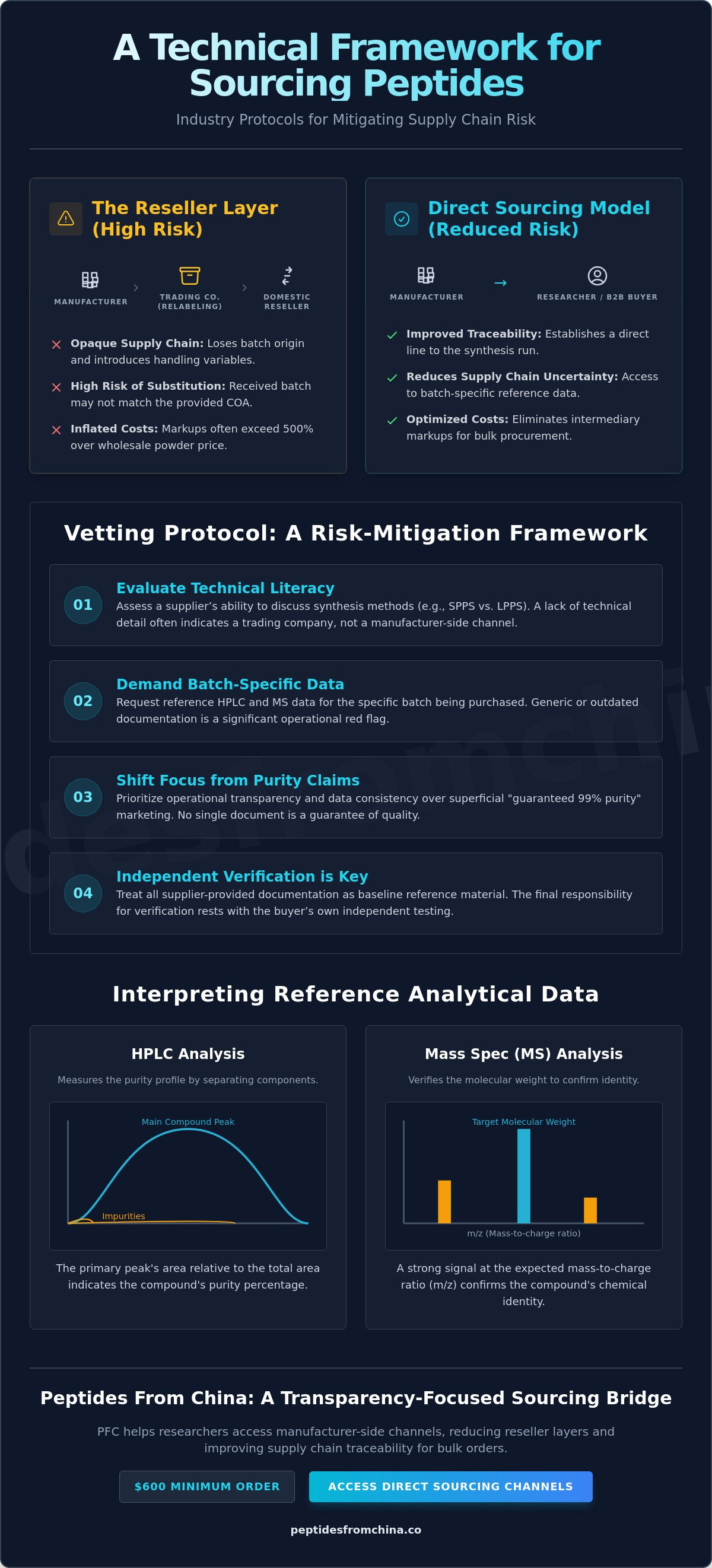
This intermediary structure doesn't just inflate costs; it fundamentally obscures the origin of the material. When a buyer procures through a reseller, they lose the ability to trace a batch back to its specific synthesis run. For professional procurement, this lack of traceability is a critical failure point. Direct sourcing helps reduce supply chain uncertainty by establishing a straight line between the buyer and the manufacturer-side channel. This directness allows for more rigorous verification of batch-specific data and reduces the risk of receiving substituted materials that don't match the provided documentation.
Synthesis Facilities vs. Trading Companies
Identifying a true manufacturer-side channel versus a trading company requires looking past polished websites. Trading companies often focus on marketing flair and "guaranteed" results, whereas manufacturers prioritize technical specifications and logistical data. Middlemen frequently engage in relabeling, which is the practice of taking generic batches and assigning them new lot numbers. This practice often leads to batch substitution, where a buyer receives a different synthesis run than the one represented by the Certificate of Analysis. Accessing the manufacturer directly improves batch-to-batch consistency because it eliminates the variable handling and storage conditions introduced by third-party warehouses.
The Economic Logic of Direct Procurement
Professional research environments rarely purchase individual vials from domestic retail sites. The price disparity between retail vials and wholesale powder is significant, often reflecting a 500% markup or higher by the time it reaches a domestic warehouse. For procurement professionals, best practices for sourcing peptides from China involve moving toward a wholesale model. This typically requires a minimum order amount of $600, which aligns with the logistical costs of international shipping and customs clearance. While variability in synthesis quality exists across the industry, direct traceability remains the only effective hedge against receiving inferior or misidentified compounds.
Vetting Manufacturers: Protocols for Professional Procurement
Vetting a manufacturer requires looking past the "guaranteed 99% purity" claims that populate retail-facing websites. In the professional sector, these claims are viewed as marketing noise rather than technical data. Genuine best practices for sourcing peptides from China focus on operational reality: the facility's ability to provide batch-specific documentation and their transparency regarding synthesis limitations. Given the broader pharmaceutical supply chain risks, procurement professionals must prioritize traceability over price. Size doesn't always equal reliability; a high-capacity factory may prioritize large-scale industrial contracts over the precision required for custom research batches.
Assessing Communication and Technical Competency
Communication speed is a baseline metric, but technical literacy is the true differentiator. Sales agents who can't discuss specific synthesis methods, such as the nuances between Solid-phase and Liquid-phase peptide synthesis, are likely working for trading companies with no direct facility access. Red flags include a lack of technical detail in responses or a refusal to provide reference analytical data before a commitment is made. A professional B2B operation won't use hyperbolic marketing. Instead, they provide clear, methodical answers regarding lead times, batch sizes, and documentation protocols. This grounded approach helps reduce supply chain uncertainty by establishing a realistic baseline for expectations.
The Sourcing Agent as a Risk Filter
Many researchers and procurement offices utilize an independent sourcing agent to act as a protective filter. These agents verify manufacturer stock and audit facility profiles to ensure the producer isn't a secondary reseller. This process often involves a sourcing deposit to initiate deep verification, moving the transaction from blind trust to a model based on verified manufacturer-side channels. Because professional procurement typically involves a minimum order amount of $600, having an on-the-ground filter is a logical hedge against capital loss. If you're looking to streamline this process, working with verified manufacturer-side channels can help eliminate the reseller layer and improve batch traceability. This methodical vetting ensures that the best practices for sourcing peptides from China are maintained throughout the procurement cycle.
Navigating Technical Documentation: HPLC and MS Analysis
Professional procurement operates on the principle of "trust but verify." A Certificate of Analysis (COA) is not a definitive quality guarantee; it is a baseline technical reference. The prevalence of "recycled" or digitally altered reports in the retail market makes technical skepticism mandatory. One of the best practices for sourcing peptides from China is to treat manufacturer documentation as a starting point for independent verification. High-profile coverage regarding the dangers of unregulated peptides underscores the reality that documentation can be detached from the actual physical product. Without direct batch traceability, a PDF report provides zero insight into the compound's actual composition.
How to Read a Peptide HPLC Report
HPLC measures purity by separating the peptide from impurities based on chemical properties. When reviewing these reports, you must look at the chromatogram's baseline. Clean integration tables should show a single, dominant peak. If you see multiple "shoulders" or significant baseline noise, the product contains truncated sequences or residual reagents. A 99% purity claim on a PDF is operationally meaningless without batch traceability. Professional operators ensure that the lot number on the HPLC report matches the labels on the bulk powder containers. This prevents the common industry practice of using one high-quality report to sell multiple, inferior synthesis runs. If the report lacks a clear timestamp or lot identifier, it should be discarded as reference material.
Mass Spectrometry: Confirming the Sequence
Mass Spectrometry (MS) is the primary tool for verifying molecular identity. It confirms that the manufacturer synthesized the correct sequence rather than a similar, less expensive compound. The MS report must show an observed mass that aligns with the theoretical molecular weight. Discrepancies are particularly risky with complex sequences like bulk BPC-157 wholesale, where even minor errors in the synthesis process can result in an inactive or degraded product. Avoid suppliers who provide "catalog COAs" that lack specific dates or batch identifiers. Effective best practices for sourcing peptides from China involve demanding real-time data from the current production cycle. This methodical approach helps reduce supply chain uncertainty and ensures that your analytical baseline is grounded in the actual material you receive.
Logistics, Customs, and Volume Strategy
Adopting the best practices for sourcing peptides from China requires a shift from small-scale retail thinking to a professional wholesale volume strategy. Managing the $600 minimum order amount is the first hurdle for professional procurement. This threshold isn't arbitrary; it reflects the logistical reality of international shipping and the administrative costs of manufacturer-side routing. By aggregating requirements into larger batches, researchers can significantly reduce the per-milligram cost and improve the efficiency of the 2026 export licensing process. Domestic warehousing is often positioned as a convenience, but it typically adds a significant reseller markup without providing additional quality assurance or batch traceability.
Neutral packaging is a functional requirement for successful international transit. Professional B2B sourcing avoids the flashy, retail-style labeling that attracts unnecessary scrutiny. Instead, compounds are shipped in a discreet, methodical manner that prioritizes the integrity of the contents over marketing flair. While the average effective tariff rate on Chinese imports into the US reached 31.6% in February 2026, the removal of VAT rebates on many chemical products in April 2026 has made direct-from-manufacturer pricing even more critical for maintaining research budgets. Customs clearance protocols rely on precise documentation, but the actual contents must match the analytical data provided in the previous sections to ensure a repeatable sourcing protocol.
Optimizing for the $600 Minimum Order
The economics of bulk powder are vastly superior to individual vials. For professional labs, strategic batch ordering is the standard. Instead of placing frequent small orders, procurement officers should structure a single sourcing request for multiple compounds, such as combining BPC-157 and TB-500. This approach maximizes shipping efficiency and helps mitigate the cost increases caused by the recent shifts in Chinese export tax policies. It's about building a sustainable supply chain that favors volume and directness over the high-frequency, high-markup retail model.
International Shipping and Tracking
Transit times from China to US or EU laboratories typically range from 7 to 14 days, depending on current logistics bottlenecks. Tracking is essential, but it must be paired with neutral packaging to reduce the risk of delays. If a shipment is seized or delayed due to documentation errors, a transparent sourcing partner will provide clear communication rather than vague excuses. Risk mitigation involves understanding that while no shipment is 100% guaranteed, following established protocols significantly improves the success rate. To begin building your own resilient supply chain, you can access manufacturer-side channels that prioritize transparency and direct routing. This methodical approach ensures you're following the best practices for sourcing peptides from China while maintaining fiscal and operational control.
Peptides From China: A Transparency-Focused Sourcing Bridge
Peptides From China (PFC) operates as a dedicated B2B sourcing agency, positioning itself as a strategic bridge between professional researchers and manufacturer-side channels. It's not a pharmaceutical manufacturer or a testing laboratory. Instead, it serves as an analytical filter designed to help researchers implement the best practices for sourcing peptides from China. By routing orders directly to synthesis facilities, this model eliminates the multiple reseller layers that typically inflate costs and obscure batch origins in the retail market. This directness is the primary mechanism for maintaining the integrity of the supply chain in an environment often characterized by opacity.
To initiate the sourcing protocol, PFC utilizes a $10 processing deposit. This fee isn't a product payment; it's a commitment that triggers a deep verification process. This includes manufacturer-side stock checks and the procurement of batch-specific reference analytical data. This methodical approach ensures that procurement professionals aren't just buying from a website but are instead engaging in a professional supply chain verification. By providing COA-verified batches as part of a professional procurement strategy, PFC helps researchers establish a repeatable sourcing protocol for compounds like Semaglutide, Tirzepatide, or BPC-157.
Reducing Supply Chain Uncertainty
Accessing manufacturer-side channels directly helps reduce supply chain uncertainty by providing a straight line to the production source. The transition from a retail-centric model to a facility-direct model improves traceability and ensures that the documentation provided actually corresponds to the current synthesis run. While PFC facilitates the acquisition of manufacturer-issued HPLC and MS reports, independent testing by the buyer remains the ultimate best practice. This second layer of verification, combined with PFC’s initial filtering, creates a robust framework for professional research that prioritizes data over marketing claims.
Getting Started with Professional Sourcing
The procurement process is structured for technical efficiency and clarity. Buyers begin by requesting a quote for their specific requirements, adhering to the $600 minimum order amount for professional wholesale procurement. Once the quote is generated, the buyer reviews the available manufacturer stock and technical documentation. Only after the documentation is approved as a baseline reference does the final payment and logistics phase begin. This ensures that no capital is committed until the manufacturer's data is scrutinized. To begin this methodical verification process, you can initiate your sourcing request with Peptides From China. This protocol ensures that the best practices for sourcing peptides from China are applied at every stage, from the initial facility audit to the final delivery of research compounds.
Building a Resilient Peptide Procurement Protocol
Establishing a professional supply chain in 2026 requires moving past the superficiality of retail websites and domestic reseller markups. Successful procurement depends on your ability to secure direct manufacturer-side channels that prioritize batch traceability and technical verification. By treating HPLC and MS reports as baseline reference material rather than definitive proof, you reduce the operational risks inherent in international logistics. It's about shifting from blind trust to a methodical framework based on analytical skepticism.
Adopting the best practices for sourcing peptides from China involves a commitment to volume and transparency. Transitioning to a $600 minimum order protocol allows you to access true wholesale pricing while utilizing neutral packaging to improve transit success. This structured approach helps mitigate the impact of shifting export regulations and ensures that your research compounds remain consistent across multiple synthesis runs. You don't have to navigate these opaque supply chains without a strategic partner.
Through direct-to-manufacturer routing and COA-verified batch traceability, we help you stabilize your procurement cycle and eliminate unnecessary intermediary layers. Start your professional sourcing request for $10 today to initiate our verification and sourcing protocol. We're ready to help you build a more transparent and cost-effective supply chain for your laboratory requirements.
Frequently Asked Questions
Is it legal to source research peptides from China for laboratory use?
Sourcing peptides for laboratory research is generally permissible under international trade laws, provided the compounds are not controlled substances or intended for human consumption. In 2026, China's Ministry of Commerce (MOFCOM) updated the Export License Management Catalogue, which requires specific permits for certain dual-use items. Buyers should verify that their intended use complies with local regulations and that the manufacturer holds the necessary export clearance for the specific compound.
What is the difference between a manufacturer COA and independent third-party testing?
A manufacturer Certificate of Analysis (COA) serves as a baseline technical reference representing the facility's internal findings for a specific batch. Independent third-party testing involves sending a sample to a secondary laboratory to verify the identity and purity peaks without manufacturer bias. Professional procurement utilizes the manufacturer's HPLC and MS reports to establish a data trail, while independent testing acts as the final risk-mitigation step to ensure the physical batch matches the provided documentation.
Why is there a $600 minimum order for wholesale peptide sourcing?
The $600 minimum order amount is an operational requirement that distinguishes professional wholesale procurement from retail-level transactions. This threshold covers the fixed costs associated with international logistics, export documentation, and the administrative overhead of manufacturer-side routing. By maintaining this minimum, sourcing agencies can provide direct access to production facilities while keeping per-milligram costs significantly lower than domestic retail alternatives. It's a key part of the best practices for sourcing peptides from China.
How do I know if a Chinese peptide manufacturer is legitimate?
Legitimacy is verified through technical literacy and operational transparency rather than marketing claims. A legitimate manufacturer will provide batch-specific HPLC and MS reports that include timestamps and lot numbers. They should also demonstrate a clear understanding of the 2026 export license requirements. Red flags include a refusal to discuss synthesis methods or a reliance on hyperbolic language without providing the underlying analytical data for the current production cycle.
What happens if my peptide shipment is seized by customs?
Customs seizures often occur due to improper documentation or labeling that triggers regulatory scrutiny. If a shipment is detained, the sourcing partner should provide the necessary paperwork to facilitate clearance or offer a resolution based on the agreed-upon risk-mitigation protocol. Utilizing neutral packaging and ensuring that all MOFCOM export permits are in order significantly reduces this risk. Professional sourcing focuses on proactive compliance to avoid these logistical bottlenecks.
Do lyophilized peptides require cold-chain shipping from China?
Lyophilized peptide powders are typically stable at ambient temperatures for the duration of international transit, which usually takes 7 to 14 days. While long-term storage requires refrigeration, the freeze-drying process protects the molecular structure from rapid degradation during shipping. Over-complicating logistics with cold-chain requirements for lyophilized research compounds often adds unnecessary costs without providing a measurable improvement in the stability of the received material.
Can I trust HPLC reports provided by Chinese factories?
HPLC reports should be treated as baseline technical reference material rather than definitive proof of quality. While reputable factories provide accurate data for their current batches, the retail market is prone to recycled or altered documentation. Following the best practices for sourcing peptides from China means verifying that the lot number on the report matches the physical product and conducting independent testing to confirm the manufacturer's internal findings.
What are the most common impurities found in low-quality peptide synthesis?
Common impurities include truncated sequences, where the amino acid chain is incomplete, and deletion sequences, where specific residues are missing. Residual reagents such as trifluoroacetic acid (TFA) or leftover solvents can also remain if the purification process is insufficient. These impurities are visible as secondary peaks or baseline noise on an HPLC chromatogram. Professional synthesis involves multiple purification cycles to minimize these contaminants and ensure high batch-to-batch consistency.