Don’t Trust the COA: Verify Peptide Purity for Labs and Procurement
The minimum reliable verification for a research peptide is an RP‑HPLC chromatogram showing area‑percent purity plus intact mass confirmation by LC‑MS. If dosing accuracy matters, add a quantitative peptide‑content assay, because purity percentage and actual peptide mass are not the same number. Request counterion (TFA) and water content on the certificate of analysis, and route anything ambiguous through an independent third‑party lab rather than a home test kit, which cannot deliver this data.
TL;DR:
Confirm the COA includes a chromatogram image, intact mass, and details on counterion and moisture content to verify purity and identity accurately.
Ask for the raw HPLC chromatogram and comprehensive method metadata, as a pure percentage alone is unreliable without these supporting data.
Require mass spectrometry data with observed versus theoretical mass, ensuring the instrument class is specified for accurate identity confirmation.
Understand that HPLC purity measures homogeneity among detected compounds, but separate tests are necessary to determine the actual peptide mass available.
Always verify lot-specific documentation, including chromatogram and mass data, before purchase to prevent using unverified or substandard peptides.
Table of Contents
What to Require Before You Trust Any Peptide COA
How Does RP‑HPLC Measure Peptide Purity?
Why Intact Mass Confirmation by LC‑MS Matters
Chromatographic Purity vs. Absolute Peptide Content
Counterions, Moisture, and the Weight You’re Not Accounting For
COA Red Flags and an On‑Receipt Verification Workflow
Preparing Samples for Third‑Party Peptide Testing
How PeptidesFromChina Qualifies Suppliers Before Listing a Peptide
Common Procurement Failures and Three Fixes
Request Verification Before You Order, Not After
Sources
What to Require Before You Trust Any Peptide COA
A usable certificate of analysis is a checklist, not a percentage. Before you accept a lot into a study, confirm the document actually contains the data needed to interpret it, not just a headline purity figure.
The minimal test set covers identity and homogeneity. For quantitative work, add absolute content and moisture data.
Chromatographic purity: RP‑HPLC area percent at 214 or 220 nm, with the actual chromatogram image, not just the number
Identity confirmation: intact mass by LC‑MS, observed versus theoretical
Quantitative content: amino acid analysis (AAA), qNMR, or a mass‑balance calculation for mg/vial
Counterion and moisture data: TFA or acetate percentage, and Karl Fischer water content
Endotoxin screening: when the peptide will touch cell culture or in vivo work
Method metadata: column type, gradient, wavelength, injection mass, instrument tier, and lot number
Any COA missing the chromatogram image or the mass spectrum data is incomplete, regardless of what the summary line claims.
How Does RP‑HPLC Measure Peptide Purity?
Reversed‑phase HPLC separates peptides on a C18 (or similar) column using a water and acetonitrile gradient, detecting eluting compounds by UV absorbance, typically at 214 or 220 nm, where the peptide backbone absorbs strongly. The resulting chromatogram plots absorbance against retention time, and the “purity” number most vendors quote is simply the area under the main peak divided by the total area of all detected peaks.
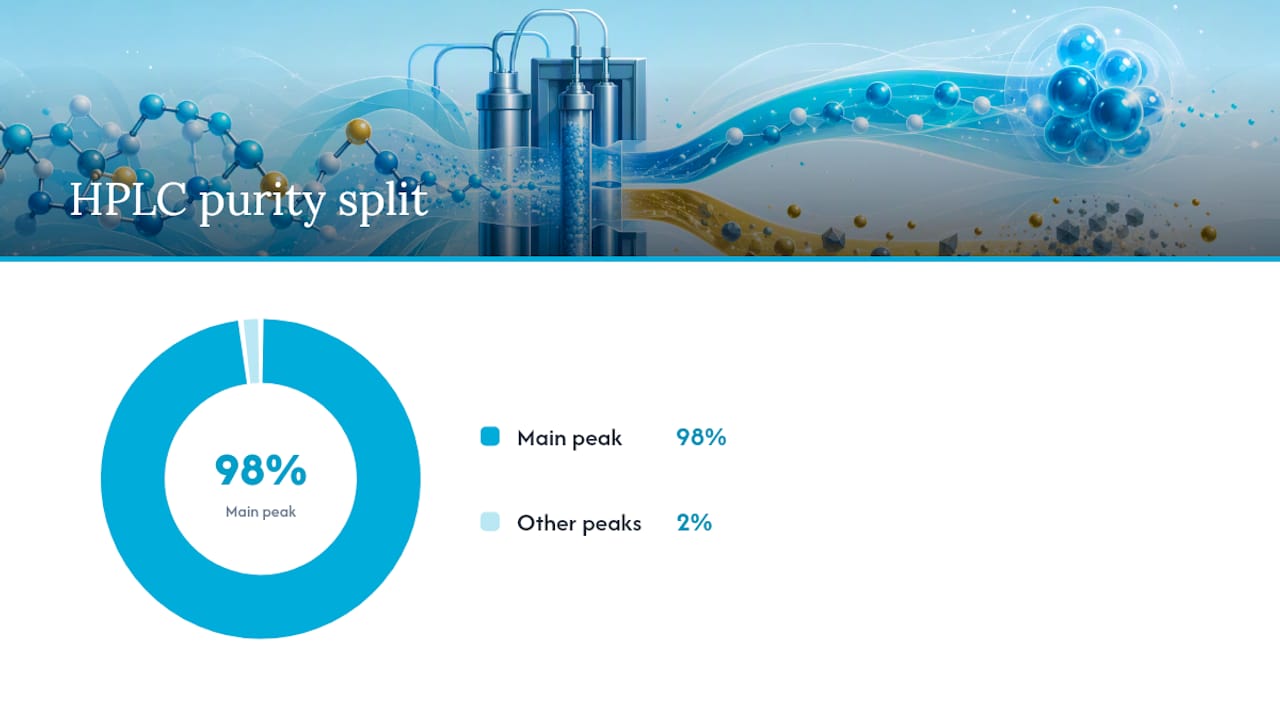
That number depends heavily on how the run was set up. Integration parameters, gradient length, and detector sensitivity all shift the reported percentage, sometimes by several points, without changing the actual peptide.
To judge whether an HPLC purity claim means anything, request these details:
The column specification (dimensions, packing material, pore size)
The gradient profile and total run time
The detection wavelength used for integration
The injection mass and concentration
The raw chromatogram image, not just the summary percentage
Red flags include a reported purity with no accompanying chromatogram, a run that appears cut short before the baseline returns to zero, or peaks that run off the top of the scale, which suggests overloading and an unreliable area calculation. As Compound Review notes, a “98% purity” figure without method metadata is functionally unverifiable. You’re trusting a number with no way to check how it was generated.
Why Intact Mass Confirmation by LC‑MS Matters
RP‑HPLC tells you how homogeneous the detected material is. It does not tell you what that material actually is. A single sharp, symmetrical peak can still contain a deamidated variant or an isobaric impurity that co‑elutes almost perfectly with the intended peptide, which is why identity confirmation by mass spectrometry is not optional for research use, according to Creative Proteomics.
The standard workflow measures intact mass and compares the observed value to the theoretical monoisotopic mass calculated from the sequence. Mass‑accuracy expectations vary by instrument tier, with higher‑resolution systems delivering tighter agreement than basic single‑quadrupole setups, so ask which instrument generated the number before treating a “match” as conclusive.
Request the observed mass alongside the theoretical mass on the COA, not just a pass/fail statement
Ask which instrument class was used (time‑of‑flight and Orbitrap systems typically resolve mass shifts that lower‑resolution instruments miss)
Request MS/MS fragmentation data when the sequence has isobaric residues (leucine/isoleucine) or when a truncation or deletion is suspected
Watch for characteristic mass shifts: +16 Da suggests oxidation, +1 Da near an asparagine or glutamine residue suggests deamidation, and a mass lower than expected by a residue’s exact weight suggests a deletion or truncated synthesis
A convincing match sits within the instrument’s stated accuracy window and is reported as a number, not an adjective. For a closer look at how to interpret observed‑versus‑theoretical mass data, PeptidesFromChina’s guide to molecular weight verification walks through the calculation.
Chromatographic Purity vs. Absolute Peptide Content
HPLC area percent describes homogeneity among UV‑absorbing material in the vial. It says nothing about how much of that material is actually peptide versus water, counterions, or synthesis byproducts that co‑elute with the main peak. A vial reporting 98% HPLC purity can still deliver meaningfully less usable peptide mass than expected once counterion weight and moisture are subtracted, a distinction Compound Review treats as one of the most misunderstood figures in the industry.
Absolute content, sometimes called net peptide content, requires a separate measurement:
Amino acid analysis (AAA): hydrolyzes the peptide and quantifies individual amino acids to back‑calculate total peptide mass
Elemental nitrogen analysis: estimates peptide content from nitrogen composition
qNMR: quantifies peptide content against a calibrated reference signal
Mass‑balance calculation: subtracts water, counterion, and residual solvent content from total vial mass, an approach USP describes as standard practice when assigning value to reference standards
If mg/vial is unreported or derived only from HPLC purity times total lyophilized weight, treat any dosing calculation built on that figure as an estimate, not a fact.
Counterions, Moisture, and the Weight You’re Not Accounting For
TFA is the standard counterion in most peptide syntheses using Fmoc chemistry, and it adds real mass to the lyophilized powder without adding any peptide. Depending on the sequence and salt form, TFA content can account for a meaningful fraction of total vial weight, which is why a purity figure alone tells you nothing about the actual usable peptide mass because of counterions and moisture.
TFA content is typically quantified by ¹⁹F‑NMR or HPLC‑ELSD
Residual solvents follow ICH Q3C guidance for acceptable limits
Water content is measured by Karl Fischer titration, a standard moisture assay
For quantitative applications where TFA load matters, request counterion exchange (commonly to acetate) or a desalting step before running content assays
COA Red Flags and an On‑Receipt Verification Workflow
Reading a certificate of analysis in the right order catches problems before a peptide reaches an experiment. Work through it methodically rather than jumping straight to the purity headline.
Confirm the lot number on the COA matches the lot number on the vial label
Check quantitative content (mg/vial) and salt form
Review the HPLC chromatogram image and method metadata, not just the area‑percent number
Confirm intact mass, observed versus theoretical
Check endotoxin data if the peptide will be used in cell culture or in vivo work
On receipt, a quick in‑house check goes a long way: weigh the vial against the stated fill weight, and run a fast RP‑HPLC pass if your lab has the capacity. A lot showing a fill‑weight mismatch, a missing chromatogram, or a mass that doesn’t match theoretical value within the instrument’s stated accuracy should be quarantined, not used, while you escalate to the supplier or send a split sample to an independent third‑party lab for a retest.
Pro Tip: Keep a simple spreadsheet logging lot number, supplier, COA date, and independent retest results for every peptide your lab uses. Patterns of quiet discrepancies across lots from the same supplier surface fast once you have three or four data points side by side.
Preparing Samples for Third‑Party Peptide Testing
Submitting a sample that a lab can actually work with starts before shipping, not after. Most labs need enough material to run HPLC, mass spec, and any requested quantitative assay without depleting the entire sample on a single pass, so a few milligrams in duplicate is a reasonable starting point for most panels.
Submit lyophilized (dried) peptide when possible; reconstituted solutions are less stable in transit and complicate concentration calculations
For MS work, avoid submitting peptide already dissolved in a buffer with high salt content, which suppresses ionization
For hydrophobic sequences, note this on the submission form since these peptides are prone to aggregation and may need a different solvent system for HPLC
Label the vial and submission form with lot number, sequence or product name, and the exact tests requested, so results map cleanly back to your inventory
Ship with appropriate temperature control and documentation matching what’s on the vial label
A professional laboratory verification guide covers panel options in more detail if your lab is setting up a testing relationship for the first time.
How PeptidesFromChina Qualifies Suppliers Before Listing a Peptide
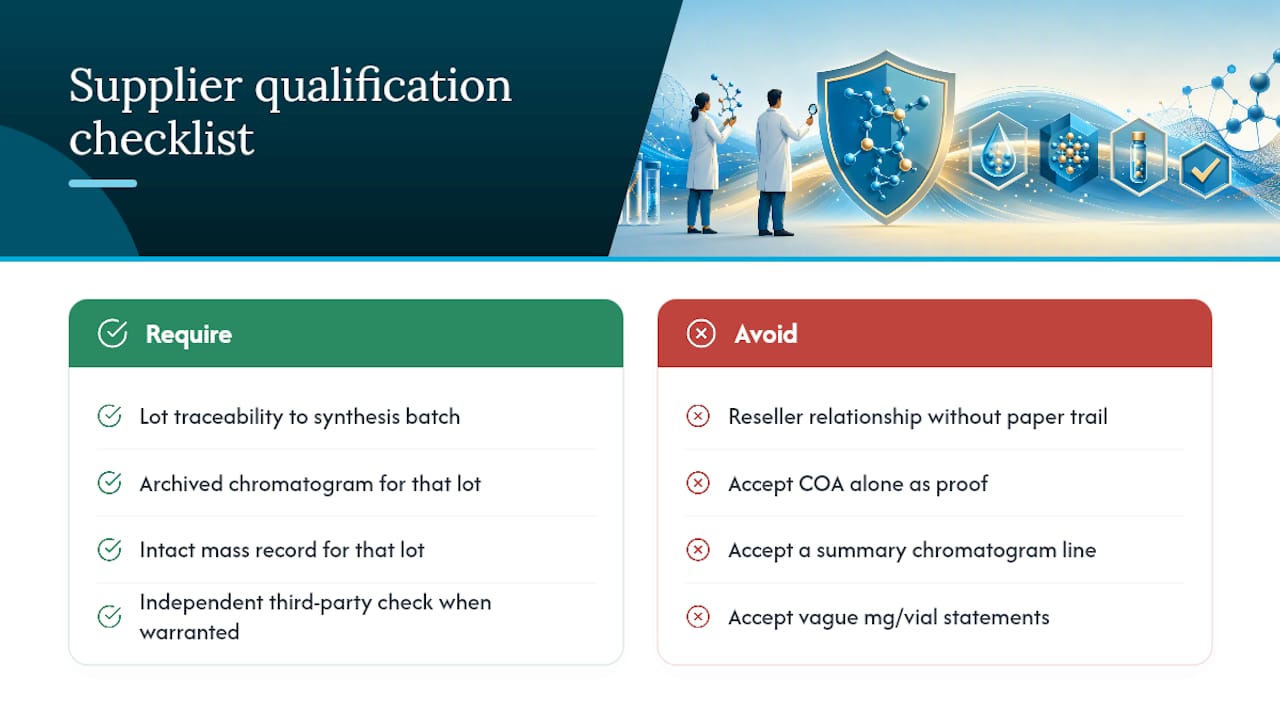
Supplier qualification in this industry runs on documentation, not reputation. Before PeptidesFromChina lists a peptide, it requires lot traceability back to the synthesis batch, an archived chromatogram and intact mass record for that lot, and, where warranted, an independent third‑party check against the supplier’s own COA. A reseller relationship without that paper trail is exactly the gap that produces mismatched fill weights and unverifiable purity claims further down the supply chain.
Procurement teams can borrow this language directly for purchase orders: require mg/vial with the calculation method stated, salt form, a chromatogram image (not a summary line), and the instrument tier used for mass confirmation. That level of specificity is what separates a documented batch from a purity claim taken on faith, and it’s the difference between reproducible research and a lot you can’t defend if a result doesn’t replicate. Reviewing how to read a peptide COA line by line makes that PO language easier to draft correctly the first time.
Common Procurement Failures and Three Fixes
The most frequent failure in peptide procurement isn’t a fake purity number. It’s an incomplete one: mg/vial left off the COA, no chromatogram image, no intact mass data. Each gap looks minor in isolation and adds up to a lot you can’t actually verify, according to KMD Analytical’s review of common documentation gaps in the field.
Three fixes address most of it. Require mg/vial and method metadata explicitly in every purchase order. Demand chromatogram images and intact mass data as standard COA components, not optional extras. And spot‑check new suppliers with an independent third‑party lab before committing to volume, since a single verified lot tells you more about a supplier’s real quality control than any marketing claim.
— Sam Levin
Request Verification Before You Order, Not After
PeptidesFromChina works from direct manufacturer relationships rather than gray‑market reselling, which means lot‑specific COAs, chromatogram images, and mass data are available on request before you commit to volume, not discovered as a surprise after payment clears.
If your lab needs to confirm a lot’s documentation before purchasing, request sample verification or COA access directly. Peptides like Epithalon ship with COA data included, and the same transparency extends across the catalog, including PE‑22‑28 and Pinealon. Reach out through the catalog to request archived chromatogram and mass records for a specific lot before you place an order, so the verification happens on your terms, not the supplier’s.