Since June 2023, every gram of semaglutide powder imported into the U.S. for compounding has originated from Chinese suppliers, yet nearly 60% of these manufacturers aren't permitted to distribute that same API for human use within their own borders. You're likely navigating the fallout of this fragmented market, facing inconsistent batch quality, reused COAs, and middleman markups that inflate your research budget. It's an environment where "pharmaceutical-grade" claims often lack the backing of a formal USP monograph, leaving researchers to verify their own analytical data.
This guide helps you navigate these supply chain uncertainties by mastering the technical specifications and quality verification protocols required for high-purity semaglutide powder in 2026. We'll show you how to reduce procurement costs by 40-60% by establishing a direct sourcing bridge that bypasses unnecessary reseller layers. We'll outline the latest FDA import restrictions, the reality of manufacturer-issued documentation, and the logistical requirements for B2B wholesale orders starting at a $600 minimum. By the end of this guide, you'll have a methodical framework for ensuring 99%+ peptide purity for consistent, reliable data.
Key Takeaways
Identify why lyophilized semaglutide powder is the industry standard for maintaining peptide stability during international logistics and long-term storage.
Learn to evaluate HPLC reports and Mass Spectrometry data as baseline technical references to improve supply chain traceability and batch consistency.
Reduce procurement costs significantly by bypassing domestic intermediaries that typically apply 300-500% markups on imported materials.
Implement standardized laboratory protocols for the storage and reconstitution of GLP-1 agonists to preserve integrity and ensure reproducible research results.
Master the B2B sourcing workflow, including the $600 minimum order requirement and the $10 deposit system used to secure factory-side priority for serious inquiries.
Table of Contents
Understanding Semaglutide Powder: Chemical Properties and Research Utility
Purity Standards and Analytical Verification for GLP-1 Peptides
Procurement Strategies: Direct-from-China vs. Domestic Resellers
Laboratory Protocols: Handling, Storage, and Reconstitution
Streamlining Your Supply Chain with Peptides From China
Understanding Semaglutide Powder: Chemical Properties and Research Utility
semaglutide functions as a long-acting glucagon-like peptide-1 (GLP-1) receptor agonist. It's a synthetic analog of human GLP-1, but with specific structural modifications that extend its half-life significantly. The primary modification involves the substitution of alanine with alpha-aminoisobutyric acid (Aib) at position 8. This change protects the peptide from degradation by the enzyme dipeptidyl peptidase-4 (DPP-4). Additionally, the attachment of a C18 fatty diacid side chain via a linker at position 26 enables high-affinity binding to albumin. This structural design is what allows for the sustained release kinetics observed in metabolic modeling.
For research applications, semaglutide powder is typically supplied in a lyophilized (freeze-dried) state. This physical form appears as a uniform white cake or powder. Lyophilization is the industry standard for maintaining the structural integrity of the peptide during international transit. Liquid formulations are susceptible to rapid degradation if temperature fluctuations occur during shipping. By contrast, the lyophilized form remains stable at room temperature for short durations; however, long-term integrity requires specific climate-controlled storage to prevent hydrolysis or oxidation.
Labs and procurement professionals prioritize the powder form over pre-filled liquid alternatives for several logistical reasons. Bulk semaglutide powder allows researchers to control the final concentration precisely during reconstitution. It also reduces the weight and volume of shipments, which lowers freight costs. Most importantly, it eliminates the stabilizers and preservatives often found in retail liquid products, which can interfere with sensitive analytical assays. Accessing the raw powder directly from synthesis facilities ensures that the material hasn't been subjected to multiple freeze-thaw cycles by intermediaries.
The Role of GLP-1 Agonists in Modern Research
Current research trends in 2026 show a shift toward high-volume procurement of GLP-1 agonists. While glycemic control and metabolic rate studies remain the foundation, researchers are increasingly exploring the peptide's neuroprotective potential. Studies involving cardiovascular modeling also rely on the consistent availability of high-purity material. Accessing manufacturer-side channels for semaglutide powder helps labs maintain these long-term studies without the risk of supply chain interruptions or reseller price spikes. The ability to source large batches ensures that data remains consistent across multiple phases of a study.
Chemical Specifications for Laboratory Standards
Accurate modeling requires adherence to specific chemical parameters. The molecular formula for semaglutide is C187H291N45O59. Understanding these specifications helps in verifying the identity of the material through independent testing.
Molecular Weight: Approximately 4113.58 g/mol.
Solubility: The powder is readily soluble in sterile water or bacteriostatic saline.
Sequence: H-His-Aib-Glu-Gly-Thr-Phe-Thr-Ser-Asp-Val-Ser-Ser-Tyr-Leu-Glu-Gly-Gln-Ala-Ala-Lys(AEEAc-AEEAc-γ-Glu-17-carboxyheptadecanoyl)-Glu-Phe-Ile-Ala-Trp-Leu-Val-Arg-Gly-Arg-Gly-OH.
Physical Appearance: Lyophilized white powder.
Reconstitution should be performed slowly to avoid aggressive agitation. Excessive mechanical stress can lead to peptide shearing or denaturation, which compromises the reliability of the research data. Proper handling starts with understanding these baseline chemical realities.
Purity Standards and Analytical Verification for GLP-1 Peptides
For researchers, 99% purity isn't just a marketing figure; it's the baseline for ensuring that observed biological effects result from the peptide itself rather than unintended contaminants. When sourcing semaglutide powder, the primary analytical tool for this verification is High-Performance Liquid Chromatography (HPLC). This process separates the components of a sample to determine the relative concentration of the target molecule. While many resellers provide a Certificate of Analysis (COA), it's vital to recognize these as baseline technical reference materials rather than absolute proof of quality. They represent a single moment in time for a specific sample, not necessarily the entire batch you receive.
Interpreting these reports requires a critical eye. A standard HPLC chromatogram should display a sharp, dominant peak. The purity is calculated based on the Area Under the Curve (AUC) for that primary peak compared to the total area of all detected peaks. However, HPLC alone doesn't confirm the identity of the substance, only its relative purity. This is why Mass Spectrometry (MS) is used in tandem to verify the molecular weight. By cross-referencing MS data with established semaglutide chemical and physical properties, buyers can confirm they've received the correct sequence rather than a substituted or mislabeled analog. It's a necessary step to avoid the risks of batch substitution common in opaque supply chains.
Supply chain opacity often leads to "ghost" COAs, where a single report is reused across multiple batches or even different suppliers. To mitigate this risk, independent third-party testing by the buyer remains the most reliable strategy. Peptides From China helps reduce supply chain uncertainty by facilitating direct access to factory-side data, allowing you to verify manufacturer-side documentation before committing to large-scale procurement. We act as a transparency bridge, helping you look past the polished surface of retail marketing.
Interpreting the HPLC Report
The primary peak represents the target molecule, but smaller secondary peaks reveal the presence of impurities such as acetate, water content, or residual Trifluoroacetic acid (TFA). While 98% purity sounds high, the remaining 2% could consist of truncated sequences or synthesis byproducts that interfere with sensitive assays. In metabolic rate studies, even minor contaminants can skew glycemic modeling data, rendering an entire study's results questionable. Don't assume a "pass" on a COA covers every potential interference.
Batch Consistency and Long-term Stability
Consistency is paramount for multi-year studies. Sourcing from variable synthesis facilities introduces "batch drift," where slight changes in the manufacturing environment alter the impurity profile. Lyophilization helps maintain stability, allowing semaglutide powder to be stored at room temperature during transit without immediate degradation. To ensure longitudinal data integrity, researchers should prioritize sourcing from a single, verified facility. Peptides From China streamlines this by vetting factories for consistent output before listing them in our B2B channel, which supports wholesale orders starting at a $600 minimum.
Procurement Strategies: Direct-from-China vs. Domestic Resellers
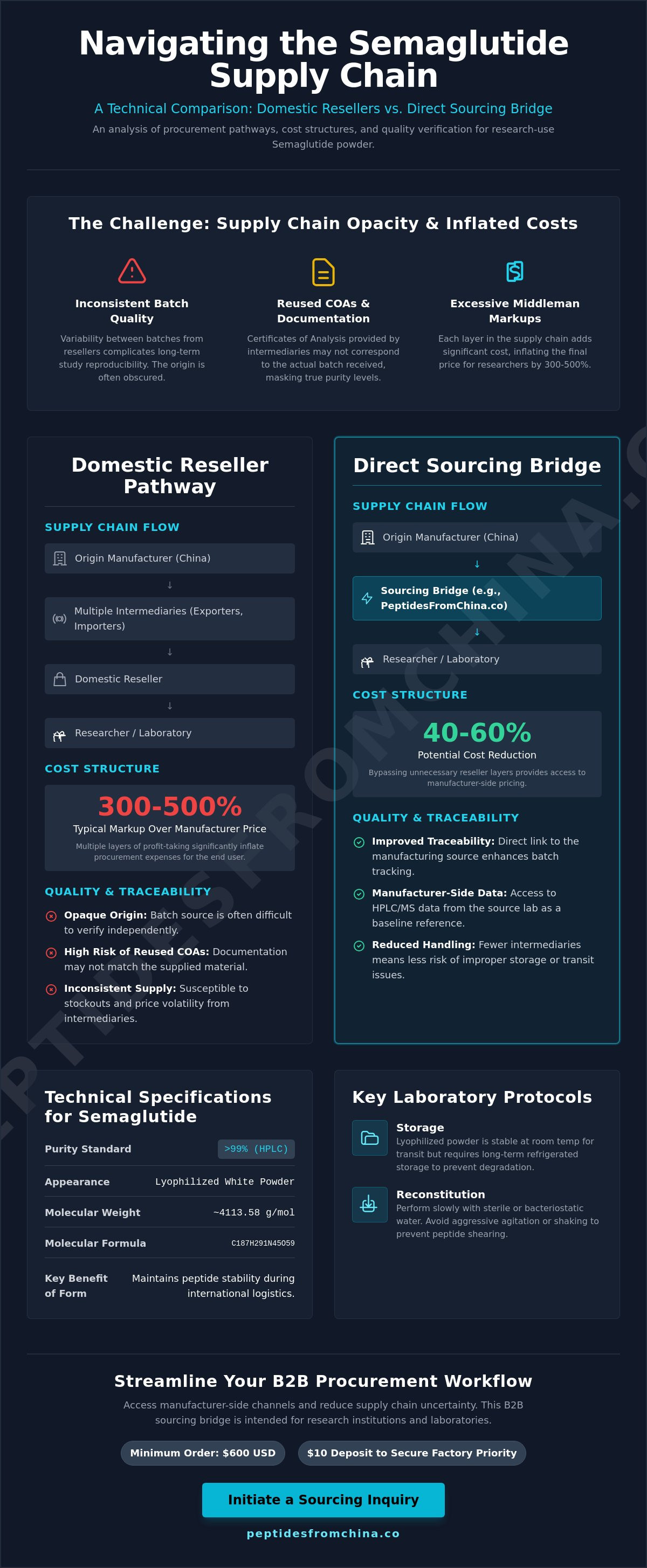
Domestic resellers provide a sense of convenience, but that convenience comes with a steep financial and transparency cost. Most domestic brands operate as relabelers. They purchase semaglutide powder from overseas synthesis facilities, apply a custom label, and increase the price by 300-500% to cover marketing and domestic overhead. This creates the "Peptide Reseller Trap," where researchers pay premium prices for the exact same material they could source directly. Beyond the cost, this model obscures the original source. If a reseller switches factories to improve their own margins, your research data could suffer from batch drift without any notification or traceability.
Direct sourcing logistics require a more methodical approach to international freight, but the benefits for professional laboratories are significant. By clearing the hurdles of international shipping yourself, you gain direct insight into the factory behind the vial. This transparency is essential for multi-year studies where consistency is the primary variable. Wholesale procurement through manufacturer-side channels typically involves specific entry requirements. For example, Peptides From China facilitates these direct connections with a minimum order requirement of $600, ensuring that synthesis facilities prioritize these B2B requests over smaller, less efficient retail orders.
Evaluating the Cost-to-Quality Ratio
A low price point is often a red flag for high salt content or low actual peptide mass. Some suppliers may offer what appears to be a bargain, but the material might only contain 70% of the stated peptide weight once you account for residual salts and water. Calculating the real cost per mg is the only way to evaluate a bulk purchase of semaglutide powder. Peptides From China eliminates the middleman markup by acting as a sourcing bridge, allowing you to allocate more of your budget toward high-purity material rather than reseller profit margins. This direct access helps ensure that your investment translates into actual peptide mass for your assays.
Risk Mitigation in International Sourcing
Success in international sourcing relies on established customs clearance protocols and the use of neutral packaging. These strategies are designed to ensure global delivery success by minimizing unnecessary scrutiny during transit. Researchers must prioritize providers that understand the nuances of international logistics, including the use of reliable tracking and insurance to protect the laboratory investment. While no shipping process is entirely without risk, moving material through verified B2B channels significantly improves the likelihood of a seamless delivery compared to using unvetted retail intermediaries. Managing these logistics directly is a standard operational requirement for modern, cost-efficient research facilities.
Laboratory Protocols: Handling, Storage, and Reconstitution
Once you've secured a reliable supply of semaglutide powder, the focus shifts to maintaining its integrity through strict laboratory protocols. Even the highest purity batch can be compromised by improper handling or storage. For long-term stability, lyophilized peptides should be stored in a freezer at -20°C. For studies extending beyond twelve months, -80°C is the preferred standard to minimize any potential for degradation. When removing vials from cold storage, allow them to reach room temperature before opening. This prevents atmospheric moisture from condensing on the powder, which can trigger premature hydrolysis and ruin the sample before the first assay begins.
Reconstitution math is straightforward but requires precision to ensure the validity of your data. If you have a 10mg vial of semaglutide powder and require a concentration of 5mg/mL, you must add exactly 2mL of solvent. Always use a calibrated micropipette to ensure volume accuracy, as small variances significantly impact the dosage in metabolic modeling. It's also vital to account for the displacement volume of the peptide itself, though this is often negligible at standard research concentrations. Maintaining a meticulous log of reconstitution dates and solvent lots helps improve traceability if unexpected variables arise during testing.
Step-by-Step Reconstitution Guide
Solvent choice depends on the specific requirements of your assay. Bacteriostatic water is common for its antimicrobial properties, while Phosphate-Buffered Saline (PBS) is often preferred for maintaining a stable pH during sensitive biological testing. When adding the solvent, aim the stream at the side of the glass vial rather than directly onto the peptide cake. Use a gentle swirling motion to dissolve the powder. You should never shake a peptide vial. Shaking creates mechanical shear stress that can denature the peptide's secondary structure, rendering it inactive. After reconstitution, aliquot the solution into single-use doses to avoid repeated freeze-thaw cycles.
Environmental Factors Affecting Potency
Environmental factors like UV exposure and humidity are silent threats to potency. Use amber vials or store containers in complete darkness to prevent photodegradation of the peptide bonds. Because semaglutide is hygroscopic, it readily absorbs moisture from the air; ensure all seals are airtight and consider vacuum-sealing bulk containers for added security. While lyophilized powder can remain stable for up to twenty-four months under ideal cold-storage conditions, reconstituted solutions typically have a shelf-life of 21 to 28 days when refrigerated at 2°C to 8°C.
Establishing these protocols is the final step in securing a reliable research workflow. If you're ready to transition from retail markups to a more professional supply chain, you can source semaglutide powder directly through our B2B channel with a $600 minimum order.
Streamlining Your Supply Chain with Peptides From China
Establishing a reliable research workflow requires more than just technical knowledge of reconstitution; it demands a stable, transparent supply chain. Peptides From China (PFC) functions as a specialized B2B sourcing bridge, connecting professional laboratories directly with verified synthesis facilities. We don't operate as a manufacturer or a testing laboratory. Instead, we act as an analytical filter and logistical coordinator. This model helps researchers move past the opacity of the retail market and access the same manufacturer-side channels used by high-volume distributors, but without the standard intermediary markups.
Our focus is strictly on wholesale procurement, catering to laboratories and procurement professionals who require consistency across large batches. To maintain this professional standard and ensure that factory production lines prioritize our clients, we implement a $600 minimum order requirement. This threshold aligns with the logistical realities of international freight and synthesis scheduling. By focusing on B2B volumes, we help reduce the risk of batch substitution and relabeling that often occurs when material is broken down into single vials for the retail market.
One distinct feature of our operation is the $10 processing deposit. This small fee serves a specific operational purpose: it filters out casual inquiries and ensures that factory-side resources are dedicated to serious researchers. Once you've identified your requirements for semaglutide powder or other compounds, this deposit initiates the verification process. We then confirm current stock levels, review recent manufacturer-issued HPLC reports, and secure factory availability for your specific batch. The deposit is fully credited toward your final invoice once the order is finalized.
How Our Sourcing Process Works
The process begins when you submit a specific request for semaglutide powder or other research peptides from our catalog. We don't maintain domestic warehousing, as this adds unnecessary overhead and potential for temperature-related degradation. Instead, we verify the material directly at the source facility. You'll receive a transparent invoice that includes the credited $10 deposit, ensuring you know exactly what you're paying for before the synthesis or shipping process begins. This methodical approach improves traceability and ensures that the technical documentation you receive is batch-specific rather than a generic reference sheet.
Global Logistics and Support
Navigating international customs and freight is often the most significant hurdle for independent labs. We manage the logistics of tracking your shipment from the synthesis facility directly to your laboratory. Our support doesn't end at delivery; we provide ongoing assistance with technical documentation and COA requests to help you maintain your research logs. If you're ready to move away from the reseller model and establish a direct-from-factory connection, you can initiate your Semaglutide sourcing request today. We are here to help you reduce supply chain uncertainty and stabilize your long-term procurement costs.
Securing a Transparent Sourcing Workflow for 2026
Professional research requires moving beyond the middleman model to ensure batch-to-batch consistency and data integrity. By mastering the technical requirements of lyophilized storage and reconstitution, you protect the longevity of your samples and the validity of your metabolic modeling. Transitioning to a direct sourcing model helps reduce supply chain uncertainty while providing access to essential baseline analytical data, including HPLC and Mass Spectrometry reports. This methodical approach ensures your lab isn't reliant on reused documentation or unverified retail batches that often suffer from salt-content variations.
Establishing a direct bridge to synthesis facilities allows your organization to reclaim research budgets by bypassing the 300-500% markups common among domestic resellers. When you source semaglutide powder through our B2B channel, you benefit from factory-side transparency and global logistics managed with neutral, discreet packaging. Every request is handled with a methodical verification process, requiring a $600 minimum order and a $10 processing deposit that is credited toward your final invoice. This system ensures factory priority and logistical efficiency for serious professional inquiries.
Start your $10 sourcing request for bulk Semaglutide powder to stabilize your supply chain and secure high-purity material for your next study. We look forward to acting as your strategic partner in navigating the complexities of the global peptide market.
Frequently Asked Questions
Is semaglutide powder legal to purchase for research purposes in the USA?
Semaglutide powder is legal for purchase in the U.S. when intended strictly for laboratory research and in vitro studies. It is not approved for human consumption or clinical use. Researchers must ensure compliance with local institutional biosafety committees and maintain records confirming the material is used solely for non-clinical applications.
What is the difference between research-grade and pharmaceutical-grade semaglutide?
The difference lies primarily in the intended use and regulatory oversight. Pharmaceutical-grade material is manufactured in cGMP facilities for human administration, while research-grade semaglutide powder is produced for analytical and metabolic modeling. While research-grade material should maintain 99% purity for experimental consistency, it lacks the clinical certifications required for patient use.
How can I verify if a semaglutide powder batch is 99% pure?
Verification requires analyzing the High-Performance Liquid Chromatography (HPLC) and Mass Spectrometry (MS) reports. The HPLC chromatogram must show a sharp peak with minimal secondary noise, while the MS should confirm a molecular weight of approximately 4113.58 g/mol. Since manufacturer-issued COAs are baseline references, independent third-party lab testing is the standard for researchers who require definitive purity confirmation.
What is the minimum order quantity for bulk semaglutide powder?
The minimum order requirement for wholesale procurement through our channel is $600. This threshold is established to ensure synthesis facilities prioritize B2B orders and to optimize the efficiency of international logistics. Smaller retail orders are typically handled by domestic resellers who apply significant markups to cover their overhead.
How should I store semaglutide powder to maintain its shelf life?
Lyophilized semaglutide powder should be stored in a freezer at -20°C to ensure long-term stability. If the material is intended for use over several years, -80°C is the preferred laboratory standard. It's essential to keep the vials in a desiccated environment, as moisture absorption can lead to peptide degradation and compromised research data.
Can semaglutide powder be shipped internationally without customs issues?
International shipping is managed through established B2B logistics channels that utilize neutral, discreet packaging. While no international transit is entirely without risk, using professional sourcing bridges helps improve the likelihood of successful customs clearance. These protocols are designed to minimize unnecessary scrutiny and ensure the material reaches the laboratory without delay.
What solvents are best for reconstituting semaglutide for laboratory use?
Bacteriostatic water and sterile water are the most common solvents for reconstitution. For assays that require a stable pH environment, researchers often utilize Phosphate-Buffered Saline (PBS). The choice of solvent should align with the specific requirements of the study to avoid interference with the peptide's chemical integrity or the assay's results.
How does Peptides From China verify the synthesis facilities they work with?
We vet synthesis facilities by reviewing their history of batch consistency and the accuracy of their technical documentation. Peptides From China acts as a transparency bridge, accessing manufacturer-side data to help researchers reduce supply chain uncertainty. We prioritize factories that provide detailed reference analytical data and demonstrate reliable production schedules for wholesale volumes.