Researchers: 4 COA Checks That Reveal Counterfeit Peptides Before Use
The single most protective action is this: stop using any peptide that lacks a batch-specific Certificate of Analysis, and for anything used in load-bearing research or clinical contexts, confirm identity through independent mass spectrometry before you continue. This sequence matters equally for researchers running reproducibility-critical studies, clinicians evaluating compounds for patient-adjacent work, and informed buyers trying to avoid wasted budget on inert powder. What follows breaks down the visible red flags, the COA verification steps, and the lab tests that actually separate real material from a well-packaged guess.
TL;DR:
Vendors demanding crypto-only payments without traceable invoices are a red flag, especially for cold-chain sensitive peptides.
Batch numbers that are missing, reused, or mismatched with the COA indicate potential forgery or improper labeling.
A legitimate COA should include matching batch information, a recent test date, chromatogram images, and verifiable lab contact details.
Mass spectrometry is the only reliable test to confirm a peptide’s molecular identity and detect substitution or contamination.
When a counterfeit suspicion arises, immediately quarantine the material, document all evidence, and seek independent testing before further use.
Table of Contents
Peptide Counterfeit Warning Signs You Can Check Immediately
How to Read and Verify a Certificate of Analysis
Laboratory Verification That Actually Confirms Identity and Purity
What to Do the Moment You Suspect a Counterfeit
Vetting Suppliers Before the Order, Not After
Why Layered Verification Matters More Than Any Single Test
A Straight Answer on Cost Versus Verification Rigor
COA-Verified Sourcing, Without the Guesswork
Where to Verify Claims and Report Bad Vendors
Sources
Peptide Counterfeit Warning Signs You Can Check Immediately
Most counterfeit peptides get caught before a vial ever reaches a bench, if you know where to look, including trusted sources like Unflavored Collagen Peptides | PRYM Wellness. The clearest signals show up in pricing, packaging, and how a vendor handles the transaction itself.
Price anomalies: a peptide selling significantly below the going rate from established synthesis-linked suppliers is usually cut with filler, underdosed, or entirely mislabeled.
Crypto-only checkout with no buyer protection: legitimate B2B research suppliers typically offer traceable payment options; cash-only or crypto-only demands with no invoice trail are a documented pattern in the gray market for injectable peptides sold online.
Missing or generic batch/lot numbers: labeling that reuses the same lot code across multiple listings, or omits it entirely, breaks the traceability chain you need for any reproducible study.
Tampered or inconsistent seals: crimps that don’t match across “identical” vials from the same supposed batch suggest repackaging outside a controlled fill line.
No cold-chain documentation: many signaling peptides degrade at room temperature; a vendor who ships without insulation or temperature logs for a cold-sensitive compound is either careless or has never handled the material at scale.
Visual inspection and reconstitution behavior (clarity, dissolution speed) can flag obvious problems, but they cannot rule out substitution. A vial can look perfect and still contain the wrong molecule.
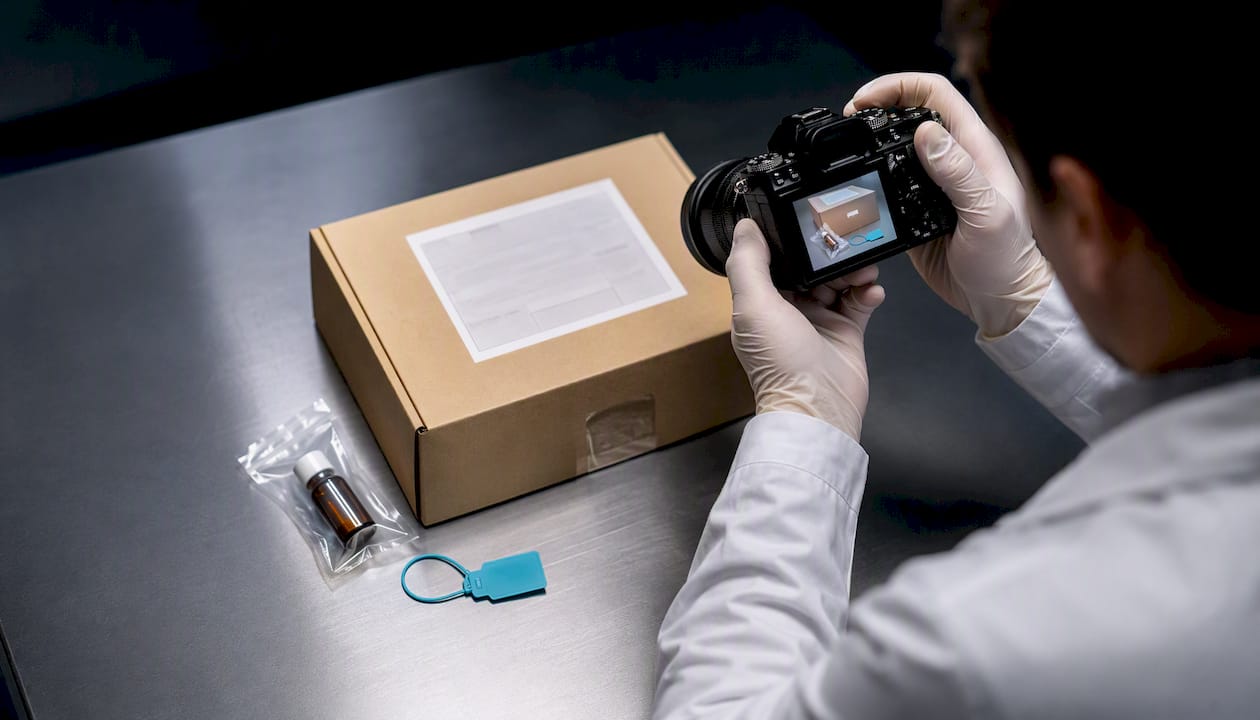
Pro Tip: Photograph the vial, box, and shipping label before you open anything. If a batch turns out to be counterfeit, that documentation becomes the evidence you need for a chargeback or a report.
How to Read and Verify a Certificate of Analysis
A real COA is a lab document, not a marketing insert. It should carry a batch number that matches your vial, a test date, chromatogram images (not just a summary line), mass spectrometry identity confirmation, endotoxin results for anything injectable, and a lab name with a verifiable contact address.
Match the batch number printed on the vial or box to the number on the COA. Any mismatch means the document belongs to a different lot, or was never tied to your material at all.
Check the test date against a reasonable shelf window. A COA dated years before your purchase, with no retest, tells you nothing about the vial in your hand.
Look for the chromatogram itself, not a stated purity percentage. A number with no underlying trace is unverifiable.
Confirm the lab is traceable. Search the lab name independently; if it doesn’t show up outside the vendor’s own site, treat the COA as unverified.
Community-compiled checklists point to a consistent pattern: COAs missing chromatograms, MS data, or a real lab contact are frequently fabricated or reused across unrelated batches. A COA that passes all four checks is adequate for lower-stakes screening. It is never a substitute for independent testing once the research is load-bearing.
Laboratory Verification That Actually Confirms Identity and Purity
Documentary review tells you what a vendor claims. Lab testing tells you what’s actually in the vial, and the two are not interchangeable.
HPLC measures chromatographic purity reliably, but it cannot confirm identity on its own. A peak at the expected retention time can still be the wrong molecule at the same polarity.
Mass spectrometry confirms molecular identity by mass, which is the only test that reliably catches substitution, the scenario where a vial contains a cheaper or underdosed peptide dressed up as the labeled compound.
Endotoxin testing is non-negotiable for anything injectable. A 2024 study on unauthorized semaglutide sellers found endotoxin contamination in every single tested sample, with measured purity between 7.7% and 14.37% despite labels claiming 99%. That gap between claim and reality is the entire argument for independent testing.
Orthogonal testing (running HPLC, MS, and endotoxin assays together) closes the blind spots each method leaves open on its own, a strategy pharmacopeial reference-standard practices also recommend for maintaining reliable characterization over time.
Research stakes Minimum recommended testing Low-risk screening or preliminary work Batch-matched COA review only New vendor, moderate-stakes study COA review plus spot MS confirmation Load-bearing or clinical-adjacent research Full identity (MS), purity (HPLC), and endotoxin panel
When shipping a sample to an independent lab, keep it frozen or refrigerated per the peptide’s stability profile, ship with a temperature log, and include the original vial label for chain-of-custody purposes.
What to Do the Moment You Suspect a Counterfeit
Stop use immediately and quarantine the material in its original packaging.
Preserve chain-of-custody documentation: screenshots of the order, invoices, shipping labels, and the batch number itself.
Request the COA and lab contact directly from the vendor, then attempt to verify that lab independently.
Send a sample for independent testing if the vendor can’t produce a verifiable, batch-matched COA.
Seek medical advice if any exposure occurred, and report through FDA MedWatch or your institution’s biosafety office.
Pro Tip: If you work inside an institution, loop in procurement and biosafety at the same time you contact the vendor. A counterfeit batch is rarely an isolated purchase; other teams may have sourced from the same supplier.
Vetting Suppliers Before the Order, Not After
The cheapest way to avoid counterfeit exposure is refusing the order in the first place. A short pre-purchase check catches most of the vendors worth avoiding.
Run a WHOIS lookup: a domain registered a few months ago selling “bulk research peptides” carries more risk than one with years of operating history.
Confirm business registration and a real, multi-channel contact method (not a contact form that routes to a generic inbox).
Ask whether COAs are batch-specific and published proactively, not produced only after a complaint.
Verify the testing lab is named and independently searchable, not an in-house “quality department” with no outside accreditation.
Favor vendors offering qualification lots before committing to full wholesale volume, and require cold-chain shipping in writing for temperature-sensitive compounds. Our guide to choosing a high-purity peptide supplier covers this qualification process in more detail.
Treat refusal to provide a traceable batch number, or pressure toward crypto-only payment with no invoice, as an immediate reason to walk away, consistent with the vendor red-flag patterns industry analysis of hundreds of peptide sellers has documented.
Why Layered Verification Matters More Than Any Single Test
Peptides degrade through specific, well-documented pathways: oxidation of methionine or cysteine residues, deamidation of asparagine and glutamine, and aggregation that clumps monomers into larger, biologically inactive structures. Each pathway can lower potency without changing how a vial looks or reconstitutes, which is exactly why visual inspection alone misses so much.
Chromatographic purity and molecular identity are not the same measurement. HPLC can report a clean 98% purity on a peptide that is nonetheless the wrong sequence, because retention time reflects polarity, not exact molecular composition. That gap is why orthogonal testing, pairing HPLC with MS, exists as standard practice rather than an optional upgrade.
The most damaging fakes in the peptide space rarely look damaged. They arrive in a clean vial with a plausible label, and the only thing wrong is the molecule inside. Mass spectrometry is the only test that reliably catches that kind of substitution.
Pro Tip: Ask any prospective supplier whether their reference standards are multi-lab characterized. Pharmacopeial guidance on peptide reference standards calls for exactly this kind of cross-validation, and a supplier who can’t answer the question hasn’t done the work.
A Straight Answer on Cost Versus Verification Rigor
Documentary checks are enough for low-stakes screening work. They stop being enough the moment a peptide feeds into a reproducibility-critical study or anything clinic-adjacent, and that’s where independent MS testing earns its cost. PeptidesFromChina treats batch traceability and COA-verified sourcing as the baseline, not the upsell, and welcomes institutional partners who want direct verification support before committing to volume.
— Sam Levin
COA-Verified Sourcing, Without the Guesswork
PeptidesFromChina works directly with synthesis-linked manufacturing relationships instead of routing through unverified reseller layers, which is the structural reason batch-specific COAs and traceability are standard practice here rather than a paid add-on.
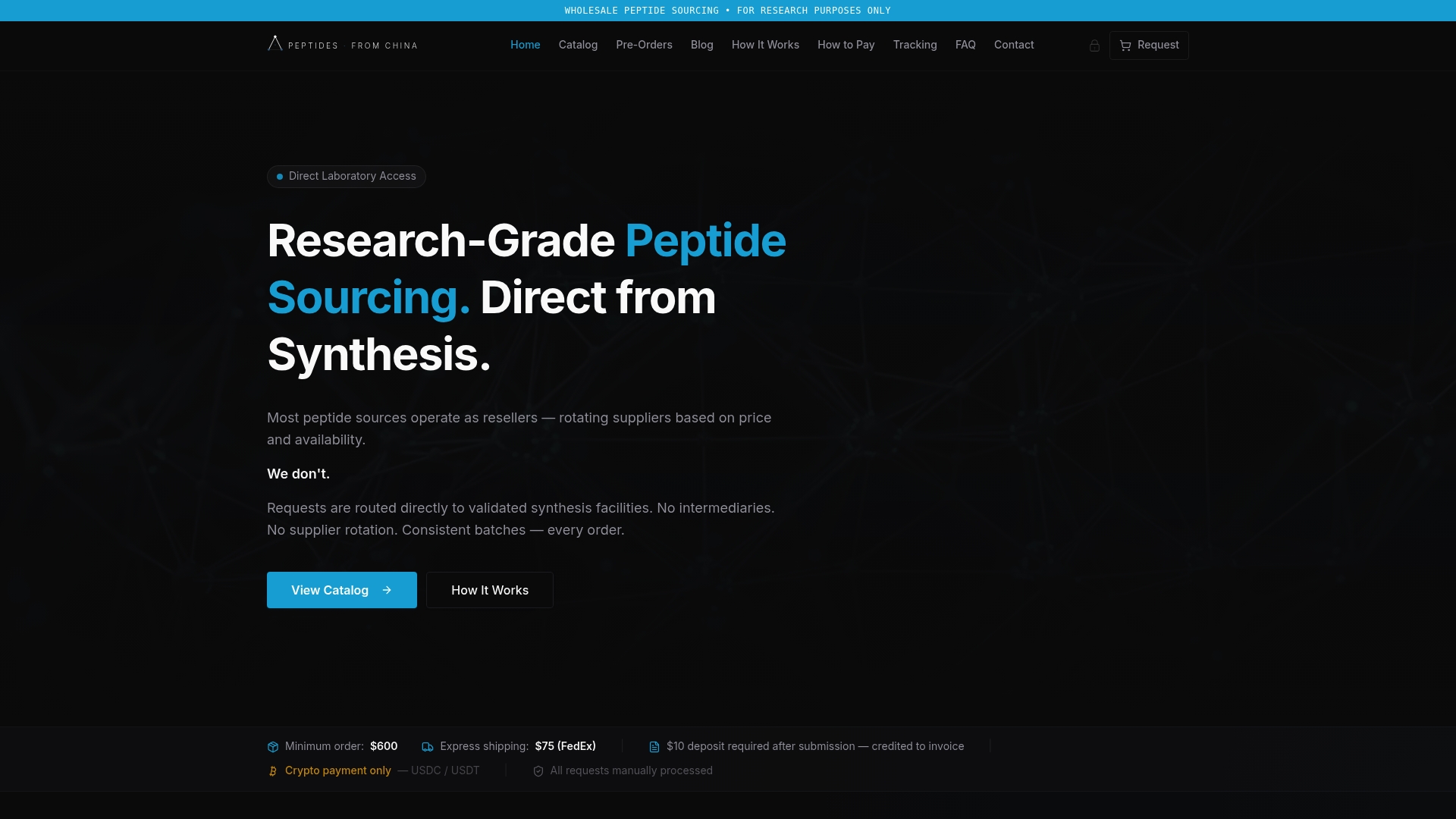
Every listed batch carries lot-specific documentation you can cross-check against the vial you receive, and the team coordinates independent testing for institutional buyers who need it before committing to full order volume. If you’re evaluating a compound like Epithalon with COA included, PE-22-28, or VIP, start with a qualification-size order rather than committing to bulk volume on an unfamiliar batch. Our peptide vendor qualification guide walks through the same due-diligence steps procurement teams use before scaling up with a new supplier. Reach out to request a sample lot or verification support before your next order.
Where to Verify Claims and Report Bad Vendors
PubMed’s 2024 semaglutide contamination study documents endotoxin and purity failures in unauthorized sellers.
FDA MedWatch is the official channel for reporting adverse events or suspected counterfeit research materials.
PeptideExaminer’s COA guide offers a practical checklist for spotting fabricated lab documents.
Our peptide quality assurance process guide covers batch-traceability practices in more depth.
This article is general information, not a substitute for advice from a qualified doctor. Consult a qualified healthcare professional about your own circumstances before acting on anything here.