
A high purity percentage on a digital document is no longer a guarantee of batch integrity, which is why knowing how to read a peptide coa is a critical skill in the 2026 global market. Most procurement professionals understand that a Certificate of Analysis can be easily manipulated or recycled across multiple batches, leading to significant risks in laboratory consistency. You likely feel the pressure of securing high-value reagents while worrying that the data provided by a manufacturer might not reflect the actual compound in the vial. This skepticism is justified.
This guide provides a technical framework for verifying manufacturer data with the precision of a quality assurance auditor. It details how to dissect High-Performance Liquid Chromatography (HPLC) chromatograms and Mass Spectrometry (MS) reports to verify that bulk orders of BPC-157 or Semaglutide meet strict research standards. The analysis covers the critical distinction between purity and net peptide content, providing a clear protocol to identify authentic 3rd-party verification. You'll gain a methodical approach to ensure every batch remains consistent with previous procurement cycles. It's about moving beyond trust and into data-driven verification.
Key Takeaways
Technical analysis of HPLC and MS reports is the only way to confirm chemical identity and purity levels for compounds like BPC-157.
Distinguishing between purity and net peptide content prevents errors in calculating actual research yields for bulk reagents.
Mastering how to read a peptide coa allows procurement officers to detect forged documentation through digital verification and batch number matching.
Effective batch consistency requires verifying the manufacturer’s documentation before committing to the $300 minimum order threshold.
Direct-to-manufacturer sourcing routes orders to facilities with verified batch records, removing the opacity of traditional reseller mark-ups.
Table of Contents
Understanding the Role of a COA in Wholesale Peptide Sourcing
Decoding Technical Metrics: HPLC Purity and Mass Spectrometry (MS)
Net Peptide Content vs. Purity: Calculating Actual Research Yield
Verification Protocols: Spotting Forged Reports and Batch Discrepancies
How Peptides From China Validates Manufacturing Batches
Understanding the Role of a COA in Wholesale Peptide Sourcing
A Certificate of Analysis (COA) is a technical record of test results for a specific batch of synthesized peptides. In a B2B context, the COA serves as the primary verification of manufacturing compliance before shipment. It's the only document that bridges the gap between a factory's production line and a laboratory's receipt of goods. For research institutions, COAs are essential for maintaining experimental reproducibility across different batches. Without a precise analytical baseline, variations in peptide purity can introduce uncontrolled variables into sensitive research environments.
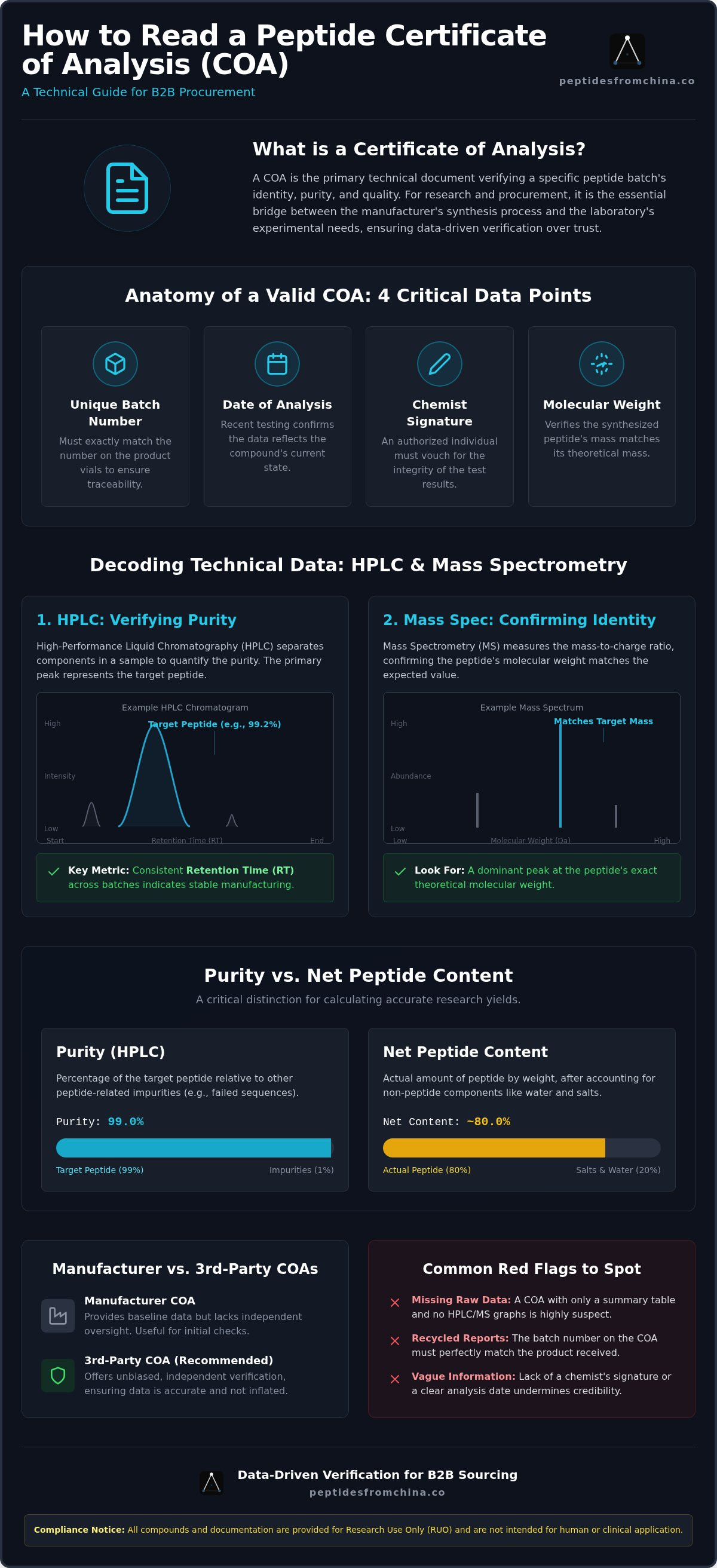
A professional report must include specific data points to be considered valid for procurement. If a document lacks these elements, it shouldn't be used for batch verification:
Unique Batch Number: This must correspond exactly to the labels on the bulk product.
Date of Analysis: Recent testing ensures the data reflects the current state of the lyophilized powder.
Chemist Signature: A named individual or authorized lab manager must vouch for the data integrity.
Molecular Weight: Verification that the synthesized sequence matches the theoretical mass.
Understanding how to read a peptide coa starts with recognizing that the document is a technical audit. It's a confirmation that the manufacturer has fulfilled the specific requirements of a procurement contract for compounds like Semaglutide or other research reagents.
The Difference Between Manufacturer and 3rd-Party COAs
Internal manufacturer reports provide baseline data, but they require independent 3rd-party validation for high-stakes research. Reliance on factory-issued reports alone can be risky because the entity producing the compound is also the one verifying its quality. Professional sourcing platforms like Peptides From China prioritize independent verification to ensure transparency. 3rd-party labs like Janoshik or MZ Biolabs provide an unbiased buffer between the factory and the buyer. They offer a secondary layer of scrutiny that confirms the purity levels stated by the synthesis facility are accurate and haven't been inflated for commercial convenience.
Research Use Only (RUO) Compliance Standards
It's vital to clarify that COAs for research peptides don't imply FDA approval or human-grade certification. The documentation focuses strictly on chemical identity and purity levels. All batch documentation should clearly feature "RUO" (Research Use Only) labeling to remain compliant with laboratory procurement standards. You should view GMP-grade claims in the research peptide space with professional skepticism. While synthesis might occur in a controlled environment, these compounds are intended for laboratory analysis rather than clinical application. For compounds like Tirzepatide, the COA's role is to prove the chemical is exactly what was ordered for the research project.
Decoding Technical Metrics: HPLC Purity and Mass Spectrometry (MS)
Professional laboratory procurement requires moving beyond simple summary tables. To truly understand how to read a peptide coa, you must analyze the raw data provided by High-Performance Liquid Chromatography (HPLC) and Mass Spectrometry (MS). HPLC determines the chemical purity of the peptide sequence, while MS confirms the identity of the compound by measuring its molecular mass. A valid COA must include the actual chromatogram and mass spectrum graphs. Summary tables are easily fabricated; visual data provides the technical proof required for batch validation.
One critical metric often overlooked is the Retention Time (RT). This value represents the specific interval a compound takes to pass through the HPLC column under defined conditions. When sourcing bulk reagents, consistent RT values across different orders indicate stable manufacturing processes and batch consistency. If the RT shifts significantly between batches of the same compound, it may suggest a change in the synthesis environment or the presence of different salts. Mastering how to read a peptide coa involves verifying these technical markers to ensure the product matches previous successful research cycles.
How to Interpret HPLC Chromatograms
The chromatogram displays a series of peaks on a graph. The primary peak represents the target peptide sequence. Secondary peaks, often referred to as "shoulders" or smaller blips, indicate impurities, residual solvents, or synthesis byproducts. Area Under the Curve (AUC) is the mathematical standard used to calculate the purity percentage by comparing the area of the main peak to the total area of all detected peaks. For high-stakes research, a purity of 99% is the industry benchmark for reagents like BPC-157. Anything lower may introduce unwanted artifacts into your experimental data.
Verifying Identity via Mass Spectrometry
While HPLC measures purity, Mass Spectrometry verifies that you've received the correct molecule. The report will list a "Theoretical Mass," which is the calculated weight of the peptide based on its amino acid sequence. You must compare this against the "Observed Mass" shown on the spectrum. In professional-grade synthesis, the variance should be minimal, typically within 0.1% of the theoretical value. This verification ensures that no amino acid deletions occurred during the synthesis cycle. If the observed mass is off by even a few Daltons, the batch identity is compromised. If you need to verify specific batch data for an upcoming project, you can request technical documentation from our sourcing desk before placing a bulk order.
Net Peptide Content vs. Purity: Calculating Actual Research Yield
A common error in laboratory procurement is conflating purity with quantity. When you learn how to read a peptide coa, you'll see a purity percentage, often 98% or higher, and a separate, lower metric for net peptide content. Purity measures the percentage of the powder that is the correct peptide sequence. Net Peptide Content measures the actual weight of the peptide relative to salts and residual water. It's the difference between the total mass of the lyophilized powder and the mass of the peptide itself.
Most research-grade peptides have a net content between 75% and 85% because of the lyophilization process. This is a standard manufacturing reality. The remaining 15% to 25% of the vial's weight consists of counter-ions and residual moisture. Researchers must account for this net content when calculating concentrations for in vitro studies. If you assume a 10mg vial contains 10mg of active peptide when the net content is actually 80%, your experimental dosage will be 20% lower than intended. This oversight is a primary cause of failed experimental reproducibility across different batches.
The Role of Counter-Ions (Acetate vs. TFA)
Trifluoroacetic acid (TFA) is the standard counter-ion used during peptide synthesis to ensure stability and solubility. These salts contribute significantly to the non-peptide mass of a vial. While TFA is acceptable for many applications, it can be toxic to certain cell lines or interfere with specific research models. In these instances, you may need to request acetate-salt versions. Understanding how to read a peptide coa involves identifying which counter-ion was used, as this directly affects both the research yield and the biological compatibility of the batch.
Practical Impact on Laboratory Budgeting
Calculating the "True Cost" of a batch requires factoring in the net peptide content. A lower price per vial may seem attractive, but if the net peptide content is significantly lower than a slightly more expensive batch, your cost per milligram of active reagent actually increases. We prioritize peptide quality and transparency regarding these metrics to ensure labs can budget accurately. Using COA data to adjust research protocols for batch-to-batch variance is a hallmark of professional procurement. It ensures that your laboratory resources are allocated based on the actual amount of research material delivered rather than the gross weight of the powder.
Verification Protocols: Spotting Forged Reports and Batch Discrepancies
Sourcing bulk reagents requires a defensive mindset regarding documentation. Forged or recycled reports are persistent issues in the international market, making it essential to understand how to read a peptide coa as a security audit rather than a simple data sheet. Digital verification remains your strongest defense. Most reputable 3rd-party labs include a unique QR code or report ID. You must always use these to verify the data on the lab's official website. If the digital record doesn't match the PDF in your hand, the batch is compromised.
A rigorous verification protocol includes several manual checks to ensure the document is legitimate and batch-specific:
Consistency Check: Confirm that the batch number printed on the vial or bulk packaging matches the COA exactly. Discrepancies here often indicate a supplier is using a "representative" report from a previous high-quality batch to sell a newer, untested one.
Visual Audit: Examine the document for signs of photo manipulation. Look for inconsistent fonts, misaligned logos, or "ghosting" around text areas where dates or purity percentages might have been altered.
Date Verification: The analysis date should logically follow the manufacturer’s synthesis lead time. A report dated months before a batch was supposedly synthesized is a clear indicator of a recycled document.
By treating the COA as a legal verification of the synthesis contract, you protect your laboratory's budget and research integrity. If you are uncertain about the legitimacy of a report you have received from a different supplier, you can contact our sourcing desk for a comparative analysis of our verified manufacturing batches.
Auditing the Testing Laboratory
Independence is the cornerstone of reliable testing. You must verify whether the lab is truly independent or merely a subsidiary of the manufacturer. Legitimate facilities provide clear contact information and a physical address that can be verified. We prioritize labs that utilize "blind testing" protocols. In these scenarios, the lab does not know the expected result or the identity of the client beforehand. This removes any incentive for the lab to "confirm" a manufacturer's desired purity level, ensuring the data remains objective and accurate.
Common Red Flags in Bulk COAs
Certain patterns in documentation should immediately trigger professional skepticism. Generic reports that lack batch-specific HPLC chromatograms are a major red flag. Furthermore, a purity result of exactly 100.0% is statistically improbable in large-scale peptide synthesis; it usually suggests the data was manually entered rather than derived from an actual test. Finally, avoid relying on reports that are over 6 months old for "current" stock. Lyophilized peptides are stable, but a COA should reflect the specific batch currently being offered for procurement to ensure batch consistency across your research timeline.
How Peptides From China Validates Manufacturing Batches
The validation of a manufacturing batch begins long before the final report reaches your laboratory. While previous sections detailed the technicalities of how to read a peptide coa, the final step in secure procurement is the validation of the source itself. Our sourcing process begins with a $10 processing deposit. This small threshold initiates the manufacturer verification phase, ensuring that the synthesis facility can provide the specific documentation required for your research project. This methodical approach filters for serious laboratory buyers and triggers our internal audit of the manufacturer's current batch data.
We route orders directly to facilities that provide verifiable COA batches for compounds like Tirzepatide. By maintaining direct relationships with synthesis facilities in China, we eliminate the reseller mark-ups that typically inflate costs for Western labs. This direct-to-manufacturer model also ensures that the technical data hasn't been altered by intermediaries. Batch consistency is the primary objective of our sourcing protocols, which focus on manufacturer accountability and factual integrity above all else.
Streamlining the $300 Minimum Order Quantity (MOQ)
Our $300 Minimum Order Quantity (MOQ) is designed to balance wholesale accessibility with the logistical costs of batch-specific verification. This threshold offers several advantages for laboratory procurement:
Wholesale Pricing: Access manufacturing rates by bypassing traditional retail mark-ups.
Batch Continuity: Secure enough material from a single, verified synthesis run to maintain study consistency.
Custom Verification: Request specific 3rd-party testing for bulk orders before final dispatch.
For large-scale research projects, sourcing direct-to-manufacturer provides a significant logistical advantage. It allows for the reservation of specific, tested batches to ensure continuity across long-term studies. You can request specific 3rd-party verification for bulk orders to add an extra layer of security before the batch leaves the facility.
Global Logistics and Quality Assurance
Once a batch is verified, the focus shifts to secure transit. We utilize tracking and neutral packaging standards for all international laboratory shipments to ensure safe delivery to your facility. The sourcing agent acts as a protective filter, managing manufacturer accountability and intervening if a batch fails to meet the agreed-upon technical specs. This system removes the uncertainty often associated with international procurement. If you're ready to secure verified reagents for your next project, you can request a wholesale quote to begin the verification process for your specific requirements.
Securing Data-Driven Laboratory Procurement
Securing batch consistency in 2026 requires more than a surface level glance at a PDF. By mastering how to read a peptide coa, you transition from a passive buyer to a technical auditor of your own supply chain. You now understand that HPLC chromatograms and Mass Spectrometry identity checks are the only reliable filters for research integrity. You also recognize that net peptide content is the critical metric for calculating accurate experimental yields and maintaining study reproducibility.
Peptides From China supports this rigorous approach by providing direct-to-manufacturer sourcing and COA-verified batches for all laboratory reagents. Our $300 wholesale MOQ ensures that even specialized research projects can access manufacturing level pricing without sacrificing the data transparency required for professional studies. We eliminate the risks of reseller manipulation by routing orders directly to verified synthesis facilities and maintaining strict quality control over every shipment.
If you're ready to implement these verification protocols for your next project, Browse our Wholesale Peptide Catalog to request a technical quote. We look forward to supporting your laboratory's commitment to factual integrity and batch consistency.
Frequently Asked Questions
What is the most important number on a peptide COA?
The purity percentage and the molecular mass are the most critical data points. Purity confirms the target sequence's dominance within the sample, while the mass spectrometry value confirms the chemical identity. However, when you learn how to read a peptide coa, the batch number is equally vital for traceability. Without it, the analytical data cannot be linked to the physical stock. Always prioritize reports that feature visual chromatograms and distinct batch identifiers.
How can I verify a Janoshik report for a bulk peptide batch?
Use the unique task ID and security key provided on the report to check the official Janoshik website. This digital verification is the only way to ensure the document hasn't been altered or forged. For bulk batches, ensure the sample name and batch number on the web record match your procurement documentation exactly. If the online database doesn't recognize the ID, the report is almost certainly a recycled forgery.
Why is net peptide content always lower than the purity percentage?
Net peptide content accounts for the actual weight of the peptide relative to residual water and counter-ions like TFA or acetate. Purity only measures the percentage of the peptide fraction that is the correct sequence. Because lyophilized powders naturally retain moisture and salts for stability, the net content typically ranges between 75% and 85%. This is a fundamental chemical property of synthesized peptides and doesn't indicate poor manufacturing quality.
Does a 99% purity COA guarantee the absence of heavy metals?
No, a standard HPLC purity test doesn't detect heavy metals or microbial contaminants. HPLC measures organic purity by separating the peptide from its synthesis byproducts. Detecting lead, arsenic, or mercury requires a separate Inductively Coupled Plasma Mass Spectrometry (ICP-MS) test. If your research protocol involves sensitive biological systems, you should request a dedicated heavy metal analysis in addition to the standard purity report to ensure batch integrity and experimental accuracy.
Can I trust a COA provided directly by the manufacturer?
You should treat manufacturer-issued reports as internal quality control documents rather than final proof. While they provide a baseline, they lack the objectivity of independent 3rd-party validation. Professional labs prefer reports from unbiased facilities like Janoshik or MZ Biolabs. Our sourcing desk bridges this gap by routing orders to facilities that allow for independent verification, ensuring the data provided is accurate and not subject to internal manufacturer bias.
How often should a research lab re-test a bulk peptide batch?
Re-testing should occur whenever you switch batches or if the material has been stored for over six months. Even lyophilized peptides can degrade if exposed to temperature fluctuations or moisture over time. For long-term studies, periodic HPLC analysis every quarter ensures the purity remains consistent with the original COA. This practice is essential for maintaining experimental reproducibility and identifying any degradation in the stock before it affects your results.
What is the difference between HPLC and MS in peptide testing?
HPLC determines the purity by separating the peptide from impurities and measuring their relative concentrations. MS confirms the identity by measuring the molecular mass of the sample. Think of HPLC as measuring the quality and MS as verifying the name. Both are required; a 99% pure HPLC report is useless if the MS shows the wrong molecular weight, which would indicate that the wrong compound was synthesized by the facility.
How do I match a COA batch number to my wholesale order?
The batch number on the COA must correspond exactly to the identifier printed on the bulk packaging or individual vial labels. When you understand how to read a peptide coa, you'll notice that this number links the analytical data to the physical synthesis run. If the supplier provides a "typical" or "representative" report without a matching batch number, the data is technically irrelevant to the specific product you received for your research.