How Blanket Purchase Orders Work for Peptide Procurement

A blanket purchase order (BPO) is a master procurement agreement that covers a defined volume of peptides, a negotiated price, and a set validity period, replacing the cycle of issuing individual purchase orders every time a release is needed. Under this structure, procurement teams negotiate terms once, then draw down quantities through individual releases as demand materializes. Each release triggers the financial and logistical events: shipping, receiving, and invoicing. The blanket itself stays open until the committed volume or spend ceiling is reached, or the agreement expires.
For peptide supply chains, the BPO model addresses a specific operational problem. Peptide raw materials require batch-specific Certificates of Analysis (COAs), chain-of-custody documentation, and supplier qualification records at every delivery, not just at onboarding. A standard purchase order process forces procurement to re-negotiate and re-verify at each transaction. A BPO embeds those requirements into the master agreement, so every release automatically carries the compliance obligations already defined.
Key elements of a peptide BPO include:
A master agreement specifying total volume or maximum spend, unit pricing, and validity period
Release mechanisms that trigger individual shipments, invoices, and receiving events
Batch-specific COA requirements attached to each release, not just the initial contract
Supplier qualification criteria, including FDA registration evidence and chain-of-custody serialization
Spend tracking against the blanket ceiling to prevent overruns
Cancellation and renewal clauses that account for peptide shelf life and demand variability
How the blanket purchase order process works in peptide sourcing
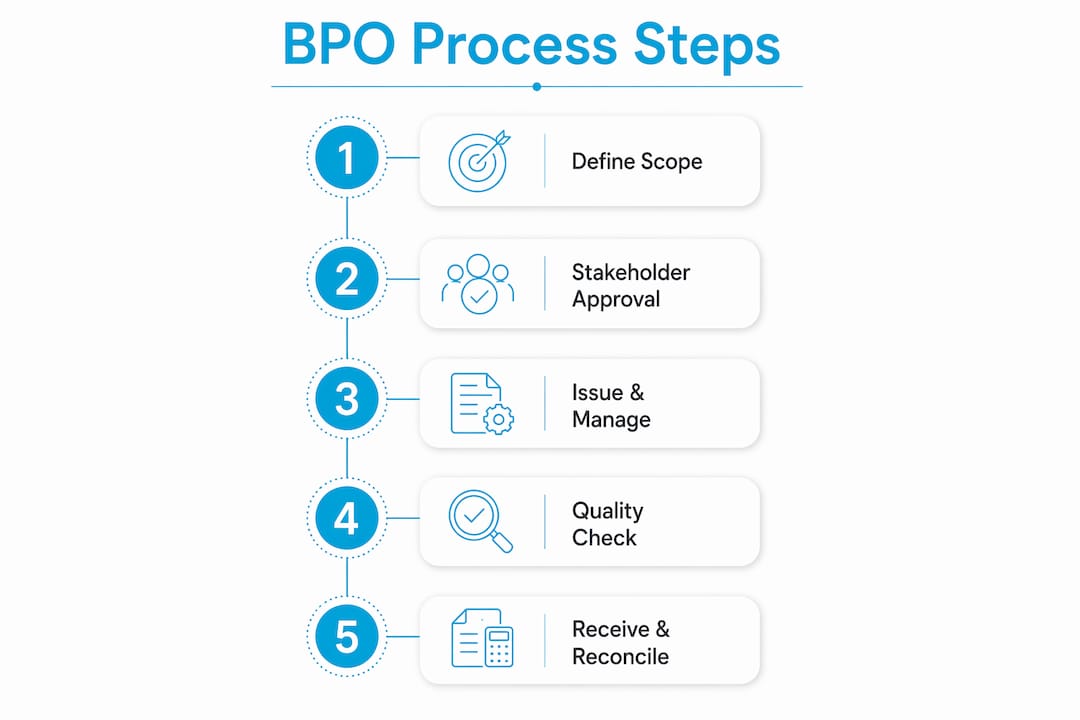
The operational sequence of a peptide BPO follows a defined path from contract execution to final reconciliation. Understanding each stage prevents the administrative gaps that create quality and compliance failures.
1. Define requirements and negotiate the master scope
Procurement starts by establishing annual or multi-quarter demand forecasts for each peptide or raw material. The master agreement then locks in unit pricing, maximum spend, delivery lead times, and quality requirements. For peptides, this negotiation should also specify acceptable purity thresholds, lyophilization standards, and packaging requirements, since these affect shelf life and downstream usability.
2. Secure stakeholder approvals
Before the BPO is issued, internal sign-off from procurement, quality assurance, and finance is required. Quality’s involvement at this stage is particularly important in peptide sourcing, because the QA team needs to confirm that the supplier’s batch release process aligns with the COA and independent verification requirements written into the agreement.
3. Issue the blanket and manage releases
In modern ERP systems like NetSuite, BPOs are non-posting transactions. Financial events only occur when a release is issued against the blanket. Each release specifies quantity, requested delivery date, and the batch documentation required. Procurement tracks open versus released quantities continuously to avoid exceeding the blanket ceiling.

4. Verify quality at each release
Batch-specific COA verification cannot be deferred to a periodic audit. Every release should be gated on receipt of the supplier’s COA, chain-of-custody records, and, where applicable, an independent third-party verification report. This is especially relevant for peptides sourced from API manufacturers in China, where batch-to-batch variation in synthesis yield and purity can occur even within a qualified supplier relationship.
5. Receive, invoice, and reconcile
Once the shipment arrives and passes receiving inspection, the invoice is matched to the release. Reconciliation at the end of the BPO period confirms that total delivered quantities and invoiced amounts align with the master agreement. Any discrepancies in quantity, pricing, or documentation should trigger a formal supplier deviation process before the BPO is renewed.
Pro Tip: Treat each release as a control gate. Before approving a release, check the supplier’s current deviation log and CAPA (Corrective and Preventive Action) status. A supplier with open, unresolved deviations on a peptide batch should not receive a release approval until those issues are formally closed, regardless of what the master agreement says.
Why blanket purchase orders improve peptide sourcing outcomes
The efficiency gains from using blanket orders for peptides are real, but they extend well beyond reducing paperwork. The structural advantages touch pricing, supply continuity, and compliance simultaneously.
Administrative consolidation: A single negotiation event covers an entire year’s recurring requirements. Lab scientists and procurement managers avoid the repeated cycle of sourcing, quoting, and approving individual orders for the same materials.
Price stability: Peptide raw material pricing fluctuates with synthesis capacity, solvent costs, and API market conditions. Locking price at the BPO level protects the procurement budget from mid-year cost increases.
Reserved manufacturing capacity: BPOs shift procurement from spot buying to a reserved capacity model, where the supplier allocates verified batch production for future releases. This reduces the risk of stockouts during periods of high demand.
Multi-sourcing support: BPOs can be issued to pre-qualified secondary vendors simultaneously, distributing volume across two or more suppliers. This mitigates the risk of a single-source batch failure halting research operations.
Traceability and compliance controls: Because COA and chain-of-custody requirements are embedded in the master agreement, every release automatically carries documentation obligations. This separates compliant procurement from gray-market sourcing, where serialized package-level documentation is absent.
Capital planning accuracy: Finance teams can forecast peptide spend against a known blanket ceiling rather than managing unpredictable spot purchase variability.
Operational continuity for research labs: Approving a full year’s routine requirements upfront removes the procurement interruptions that delay research timelines.
How blanket purchase orders compare to standard purchase orders
The choice between a BPO and a standard PO depends on demand predictability, supplier relationship maturity, and the administrative cost of repeated transactions. For peptides with stable, recurring consumption, the BPO model consistently outperforms the standard PO approach on cost and compliance.
Feature Blanket Purchase Order Standard Purchase Order Duration Multi-month or annual agreement Single transaction Pricing negotiation Once, at contract execution Repeated at each order Volume commitment Total volume or spend ceiling Per-order quantity only Release mechanism Individual releases draw down the blanket Each PO is a standalone event Invoice matching Release-level matching against master PO-level matching per transaction Administrative overhead Low after initial setup High, repeated per order Quality documentation Embedded in master agreement Re-negotiated or omitted per order Supplier relationship Long-term, performance-tracked Transactional Best suited for Recurring, predictable peptide demand One-time or experimental purchases
For peptides with erratic demand or highly experimental applications, a standard PO remains appropriate. The BPO model requires enough demand predictability to commit to a volume or spend ceiling without creating excess inventory risk.
Which peptides and materials are best suited for blanket purchase orders
Not every peptide in a procurement portfolio belongs under a blanket agreement. The BPO model works best when demand is predictable, the supplier relationship is established, and the material has a track record of batch consistency.
Peptides and materials that fit the BPO model well include:
Research peptides with stable monthly or quarterly consumption, such as BPC-157, TB-500, or GLP-1 agonist analogs used in ongoing studies
Raw API materials reordered on a regular cycle from a qualified synthesis facility
Lyophilized peptide vials with defined shelf life that can be scheduled for delivery in batches without expiry risk
Peptides sourced from a supplier with at least two completed audit cycles and a clean deviation history
Consumables and excipients used in peptide formulation, where demand is tied to production volume
Materials that should stay on standard purchase orders include highly experimental peptides ordered once or twice for feasibility studies, peptides from suppliers that have not yet completed full qualification, and any material where demand is driven by unpredictable research outcomes rather than a defined program schedule.
Pro Tip: Apply a confidence factor when converting forecast demand into a BPO commitment. If the forecast is 100 units per quarter, commit to 80 units under the blanket and leave room for spot purchases to cover upside demand. This prevents over-commitment against a blanket ceiling when research timelines shift.
Best practices for setting up a peptide blanket purchase order
1. Build the demand forecast from actual consumption data
Historical purchase records, lab consumption logs, and project timelines are the inputs. A forecast built on actual data rather than estimates reduces the risk of over-committing to a volume the organization cannot absorb within the BPO period.
2. Qualify the supplier before the blanket is issued
Supplier qualification for a peptide BPO requires more than a vendor registration form. Procurement needs FDA registration evidence, batch COA samples from recent production runs, chain-of-custody documentation, and a completed quality questionnaire. Annual performance audits should be written into the BPO terms for critical materials.
3. Negotiate contract terms that reflect peptide-specific risks
The master agreement should specify unit pricing with escalation limits, a maximum spend ceiling, a validity period aligned with the demand forecast, and a cancellation clause that accounts for batch failure scenarios. Pricing escalation caps protect the budget if raw material costs rise mid-agreement.
4. Embed quality requirements at the release level
Each release under a blanket purchase order should follow the documentation and independent-testing requirements written into the buyer’s contract and quality agreement. Do not assume that a particular document package is universally included.
5. Monitor spend and supplier performance continuously
Track released quantity against the blanket ceiling in real time. Procurement KPIs for peptide BPOs should include on-time delivery rate, COA pass rate per release, deviation frequency, and spend utilization against the blanket. Reviewing these metrics quarterly gives procurement the data needed to make informed renewal decisions.

Pro Tip: Layer a quality agreement on top of the commercial BPO. The quality agreement specifies manufacturer-side analytical documentation requirements, independent verification obligations, and the supplier’s deviation reporting timeline. This creates two enforceable documents: one governing price and volume, the other governing quality. When a batch fails, the quality agreement defines the remediation path without requiring renegotiation of the commercial terms.
Handling variations in peptide quality and specifications within blanket POs
Peptide synthesis is not a perfectly uniform process. Even a qualified supplier with a clean audit history can produce batches that deviate from specification on purity, water content, or residual solvent levels. A blanket purchase order that does not account for this variability creates a compliance gap at the release stage.
The most effective approach is to define acceptance criteria explicitly in the master agreement rather than relying on the supplier’s internal release standards. Acceptable purity ranges, HPLC method requirements, and mass spectrometry confirmation should all be specified. When a batch COA falls outside these parameters, the release should be held pending supplier investigation.
Independent verification adds a second layer of control. Sending a sample from each received batch to a third-party analytical laboratory confirms whether the supplier’s COA reflects actual material quality. This is particularly relevant for peptides sourced through synthesis facilities where the buyer does not have direct visibility into the manufacturing process. Batch-specific COAs paired with independent reports give procurement a defensible record if a quality dispute arises later.
Specification drift is a subtler risk. A supplier may deliver material that meets the original specification but gradually shifts toward the lower boundary of acceptable purity over successive batches. Tracking COA results across all releases under a BPO reveals this trend before it becomes a failure. Procurement teams that review COA data only at renewal miss this signal entirely.
Approaches to cost control and budgeting using blanket purchase orders for peptides
The BPO structure gives procurement two distinct cost control mechanisms: price lock and spend ceiling. Used together, they prevent the budget overruns that are common in peptide sourcing programs that rely on repeated spot purchases.
Price lock eliminates the exposure to mid-year peptide market price increases. When synthesis capacity tightens or solvent costs rise, spot buyers absorb the full price increase on every transaction. BPO holders pay the negotiated rate for the duration of the agreement, regardless of market movement. The trade-off is a volume commitment, which requires accurate demand forecasting to avoid paying for material that cannot be absorbed.
The spend ceiling functions as a hard budget cap. Finance teams can allocate the full blanket value at the start of the fiscal year and treat it as a committed liability rather than an open-ended variable. This simplifies budget reporting and prevents the accumulation of unplanned peptide spend across multiple departments ordering independently.
For organizations sourcing peptides across multiple research programs, consolidating demand under a single BPO per supplier also creates volume leverage. A supplier receiving a committed annual volume is more likely to offer favorable pricing and prioritize delivery scheduling than one receiving unpredictable spot orders. This dynamic is particularly relevant when sourcing from API manufacturers in China, where production scheduling is often driven by committed order volume rather than spot demand signals.
Compliance and regulatory considerations for peptides in blanket purchase orders
Regulatory compliance in peptide procurement operates at the documentation level. The BPO structure does not automatically confer compliance; it provides a framework within which compliance requirements can be systematically enforced across every release.
Serialized chain-of-custody documentation is the baseline requirement. Each release under a peptide BPO should be accompanied by documentation that traces the material from the synthesis facility through any intermediate handling to the final delivery point. Without this, the BPO offers no protection against receiving non-conforming or substituted material, regardless of what the master agreement states.
FDA registration status of the manufacturing facility is a separate verification requirement. For peptides intended for research use in the United States, procurement teams should confirm that the supplier’s facility appears on the FDA’s registered establishment database and that registration is current at the time of each release, not just at contract execution. Facility registration can lapse or be suspended between the BPO start date and a later release.
For organizations sourcing GLP-1 agonists or other peptides with heightened regulatory scrutiny, the BPO should also specify authorized trading partner status requirements. This aligns with supply chain security frameworks and reduces the risk of receiving material that has passed through unauthorized intermediaries. Procurement teams working in this space can find additional sourcing guidance through resources like biopharma drug screening frameworks that address documentation standards for research-grade materials.
Best practices for contract terms and renewal in peptide blanket purchase orders
Contract terms for a peptide BPO require more specificity than a standard commercial blanket agreement. The renewal decision is equally consequential, because renewing a BPO with a supplier whose quality performance has degraded locks procurement into another period of elevated risk.
Validity periods should align with the demand forecast horizon and the shelf life of the peptide being sourced. A 12-month BPO for a lyophilized peptide with an 18-month shelf life is workable. A 24-month BPO for the same material requires careful delivery scheduling to prevent expiry risk accumulating in inventory.
Cancellation clauses should address batch failure scenarios explicitly. If a supplier delivers a batch that fails COA acceptance criteria and cannot be replaced within the agreed lead time, procurement needs a defined exit path that does not expose the organization to a penalty for canceling the remaining blanket volume. This clause is often omitted in standard commercial templates and must be negotiated specifically for peptide agreements.
Renewal timing should be driven by supplier performance data, not by the calendar. Reviewing on-time delivery rates, COA pass rates, and deviation frequency from the expiring BPO period gives procurement an objective basis for the renewal decision. A supplier with a declining COA pass rate over the final quarter of a BPO period warrants a qualification review before renewal, not an automatic rollover.
Peptide supplier contract negotiation at renewal is also an opportunity to renegotiate pricing based on updated market conditions and the supplier’s delivery track record. Procurement teams that treat renewal as a formality leave cost savings and quality improvements on the table.
PeptidesFromChina coordinates sourcing from established Chinese manufacturing facilities together with international logistics. Buyers requiring independent verification may arrange third-party analytical testing. The research peptide catalog includes materials with batch COAs and sourcing documentation suited to BPO procurement frameworks.
Key Takeaways
Blanket purchase orders in peptide procurement reduce administrative overhead, stabilize pricing, and enforce compliance requirements across every release when the master agreement is structured correctly.
Point Details BPO core mechanics A master agreement covers total volume, price, and period; individual releases draw down quantities and trigger financial events. Quality at every release Batch-specific COAs and chain-of-custody documentation must be required at each release, not just at supplier onboarding. Release as a control gate Check supplier deviation logs and CAPA status before approving each release to prevent accepting substandard batches. Best-fit materials Peptides with stable, recurring demand and established supplier relationships benefit most from blanket agreements. Renewal requires data Base renewal decisions on COA pass rates, on-time delivery, and deviation frequency from the expiring BPO period.