
Most laboratory procurement departments are unknowingly paying a 500% markup to domestic resellers for the exact same synthesis batches they could source directly from the point of origin. You've likely dealt with the frustration of inconsistent HPLC reports or sudden "out of stock" notifications from retail shops that don't actually control their own production lines. It's a systemic lack of transparency that puts longitudinal studies at risk and drains research budgets. Securing a high purity peptides bulk order shouldn't feel like a gamble on batch-to-batch consistency.
This 2026 sourcing guide provides a technical roadmap for bypassing middleman markups and securing laboratory-grade compounds like BPC-157, Semaglutide, and Tirzepatide directly from verified synthesis facilities. We'll outline the operational protocols required to ensure 99% purity across all bulk batches, from initial HPLC verification to international logistics. By the end of this guide, you'll understand how to establish a transparent, direct supply chain that meets the rigorous documentation standards required for institutional audits and long-term research projects.
Key Takeaways
Understand the economic advantages of direct-to-manufacturer sourcing, which eliminates the 500% markup typically applied by domestic retail resellers.
Learn the technical protocols required to secure a high purity peptides bulk order with verified 99%+ consistency across every batch.
Discover how to decode technical HPLC and MS reports to ensure all research materials meet the rigorous transparency standards required for institutional audits.
Navigate the professional B2B procurement workflow, including the $300 minimum order requirement and the $10 verification deposit that initiates the sourcing process.
Identify the logistics of sourcing high-demand research compounds like BPC-157, Semaglutide, and Tirzepatide directly from synthesis facilities.
Table of Contents
The Landscape of Bulk Peptide Sourcing in 2026
Purity Standards: Verifying HPLC and MS Reports for Bulk Batches
Economic Logistics of Large-Scale Peptide Procurement
Facility Audits and Manufacturing Verification Protocols
Initiating a Bulk Order: The Professional Sourcing Workflow
The Landscape of Bulk Peptide Sourcing in 2026
The global peptide supply chain is undergoing a fundamental shift. Professional labs are moving away from retail-focused domestic shops that prioritize branding over biochemical transparency. By utilizing a direct-to-manufacturer model, institutions can bypass the arbitrary price inflation inherent in the middleman structure. This approach requires a transition from the single-vial consumer mindset to a professional wholesale procurement strategy that prioritizes volume and verification over convenience.
Reseller Markups vs. Direct Sourcing Logistics
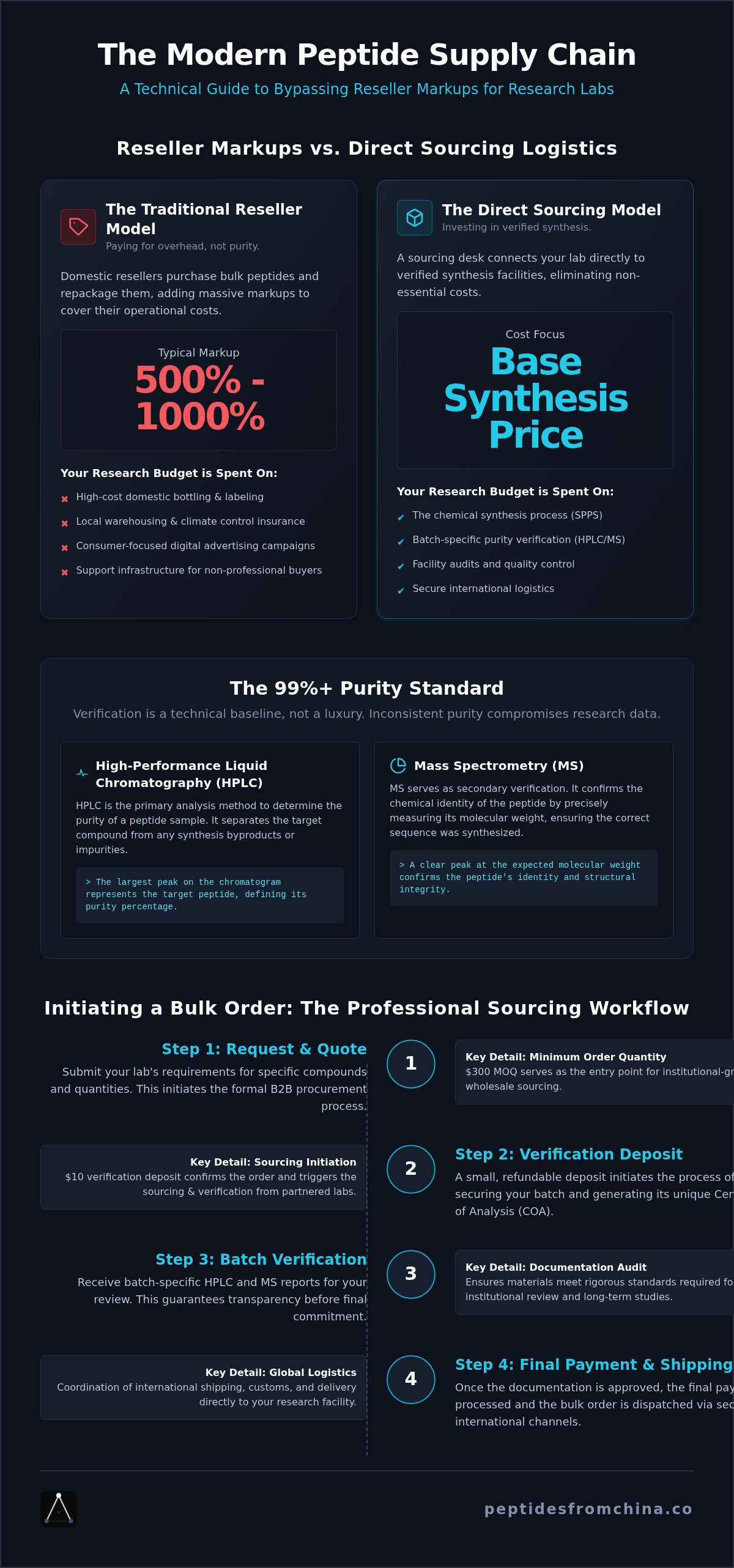
Domestic resellers typically operate as high-volume retail storefronts. They purchase bulk batches, repackage them into individual vials, and add significant margins to cover localized warehousing, customer service, and digital marketing. These overhead costs often result in a 500% to 1000% markup over the base manufacturing price. For labs conducting longitudinal studies, these costs are prohibitive. A high purity peptides bulk order eliminates these secondary expenses by connecting the buyer directly to the point of synthesis.
The economic disparity is driven by several factors that don't add value to the chemical compound itself:
Third-party bottling and labeling fees in high-cost domestic jurisdictions.
Expensive domestic warehouse insurance and climate-controlled storage.
High-spend digital advertising campaigns targeting retail consumers.
Customer support infrastructure geared toward non-professional buyers.
Direct sourcing preserves research budgets by focusing funds on the synthesis process rather than the logistical fluff of a domestic storefront. While retail shops cater to small-scale needs, the professional $300 minimum order quantity (MOQ) serves as the entry point for institutional-grade sourcing.
The 2026 Standard for Research Peptide Procurement
In 2026, the standard for research procurement is defined by chain-of-custody transparency. Institutional buyers no longer accept "domestic" labels as a proxy for quality. Most commercial peptides are produced using Solid-phase peptide synthesis (SPPS), a process that requires specialized equipment and chemical expertise found in primary manufacturing hubs. It's a technical reality that many resellers attempt to obscure with marketing language.
A sourcing desk acts as a technical filter, vetting these facilities to ensure that compounds like BPC-157, Semaglutide, or Tirzepatide arrive with batch-specific verification. This model mitigates international supply chain risks by focusing on factual integrity rather than marketing claims. It's about establishing long-term reliability with verified manufacturing facilities that can provide consistent 99%+ purity across every bulk order. Moving to a B2B sourcing desk ensures that your lab isn't just buying a product, but is securing a verified position in the global manufacturing queue.
Purity Standards: Verifying HPLC and MS Reports for Bulk Batches
In professional research, 99% purity isn't a luxury; it's a technical baseline. When conducting large-scale studies, even a 1% variance in impurities can introduce uncontrolled variables that compromise the integrity of your data. Securing a high purity peptides bulk order requires a rigorous verification process that goes beyond accepting a printed sheet at face value. You must understand how to audit the technical data provided by the synthesis facility to ensure the material matches your research specifications.
High-Performance Liquid Chromatography (HPLC) is the primary tool used to determine chemical purity. It works by passing the peptide through a column under high pressure, separating the target compound from synthesis byproducts. The resulting chromatogram displays "peaks"; the largest peak represents your peptide, while smaller peaks indicate impurities. Mass Spectrometry (MS) serves as the secondary verification, confirming the identity of the sequence by measuring its molecular weight. If the MS report doesn't show a clear peak at the theoretical mass of the compound, the batch identity is unverified, regardless of what the HPLC suggests.
How to Read a Certificate of Analysis (COA)
A valid COA must include a specific lot number and a recent synthesis date. If these details are missing or obscured, the report cannot be reliably linked to your specific batch. When reviewing the HPLC chromatogram, pay close attention to the baseline noise. A "clean" report with a flat baseline and a single, sharp peak is the standard. If you see multiple "shoulders" or significant fluctuations in the baseline, the purity percentage may be artificially inflated. For labs requiring specific documentation for institutional audits, you can request sample reports from our current manufacturing queue to compare against your existing standards.
Identifying Quality Red Flags in Bulk Orders
One of the most prevalent issues in the wholesale market is the use of "reused" HPLC reports. If the chromatograms for two different batches look identical down to the pixel, they're likely forged. Another critical factor is the presence of residual solvents like Trifluoroacetic acid (TFA). While TFA is a standard reagent in synthesis, high levels can be toxic to certain cell cultures or biological models. Maintaining high peptide quality involves checking for these residuals and ensuring the manufacturer has performed adequate lyophilization to remove them. Batch-to-batch consistency is the ultimate test of a synthesis facility; if a manufacturer cannot produce identical MS/HPLC results across three consecutive lots, they shouldn't be a part of your long-term supply chain.
Economic Logistics of Large-Scale Peptide Procurement
Transitioning from retail-level purchases to a professional sourcing model requires a shift in how your lab manages its procurement budget. While purity verification is the technical foundation, the logistical framework determines the actual return on investment (ROI) for your research institution. Managing a high purity peptides bulk order involves balancing synthesis lead times, international transit protocols, and secure B2B payment standards to maintain a steady supply chain without the overhead of domestic resellers.
Managing Minimum Order Quantities (MOQ) for Labs
Professional sourcing desks implement a $300 minimum order quantity (MOQ) to maintain the integrity of the B2B model. This threshold isn't arbitrary; it serves as a filter to ensure the desk remains focused on the needs of research institutions and wholesale buyers rather than the retail consumer market. For procurement officers, this means strategic planning is required to optimize each shipment.
When preparing an order, labs often consolidate their requirements for high-demand compounds such as BPC-157 and Semaglutide to meet the MOQ while ensuring batch freshness. Lyophilized peptides are highly stable when stored correctly, but over-ordering can lead to unnecessary inventory management. We recommend calculating your quarterly research needs to align with manufacturing cycles, ensuring you receive the most recent synthesis batches directly from the facility.
Global Shipping and Customs Navigation
The logistics of moving laboratory-grade compounds across international borders requires a methodical approach to packaging and documentation. We utilize neutral, professional packaging designed for international transit. This avoids the "marketing-heavy" aesthetic of retail brands, which can cause unnecessary delays during customs inspections. Every bulk shipment is assigned a tracking number, allowing labs to monitor the chain of custody from the manufacturing hub to the final delivery point.
There's a persistent myth that domestic warehousing provides a "safety" advantage for research labs. In reality, domestic warehousing is simply a method for resellers to justify the significant markups discussed earlier. A properly documented high purity peptides bulk order that follows international shipping standards has a high success rate in global logistics. By sourcing directly, you eliminate the risk of "stale" inventory that has been sitting in a reseller's domestic warehouse for months, ensuring that your lab receives the most stable, recently lyophilized material available. For more details on the logistics of our process, you can review how it works or check our FAQ for shipping timelines.
Facility Audits and Manufacturing Verification Protocols
Securing a high purity peptides bulk order is a process that relies entirely on the technical integrity of the synthesis facility. Vetting these facilities requires an analytical approach that looks beyond marketing brochures and focuses on technical infrastructure. We prioritize facilities that maintain modern synthesis equipment and employ staff with deep expertise in complex amino acid sequencing. This technical focus ensures that the manufacturing process is consistent, repeatable, and capable of meeting the 99% purity standards required for professional research.
Our sourcing desk serves as an analytical filter between the lab and the production floor. This is reflected in the how it works protocol, which includes independent batch testing and facility audits. To maintain this professional standard, we implement a $10 processing deposit for all new inquiries. This small fee acts as a filter, ensuring that our resources are dedicated to serious research institutions and wholesale buyers rather than retail inquiries. This deposit is always credited toward your final invoice once the sourcing process is complete.
Sourcing from Verified Chinese Synthesis Hubs
China continues to lead the global market in large-scale peptide synthesis due to its massive chemical manufacturing infrastructure and high concentration of biochemical engineering talent. When sourcing high-demand compounds like Tirzepatide and Retatrutide, the advantage of direct-from-hub procurement is clear. We evaluate facilities based on historical batch performance and their ability to provide transparent documentation for every synthesis cycle. This direct connection eliminates the "black box" of reseller supply chains, where the origin of the material is often obscured.
The Intermediary Advantage: Verification over Marketing
Unlike retail shops that rely on sales representatives to push inventory, a sourcing desk focuses on direct communication with manufacturing engineers. This ensures that technical specifications are met at the synthesis level. We act as your quality filter, approving manufacturer stock only after verifying the HPLC/MS data and the facility's recent audit history. Every wholesale invoice is backed by batch-specific verification, ensuring that the material delivered to your lab is the exact material tested at the facility. For institutions requiring specific facility credentials or bulk quotes, you can submit a verification request to begin the vetting process.
Initiating a Bulk Order: The Professional Sourcing Workflow
Executing a high purity peptides bulk order requires a structured approach that prioritizes biochemical data over marketing promises. The process begins with a precise definition of your research requirements. You need to specify the compound, the required purity level (typically 99%+), and any specific lyophilization parameters necessary for your study. Unlike retail shops with automated checkouts, our workflow is designed for procurement officers who require direct manufacturing verification before funds are committed.
Once your requirements are defined, the next step is submitting the $10 verification deposit. This fee filters out non-professional inquiries and is fully credited toward your final invoice. Upon receipt, our sourcing desk initiates the search through our vetted manufacturing network, retrieving batch-specific HPLC and MS reports for your review. This stage is critical; you aren't just buying inventory, you're approving a specific synthesis lot based on current technical data provided directly from the facility.
Requesting a Quote for Research Compounds
To start the technical inquiry, navigate to our contact page. In your request, detail the specific compounds from our catalog, such as BPC-157, Semaglutide, or Tirzepatide. Be precise about quantities and any institutional documentation needs. This precision allows us to provide an accurate wholesale quote that reflects current manufacturing lead times and logistics costs without the arbitrary markups found in the domestic retail market.
Post-Order Support and Batch Documentation
After finalizing the wholesale invoice, we coordinate the international logistics. Our role shifts to managing the chain of custody from the synthesis facility to your lab dock. We provide the tracking information and the finalized batch documentation, including COA reports that should be archived for institutional compliance. It's vital to maintain these records for future study replication or audits. If you encounter any logistical or technical hurdles during the transit process, you can consult our FAQ for troubleshooting protocols. This workflow ensures that every high purity peptides bulk order is handled with the methodical care required for high-stakes laboratory research, maintaining a transparent bridge between production and procurement.
Securing the Future of Your Research Procurement
Transitioning to a direct-to-manufacturer sourcing model is a strategic necessity for labs aiming to maximize research ROI in 2026. It's a fundamental shift toward factual integrity. By removing the 500% markups associated with domestic resellers, institutions can reallocate significant portions of their budgets toward actual research activities. Success in this landscape depends on moving beyond marketing claims and enforcing a technical verification standard for every synthesis batch.
A high purity peptides bulk order is only as reliable as the documentation supporting it. Utilizing a professional sourcing desk ensures that your facility audits and HPLC/MS reports are handled by experts who prioritize data over sales volume. This methodical approach to chain-of-custody and logistics creates a stable foundation for longitudinal studies and institutional compliance. We provide direct manufacturing pricing and specialized B2B sourcing for research institutions, ensuring COA-verified batches for every order.
Establishing a direct, transparent supply chain is the most effective way to guarantee batch-to-batch consistency for your laboratory. Request a Bulk Sourcing Quote for Your Lab to begin the verification process today. We look forward to supporting your institutional procurement goals.
Frequently Asked Questions
What is the typical lead time for a bulk peptide order from China?
Typical lead times for a high purity peptides bulk order range from 10 to 25 days. Synthesis for standard stock items usually requires 3 to 5 business days, while custom synthesis for complex sequences can take up to 3 weeks. International express shipping adds approximately 7 to 10 days. This methodical timeframe ensures that every batch is freshly lyophilized and undergoes rigorous HPLC verification before it leaves the manufacturing hub.
How do you ensure the purity of peptides for large-scale research orders?
We ensure purity through batch-specific High-Performance Liquid Chromatography (HPLC) and Mass Spectrometry (MS) testing. Every order is accompanied by a Certificate of Analysis (COA) from the synthesis facility. We audit these reports to ensure the target peak represents 99% or more of the sample. This technical verification process confirms the chemical identity and purity levels required for professional research applications and institutional audits.
Why is there a $10 processing deposit for sourcing inquiries?
The $10 deposit acts as a professional filter to ensure our sourcing desk resources are dedicated to legitimate research institutions and wholesale buyers. It prevents retail-level inquiries from slowing down the procurement process for professional labs. This small fee isn't an additional cost; it's a credit that's applied directly to your final wholesale invoice once the order is finalized through our verified manufacturing network.
What is the minimum order quantity (MOQ) for wholesale peptides?
Our minimum order quantity is $300 per shipment. This threshold supports the B2B direct-to-manufacturer model by consolidating synthesis and logistics costs for the facility. It allows labs to secure compounds like BPC-157 or Tirzepatide at manufacturing rates without the 500% markups found in retail shops. This MOQ is a standard requirement for professional laboratory procurement and wholesale sourcing.
Are the peptides shipped in ready-to-use vials or bulk powder?
Peptides are shipped as lyophilized powder in glass vials for maximum chemical stability during international transit. While we focus on bulk quantities, the material is often pre-portioned into 5mg or 10mg vials to prevent degradation caused by repeated exposure to moisture or air. This format is the standard for research use and ensures the chemical integrity of the batch remains intact from the synthesis facility to your lab.
How do labs verify the HPLC reports provided by the manufacturer?
Labs verify HPLC reports by checking for a sharp, single peak and a flat baseline on the chromatogram. We provide the specific lot number and synthesis date on every Certificate of Analysis (COA) to ensure traceability. If an institution requires higher levels of verification, they can cross-reference the manufacturer's data with an independent third-party lab. This process confirms that the high purity peptides bulk order meets your specific research standards.
What payment methods are accepted for international wholesale orders?
We accept secure B2B payment methods for international transactions, including bank wire transfers and cryptocurrency. These methods ensure efficient processing and clear documentation for institutional accounting departments. All payment instructions are provided after the $10 deposit is verified and the batch-specific documentation is approved by the buyer. Detailed protocols for these transactions are available on our how to pay page to assist with your procurement workflow.
Do you provide domestic warehousing in the US or EU?
We don't provide domestic warehousing in the US or EU. Our model focuses on direct-to-manufacturer sourcing to eliminate the overhead costs and reseller markups associated with local storage and domestic logistics. This ensures that labs receive the most recently synthesized batches rather than inventory that's been stored for months. We utilize professional, neutral packaging to ensure efficient international delivery from the manufacturing hub directly to your research facility.