
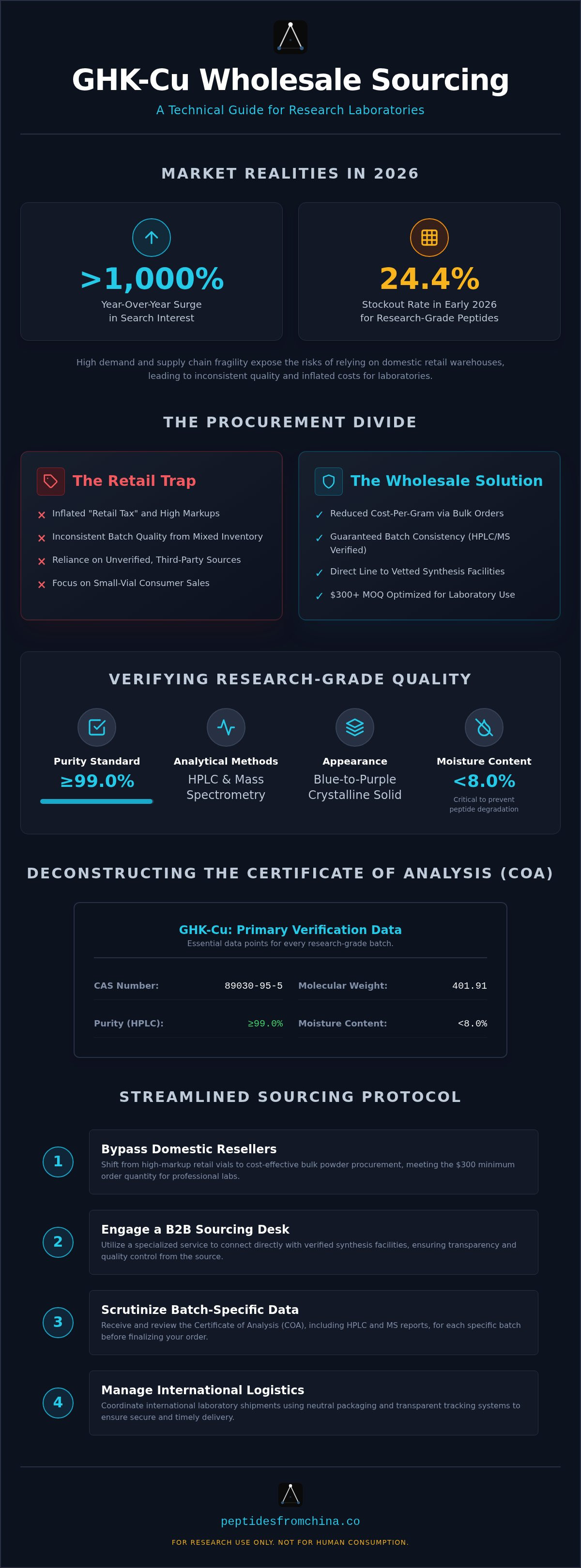
Search interest for GHK-Cu has surged by more than 1,000% year-over-year, yet the research-grade peptide market faced a 24.4% stockout rate in early 2026. If you're managing a laboratory or a high-volume research project, you've likely realized that relying on domestic retail warehouses often leads to inconsistent batch quality and inflated markups. Finding a reliable GHK-Cu wholesale supplier shouldn't feel like a gamble with your research budget or your data integrity.
It's frustrating to deal with the lack of transparency found in traditional middleman structures. This guide provides a technical roadmap for navigating the complexities of high-volume procurement, focusing on direct factory verification and wholesale logistics. You'll learn how to establish a direct line to verified synthesis facilities and ensure batch-to-batch consistency via HPLC and MS verification. We'll also detail how to reduce your cost per gram through $300+ wholesale orders, moving from retail vial pricing to efficient bulk sourcing. This breakdown examines peptide quality standards and explains how the ordering process facilitates direct access to manufacturing.
Key Takeaways
Learn how to identify a reliable GHK-Cu wholesale supplier by bypassing high-markup domestic resellers and accessing direct synthesis facilities for GHK-Cu.
Understand the technical requirements for research-grade purity, including the necessity of HPLC and Mass Spectrometry for batch-to-batch verification.
Discover the economic logic of high-volume procurement and how a $300 minimum order threshold eliminates the "retail tax" associated with small-vial purchases.
Review the logistical protocols required for international laboratory shipments, including the use of neutral packaging and transparent tracking systems.
Explore how a B2B sourcing desk streamlines the verification process to ensure consistent research data through COA-verified batches.
Table of Contents
The GHK-Cu Wholesale Landscape: Market Realities in 2026
Technical Specifications and Quality Standards for GHK-Cu
Economic Logic: Direct Sourcing vs. Domestic Retailers
Verification Protocols and International Logistics
Streamlining GHK-Cu Procurement via Peptides From China
The GHK-Cu Wholesale Landscape: Market Realities in 2026
The global market for Copper peptide GHK-Cu is expanding rapidly, with projections suggesting a total market value of USD 2,250.00 million by 2033. This growth is driven by increased demand for high-purity synthesis in research sectors. However, the B2B landscape remains fragmented. Many research institutions face "retail markups" that can inflate costs by several hundred percent compared to direct factory rates. By bypassing domestic resellers who stock small vials, professional buyers are moving toward direct-to-manufacturer sourcing. This shift is essential for maintaining project budgets and ensuring batch-to-batch consistency.
A professional GHK-Cu wholesale supplier operates on a different economic model than consumer-facing shops. Instead of single-vial sales, the focus is on bulk powder procurement with a $300 minimum order threshold. This threshold serves as a filter, ensuring that the logistics and quality control protocols remain optimized for laboratory environments rather than individual users. This approach prioritizes factual integrity and long-term reliability over traditional marketing flair.
Identifying Market Volatility and Supply Consistency
Synthesis costs at the factory level are influenced by technological advances like microwave-assisted reactors and continuous-flow systems. While these reduce production time, the research-grade market still experienced a 24.4% stockout rate in early 2026. Sourcing from multiple retail resellers introduces the risk of batch inconsistency, as these middlemen often pull inventory from various unverified sources. Large-scale research requires stable, long-term supply lines where every batch is verified through independent HPLC analysis. Consistency is the primary currency for labs that can't afford to have their data compromised by varying purity levels between small, mixed-inventory orders.
The Role of the Sourcing Desk in Modern Procurement
The modern sourcing desk acts as a protective filter between production facilities and lab buyers. It replaces the traditional "vial shop" model with a transparent acquisition process for bulk powder. In 2026, the importance of a transparent sourcing intermediary is paramount as regulatory scrutiny increases. By establishing direct factory connections, a GHK-Cu wholesale supplier ensures that every batch meets a baseline purity of ≥99.0%. This model prioritizes technical verification over marketing flair, providing a bridge that manages international logistics and peptide quality without the overhead of domestic warehousing. This structured approach helps labs understand how it works when moving from retail to professional procurement levels.
Technical Specifications and Quality Standards for GHK-Cu
Pure GHK-Cu powder presents as a distinct blue-to-purple crystalline solid. This coloration is a direct result of the copper complexation process. In a B2B procurement context, relying on visual cues is insufficient for laboratory standards. A professional GHK-Cu wholesale supplier must provide quantitative data to back every shipment. The baseline for research-grade material is a purity level of ≥99.0%. While cosmetic-grade suppliers might accept lower thresholds, laboratory research requires the highest possible fidelity to ensure experimental reproducibility.
Scientific documentation, such as the paper on the Regenerative and Protective Actions of GHK-Cu, highlights the importance of the compound's molecular structure in biological interactions. Maintaining this structure during synthesis requires strict control over moisture content and pH levels. Excess moisture, often exceeding the 8.0% threshold in sub-standard batches, can lead to peptide degradation and inaccurate mass calculations during research. pH levels must be tightly controlled during the final stages of synthesis to ensure the copper ion remains correctly chelated within the tripeptide structure.
Reading a Certificate of Analysis (COA) for GHK-Cu
The COA is the primary document for quality verification. It must list the CAS number 89030-95-5 and a molecular weight of 401.91. Beyond purity, the report should detail heavy metal limits and microbial contamination standards. Microbial testing should confirm the absence of E. coli and Salmonella, while heavy metal testing must prove levels of Lead, Cadmium, and Mercury fall within acceptable parts-per-million (ppm) ranges for laboratory reagents. It's standard practice to cross-reference factory reports with independent laboratory testing to ensure the data hasn't been fabricated. If you need assistance verifying a specific batch, you can request a technical consultation regarding our verification protocols.
Batch Consistency and Large-Scale Synthesis
Scaling synthesis from small lab samples to 1kg+ batches introduces significant variables. Maintaining 99%+ purity across these larger volumes is a technical challenge for many facilities. The specific synthesis method used, whether solid-phase or liquid-phase, directly impacts the final compound's stability and reactivity. HPLC verification is the gold standard for peptide purity. Without this quantitative proof, consistency remains theoretical. The sourcing desk prioritizes peptide quality by ensuring every batch undergoes rigorous Mass Spectrometry (MS) and High-Performance Liquid Chromatography (HPLC) analysis before it leaves the manufacturing facility. This methodical approach ensures that a GHK-Cu wholesale supplier provides the reliability required for multi-phase research projects.
Economic Logic: Direct Sourcing vs. Domestic Retailers
Procuring GHK-Cu through a professional GHK-Cu wholesale supplier is a strategic decision based on cost efficiency and data reliability. Domestic resellers often position themselves as a convenient option, but this convenience comes with a hidden tax that drains research budgets. When you deconstruct the pricing structure of a domestic shop, you'll find that the majority of the retail price supports non-research expenses. These include expensive domestic warehousing, localized marketing campaigns, and high retail profit margins. By moving to a direct sourcing model, labs eliminate these unnecessary layers from the supply chain.
The financial advantage of the $300 minimum order threshold becomes clear when calculating the price per gram. This threshold is a professional filter that allows the sourcing desk to optimize international logistics. It spreads the fixed costs of shipping and independent verification across a larger volume of material. This model facilitates larger research sample sizes for the same budget, allowing institutions to extend their study durations or increase the number of active test groups without requiring additional funding.
The Cost of Local Warehousing
Domestic ready-to-ship stock often carries a 200-500% premium compared to factory-direct rates. This markup is necessary for the reseller to cover localized rent, labor, and the financial risk of holding inventory that may degrade over time. For laboratories, the trade-off involves weighing immediate delivery against significant cost savings and chemical freshness. Direct sourcing ensures that the material is synthesized to order, aligning with international standards such as the EU Cosmetics Regulation (EC) No. 1223/2009 regarding ingredient purity and documentation. Freshly synthesized batches provide more reliable data than inventory that has sat in a middleman's warehouse for months.
Strategic Sourcing for Institutional Budgets
Professional procurement requires shifting from vial-by-vial purchasing to a methodical bulk acquisition strategy. Optimizing procurement for quarterly laboratory research cycles allows for better budget forecasting and inventory management. The use of sourcing deposits plays a critical role in this process, acting as a verification step that secures factory-direct pricing for the buyer. This approach prioritizes factual integrity and technical standards over the superficial speed of retail shops. You can review how it works to understand the transition from retail purchases to professional wholesale logistics. By focusing on bulk procurement, institutions can maintain high-purity standards while significantly reducing their overall expenditure on research materials.
Verification Protocols and International Logistics
Navigating international procurement requires a structured approach to logistics that retail-focused shops often ignore. When you partner with a professional GHK-Cu wholesale supplier, the priority shifts from immediate, small-scale delivery to secure, batch-verified bulk transit. This process involves managing lead times from synthesis facilities to your laboratory, ensuring that the chemical integrity of the GHK-Cu remains intact throughout the journey. Professional sourcing platforms utilize secure payment protocols and neutral packaging to streamline the movement of research materials across international borders.
Neutral packaging is a standard B2B practice that minimizes administrative delays at entry points. It ensures that the contents are described accurately for research use while maintaining the privacy of the receiving institution. This methodical approach to logistics reduces the anxieties typically associated with international sourcing, providing a reliable bridge between production and research.
Direct-to-Manufacturer Sourcing Steps
The transition from retail purchasing to institutional procurement follows a logical sequence. Understanding how the direct sourcing process works is essential for laboratory managers who need to maintain strict project timelines. The process begins with a professional verification step to filter out non-institutional inquiries.
Request Initiation: Buyers initiate a request via a $10 processing deposit. This deposit serves as a professional handshake, confirming the buyer's intent and allowing the sourcing desk to allocate resources for factory-level verification.
Documentation Review: Before a final invoice is issued, you receive factory stock reports and quality documentation. This includes the COA and HPLC reports for the specific batch being allocated to your order.
Logistics Monitoring: Once the final payment is confirmed, the order moves into the shipping phase. You're provided with international tracking numbers to monitor the shipment's progress from the synthesis facility to your lab arrival.
Handling and Storage for Research Use
Maintaining the stability of high-purity GHK-Cu requires adherence to specific environmental controls. The blue-to-purple crystalline powder is sensitive to both light and air, which can cause oxidation or degradation if handled incorrectly during transit or storage. Sourcing desks mitigate these risks by using specialized packaging that protects the material from environmental exposure during the international shipping process.
For long-term stability, GHK-Cu powder should be stored at -20°C in a moisture-free environment. If the material is intended for immediate use within a research cycle, it may be kept at 4°C for short durations, though deep-freeze storage is the gold standard for maintaining a purity level of ≥99.0%. These protocols ensure that the batch consistency established during synthesis is preserved until the moment of laboratory application. To begin the verification process for your specific research requirements, request a formal procurement quote.
Streamlining GHK-Cu Procurement via Peptides From China
Peptides From China functions as a specialized B2B sourcing desk, providing a streamlined alternative to the fragmented retail market. Our platform connects research institutions directly to verified synthesis facilities, acting as a reliable GHK-Cu wholesale supplier for high-volume needs. This direct routing eliminates unnecessary markups and ensures that every batch originates from a documented source. Our global shipping capabilities are specifically calibrated for professional laboratory requirements, utilizing neutral packaging to minimize administrative delays at international borders.
Transparency is the cornerstone of our operational model. By providing a single point of access to multiple verified factories, we allow procurement officers to compare quality documentation and lead times without managing dozens of individual relationships. This centralized approach ensures that research data remains consistent across multi-year projects by securing supply lines that prioritize factual integrity over marketing flair.
The Sourcing Advantage for Research Labs
Procurement professionals leverage our platform to access a wide range of research compounds through a single, authoritative interface. Beyond serving as a GHK-Cu wholesale supplier, we facilitate direct access to verified facilities producing BPC-157, TB-500, and the complete catalog. This consolidation significantly reduces administrative overhead for institutional buyers. We provide professional support for high-volume procurement and address technical queries regarding batch consistency and synthesis protocols. Our desk acts as a strategic partner, verifying that manufacturers adhere to the stringent quality standards required for reproducible research results.
Initiating Your Wholesale Request
The procurement process is designed for maximum transparency and efficiency. To initiate a request for a custom quote on large-scale GHK-Cu orders, buyers use a $10 processing deposit to verify their institutional intent. This step allows our team to allocate resources to secure real-time factory availability and quality documentation. The $300 minimum order threshold remains a firm standard for professional B2B transactions, ensuring that the logistical efficiency of bulk powder acquisition is maintained. Every order includes access to batch-specific data through our Peptide Quality portal, providing the HPLC and MS verification necessary for clinical-level research.
Optimizing Your Laboratory Supply Chain for 2026
It's the most effective way to protect your research budget and data integrity by transitioning from retail vial purchases to a professional direct-sourcing model. By bypassing domestic resellers, you'll eliminate the hidden costs of local warehousing and marketing markups while gaining access to freshly synthesized batches. Establishing a relationship with a verified GHK-Cu wholesale supplier ensures that every gram of material meets the rigorous purity standards required for reproducible results. Efficiency drives results.
Our platform provides a transparent bridge to manufacturing facilities, offering HPLC and MS verified batches that maintain research consistency. Our methodical logistics process includes neutral packaging and international tracking to ensure your materials arrive securely at your facility. This structured approach allows you to focus on your research objectives rather than supply chain volatility. To begin the verification process and secure factory-direct pricing for your next project, you can Request a Wholesale GHK-Cu Quote today. We look forward to supporting your high-volume procurement needs with technical precision and logistical reliability.
Frequently Asked Questions
What is the minimum order quantity for wholesale GHK-Cu?
The minimum order threshold for all transactions is $300. This standard ensures that the logistics and quality control protocols remain optimized for professional laboratory environments. By maintaining this minimum, we can spread the fixed costs of independent verification and international shipping across a larger volume of material. This model is specifically designed for high-volume procurement rather than single-vial retail sales, allowing a GHK-Cu wholesale supplier to provide significant cost savings per gram.
How is the purity of the GHK-Cu powder verified?
Every batch undergoes rigorous High-Performance Liquid Chromatography (HPLC) and Mass Spectrometry (MS) analysis at the synthesis facility. These quantitative reports are compiled into a Certificate of Analysis (COA) that accompanies the shipment. This process establishes a baseline purity of ≥99.0% for research-grade material. We prioritize batch-to-batch consistency by ensuring that independent laboratory testing cross-references factory reports before any material is allocated to a wholesale order.
What are the typical lead times for direct-from-manufacturer sourcing?
Lead times for direct-from-manufacturer sourcing vary based on synthesis requirements and international logistics schedules. Typically, orders move from synthesis verification to laboratory arrival within a professional procurement cycle. Since we bypass domestic middleman warehouses to ensure chemical freshness, the timeline accounts for international transit and customs clearance. We provide tracking numbers for all shipments so research teams can monitor progress and coordinate their laboratory schedules accordingly.
Is GHK-Cu shipped in ready-to-use vials or raw powder?
We specialize in the procurement of raw bulk powder rather than finished retail vials. This allows laboratories to acquire larger quantities of GHK-Cu for formulation or specific research applications without the markup associated with pre-packaged consumer units. By focusing on bulk powder, institutions can better manage their project budgets and ensure they're working with freshly synthesized material rather than aged stock from a reseller's domestic warehouse.
How does the $10 sourcing deposit work?
The $10 sourcing deposit is a professional verification step used to filter institutional inquiries from casual retail interest. Once the deposit is processed, our sourcing desk initiates a real-time check of factory inventory and quality documentation. This allows you to review the specific COA and HPLC data for available batches before committing to a final invoice. It's a methodical approach that ensures transparency and secures factory-direct pricing for the buyer.
Do you provide domestic US or EU warehousing for faster shipping?
We don't provide domestic US or EU warehousing. Our model is built on direct routing from verified synthesis facilities in China to your laboratory. This strategy eliminates the 200-500% markups that domestic resellers charge to cover their local overhead and inventory risks. While this requires planning for international lead times, it guarantees that you receive the most competitive wholesale rates and the highest level of chemical purity available.
What payment methods are accepted for bulk peptide orders?
We accept professional B2B payment methods designed for secure international transactions. These include bank wire transfers and verified digital assets, which provide the speed and security required for high-volume procurement. Detailed instructions are provided during the invoicing stage to ensure a seamless transition from the quote request to order fulfillment. You can review our payment protocols for more specific information on managing bulk transaction logistics.
Are these peptides intended for human consumption or clinical use?
All compounds, including GHK-Cu, are strictly for laboratory research and development use only. They aren't intended for human consumption, clinical use, or as finished pharmaceutical products. We never provide dosing instructions or medical advice. Our role is to function as a bridge between verified synthesis facilities and professional researchers who require high-purity reagents for in vitro or animal-based research projects within a controlled environment.