
The 2026 peptide market is defined by a paradox where demand for copper peptides is surging while supply chain transparency remains at an all-time low. Most buyers seeking GHK-Cu wholesale access are inadvertently paying for multiple layers of reseller markups and recycled paperwork rather than actual synthesis quality. With the 50% US tariff on copper derivatives implemented in August 2025 and increased NMPA oversight in China as of April 2026, the margin for error in procurement has effectively disappeared.
You likely realize that a standard Certificate of Analysis is no longer a sufficient safeguard against batch substitution or inconsistent copper-to-peptide ratios. This guide provides a technical roadmap for navigating direct-to-manufacturer logistics. We'll examine the impact of current regulatory shifts, the necessity of independent verification, and how to utilize sourcing bridges like Peptides From China (PFC) to bypass the cosmetic-retail layer. Our focus remains on securing batch-specific documentation and transparent pricing for bulk research requirements starting at a $600 minimum order.
Key Takeaways
Distinguish between diluted cosmetic-grade additives and high-purity GHK-Cu wholesale powder to ensure research-grade consistency.
Interpret HPLC and Mass Spectrometry reports as baseline technical references rather than absolute proof of purity, necessitating independent verification.
Analyze the cost structure of direct-to-manufacturer sourcing compared to domestic resellers who often double the price per gram for local warehousing.
Implement strategic shipping protocols and neutral packaging to navigate the evolving 2026 international customs landscape for bulk peptide shipments.
Utilize the PFC sourcing bridge to access manufacturer-side channels and reduce supply chain layers with a $600 minimum order requirement.
Table of Contents
Understanding GHK-Cu in a Wholesale Context
Technical Documentation: HPLC and Mass Spectrometry
The Economics of Direct GHK-Cu Sourcing
Operational Logistics: Shipping and Customs
Navigating GHK-Cu Sourcing with Peptides From China
Understanding GHK-Cu in a Wholesale Context
Copper peptide GHK-Cu is a naturally occurring tripeptide complex consisting of glycyl-L-histidyl-L-lysine bound to a copper(II) ion. In a GHK-Cu wholesale environment, the primary challenge isn't just basic synthesis. It's the precise chelation of copper to the peptide backbone. If a manufacturer fails to achieve a stable 1:1 ratio during large-scale production, the resulting material is essentially a mixture of free copper and uncomplexed GHK. This lack of molecular precision is a primary driver behind the batch inconsistency that often plagues the bulk market.
The 2026 wholesale landscape is currently saturated with resellers who relabel lower-grade cosmetic additives as research-grade material to inflate margins. This practice is prevalent because GHK-Cu is one of the few peptides with a massive retail skincare market. Buyers frequently encounter "reused COAs" where a single high-quality report from a previous year is used to move dozens of disparate batches. Acknowledging that manufacturer-issued documentation is only a baseline technical reference, rather than a definitive guarantee, is the first step toward secure procurement. Independent verification remains the only way to confirm a batch's actual identity and purity levels.
The Chemistry of High-Purity GHK-Cu
The signature azure blue color of GHK-Cu is a physical property of the copper complex itself. It's a common misconception in the bulk market that a darker or more "vibrant" blue indicates higher purity. In reality, some low-tier manufacturers use synthetic dyes to mask poor chelation or low peptide content. High-purity powder should be a consistent, crystalline azure. Storage is equally critical for bulk quantities. The material requires protection from light and moisture to prevent the copper ion from dissociating, which would render the batch useless for precise laboratory work.
Research vs. Cosmetic Grade: Procurement Differences
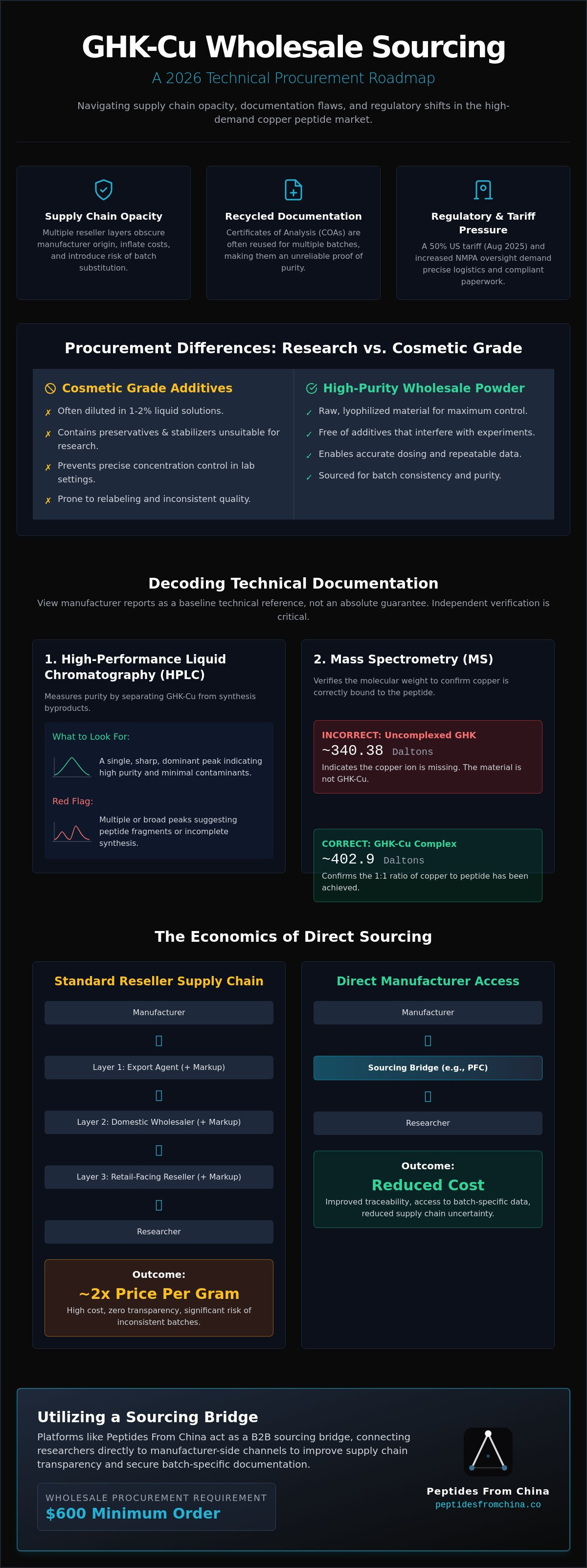
By 2026, the demand for high-volume laboratory-grade sourcing has shifted away from pre-mixed solutions. Cosmetic-grade GHK-Cu is often sold as a 1% or 2% liquid serum, which is unsuitable for rigorous research because of the presence of preservatives and stabilizers. Professional labs require raw, lyophilized powder to control concentration levels and ensure the integrity of their data. Accessing these manufacturer-side channels often requires using peptide sourcing platforms that bridge the gap between production facilities and international buyers. For those utilizing Peptides From China, a $600 minimum order is required to access these wholesale channels, ensuring the supply chain remains focused on professional-scale volume rather than retail distribution.
Technical Documentation: HPLC and Mass Spectrometry
A Certificate of Analysis (COA) is frequently misunderstood as a definitive guarantee of quality. In the GHK-Cu wholesale market, it's more accurate to view it as a manufacturer's self-reported baseline. Professional procurement requires looking past the "99% Purity" headline to analyze the raw data from High-Performance Liquid Chromatography (HPLC) and Mass Spectrometry. These documents provide the technical foundation for batch traceability, but they require a critical eye to identify discrepancies before a shipment leaves the facility.
HPLC measures purity by separating the tripeptide from synthesis byproducts. For GHK-Cu, the chromatogram should show a single, sharp peak at a specific retention time. Broad or multiple peaks suggest the presence of peptide fragments or incomplete synthesis. However, HPLC alone cannot confirm that the copper is actually bound to the peptide. Mass Spectrometry is mandatory for this purpose. It verifies the exact molecular weight of the complex. The tripeptide GHK has a molecular weight of approximately 340.38 Daltons. When properly complexed with copper, the mass-to-charge (m/z) ratio shifts to reflect the added ion, reaching approximately 402.9 Daltons. If your technical documentation only shows the GHK peak without the copper complex weight, you're likely holding uncomplexed material.
Navigating these technicalities is essential because of the evolving regulatory environment. The FDA's 503A bulks list provides context on how bulk substances are evaluated for compounding, which influences how customs officials view large-scale shipments. Understanding these standards helps researchers maintain compliance and operational safety.
Common Red Flags in Wholesale Documentation
Transparency-first sourcing means identifying "templated" COAs. These documents often lack batch-specific dates, facility stamps, or unique batch numbers. If a supplier provides the same HPLC report for orders placed six months apart, the documentation is effectively useless for traceability. Relying on manufacturer-provided purity claims without verification is a high-risk strategy that often leads to batch substitution or the receipt of degraded material.
Establishing a Verification Protocol
A robust protocol involves sending random samples from every bulk shipment to independent peptide testing facilities. This step helps reduce supply chain uncertainty by correlating manufacturer data with objective laboratory results. Maintaining a transparent chain of custody from the synthesis facility to your lab is the only way to ensure operational consistency. For those looking to establish a direct-to-manufacturer connection, you can explore manufacturer-side documentation through the PFC platform. We facilitate access to baseline reports for GHK-Cu wholesale orders starting at $600, allowing researchers to begin their verification process with credible reference analytical data.
The Economics of Direct GHK-Cu Sourcing
The price disparity in the GHK-Cu market is rarely a reflection of synthesis quality. Instead, it's a byproduct of the number of intermediaries between the laboratory and the synthesis facility. When purchasing GHK-Cu wholesale, the cost structure is primarily divided into raw material synthesis, purification, and the "convenience markup" added by domestic resellers. Domestic warehousing in the US or EU often doubles the price per gram because buyers are paying for the reseller's import duties, local storage overhead, and localized marketing budgets. While domestic sourcing offers immediate availability, it often comes at the expense of supply chain transparency and batch-specific data.
Transitioning to a direct-to-manufacturer model helps reduce supply chain uncertainty by providing a clearer line of sight to the production facility. This approach is essential for researchers who rely on the specific biological properties of the tripeptide. As noted in this GHK-Cu scientific review, the compound's regenerative and anti-inflammatory actions are highly dependent on the integrity of the copper-peptide complex. Bypassing resellers ensures that the material hasn't been sitting in a third-party warehouse under sub-optimal conditions for months, which can lead to molecular degradation.
Bypassing the Reseller Layer
Domestic "research chemical" sites often function as relabeling operations. They buy large quantities of powder, repackage it into smaller vials, and sell it at a 200% to 500% markup. The hidden cost here isn't just financial. It's the loss of traceability. Sourcing agents and B2B platforms act as a bridge, allowing buyers to access the same facilities used by major brands without the unnecessary retail layers. Direct wholesale peptides offer better long-term consistency because the buyer receives documentation tied directly to the synthesis run rather than a generic, relabeled report.
Minimum Order Quantities (MOQ) and Scaling
Professional synthesis facilities operate on volume. They require Minimum Order Quantities to justify the setup of a custom batch and the subsequent purification cycles. Strategic procurement involves balancing your immediate inventory needs with the necessity of batch freshness. At Peptides From China, we maintain a $600 wholesale threshold for all international sourcing. This minimum order amount ensures that the procurement process remains focused on professional-scale volume, allowing us to facilitate manufacturer-side pricing and logistics for laboratories that have outgrown the retail-reseller model.
Operational Logistics: Shipping and Customs
Moving bulk GHK-Cu wholesale shipments across international borders requires more than just a tracking number. It demands a methodical approach to packaging and documentation that recognizes the heightened scrutiny of global customs in 2026. Professional synthesis facilities utilize neutral, durable packaging designed to protect the lyophilized powder from light and moisture while maintaining a low profile during transit. This is a strategic necessity. It helps avoid the unnecessary delays often associated with the consumer-facing, branded labels used by retail resellers that can trigger manual inspections.
A sourcing platform acts as the operational lead in this process, managing the manufacturer-side logistics to ensure the material is handled correctly before it leaves the facility. High-value wholesale orders are backed by international tracking and insurance protocols. These measures ensure that the chain of custody remains transparent from the synthesis lab to the final destination, providing a level of security that standard e-commerce shipping cannot match.
Ensuring Successful Customs Clearance
Customs clearance for research compounds is increasingly data-driven. For shipments entering the US, UK, or EU, every commercial invoice must be precise. This includes clearly defining the contents as research-grade compounds and ensuring every vial is labeled "Not for Human Consumption." Managing the peptides production timeline is equally critical to logistics. Delays in synthesis or purification can create bottlenecks in shipping lanes, so receiving real-time updates on batch progress is essential for laboratory planning.
The Sourcing Deposit Model
To reduce financial risk and initiate the verification process, we utilize a $10 processing deposit. This small fee allows the sourcing bridge to start the manufacturer verification and secure batch-specific reference analytical data. Once the laboratory reviews the documentation and approves the batch for shipment, the deposit is credited toward the final wholesale invoice. This staged protocol ensures that the synthesis facility remains accountable for the specific quality of the material produced.
All procurement through Peptides From China is subject to a $600 minimum order requirement. This threshold is necessary to maintain the economics of international wholesale shipping and ensures that the logistical support provided is scaled for professional laboratory needs. You can access our manufacturer-side logistics channels to begin streamlining your bulk procurement process today.
Navigating GHK-Cu Sourcing with Peptides From China
Peptides From China (PFC) isn't a manufacturer or a laboratory. Instead, we function as a transparency-focused B2B sourcing bridge that connects professional laboratories directly to verified synthesis channels in China. This model addresses the systemic issues of supply chain opacity and reseller markups discussed throughout this guide. By facilitating a direct connection to production facilities, we help researchers secure GHK-Cu wholesale batches that haven't been filtered through multiple layers of domestic middlemen.
Accessing manufacturer-side documentation is a core component of our platform. We provide batch-specific HPLC and Mass Spectrometry reports as reference analytical data for every order. While these documents are baseline technical references rather than absolute proof of quality, they provide the necessary starting point for your own independent verification. All wholesale procurement through our platform requires a $600 minimum order. This threshold ensures that the logistical and technical support we provide remains scaled for professional-level research and high-volume procurement.
The Peptides From China Sourcing Workflow
Our workflow is designed to prioritize data before financial commitment. The process follows three methodical steps:
Step 1: Request current manufacturer stock levels and the most recent quality documentation for the specific batch in production.
Step 2: Review the provided baseline analytical data (HPLC/MS) to ensure the technical specifications align with your laboratory requirements.
Step 3: Facilitate direct-to-lab shipping using neutral, professional packaging with international tracking to maintain a clear chain of custody.
Why Transparency Beats Domestic Warehousing
Domestic warehousing often introduces unnecessary risks such as batch substitution and relabeling. When material sits in a third-party warehouse, the buyer loses visibility into the synthesis date and storage conditions. Sourcing directly ensures that your GHK-Cu wholesale order consists of recently synthesized material rather than aged stock. This direct-to-manufacturer approach also provides consistent access to other essential research compounds, including bulk BPC-157 wholesale. By eliminating the reseller layer, you improve traceability and reduce the variables that lead to operational inconsistency in large-scale research projects.
Strategic Procurement for GHK-Cu in 2026
Securing GHK-Cu wholesale access requires a shift from retail-style purchasing to methodical, manufacturer-direct procurement. You've seen how technical documentation like HPLC and Mass Spectrometry serves as a baseline for verification; however, the most reliable safeguard is reducing the number of intermediaries between your lab and the synthesis facility. By bypassing domestic resellers, you eliminate unnecessary markups and gain better visibility into batch-specific data and storage conditions. This approach is essential for maintaining the integrity of the copper-peptide complex in large-scale research.
Peptides From China facilitates this transition by acting as a transparency-focused B2B bridge. We provide access to manufacturer-side channels, providing baseline analytical reports for orders starting at a $600 minimum. This model helps reduce supply chain uncertainty and supports the independent verification protocols necessary for professional research. Establishing a direct line to the source is the only way to navigate the complexities of the 2026 peptide market with confidence.
Access Direct-to-Manufacturer GHK-Cu Sourcing via Peptides From China
Frequently Asked Questions
What is the standard purity for wholesale GHK-Cu powder?
High-purity synthesis facilities typically report purity levels of 98% or higher for research-grade material. You should treat these figures as manufacturer-reported baseline data rather than absolute proof of quality. Purity claims in the GHK-Cu wholesale market are often based on internal HPLC results that may not fully account for the copper-to-peptide ratio. Independent testing by the buyer remains the only way to confirm if a specific batch meets your laboratory's required technical specifications.
Why is GHK-Cu blue and how does it affect batch verification?
The azure blue color is a natural result of the chelation process where a copper ion binds to the tripeptide backbone. While this color is a physical marker of the complex, it isn't a reliable indicator of purity or concentration. Some lower-tier manufacturers use synthetic dyes to mimic the appearance of a high-quality complex. Verification requires Mass Spectrometry to confirm the molecular weight of the actual copper-bound tripeptide rather than simply observing the powder's visual appearance.
What is the minimum order requirement for GHK-Cu wholesale?
Procurement through Peptides From China requires a minimum order amount of $600 for all wholesale transactions. This threshold allows us to maintain the logistical infrastructure needed for international tracking, neutral packaging, and the provision of manufacturer-side analytical reports. By focusing on professional-scale volume, we're able to help researchers bypass the high markups associated with small-scale retail resellers and access manufacturer-side pricing channels directly.
How do I verify a manufacturer-provided HPLC report for GHK-Cu?
Verification starts by checking for batch-specific identifiers such as synthesis dates, facility stamps, and unique batch numbers. You should look for a sharp, single peak on the HPLC chromatogram, which indicates the successful separation of the peptide from synthesis byproducts. If the report lacks these details or appears templated, it's a significant red flag. Always correlate these baseline reports with independent laboratory testing once the material arrives to ensure batch traceability.
Does GHK-Cu powder require cold-chain shipping for bulk orders?
Lyophilized GHK-Cu powder is chemically stable during standard international transit and doesn't require active cold-chain shipping. The material's molecular integrity is maintained as long as it's kept in a sealed, moisture-proof environment away from direct light. Once the bulk order reaches your facility, you should store the powder at -20°C for long-term stability to prevent the copper ion from dissociating from the peptide backbone over time.
How long does it take to source GHK-Cu directly from a Chinese facility?
Direct sourcing lead times generally range from 10 to 21 days depending on current synthesis cycles and customs processing. If the facility has a batch in stock, shipping to the US or EU typically takes 7 to 14 days. If a custom synthesis run is required to meet specific purity or volume needs, the production phase can add another 5 to 10 days to the overall procurement timeline for your order.
What is the difference between GHK-Cu and Copper Tripeptide-1?
These terms refer to the same molecular complex, but they're used in different regulatory and commercial contexts. GHK-Cu is the technical shorthand for the tripeptide, while Copper Tripeptide-1 is the formal INCI designation used in the cosmetic industry. In the wholesale market, research-grade material usually implies a lyophilized powder with fewer stabilizers or preservatives than the liquid dilutions typically sold under the cosmetic-grade name.
Can I request a third-party lab test before the batch is shipped?
Most synthesis facilities provide their own internal HPLC and Mass Spectrometry reports as baseline documentation before shipping. While you can't usually demand a Western third-party test before the material leaves the facility, you can use a $10 processing deposit to secure and review the manufacturer's internal data. The most realistic approach is to use this data as a reference and conduct your own independent testing immediately upon receipt of the shipment.