
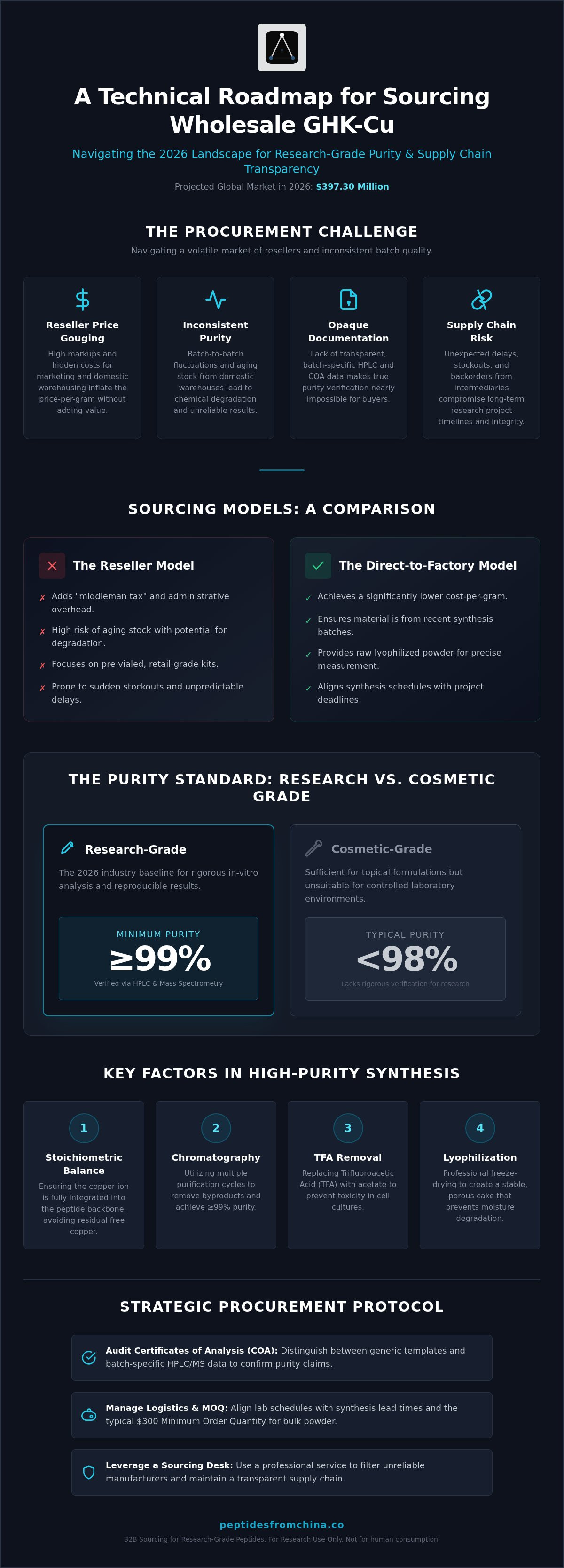
With the global GHK-Cu market projected to reach $397.30 million in 2026, the gap between high-volume research demand and verified synthesis capacity has created a volatile environment for laboratory procurement. Most buyers are forced to navigate a landscape of reseller price gouging and inconsistent batch purity, where the lack of transparent HPLC documentation makes it difficult to secure reliable materials. You likely recognize that the traditional middleman model often obscures the technical reality of the product, leading to unexpected shipping delays and purity fluctuations that compromise research integrity.
This guide provides a technical roadmap for professional GHK-Cu wholesale sourcing, moving away from retail-style storefronts to establish direct-to-manufacturer relationships. We prioritize purity verification and supply chain transparency as the primary metrics for success. You'll learn how to navigate the 2026 landscape of direct procurement, focusing on the protocols required to ensure a minimum of 99% purity across every batch. We'll also detail the logistical frameworks for auditing Chinese synthesis facilities, interpreting complex COA data, and managing international logistics to maintain a consistent, long-term supply chain for your laboratory.
Key Takeaways
Identify the financial and quality advantages of shifting to a direct-to-factory model for GHK-Cu wholesale sourcing.
Establish technical benchmarks for research-grade materials, focusing on the current 2026 industry standard of ≥99% purity.
Implement rigorous audit protocols for Certificates of Analysis to distinguish between generic templates and batch-specific HPLC data.
Optimize procurement efficiency by managing the $300 minimum order quantity and aligning laboratory schedules with synthesis lead times.
Leverage a professional sourcing desk to filter out unreliable manufacturers and maintain a transparent, consistent supply chain.
Table of Contents
Navigating the GHK-Cu Wholesale Market: Resellers vs. Direct Sourcing
Technical Standards for High-Purity GHK-Cu Synthesis
Strategic Manufacturer Verification: Beyond the Surface COA
Logistical Framework for Bulk GHK-Cu Procurement
Optimizing Your Research Supply Chain with Peptides From China
Navigating the GHK-Cu Wholesale Market: Resellers vs. Direct Sourcing
Professional GHK-Cu wholesale sourcing refers to a direct-to-factory procurement model that bypasses traditional retail intermediaries. In this framework, laboratories and institutional buyers interact directly with synthesis facilities or specialized sourcing desks rather than purchasing from domestic "peptide shops." This shift is essential for maintaining the integrity of high-volume research. Domestic resellers typically operate on a high-markup strategy, often adding significant costs to cover their own marketing, domestic warehousing, and administrative overhead. These hidden expenses don't add value to the chemical compound itself but do inflate the final price-per-gram for the end user.
The 2026 research environment demands higher fiscal accountability and stricter quality controls. Relying on resellers introduces the risk of aging stock. Peptides stored in domestic warehouses for months can undergo degradation, especially if temperature controls aren't rigorously documented. Direct sourcing ensures that the material is coming from a recent synthesis batch, maximizing chemical stability. There's also a clear distinction between retail-grade kits, which are often pre-vialed for individual use, and wholesale raw materials intended for large-scale laboratory analysis. Bulk procurement focuses on the raw lyophilized powder, allowing for precise weight-based measurements in a controlled environment.
The Economic Logic of Direct Procurement
Directly accessing the manufacturing source eliminates the "middleman tax" that plagues the domestic market. When you buy from a reseller, you're paying for their brand equity and localized shipping convenience. For institutional orders, these costs become unsustainable. By routing procurement through a direct synthesis channel, labs can achieve a significantly lower cost-per-gram. This efficiency is mandatory for long-term projects where supply chain consistency is as important as the initial price. Furthermore, direct communication with the facility allows for better alignment on batch timing. Instead of hoping a reseller has stock, you're scheduling synthesis to meet your specific project deadlines. This methodical approach reduces the anxiety of sudden stockouts or backorders.
Research-Grade Standards vs. Cosmetic Grade
The Copper peptide GHK-Cu is widely used in both the laboratory and the cosmetic industry, but the standards for each are vastly different. Many wholesale suppliers offer "cosmetic grade" material, which often features purity levels below 98%. While sufficient for topical formulations, this grade is unsuitable for rigorous in-vitro analysis. Research-grade GHK-Cu must meet a minimum purity threshold of 99%, a standard that became the industry baseline in 2026. Sourcing at this level requires verified HPLC and Mass Spectrometry data to confirm the absence of synthesis byproducts or residual solvents. Professional buyers must prioritize these technical benchmarks over the lower price points associated with cosmetic-grade alternatives. You can learn more about our peptide quality standards to understand how we filter for these specific laboratory requirements.
Technical Standards for High-Purity GHK-Cu Synthesis
GHK-Cu, or Copper Tripeptide-1, consists of the amino acids glycine, histidine, and lysine complexed with a copper (II) ion. The primary challenge in GHK-Cu wholesale sourcing involves achieving a stoichiometric balance during the complexation phase. This ensures the copper ion is fully integrated into the peptide backbone. If the synthesis process is poorly managed, residual free copper or uncomplexed peptides can remain in the batch, which significantly skews research results in analytical environments. 2026 standards mandate a purity threshold of ≥99%, a benchmark that requires multiple purification cycles through preparative chromatography to achieve.
Another critical technical factor is the removal of trifluoroacetic acid (TFA). Since TFA is used to cleave the peptide from the resin during solid-phase synthesis, it often remains as a counter-ion in the raw material. Professional laboratories typically require a salt exchange process to replace TFA with acetate or chloride, as residual TFA can be toxic to cell cultures and interfere with enzymatic assays. Following purification, the compound must undergo a rigorous lyophilization protocol. This freeze-drying process removes moisture through sublimation under a vacuum, resulting in a stable, porous cake that prevents hydrolysis and ensures long-term chemical stability during transport and storage.
Interpreting HPLC and MS Reports
HPLC reports are the primary tool for verifying chemical purity. On a chromatogram, the area under the main peak relative to the total area of all detected peaks determines the purity percentage. Mass Spectrometry (MS) complements this by verifying the molecular weight, ensuring the identity of the synthesized compound matches the theoretical profile. HPLC identifies impurities by separating chemical components based on their interaction with a stationary phase, revealing any secondary peaks that deviate from the target molecule's retention time. Verification of these documents is the only way to confirm a batch meets the ≥99% threshold before procurement.
Batch Consistency in Large-Scale Production
Wholesale procurement involves larger volumes where batch-to-batch variance becomes a significant risk. If a manufacturer lacks rigid process controls, you might see fluctuations in moisture levels or net peptide content between different synthesis runs. Institutional buyers require standardized protocols to ensure that every gram delivered meets the same specifications for salt content and moisture. You can browse GHK-Cu specifications in our catalog to see the benchmarks we demand from our synthesis partners. If your laboratory requires specific batch-to-batch validation or custom salt exchanges, contact our sourcing desk for a technical consultation.
Strategic Manufacturer Verification: Beyond the Surface COA
The primary risk in GHK-Cu wholesale sourcing is the reliance on "template" Certificates of Analysis (COA). In the current market, it's common for vendors to circulate static PDF documents that were generated months or even years prior to the current synthesis run. These templates don't reflect the specific impurities or the net peptide content of the batch you're actually purchasing. Professional procurement requires a shift toward batch-specific verification where the HPLC chromatogram and Mass Spectrometry data are tied to a unique lot number. Relying on a generic document provided by a sales agent is a failure of due diligence that often leads to receiving sub-standard material.
To mitigate this, laboratories must establish direct lines of communication with facility managers rather than relying solely on front-end sales representatives. Sales agents are often trained to provide scripted reassurances and may not have the technical depth to explain synthesis deviations or salt exchange protocols. Direct engagement with the production desk allows you to request raw data files rather than just summarized reports. This transparency is the only way to ensure that the material was synthesized under the specific parameters your research requires, such as the removal of residual solvents or specific counter-ion adjustments.
Facility Standards and Compliance
When auditing a Chinese synthesis plant, look for specific institutional benchmarks such as ISO 9001 for quality management and ISO/IEC 17025:2017 for laboratory testing competence. These certifications indicate that the facility maintains calibrated equipment and follows standardized operating procedures. It's also vital to distinguish between genuine manufacturers and "re-labelers." Re-labelers often masquerade as factories but actually source from various low-tier labs, resulting in high batch-to-batch variance. A legitimate plant will have onsite Agilent or Shimadzu HPLC systems and dedicated cleanrooms that meet ISO Class 7 or 8 standards to prevent cross-contamination between different peptide sequences.
Third-Party Verification Strategies
Independent laboratory testing is a non-negotiable requirement for wholesale buyers. Even with a factory-provided COA, verifying a random sample from a bulk order through a third-party facility ensures the data hasn't been manipulated. We act as a professional filter in this process, facilitating batch-specific verification before you commit to a final payment. This includes utilizing our $10 processing deposit as a risk-mitigation tool for researchers, allowing for initial verification without a large upfront capital commitment. For a deeper look at these protocols, review our guide on peptide testing and analysis. By implementing these audit layers, you ensure that your research is built on a foundation of verified chemical integrity rather than marketing promises.
Logistical Framework for Bulk GHK-Cu Procurement
Efficient GHK-Cu wholesale sourcing requires a structured timeline that accounts for synthesis, batch verification, and international transit. Navigating the complexities of GHK-Cu wholesale sourcing involves balancing manufacturer lead times with laboratory deadlines. Synthesis lead times in 2026 typically range from 10 to 15 business days for standard batches, although custom salt exchanges or high-volume orders may extend this window. Managing the $300 minimum order quantity (MOQ) is a strategic requirement for institutional efficiency. This threshold ensures that the logistical costs of international transport and neutral packaging are amortized over a sufficient volume of material, making the price-per-gram sustainable for long-term research budgets.
International shipping protocols for research compounds must be methodical to avoid delays. We utilize neutral packaging with tracking to move material from Chinese facilities to global laboratories. Ensuring compliance with Research Use Only (RUO) documentation is a critical step for customs navigation. This documentation clearly defines the material's intent for laboratory analysis, distinguishing it from finished pharmaceutical products. Every shipment is accompanied by the necessary paperwork to facilitate a smooth transition through regulatory checkpoints, minimizing the risk of seizure or prolonged inspection.
The Sourcing Process: From Deposit to Delivery
The procurement cycle begins with a $10 processing deposit. This nominal fee acts as a risk-mitigation tool, allowing us to initiate manufacturer stock checks and verify batch availability without requiring a full capital commitment upfront. Once the batch is confirmed and technical data is reviewed, the remaining balance is settled through secure B2B payment protocols. This system balances the need for transaction speed with the security requirements of institutional finance departments. You can review exactly how the sourcing process works to align your procurement schedule with our operational milestones.
Shipping and Storage Considerations
Lyophilized GHK-Cu is remarkably stable at ambient temperatures during transit, provided it remains in its vacuum-sealed state. While cold-chain logistics aren't strictly necessary for the shipping phase of freeze-dried powders, long-term storage in the laboratory should be conducted at -20°C to prevent oxidation and moisture absorption. Tracking and insurance are standard for all high-value wholesale shipments, providing a layer of accountability from the factory floor to your facility. Upon arrival, bulk powder should be stored in an environment with controlled humidity to maintain its chemical integrity over several years. If you're ready to initiate a bulk order or need specific shipping quotes, contact our sourcing desk for a detailed logistical plan.
Optimizing Your Research Supply Chain with Peptides From China
Peptides From China functions as a specialized B2B sourcing desk, acting as a protective filter between institutional buyers and the global manufacturing market. In the context of GHK-Cu wholesale sourcing, our role is to eliminate the variables that often lead to research failure. We don't operate as a retail shop; instead, we provide a direct channel to verified synthesis facilities. This model ensures that you receive direct factory pricing, removing the significant markups typically applied by domestic resellers who must cover localized overhead. By facilitating this direct connection, we allow laboratories to scale their operations efficiently, moving from initial $300 minimum order quantities to kilogram-level procurement as research phases progress.
Batch-specific COA verification is a standard operational procedure for every request we handle. Unlike vendors who provide static or outdated documents, we ensure that the technical data matches the specific synthesis run you're purchasing. This level of transparency is mandatory for maintaining the integrity of longitudinal studies where consistency across multiple batches is required. As you move toward larger procurement volumes, our desk manages the logistical complexities, ensuring that the transition from small-scale analysis to high-volume institutional supply is seamless and technically sound.
Why Direct-to-Manufacturer Beats Domestic Warehousing
Relying on domestic warehouses introduces a significant risk of product degradation. Peptides stored in localized facilities for extended periods often lack the rigorous temperature logs required to guarantee chemical stability. By sourcing directly from the point of synthesis, you ensure that the material is fresh and hasn't been sitting in a third-party warehouse for months. This direct access also allows for custom synthesis specifications, such as specific salt exchanges or adjusted net peptide content, which are rarely available through retail-focused domestic shops. You can explore why transparency beats domestic warehousing to better understand these logistical risks.
Initiating Your GHK-Cu Sourcing Request
The process for securing high-purity GHK-Cu begins with a clear definition of your laboratory's requirements. To receive a formal quote, you should provide details regarding your volume needs and any specific analytical benchmarks required for your study. Our team will then initiate a stock check and provide a technical overview of the available batches. If you have questions regarding payment security or shipping timelines, you can consult our FAQ for detailed logistical answers. When you're ready to proceed with a procurement request, contact our sourcing desk for a quote to begin the verification process.
Securing Your Laboratory’s GHK-Cu Supply
Transitioning from domestic resellers to a direct synthesis model is the most effective way to stabilize your research budget while ensuring chemical integrity. By prioritizing direct-to-manufacturer routing, laboratories can eliminate the unnecessary markups and quality risks associated with aging retail stock. Successful GHK-Cu wholesale sourcing in 2026 relies on a methodical approach to batch verification, requiring a minimum of 99% purity and batch-specific HPLC data for every order. This technical rigor ensures that your analytical results remain consistent and reproducible over the long term.
Our sourcing desk provides a streamlined bridge to verified facilities, offering direct-to-manufacturer pricing and COA/HPLC batch verification as standard protocols. With a manageable $300 Minimum Order Quantity, institutional buyers can secure high-purity materials without the logistical hurdles of navigating international markets alone. We invite you to Request a Wholesale GHK-Cu Quote to begin auditing our current available batches. Establishing a transparent, reliable supply chain today is the foundation for your laboratory’s future success.
Frequently Asked Questions
Is GHK-Cu sourced from China safe for laboratory research?
Chemical safety in a research context is defined by high-purity thresholds and the absence of synthesis byproducts. GHK-Cu wholesale sourcing from verified Chinese facilities is a standard practice for global laboratories, provided that stringent purity benchmarks of ≥99% are met. We act as a professional filter, auditing manufacturers to ensure their synthesis protocols and cleanroom standards align with international laboratory requirements for analytical consistency.
What is the minimum order quantity for wholesale GHK-Cu?
The minimum order quantity for all procurement through our sourcing desk is $300 per transaction. This threshold is established to maintain institutional efficiency, allowing laboratories to access direct-to-manufacturer pricing while amortizing the costs associated with international logistics and neutral packaging. This MOQ ensures that the price-per-gram remains sustainable for large-scale research projects and long-term supply chain planning.
How do I verify the HPLC report provided by a Chinese manufacturer?
Verification involves analyzing the area under the main peak relative to the total peak area on the chromatogram. You must ensure the report includes a batch-specific lot number and cross-reference the retention time with known standards. We facilitate this process by requesting raw data files rather than static PDF templates, ensuring that the chemical identity and purity levels are accurately represented before final procurement.
What is the typical lead time for a bulk GHK-Cu synthesis order?
Typical lead times for bulk synthesis in 2026 range from 10 to 15 business days. This timeframe covers the initiation of solid-phase peptide synthesis, complexation with copper ions, and multiple purification cycles. Final lyophilization and batch verification are also completed within this window. Laboratories should account for these production schedules when planning their procurement to avoid interruptions in their research timelines.
Does Peptides From China provide domestic US or EU warehousing?
No, we do not offer domestic US or EU warehousing. We function as a direct-to-manufacturer sourcing desk, routing all orders straight from verified Chinese synthesis plants to your facility. This model eliminates the "middleman tax" and the risk of product degradation associated with long-term storage in localized warehouses. Every batch is dispatched shortly after synthesis to guarantee maximum chemical stability and freshness.
Can I request custom vial sizes or concentrations for my research?
Customization is available for institutional buyers with specific research requirements. While our primary focus is the procurement of bulk lyophilized powder, we can facilitate requests for custom synthesis specifications or specialized salt exchanges. These requirements should be detailed during the initial quote request. Our sourcing desk coordinates directly with facility managers to ensure that the final material meets your laboratory’s exact technical parameters.
How are wholesale peptide shipments packaged for international transit?
Wholesale shipments are dispatched using neutral packaging with comprehensive tracking to ensure a smooth transition through international customs. The lyophilized powder is vacuum-sealed in glass vials or bulk containers to prevent moisture absorption and oxidation. This packaging protocol maintains the stability of the compound at ambient temperatures during the transit period, ensuring the material arrives at your facility in its intended chemical state.
What payment methods are accepted for direct manufacturer sourcing?
We utilize secure B2B payment protocols that align with the requirements of institutional finance departments. The process starts with a $10 processing deposit, which initiates the manufacturer stock check and quality verification. Once the batch-specific documentation is approved, the remaining balance is settled through established secure channels. This structured approach balances transaction speed with the necessary financial protections required for high-value wholesale procurement.