
Did you know that GHK-Cu has the documented capacity to modulate the expression of over 4,000 human genes? While the biological potential for collagen stimulation and tissue remodeling is well-established, the practical execution of GHK-Cu research applications is frequently hindered by a fragmented global supply chain. You've likely encountered the industry's darker side: inconsistent batch purity, relabeled vials, and the pervasive use of outdated analytical reports that offer little more than a snapshot of a single, long-gone production run.
We understand that for procurement professionals and laboratory directors, a PDF of an HPLC report isn't a guarantee of quality; it's merely a baseline reference. This guide moves past the hyperbolic claims found in retail spaces to offer a technical deep-dive into peptide mechanisms and the 2026 operational realities of sourcing. We'll provide a framework for verifying manufacturer documentation and explain how a direct-to-manufacturer B2B bridge can help reduce supply chain uncertainty. This analysis outlines a clear path for professional-grade procurement through Peptides From China, where a $600 minimum order facilitates a sourcing route that prioritizes traceability and manufacturer-side transparency over traditional reseller markups.
Key Takeaways
Understand the biological mechanism of GHK-Cu as a gene modulator capable of resetting cellular expression and stimulating systemic tissue repair.
Evaluate the most relevant GHK-Cu research applications, specifically its documented role in accelerating dermal wound healing and stimulating collagen synthesis.
Learn to navigate supply chain opacity by treating HPLC and Mass Spectrometry reports as baseline reference analytical data rather than definitive proof of batch quality.
Identify a strategic B2B procurement route that minimizes intermediary layers to improve traceability and operational consistency for laboratory sourcing.
Establish a professional-grade sourcing framework by utilizing manufacturer-side channels with a $600 minimum order requirement to ensure consistent research batches.
Table of Contents
What is GHK-Cu? Understanding the Copper Tripeptide-1 Mechanism
Primary Research Applications: Regenerative Medicine and Gene Expression
GHK-Cu in Dermatological Studies: Wound Healing and Collagen Synthesis
Supply Chain Realities: Verifying GHK-Cu Purity and Concentration
B2B Procurement: Direct-to-Manufacturer Sourcing for GHK-Cu
What is GHK-Cu? Understanding the Copper Tripeptide-1 Mechanism
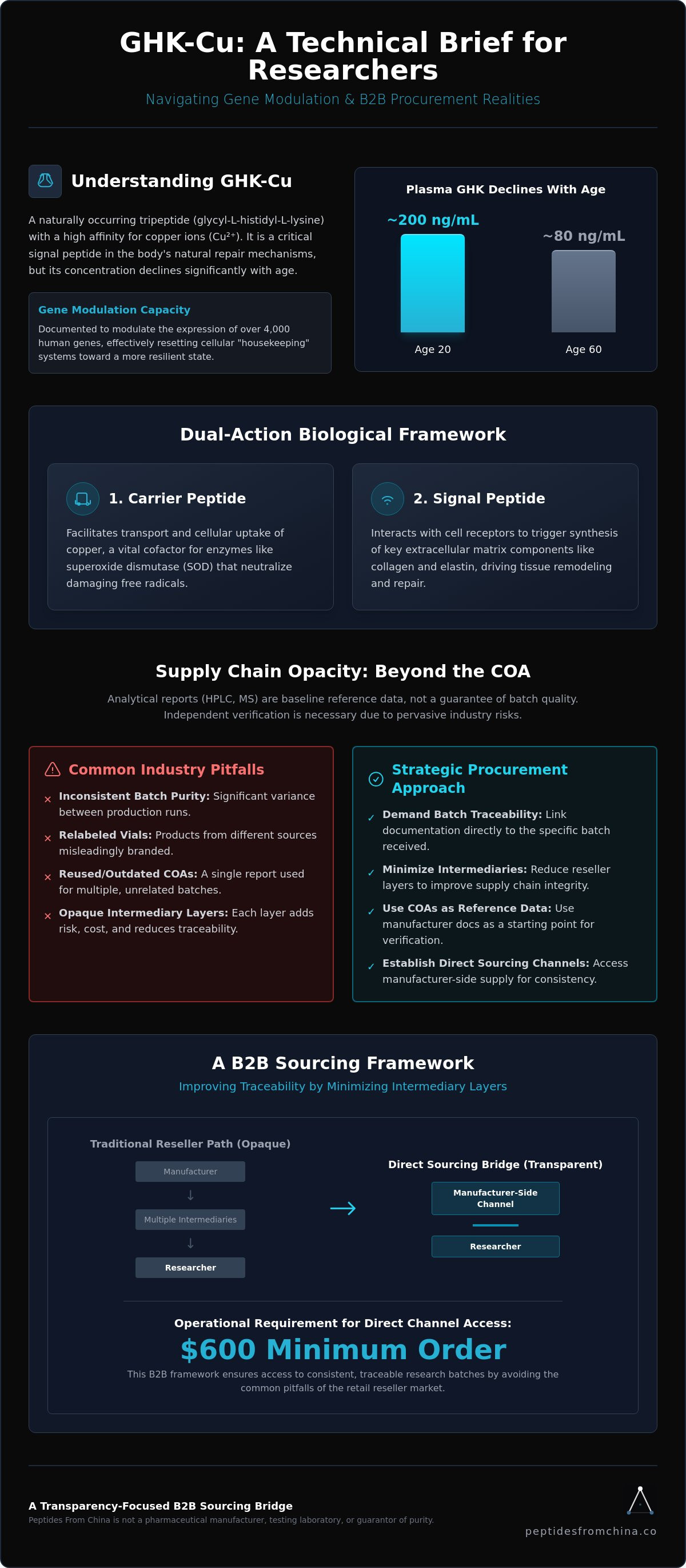
GHK-Cu is a naturally occurring tripeptide, specifically glycyl-L-histidyl-L-lysine, known for its exceptional affinity for copper ions. Originally isolated from human plasma in 1973, this Copper peptide GHK-Cu serves as a critical component in the body's natural repair mechanisms. Research indicates that its concentration in the blood declines significantly with age. For instance, levels typically drop from approximately 200 ng/mL at age 20 to roughly 80 ng/mL by age 60. This decline correlates with a reduced capacity for tissue regeneration and increased systemic inflammation, making it a focal point for modern GHK-Cu research applications.
In a laboratory setting, the biochemical significance of the GHK-copper complex lies in its ability to act as a signal peptide. It doesn't just sit in the extracellular matrix; it actively modulates cellular behavior by influencing gene expression and protein synthesis. This mechanism is central to its role in extracellular matrix (ECM) remodeling, where it helps balance the production and degradation of structural proteins.
The Molecular Structure of GHK-Cu
The sequence is composed of three amino acids: glycine, l-histidine, and l-lysine. The biological activity of the molecule depends on the integration of a copper (II) ion, which binds to the nitrogen atoms within the histidine side chain and the peptide's amino terminus. Stability is a major operational concern for researchers. While lyophilized powder remains stable for extended periods under refrigeration, aqueous solutions are susceptible to hydrolysis and microbial contamination. Reliable GHK-Cu research applications require starting material that has been synthesized with high precision to ensure the copper-to-peptide ratio remains consistent across batches.
Carrier vs. Signal Peptide Functions
GHK-Cu operates through a dual-action framework. As a carrier peptide, it facilitates the transport and cellular uptake of copper, a vital cofactor for enzymes like superoxide dismutase, which neutralizes free radicals. Simultaneously, it functions as a signal peptide by interacting with cell receptors to trigger the synthesis of collagen, elastin, and glycosaminoglycans. This dual capability makes GHK-Cu a priority for regenerative medicine studies, specifically in wound healing and tissue repair.
Professional procurement requires moving past the simplified marketing found in retail peptide shops. At Peptides From China (PFC), we view manufacturer documentation merely as a baseline technical reference. Real operational consistency comes from reducing intermediary layers and accessing manufacturer-side channels directly. For laboratories requiring high-purity batches, our $600 minimum order ensures a streamlined B2B sourcing route that avoids the common pitfalls of reseller-driven supply chains.
Primary Research Applications: Regenerative Medicine and Gene Expression
Gene Modulation and Anti-Aging Research
The ability of GHK-Cu to influence the human genome is perhaps its most significant trait. Research indicates that GHK-Cu can modulate the expression of over 4,000 human genes, essentially resetting them to a more youthful state. This new gene data highlights its influence on the ubiquitin-proteasome system, which is responsible for clearing damaged proteins from the cell. By enhancing the expression of DNA repair genes, the peptide helps maintain genomic integrity. This cellular "housekeeping" is vital for longevity research, as it addresses the accumulation of protein aggregates that characterize aging and neurodegeneration.
Systemic Organ Repair and Protection
The peptide's influence extends to vital organs, where it has demonstrated a capacity to reverse fibrotic changes and accelerate healing. In models of Chronic Obstructive Pulmonary Disease (COPD), GHK-Cu has been shown to restore the function of lung fibroblasts, which are typically impaired in their ability to remodel the lung's architecture. It also exhibits protective actions against acute lung injury and liver fibrosis by suppressing oxidative stress and balancing inflammatory responses. For researchers investigating the negative side effects of corticosteroids, GHK-Cu offers a potential mechanism to block the inhibition of wound healing often caused by these drugs. These systemic GHK-Cu research applications suggest a role for the peptide in mitigating tissue damage across the liver, stomach lining, and respiratory system.
Beyond organ repair, laboratory observations show that GHK-Cu stimulates nerve outgrowth and provides neuroprotective effects. Its anti-inflammatory properties are equally robust, characterized by the suppression of pro-inflammatory cytokines such as TNF-alpha and IL-6. For institutions conducting these high-stakes studies, supply chain transparency is non-negotiable. Reused COAs and batch substitution are operational risks that can invalidate months of data. Accessing direct-to-manufacturer sourcing channels helps reduce these uncertainties by providing baseline reference analytical data for every batch. This transparency-first approach is essential for maintaining the integrity of complex regenerative medicine research.
GHK-Cu in Dermatological Studies: Wound Healing and Collagen Synthesis
While the systemic gene modulation discussed previously establishes a broad biological foundation, the most visible GHK-Cu research applications are found in dermatology and wound care. In these settings, the peptide acts as a precise coordinator of the tissue repair process. Laboratory models consistently show that GHK-Cu accelerates dermal wound contraction, reducing the time required for epithelialization. This efficiency is largely attributed to the peptide's ability to stimulate the synthesis of glycosaminoglycans (GAGs) and proteoglycans, which are essential components of the skin's structural integrity.
A critical aspect of its efficacy is the modulation of metalloproteinases (MMPs). Unlike many topical agents that simply stimulate growth, GHK-Cu helps regulate the balance between tissue production and degradation. By inhibiting excessive MMP activity, it prevents the overproduction of collagen that leads to hypertrophic scarring. When compared to other signal peptides like Palmitoyl Pentapeptide-4, GHK-Cu often demonstrates a more comprehensive influence on the extracellular matrix, particularly regarding its ability to facilitate copper-dependent enzymatic reactions.
The Wound Healing Cascade
Extracellular Matrix (ECM) Remodeling
In ECM research, GHK-Cu is valued for its ability to increase both Type I and Type III collagen production. Laboratory data suggests that it can stimulate collagen synthesis by up to 70% in certain models. Beyond collagen, it plays a vital role in elastin fiber assembly through the activation of fibroblasts. These actions contribute to measurable increases in skin thickness and barrier repair in laboratory studies. For researchers, achieving these results depends on the chemical integrity of the peptide batch.
Operational reality in the peptide industry is often complicated by supply chain opacity. Inconsistent synthesis quality from resellers can lead to variable results in skin thickness and barrier studies, potentially invalidating research outcomes. We treat manufacturer-issued HPLC reports as baseline technical reference material, acknowledging that they do not serve as a final guarantee of purity. Peptides From China facilitates a more reliable procurement route by providing a direct B2B bridge to manufacturing facilities. Our $600 minimum order requirement allows labs to access wholesale channels that prioritize batch traceability and reduce the risks associated with multiple intermediary resellers.
Supply Chain Realities: Verifying GHK-Cu Purity and Concentration
The biological efficacy of GHK-Cu research applications depends entirely on the chemical integrity of the material used. In the current market, supply chain opacity is the standard, not the exception. Many resellers provide Certificates of Analysis (COAs) that are months or even years old, often reused across multiple batches or even different manufacturers. This practice makes a single HPLC report a baseline technical reference rather than definitive proof of quality. Verification is mandatory.
Batch substitution and relabeling are common operational realities. A reseller may purchase a high-purity batch for initial testing and then fulfill subsequent orders with lower-grade material. Without independent third-party testing, laboratories risk basing their entire research framework on inconsistent variables. Identifying signs of relabeling, such as mismatched batch numbers or generic packaging without manufacturer-side identifiers, is a critical first step in risk management.
Reading HPLC and Mass Spectrometry Reports
Understanding the nuances of analytical data is essential for procurement. It's common to see "photoshopped" or reused reports where headers have been altered to match a reseller's brand. You should also distinguish between purity percentages and actual peptide content. A vial might show 99% purity, but if the actual peptide content is only 60% due to residual salts or moisture, your concentration calculations will be inaccurate. For a deeper look at these technical requirements, see our guide on Peptide Testing and Analysis.
Minimizing Intermediary Risk
Reducing these risks requires a strategic approach to procurement. Peptides From China acts as a transparency-focused B2B sourcing bridge, helping researchers secure a transparent B2B sourcing route that bypasses the traditional reseller model. By maintaining a $600 minimum order requirement, we facilitate access to manufacturer-side channels that prioritize batch traceability and reference analytical data for professional-grade GHK-Cu research applications.
B2B Procurement: Direct-to-Manufacturer Sourcing for GHK-Cu
High-volume sourcing is a strategic necessity for institutions investigating long-term GHK-Cu research applications. Relying on retail-level resellers often introduces variables that compromise data integrity. When you buy single vials, you're frequently receiving material from different synthesis runs, each with slight variations in peptide content or residual salts. These minor deviations can lead to significant discrepancies in tissue repair or gene modulation studies. Professional labs don't just buy a product; they secure a verified production run.
Optimizing Large-Scale Research Orders
The economic logic of bulk procurement is clear. Beyond the lower price per milligram, the primary benefit is batch traceability. Procuring a significant quantity from a single manufacturer ensures that your entire study uses chemically identical material. This reduces the risk of anomalous data caused by batch-to-batch inconsistency. For a detailed breakdown of these logistics, consult our Wholesale Peptides Sourcing Guide. Maintaining a consistent supply chain is often the difference between a successful trial and an invalidated data set. It's about protecting the investment in your research hours.
The PFC Sourcing Process
Peptides From China (PFC) operates as a transparency-focused B2B sourcing bridge. We don't claim to be the manufacturer or a testing lab. Instead, we provide the infrastructure needed to access manufacturer-side channels directly. Our process starts with a $10 processing deposit. This small commitment initiates the manufacturer verification phase. During this stage, we identify current stock availability and request manufacturer-issued papers for your review. It's a methodical way to ensure the material meets your baseline technical requirements before any significant capital is deployed.
Once the reference analytical data is approved, we facilitate the wholesale transaction. Our $600 minimum order requirement ensures that we're serving professional researchers who value operational consistency over retail convenience. We manage the complexities of international logistics, utilizing neutral packaging and providing reliable tracking to ensure your samples arrive at the laboratory without unnecessary diversions. This approach helps reduce supply chain uncertainty and improves traceability for every batch. If you're ready to move past the opacity of the reseller market, the next step is to Request a GHK-Cu Sourcing Quote. Our model prioritizes factual integrity and long-term reliability, acting as a strategic filter between production facilities and professional buyers.
Securing Operational Consistency for GHK-Cu Research
The long-term viability of GHK-Cu research applications depends on a fundamental shift from retail-style procurement to professional supply chain management. We've established that the peptide's capacity for gene modulation and tissue repair is scientifically significant; however, these outcomes are only as reliable as the chemical consistency of the starting material. Moving forward, laboratories must prioritize direct-to-manufacturer channels to help reduce the risks inherent in reseller-heavy markets.
Peptides From China (PFC) provides the necessary B2B bridge to help you navigate these complexities. By bypassing intermediary layers, you improve traceability and secure access to manufacturer-issued reference analytical data. Our model supports independent verification through a structured process, ensuring that your $600 minimum order is fulfilled with tracked, neutral packaging designed for professional laboratory environments. This methodical approach ensures that your focus remains on data generation rather than supply chain troubleshooting.
Don't let market opacity compromise your research integrity. You can request a wholesale GHK-Cu sourcing quote from verified manufacturers today to establish a more transparent procurement route. We're ready to help you secure the consistent batches required for advanced regenerative studies.
Frequently Asked Questions
Is GHK-Cu stable for long-term laboratory research?
GHK-Cu is highly stable in its lyophilized form when stored under appropriate conditions. At -20°C, the powder maintains its integrity for several years. However, once reconstituted in an aqueous solution, the peptide becomes susceptible to hydrolysis and microbial growth. Researchers should only reconstitute the amount needed for immediate use and store the remaining solution at 4°C for no more than two to four weeks.
How does GHK-Cu compare to other copper peptides in regenerative studies?
GHK-Cu remains the gold standard for regenerative studies due to its unique 1:1 binding affinity and documented gene-resetting capabilities. While other peptides like copper tripeptide-1 or palmitoyl derivatives exist, they don't possess the same breadth of data regarding the modulation of 4,000+ human genes. This specific molecular signature makes it the primary choice for complex GHK-Cu research applications focused on systemic tissue repair.
What is the standard purity requirement for research-grade GHK-Cu?
Professional laboratories typically require a purity level of 99% or higher as measured by High-Performance Liquid Chromatography (HPLC). It's vital to remember that purity percentages on a report don't always reflect the total peptide content. Residual salts, moisture, and counter-ions like TFA can occupy a significant portion of the vial's weight, making independent verification of the actual peptide mass essential for accurate dosing.
Can GHK-Cu be used systemically in animal research models?
How do I verify a manufacturer-issued HPLC report for GHK-Cu?
Verification begins with a visual audit of the document for inconsistencies in fonts, mismatched batch numbers, or altered dates. Many resellers reuse old reports or edit headers to obscure the original manufacturer. You should treat these documents as baseline reference analytical data. The only way to ensure batch identity is through independent third-party testing or by establishing a direct-to-manufacturer sourcing route that provides better traceability.
What are the storage requirements for lyophilized GHK-Cu powder?
Lyophilized powder should be stored in a freezer at -20°C to ensure maximum longevity. For short-term needs, refrigeration at 4°C is sufficient, provided the vial is kept away from light and moisture. Oxidation of the copper ion can occur if the seal is compromised, which may alter the peptide's biological activity. Always allow the vial to reach room temperature before opening to prevent condensation from entering.
Does GHK-Cu research require specific copper-to-peptide ratios?
A 1:1 molar ratio of copper to the GHK peptide is necessary for optimal biological signaling. An imbalance can lead to free copper ions in the solution, which may cause oxidative stress or cellular toxicity in sensitive models. Conversely, an insufficient amount of copper means the peptide cannot form the active complex required for gene modulation. Reliable manufacturers ensure this ratio is consistent throughout the synthesis process.
Why is direct-to-manufacturer sourcing preferred for GHK-Cu batches?
Direct sourcing eliminates the intermediary layers that contribute to supply chain opacity and batch substitution. When you buy from resellers, you lose the ability to trace the material back to its specific production run. At Peptides From China, we facilitate this direct B2B bridge for orders over $600. This model ensures that researchers receive manufacturer-side documentation and can maintain a consistent supply for long-term institutional studies.