Dry Ice Shipping Regulations Every Shipper Must Follow

Dry ice ships as UN 1845, Class 9, and any shipment moving by air or sea must use vented packaging, carry the net weight and proper shipping name on the outer box, and be prepared by someone who knows the applicable limits. A small-quantity exception covers air shipments of 2.5 kg (5.5 lb) or less used as a refrigerant, which simplifies marking but does not eliminate it. Before booking anything, confirm your carrier’s operator variations and make sure whoever packs the box has been trained.
TL;DR:
Confirm that dry ice packaging is vented with lap seams or purpose-built vented shippers, never sealed airtight containers.
Always weigh dry ice at handoff from a calibrated scale and verify net weight against current shipment needs to prevent sublimation losses.
Be aware that air, sea, and ground transport rules differ, with stricter carrier-specific limits often overriding federal regulations, requiring carrier confirmation.
Ensure proper markings include the shipper’s name, UN 1845, correct net weight, and, if necessary, a Class 9 hazard label, especially for larger shipments.
Train staff on proper PPE use, handling procedures, documentation, and the importance of confirming operator variations before shipping.
Table of Contents
What Is Dry Ice, and Why Do Regulators Care?
How Do the Rules Differ by Air, Sea, and Ground?
What Packaging Actually Satisfies the Venting Requirement?
What Markings and Paperwork Does a Dry Ice Shipment Need?
How Much Dry Ice Do You Actually Need?
What Handling and Training Does Staff Need?
Why Do Carrier Rules Differ from the Federal Baseline?
How Should Labs Fold This Into Existing Shipping SOPs?
Pre-Shipment Checklist and Where to Verify Current Rules
The Playbook That Actually Prevents Rejected Shipments
Sources
What Is Dry Ice, and Why Do Regulators Care?
Dry ice is solid carbon dioxide, held at −109.3°F. It never melts into liquid at normal atmospheric pressure. It sublimates directly into CO2 gas, and that phase change is the entire reason regulators built a rulebook around a substance that is otherwise chemically inert and non-toxic.
Two hazards follow from sublimation. First, gas building up inside a sealed container creates pressure that can rupture packaging or, in worse cases, an aircraft cargo hold. Second, CO2 released in a confined space displaces oxygen, which creates an asphyxiation risk for anyone nearby, including cargo handlers and delivery drivers. That combination, pressure and oxygen displacement, is why 49 CFR § 173.217 classifies dry ice as UN 1845, Class 9 (miscellaneous hazardous material), and why the entire regulatory structure for dry ice shipping regulations centers on venting, not containment.
How Do the Rules Differ by Air, Sea, and Ground?
Regulatory coverage is not uniform across transport modes, and that inconsistency trips up more shippers than any single packaging error.
Air: Governed by IATA Packing Instruction 954 (PI 954) under the IATA Dangerous Goods Regulations. It requires vented packaging, net weight marked on the package, and imposes per-package quantity limits that vary by aircraft type. IATA’s own guidance flags that operator variations can tighten these limits further, so the airline’s own rules sometimes override the baseline.
Water/vessel: The IMDG Code governs stowage and marking for vessel shipments, with its own segregation and container-marking rules distinct from the air rulebook, even though the UN number and hazard class stay the same.
Ground: Domestic highway and rail movement in the U.S. is largely exempt from hazmat regulation when dry ice is the only regulated material aboard. Industry compliance guidance notes the DOT Hazardous Materials Table marks dry ice with “A” and “W” designators, meaning air and water triggers apply, while pure ground transport typically does not.
A shipment that touches more than one mode, say, a ground pickup that connects to an air leg, inherits the stricter mode’s requirements for the entire trip.
What Packaging Actually Satisfies the Venting Requirement?
The rule that trips up new shippers most often is simple in concept and easy to violate in practice: packaging must permit the release of CO2 gas. Hermetically sealed containers, including anything airtight or glass, are prohibited outright under 49 CFR § 173.217, because a sealed box holding dry ice is a pressure vessel waiting to fail.
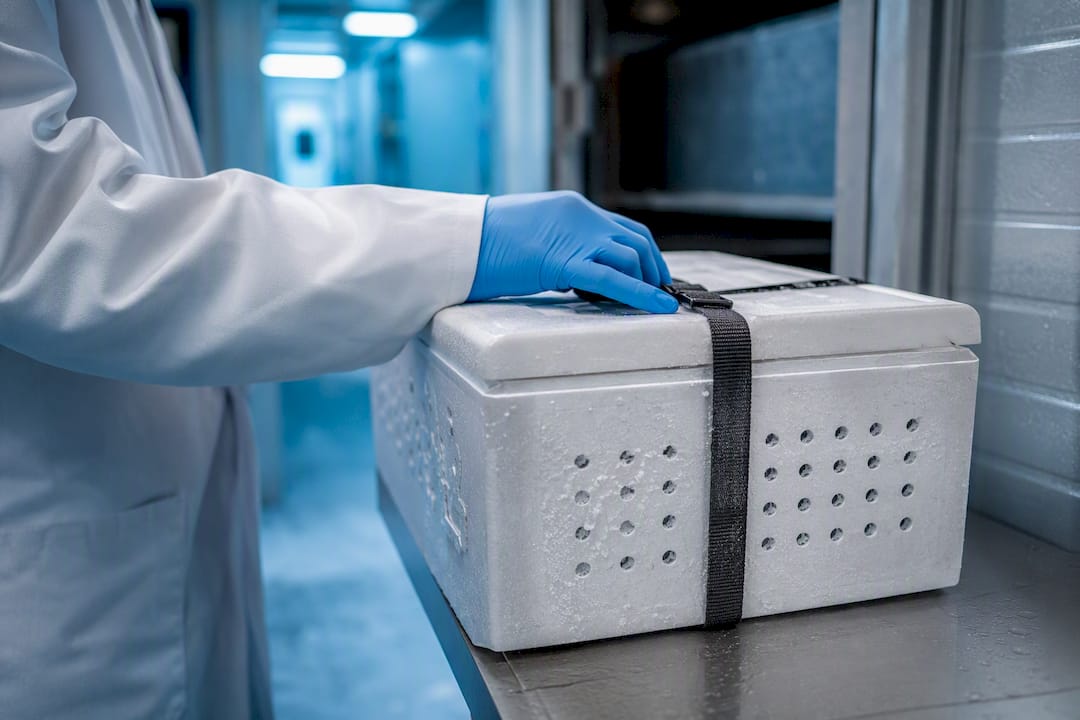
Expanded polystyrene (EPS) foam liners set inside a corrugated outer box remain the industry default. Carrier guidance from UPS treats this combination, or a purpose-built vented shipper, as standard practice because it insulates the payload while still allowing gas to escape through the box seams or a designed vent. A detailed look at packaging materials from lab-focused sources covers insulation grades and liner thickness in more depth if you’re specifying packaging at scale.
A reliable packing sequence looks like this:
Line the corrugated outer box with EPS foam, leaving no gaps against the walls.
Place absorbent material and secondary containment around any liquid payload first.
Add the dry ice on top of or around the payload, never in direct sealed contact with glass vials.
Close the foam liner loosely enough to allow gas movement, then seal the outer box.
Mark and label the outer box immediately, before it leaves the packing station.
Pro Tip: Never tape over foam liner seams completely. A fully taped, airtight foam liner defeats the entire purpose of the vented outer box and can trap enough pressure to blow the lid during transit.
What Markings and Paperwork Does a Dry Ice Shipment Need?
Every package needs the proper shipping name, “Dry Ice” or “Carbon Dioxide, Solid,” paired with the UN number 1845 and the net weight of dry ice in kilograms, current as of the moment the carrier accepts the package. Weight drifts downward from sublimation, so this figure has to be checked, not estimated from packing time.
Whether a Class 9 label is also required depends on quantity and use:
Shipments above the small-quantity exception, or those not used strictly as a refrigerant, generally require the Class 9 hazard label alongside the UN number.
The 2.5 kg (5.5 lb) exception allows simplified marking-only treatment for small air shipments used as a refrigerant, without the full labeling and documentation package.
Diagnostic or treatment specimen shipments can qualify for relief from shipper’s declaration and certification paperwork when the marking conditions under paragraph (a) and ©(2) of § 173.217 are met.
For air waybills, the proper shipping name, UN number, class, and net quantity must appear in the dangerous goods description field even when a full shipper’s declaration isn’t required. A single mismarked airway bill entry is enough to trigger a carrier refusal at the counter, which is the most common and most avoidable delay in dry ice shipping.
How Much Dry Ice Do You Actually Need?
Sublimation rates vary with insulation quality, box geometry, and ambient temperature, but carrier data puts typical loss at roughly 5 to 10 lb per 24 hours for a well-insulated container. Treat that as a planning range, not a guarantee.
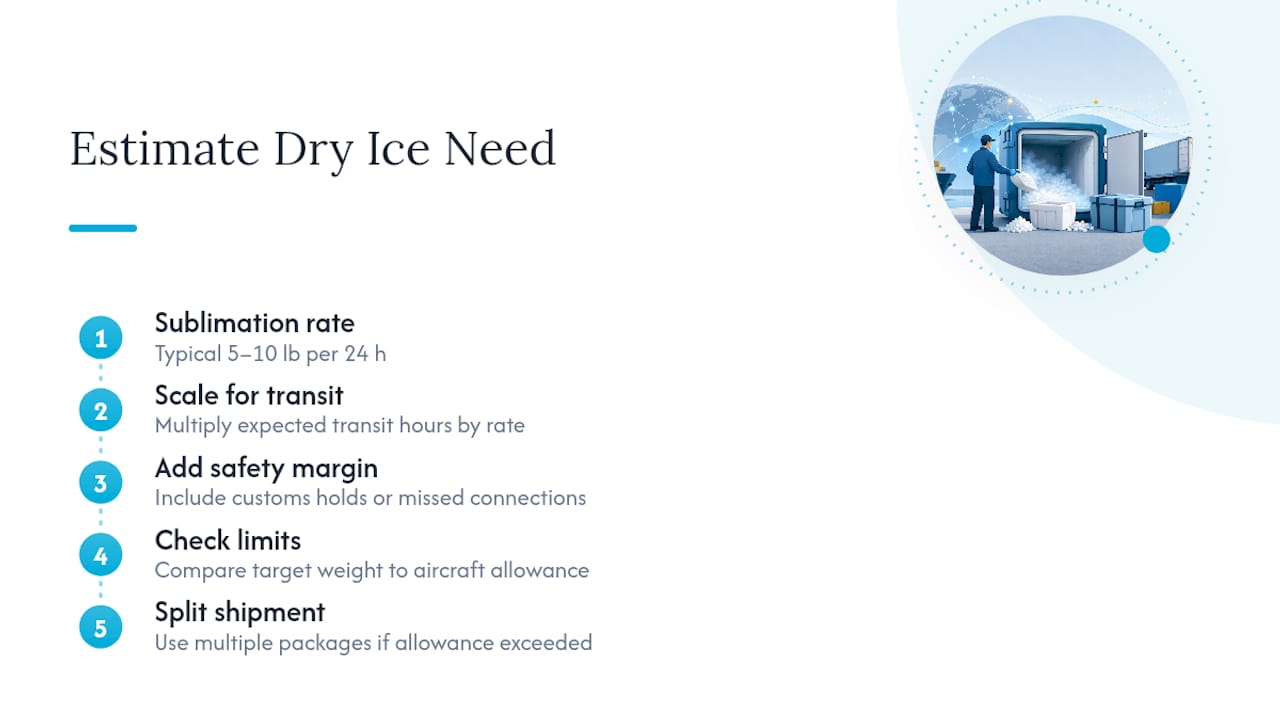
A workable calculation: multiply expected transit hours by your sublimation rate, then add a safety margin for customs holds or missed connections. Poor insulation or hot tarmac exposure pushes losses toward the high end of that range. Once you have a target weight, check it against air quantity limits. If your calculated need exceeds the per-package allowance for your aircraft type, split the shipment across multiple packages rather than exceeding the limit.
What Handling and Training Does Staff Need?
Anyone packing or handling dry ice needs cryogenic gloves, eye protection, and long sleeves. Bare skin contact causes frostbite in seconds, and tongs or scoops, never hands, should move the material.
Training should cover classification (UN 1845, Class 9), the venting requirement, correct marking, documentation exceptions, and what to do if a package leaks CO2 in an enclosed space. Carrier guidance stresses that compliance with the federal rules is necessary but not sufficient. Staff also need to know that operator variations differ by carrier and route.
Verify net weight on a calibrated scale at the moment of handoff, not at pack time.
Log the weight, packing date, and handler name for chain-of-custody on sensitive payloads.
Ventilate any enclosed vehicle or room where a package has leaked before re-entering.
Never store bulk dry ice in a walk-in freezer or sealed vehicle cab overnight.
Pro Tip: If your delivery vehicle carries multiple dry-ice packages, crack a window or run the ventilation fan continuously. CO2 concentration in a sealed cargo van can reach dangerous levels faster than most drivers expect.
Why Do Carrier Rules Differ from the Federal Baseline?
Airlines and couriers routinely layer stricter limits on top of the IATA and 49 CFR baselines, called operator variations, and those variations change without much public notice. What passed acceptance last quarter may not pass this one.
Before scheduling, confirm current acceptance limits directly with the carrier, and ask whether an internal shipper’s certification (ISC) applies to your account. Build in buffer time for customs inspection, since a held package still sublimates on the shelf. Avoid mixed-mode routings when possible. A ground-to-air transfer inherits the air rules for the entire trip, which can catch shippers who packed to the more relaxed ground standard. For high-volume or international lanes, a freight forwarder familiar with customs clearance for temperature-sensitive shipments often prevents more delays than any packaging upgrade.
How Should Labs Fold This Into Existing Shipping SOPs?
None of this exists in isolation from the payload. A vial of lyophilized peptide that arrives warm because the dry ice sublimated early is a research variable you didn’t intend to introduce, and proper reconstitution depends on the compound having stayed cold the entire way.
Good lab SOPs treat dry ice packing as one step inside a larger chain-of-custody process, not a separate task. That means documentation practices covering batch identifiers and COA pairing get logged alongside the dry ice weight and packing time, so a temperature excursion and a documentation gap don’t compound each other. PeptidesFromChina’s own sourcing process reflects this layering: independent batch verification and supply-chain transparency matter little if the shipping leg introduces an unlogged variable. Fold dry-ice steps into whatever SOP already governs batch traceability rather than running a separate checklist.
Pre-Shipment Checklist and Where to Verify Current Rules
Run through this before any package leaves the building:
Confirm the transport mode (air, water, ground, or mixed) and identify which rulebook governs.
Pack with vented materials only, never a sealed or airtight container.
Mark the outer box with proper shipping name, UN 1845, and current net weight.
Confirm whether a Class 9 label applies based on quantity and use.
Verify staff have completed relevant training and PPE is available.
Confirm carrier acceptance and check for operator variations before booking.
Attach or exempt documentation correctly, per 49 CFR § 173.217 conditions.
Regulatory source What it governs Where to check 49 CFR § 173.217 Federal packaging, marking, and exception rules for U.S. shipments Cornell Law e-CFR IATA PI 954 / DGR Air packing instruction, quantity limits, operator variations Current IATA Dangerous Goods Regulations edition IMDG Code Vessel stowage and marking rules Current IMDG Code edition Carrier guidance (UPS, FedEx) Practical packing steps, sublimation estimates, acceptance policy UPS dry ice guidance
Takeaway Action Regulations change edition to edition Check the current IATA DGR and IMDG Code before every high-volume shipment cycle Net weight drifts from sublimation Weigh at handoff, not at pack time Operator variations override baselines Call the carrier before booking, every time
Pro Tip: Bookmark the current edition of 49 CFR § 173.217 rather than relying on a saved PDF. The e-CFR updates the moment a rule changes, and a stale copy is how shippers get caught marking to last year’s exception threshold.
The Playbook That Actually Prevents Rejected Shipments
Most guidance on dry ice shipping regulations treats the topic as a compliance checklist. That framing misses where shipments actually fail. Federal rules under 49 CFR § 173.217 set the floor, but they don’t determine whether your package clears a specific carrier’s dock on a specific day. Operator variations do that, and they change more often than most shipping coordinators check.
The conventional advice, “follow the CFR and you’re covered,” is technically true and practically insufficient. A lab shipping temperature-sensitive peptide payloads needs the CFR baseline plus a carrier confirmation call plus an internal SOP that treats dry ice packing as one link in a chain-of-custody process, not a separate hazmat task bolted onto shipping.
If you take one thing from this, prioritize the carrier call over the packaging upgrade. A well-vented box with the wrong net weight marking or an unconfirmed operator limit fails at the counter regardless of how good the foam liner is. Get the paperwork and the phone call right first. The packaging materials matter, but they’re rarely what stops a shipment.
— Sam Levin