
Most domestic peptide suppliers are essentially high-margin logistics intermediaries that add significant markups to the same synthesis batches available at the source. You've likely realized that inflated pricing and a polished website don't equate to better quality control; often, they just mask a fragmented supply chain and reused HPLC reports. If you're tired of paying for a reseller's marketing budget instead of the raw material, it's time to shift your strategy toward peptide sourcing without reseller markup.
We understand the skepticism surrounding international procurement, especially with the elimination of the $800 duty-free threshold in 2025 and the continued complexities of Section 301 tariffs. This guide provides a methodical B2B framework to help you navigate these logistical hurdles. You'll learn how to move beyond baseline manufacturer documentation to establish a rigorous, transparency-first sourcing model. We will cover the logistics of direct manufacturing channels, the necessity of independent third-party verification, and the operational requirements for wholesale procurement, including the $600 minimum order floor required for professional-grade access.
Key Takeaways
Differentiate between genuine synthesis facilities and trading companies to identify hidden layers and unnecessary costs in your current supply chain.
Implement a framework for peptide sourcing without reseller markup by routing orders directly to manufacturers through a transparent B2B bridge.
Evaluate manufacturer-issued documentation as baseline reference analytical data while recognizing the necessity of independent, third-party batch testing.
Navigate professional procurement logistics, including the $600 wholesale minimum and strategic neutral packaging for improved customs clearance.
Shift from inconsistent retail-style purchases to a methodical B2B sourcing model that supports long-term laboratory planning and batch traceability.
Table of Contents
The Landscape of Chinese Peptide Manufacturing: Middlemen vs. Direct Sourcing
The Direct-to-Manufacturer Sourcing Model: How PFC Bridges the Gap
Verification Realities: Why a COA is Only the Beginning of Quality Control
Procurement Logistics: Navigating Minimums, Deposits, and Customs Clearance
Building a Resilient Research Supply Chain with Peptides From China
The Landscape of Chinese Peptide Manufacturing: Middlemen vs. Direct Sourcing
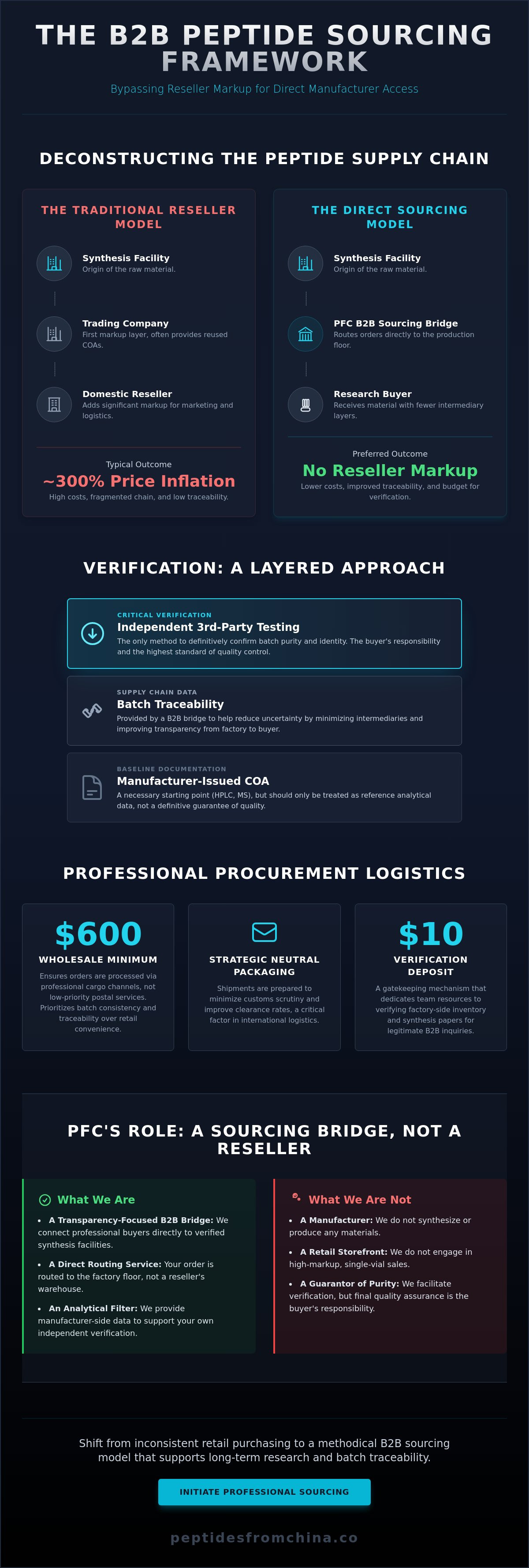
China remains the global epicenter for large-scale production, with the Chinese peptide market projected to reach $45 billion by 2026. For B2B buyers and research laboratories, the primary challenge isn't finding a supplier; it's identifying who actually controls the synthesis. Most brands encountered in Western markets are tertiary resellers that inflate costs by 300% or more while providing zero additional quality assurance. True peptide sourcing without reseller markup requires a framework that bypasses these trading layers and connects directly to the production floor.
Synthesis Facilities vs. Trading Companies
Real synthesis facilities invest heavily in the physical infrastructure required for high-purity peptide synthesis, including automated solid-phase reactors and preparative HPLC systems. Trading companies, by contrast, operate out of standard office buildings. They masquerade as manufacturers by using stock photos of labs and vague technical descriptions. You can often spot these resellers by their "all-in-one" product catalogs that include everything from peptides to lab glassware and industrial chemicals. A genuine manufacturer focuses on specific chemical classes. Peptides From China (PFC) acts as a transparency-focused bridge, routing orders directly to these specialized facilities rather than through the high-margin trading desks that dominate the search results.
The Economic Logic of Direct Procurement
Domestic resellers justify their markups by claiming to offer "guaranteed purity" and local warehousing. However, these claims often fall apart under scrutiny. Most resellers simply pass through the manufacturer's COA, which should only be viewed as a baseline reference document. By the time a vial reaches a domestic warehouse, it has passed through multiple hands, each adding a layer of cost and decreasing supply chain transparency. Bypassing these layers allows laboratories to reallocate budgets toward independent, third-party testing rather than paying for a reseller's marketing.
When you shift to a direct-to-manufacturer model, you're trading the convenience of single-vial retail sales for the operational efficiency of wholesale procurement. For example, Peptides From China maintains a $600 minimum order requirement to ensure that shipments are handled through professional cargo channels rather than low-priority postal services. This approach prioritizes batch consistency and traceability over the high-markup, low-transparency model of the retail "gray market." It's a shift from reactive buying to strategic procurement.
The Direct-to-Manufacturer Sourcing Model: How PFC Bridges the Gap
Traditional procurement often involves a complex web of intermediaries, each adding significant costs without improving the actual product. Peptides From China (PFC) functions as a transparency-focused B2B bridge designed to eliminate these layers. We don't operate as a manufacturer or a retail storefront; instead, we provide a direct routing service that connects professional buyers with verified synthesis facilities. This model enables peptide sourcing without reseller markup by removing the overhead of domestic warehousing and marketing expenses that typically inflate prices.
The Sourcing and Verification Fee
Unlike retail sites that prioritize volume, our workflow is built for serious procurement. We utilize a $10 processing deposit to initiate factory verification and stock checks. This isn't an additional cost; it's a gatekeeping mechanism that allows our team to dedicate resources to verifying factory-side inventory and synthesis papers for legitimate B2B inquiries. Once your order is finalized, this deposit is credited directly toward your final wholesale invoice. This step ensures that we focus on providing high-level technical support and manufacturer-issued documentation for compounds like Tirzepatide, Semaglutide, or BPC-157 without the distractions of retail-style inquiries.
Wholesale Procurement Standards
To access manufacturer-direct channels, buyers must adhere to wholesale thresholds. We maintain a strict $600 minimum order requirement for all transactions. This floor is necessary because synthesis facilities don't engage in single-vial distribution; their operations are geared toward bulk production and international cargo handling. When using our peptide sourcing platform, you aren't just buying a product; you're optimizing your entire supply chain for scale and traceability.
While we align with USP Peptide Standards for reference, we always emphasize that these documents are baseline technical material. Independent testing remains the only way to confirm product identity after international transit. If you're ready to move beyond retail markups and improve your supply chain transparency, you can explore our manufacturer-direct catalog to begin the verification process.
Verification Realities: Why a COA is Only the Beginning of Quality Control
Professional procurement requires moving past the superficial trust often placed in a PDF document. While peptide sourcing without reseller markup offers significant cost advantages, it doesn't remove the burden of verification from the buyer. Manufacturer-issued High-Performance Liquid Chromatography (HPLC) and Mass Spectrometry (MS) reports are industry standards, but they aren't definitive proof of batch identity or purity. In the gray market, "reused COAs," where one high-quality report is used for multiple subsequent synthesis batches, remain a persistent risk that can compromise research integrity.
Technical documentation should be treated as reference analytical data rather than absolute truth. Even with FDA guidance on synthetic peptide quality establishing clear benchmarks for purity and impurity profiles, manufacturer-side papers can be subject to batch substitution or relabeling. This is why professional buyers view these reports only as a baseline. The goal of direct sourcing isn't to find a vendor that promises "perfection," but to find one that provides the transparency needed for your own independent verification efforts.
Reading HPLC and MS Reports Like an Insider
Analyzing synthesis documentation requires a technical eye. You should look for baseline noise, the integration of peaks, and consistency between the HPLC purity percentage and the Mass Spectrometry molecular weight. Common red flags include inconsistent fonts, missing timestamps, or impurity peaks that appear to have been manually "cleaned" from the visual graph. If a report looks too polished or lacks specific batch identifiers, it's a signal to proceed with caution. No single document, regardless of how official it appears, can replace the security of independent, third-party analysis conducted after the material has cleared customs.
Reducing Supply Chain Uncertainty
Direct-to-manufacturer routing helps reduce supply chain uncertainty by improving batch traceability. When you remove the reseller, you minimize the number of intermediaries who handle the product, which significantly reduces the chance of intentional batch substitution or degradation due to poor storage. However, realistic sourcing practices always include a dedicated budget for independent testing. By capturing the savings from peptide sourcing without reseller markup, B2B buyers can reallocate those funds toward rigorous third-party verification. This approach ensures operational consistency and provides a grounded, data-driven foundation for long-term research planning.
Procurement Logistics: Navigating Minimums, Deposits, and Customs Clearance
Logistics is the stage where theoretical savings become operational reality. Establishing a robust framework for peptide sourcing without reseller markup requires a clear understanding of how specialized chemical compounds move across international borders. This process isn't as simple as a retail checkout; it involves a methodical sequence of verification, payment, and customs navigation designed to protect the integrity of the supply chain and the buyer's capital.
To improve the probability of successful customs clearance, we utilize neutral packaging strategies. This involves shipping lyophilized vials without retail branding, instead using standardized industrial identifiers that align with professional B2B chemical distribution. This approach helps reduce supply chain uncertainty and ensures that the focus remains on the technical content of the shipment rather than marketing aesthetics. Each order is assigned an international tracking number only after it clears the initial export processing center, allowing laboratories to coordinate their receipt protocols and independent testing schedules with precision.
Order Fulfillment and Payment Protocols
The procurement workflow starts with a $10 processing deposit. This deposit functions as a gatekeeping mechanism, allowing our team to dedicate resources to verifying current manufacturer-side stock and synthesis documentation for your specific inquiry. Once the material is confirmed and the batch papers are reviewed, we issue a final wholesale invoice. The initial $10 is credited directly toward this balance. Because synthesis facilities operate on a volume-based model, we maintain a strict $600 minimum order requirement. This threshold is necessary to move shipments through professional cargo channels, which offer better traceability and handling than standard low-value postal services.
Stability and Storage of Lyophilized Peptides
We route all orders as lyophilized powders because of their inherent stability during international transit. Freeze-drying the compounds allows them to withstand temperature fluctuations without the need for a continuous cold chain, which is often a point of failure during customs delays. Upon receipt, your laboratory should implement immediate storage protocols, typically refrigeration at 2 to 8 degrees Celsius for short-term use or deep-freeze storage for long-term preservation. For more detailed operational guidance on handling larger volumes, see our technical brief on bulk BPC-157 wholesale.
Ready to bypass the markups and standardize your procurement? Access our direct-to-manufacturer procurement portal to submit your first verification inquiry.
Building a Resilient Research Supply Chain with Peptides From China
Developing a resilient supply chain requires shifting from the sporadic, retail-style buying common in the research space toward professional procurement protocols. When you rely on domestic resellers, you're at the mercy of their inventory fluctuations and opaque sourcing decisions. By contrast, peptide sourcing without reseller markup allows your laboratory to build a direct relationship with the production source. Peptides From China (PFC) facilitates this transition by acting as your analytical filter and operational bridge, ensuring that your procurement strategy is based on batch traceability rather than marketing promises.
Our role as a sourcing bridge is to troubleshoot factory-side supply issues before they impact your laboratory timeline. If a synthesis facility reports a delay or a batch fails to meet the reference analytical data requirements, we manage the manufacturer-side communication to find a resolution. This methodical approach provides a level of operational consistency that isn't possible when buying through intermediaries. By eliminating the reseller, you gain transparency into the origin of your compounds and the ability to plan long-term research cycles with greater confidence.
Strategic Sourcing for Diverse Research Portfolios
A professional supply chain often involves consolidating multiple compounds into a single procurement cycle to maximize efficiency. Our model supports the simultaneous sourcing of metabolic research compounds like Tirzepatide, Semaglutide, and Retatrutide alongside regenerative peptides such as BPC-157 and TB-500. Laboratories focused on neurological studies can secure neuro-research compounds like Selank and Semax through the same verified channels. For high-volume needs, we facilitate direct routing for GHK-Cu, Epithalon, and IGF-1 LR3, ensuring that even large-scale requirements are met without the logistical friction of retail markups.
Next Steps: Initiating Your First Sourcing Request
Transitioning to a direct-to-manufacturer model starts with a formal verification request. Because we operate as a B2B bridge rather than a retail shop, we require a $10 processing deposit to initiate factory-side inventory checks and document verification. This deposit is fully credited toward your final wholesale invoice once the order is confirmed. You should prepare your procurement plan to meet the $600 minimum order threshold, which is the standard floor for accessing manufacturer-side pricing and professional cargo channels. This threshold ensures that your materials are handled with the care required for international research shipments. By following these protocols, you establish a direct line to verified synthesis facilities and take control of your laboratory's supply chain integrity.
Standardizing Your Professional Peptide Supply Chain
Shifting to a direct-to-manufacturer model is a strategic decision to prioritize batch traceability over retail convenience. By implementing a framework for peptide sourcing without reseller markup, your laboratory eliminates unnecessary financial layers and restores transparency to the procurement process. You've seen that manufacturer documentation serves only as reference analytical data; the true security of your supply chain depends on independent, third-party verification and a methodical approach to international logistics.
Professional procurement isn't about finding a perfect vendor, but about establishing a transparent B2B sourcing model that helps reduce supply chain uncertainty. With Peptides From China, you gain a dedicated bridge to verified synthesis facilities while maintaining the rigorous standards required for high-level research. If you're ready to bypass the markups and stabilize your long-term supply, you can initiate your manufacturer-direct sourcing request with a $10 deposit. Moving toward a $600 minimum wholesale floor ensures your materials are handled through professional cargo channels. It's time to take control of your research integrity with a grounded, data-driven sourcing strategy.
Frequently Asked Questions
How does Peptides From China verify manufacturing facilities?
We verify synthesis facilities by conducting technical reviews of their physical infrastructure and historical batch consistency. Our process involves identifying specific indicators of solid-phase peptide synthesis (SPPS) capabilities rather than relying on marketing claims. This methodical screening helps reduce supply chain uncertainty by ensuring your orders are routed to actual production floors rather than the high-margin trading desks that dominate the search results.
What is the significance of the $600 minimum order amount?
The $600 minimum order requirement is the operational floor necessary to access manufacturer-side pricing and professional cargo logistics. This threshold enables peptide sourcing without reseller markup because it allows shipments to move through B2B channels rather than low-priority, high-risk retail postal services. It standardizes the procurement process for laboratories that require batch consistency and improved traceability over small-scale retail purchases.
Is the $10 deposit refundable if the sourcing request is not met?
The $10 deposit is a non-refundable processing fee that covers the technical labor required to verify manufacturer-side stock and synthesis papers for your specific inquiry. However, this entire amount is credited directly toward your final wholesale invoice once the order is finalized. This gatekeeping mechanism ensures that our resources remain focused on providing high-level support for legitimate B2B procurement and professional research inquiries.
How do you handle customs clearance for international peptide shipments?
We utilize neutral packaging and standardized industrial identifiers to improve the probability of successful customs clearance for international orders. Our team manages the necessary export documentation and provides tracking data once the material clears the initial processing center. This methodical approach is designed to navigate the complexities of international trade while minimizing the risks associated with supply chain opacity and domestic reseller markups.
Why do you emphasize independent testing over provided COAs?
Independent testing is the only way to confirm product identity because manufacturer-issued COAs should only be viewed as baseline reference analytical data. In an industry where reused COAs and batch substitution are documented risks, no single document can fully guarantee purity or identity. We advocate for buyer-side testing as a critical final step in a transparency-first sourcing model to ensure the integrity of your research.
Do you provide cold-chain shipping for research peptides?
We do not provide cold-chain shipping because our products are routed as lyophilized powders. Freeze-dried compounds are inherently stable at room temperature during international transit, which eliminates the risk of degradation due to cold-chain failures during customs delays. Upon receipt, laboratories should implement their own standardized refrigeration or deep-freeze protocols to maintain long-term stability and ensure operational consistency for their research portfolios.
What is the difference between research-grade and human-grade peptides?
Can I order single vials for initial testing before a bulk purchase?
We don't offer single-vial sales or retail-style sampling because synthesis facilities are not equipped for small-scale distribution. Accessing manufacturer-direct pricing requires adhering to the $600 wholesale minimum order floor. Professional buyers seeking to verify a new source should plan their procurement around this threshold and include a dedicated budget for independent, third-party testing of the resulting batch to establish a grounded baseline for quality.