
A Certificate of Analysis is often marketed as the gold standard for verification, yet in the current market, it's frequently little more than a baseline technical reference that may not even belong to the batch you received. If you've encountered reused HPLC reports or batch substitutions by resellers, you're already aware that documentation alone doesn't ensure research peptide quality standards are met. The reality of international sourcing involves navigating supply chain opacity and variable synthesis quality that paperwork cannot always capture.
We understand that procurement professionals and researchers require more than just marketing fluff; you need a methodical approach to supply chain integrity. This 2026 guide provides a protocol to help you reduce uncertainty by moving closer to the point of manufacture. We'll cover the impact of the April 2026 FDA reclassifications for peptides like BPC-157 and TB-500, the implications of the July 2026 revised draft Product-Specific Guidances, and how Peptides From China (PFC) acts as a transparency-focused bridge for wholesale orders starting at $600. You'll learn how to implement independent verification steps that move beyond the limitations of manufacturer-issued papers to ensure consistent operational outcomes.
Key Takeaways
Learn why a 99% purity claim is technically incomplete without sequence confirmation and how to define research peptide quality standards beyond simple percentages.
Identify common documentation risks, such as template COAs and batch substitution, to better evaluate the reference analytical data provided by suppliers.
Discover how reducing reseller layers helps minimize supply chain uncertainty and improves the overall traceability of your peptide batches.
Establish a reliable verification protocol that combines visual inspection of lyophilized cakes with rigorous cross-referencing of HPLC and Mass Spectrometry data.
Understand how to leverage Peptides From China as a transparency-focused B2B bridge for manufacturer-side access with a minimum procurement threshold of $600.
Table of Contents
Defining Research Peptide Quality Standards in 2026
The Documentation Gap: Why COAs Aren't Definitive Proof
Operational Sourcing: Reducing Supply Chain Uncertainty
A Researcher’s Protocol for Verifying Peptide Integrity
Professional Sourcing with PFC: The Transparency-First Bridge
Defining Research Peptide Quality Standards in 2026
In 2026, the baseline for research peptide quality standards has shifted from simple purity percentages to comprehensive identity verification. A 99% purity claim, frequently cited by retail resellers, is functionally meaningless if the molecular sequence hasn't been confirmed through primary data. High-purity impurities, such as truncated sequences or isomers, can bypass basic testing while compromising research results. These nuances are why professional buyers now demand raw spectra rather than just summarized tables. This shift follows the April 2026 FDA reclassification of several peptides, which has increased the demand for transparency in the compounding and research sectors.
Understanding the difference between research-grade and cGMP synthesis is critical for procurement. While cGMP environments require rigorous validation of every step, research-grade facilities focus on high-throughput Chemical peptide synthesis that meets specific analytical thresholds. Lyophilization plays a vital role in this chain. This freeze-drying process ensures the structural integrity of the peptide cake during global transit, preventing degradation before the vial reaches the lab. For those sourcing through Peptides From China, this direct access to manufacturer-side synthesis helps maintain these standards for wholesale orders starting at $600. It bypasses the reseller layers that often obscure the original synthesis conditions.
Purity Metrics and Functional Identity
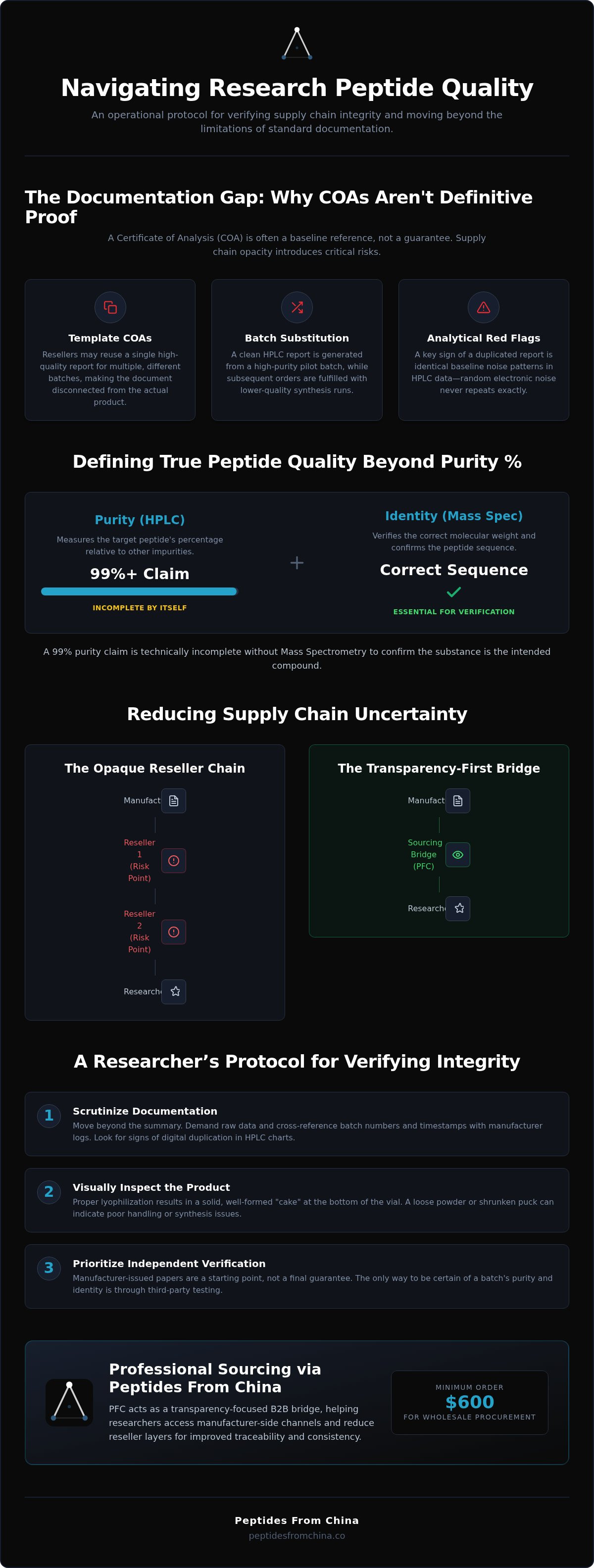
HPLC (High-Performance Liquid Chromatography) measures the relative amount of the target peptide compared to other UV-absorbing impurities. It doesn't, however, confirm that the substance is actually the intended compound. Mass Spectrometry (MS) is required to verify the molecular weight and ensure the peptide sequence is correct. Without MS data, a batch of BPC-157 could technically be another peptide with a similar retention time. In the context of research-grade compounds, peptide purity is defined as the percentage of the target peptide relative to the total peptide content in the sample, excluding moisture and counter-ions.
The Impact of Residual Solvents and Counter-Ions
Synthesis often leaves behind residual TFA (Trifluoroacetic acid), which is a common solvent that can influence cellular assays or research outcomes if levels are too high. Choosing between Acetate and Hydrochloride salts is an operational decision based on required solubility and the specific biological model being used. For example, some researchers prefer acetate salts to avoid the potential toxicity of TFA or the acidity of HCl. Standard thresholds for bulk batches typically aim for moisture content below 5% and residual solvents under 0.5% to ensure long-term stability. Managing these variables is essential for establishing reliable research peptide quality standards across different batches and ensuring that the analytical data matches the physical product.
The Documentation Gap: Why COAs Aren't Definitive Proof
A Certificate of Analysis (COA) is often viewed as a definitive guarantee, but in the current global market, it frequently functions as a marketing tool rather than a validation of research peptide quality standards. Resellers often operate with high-volume inventories where documentation becomes disconnected from the physical product. This leads to the "template COA" phenomenon, where a single high-quality report is used for multiple batches over several months. If the documentation provided doesn't include a specific, verifiable timestamp and batch number that correlates with the manufacturer's internal logs, its utility is significantly diminished.
Batch substitution represents a critical failure point in the supply chain. A reseller might source a high-purity pilot batch to generate a clean HPLC report, then fulfill subsequent orders with lower-quality synthesis runs. This practice exploits the fact that most buyers don't perform their own verification until a research project fails. Identifying red flags in an HPLC chromatogram requires a technical eye; look for identical baseline noise patterns across different reports. In genuine analytical chemistry, random electronic noise never repeats exactly; if it does, the graphic has been digitally duplicated.
Identifying Reused or Forged Reports
Forgery in documentation has become more sophisticated, but certain indicators remain constant. Inconsistent font styles, mismatched dates between the synthesis and the test, or the absence of manufacturer-side traceability codes are immediate warning signs. Professional procurement requires cross-referencing these documents against best practices in peptide reference standards, which emphasize that a single piece of paper cannot replace a transparent chain of custody. Digital verification and direct manufacturer-side codes are increasingly necessary to confirm that the data hasn't been altered by an intermediary.
The Necessity of Independent Third-Party Testing
Because manufacturer-issued papers are only baseline technical reference materials, independent verification is the only way to confirm a batch's integrity. Blind analysis, where the lab doesn't know the expected result, provides the most objective data. We view peptide testing as a mandatory operational step for any high-volume procurement strategy. It’s the only method that effectively counters the risk of batch substitution and ensures that your internal research peptide quality standards are maintained. If you're looking to simplify this process, sourcing through a transparency-focused bridge like PFC, which facilitates wholesale orders starting at $600, helps you move closer to the manufacturer and reduces the number of hands that touch the documentation.
Operational Sourcing: Reducing Supply Chain Uncertainty
Reducing supply chain uncertainty requires a shift from retail convenience to operational control. While many domestic resellers offer the allure of fast shipping through local warehousing, this model often obscures the original synthesis facility. Every additional layer between the lab and the manufacturer increases the risk of relabeling, batch substitution, and price inflation. For professional procurement, the priority is maintaining research peptide quality standards through direct oversight rather than relying on a reseller's unverified storage conditions. Intermediaries don't just add cost; they add blind spots that can compromise the integrity of a study.
Sourcing wholesale peptides directly from synthesis facilities allows researchers to secure larger quantities from a single production run. This is economically logical for longitudinal studies where batch-to-batch variation must be minimized to ensure data validity. Navigating the international logistics of such orders involves managing neutral packaging and tracking protocols that ensure the compounds remain stable and discrete during transit. By moving closer to the source, you eliminate the variable quality often found in the domestic secondary market.
Direct Sourcing vs. Reseller Layers
The choice between a peptide sourcing agent vs platform fundamentally dictates your chain of custody. Platforms often act as automated marketplaces with little technical vetting, whereas a transparency-focused bridge like Peptides From China (PFC) provides a direct route to verified facilities. This directness helps mitigate the risk of "white-labeling," where a product is rebranded multiple times, making it impossible to trace its origin if a quality issue arises. Adhering to regulatory considerations for peptide quality means acknowledging that domestic warehousing doesn't guarantee stability; only a transparent manufacturing history does.
Batch Traceability and Synthesis Logs
True traceability isn't found on a retail website; it's found in synthesis logs. These logs provide a timeline of production, detailing the specific reagents and conditions used for a specific run. When sourcing via PFC, where the minimum procurement threshold is $600, buyers gain access to manufacturer-side data that resellers typically withhold. This level of detail supports independent verification and ensures that multi-vial orders maintain high consistency. By reducing the number of intermediaries, you naturally improve the reliability of your research peptide quality standards and decrease the operational friction inherent in international sourcing.
A Researcher’s Protocol for Verifying Peptide Integrity
Establishing a rigorous internal protocol is the only way to ensure that research peptide quality standards are maintained throughout your procurement cycle. Relying solely on manufacturer documentation is an operational risk. A structured five-step verification process allows you to identify batch inconsistencies before they compromise your data. This protocol moves from basic physical observations to advanced analytical confirmation, ensuring that the material in the vial matches the reference spectra provided by the synthesis facility.
The first step involves a visual inspection of the lyophilized cake. A high-quality freeze-drying process results in a uniform, stable cake that doesn't appear collapsed or "shrunken" against the vial walls. Discoloration, such as yellowing or spotting, often suggests the presence of residual solvents or synthesis byproducts. Once physical consistency is confirmed, you must cross-reference the provided HPLC and Mass Spectrometry data against known standard spectra for that specific peptide. Any significant deviation in the primary peak or the presence of unexpected secondary peaks warrants further investigation through independent testing of a random sample from the batch.
Physical Inspection of Lyophilized Compounds
Cake consistency provides immediate insight into the manufacturer's operational standards. A collapsed or "melted" cake usually indicates poor moisture control during the lyophilization cycle, which can lead to rapid degradation during storage. You should also check for particulates or "floaters" that remain after reconstitution. To perform a basic solubility test as a preliminary check, add a sterile diluent and observe the time to clear solution; any persistent cloudiness or precipitation suggests potential contamination or an incorrect salt form that could skew your research results.
Advanced Analytical Verification
For high-stakes studies, basic HPLC isn't enough. Utilizing Nuclear Magnetic Resonance (NMR) provides high-level structural confirmation that simple chromatography cannot offer. Additionally, Amino Acid Analysis (AAA) is essential for determining the exact peptide concentration within a vial, as the total weight often includes moisture and counter-ions. Managing the costs of these tests is a matter of batch sizing. By sourcing larger quantities through a B2B sourcing bridge like PFC, where wholesale orders start at $600, you can spread the cost of a single independent test across hundreds of vials. This approach makes advanced verification financially viable while reinforcing your research peptide quality standards. Finally, document these metrics in your longitudinal research logs to track batch performance over time and identify subtle shifts in synthesis quality.
Professional Sourcing with PFC: The Transparency-First Bridge
Peptides From China (PFC) operates as a dedicated B2B sourcing bridge, specifically designed to connect professional laboratories with verified synthesis facilities. Unlike retail resellers that prioritize volume and marketing, PFC focuses on operational transparency and the reduction of supply chain layers. This approach is essential for maintaining research peptide quality standards, as it allows procurement officers to bypass the opacity of the secondary market. By enforcing a $600 minimum order requirement, we ensure that our resources are focused on professional-grade fulfillment rather than high-turnover retail transactions.
We prioritize factual accuracy over the hyperbolic marketing hype common in the peptide industry. We don't offer pharmaceutical-grade guarantees; instead, we provide a methodical route to manufacturer-side analytical data. This allows your team to perform the necessary independent verification steps described earlier in this guide. Our role is to act as an analytical filter, helping you navigate the complexities of international logistics while providing the baseline documentation required for a professional chain of custody. This transparency-first positioning helps you establish a more reliable research peptide quality standards protocol within your own organization.
Direct Manufacturer Sourcing Protocols
Eliminating the reseller mark-up is only one part of the value proposition. The primary benefit of direct-to-manufacturer routing is the mitigation of relabeling risks and batch substitution. When you source through PFC, you gain access to COA-verified batches for high-demand compounds such as bulk BPC-157 wholesale. This direct channel ensures that the reference analytical data you receive comes straight from the synthesis facility rather than being filtered through a third-party reseller. Similar protocols apply when procuring TB-500 peptide, where maintaining batch-to-batch consistency is critical for research success.
Managing Wholesale Logistics and Security
Scaling your research operations requires a logistics partner that understands the nuances of international transit. PFC utilizes neutral packaging and provides global tracking to ensure that your materials arrive securely and discretely. The process begins with a $10 processing deposit, which initiates the verification of current batch availability and documentation. This step ensures that we only move forward with orders that meet our strict transparency criteria. By utilizing a professional peptide sourcing platform, you can manage large-scale synthesis requirements with a higher degree of operational consistency and a significant reduction in supply chain blind spots.
Implementing a Transparency-First Procurement Strategy
Navigating the global market in 2026 requires moving beyond the "template COA" and adopting a direct-to-manufacturer approach. By establishing a rigorous internal verification protocol and reducing the number of intermediaries, labs can significantly improve batch traceability and data reliability. Maintaining high research peptide quality standards is no longer just about reading a report; it's about controlling the source and acknowledging that documentation is a baseline technical reference rather than definitive proof of purity.
Reducing supply chain uncertainty is an operational necessity for large-scale studies. You can Access Direct-to-Manufacturer Peptide Sourcing at Peptides From China to secure B2B-focused procurement with transparent manufacturer-side pricing. This model helps eliminate reseller mark-ups and relabeling while providing the batch traceability required by professional research labs for wholesale orders of $600 or more. Transitioning to a more direct supply chain helps you navigate industry complexities with a methodical, data-driven perspective that prioritizes factual integrity over marketing flair.
Frequently Asked Questions
What is the industry standard for research peptide purity?
The baseline standard for research-grade peptides is typically 98% purity as measured by HPLC. However, purity alone is insufficient for establishing comprehensive research peptide quality standards. You must also confirm the peptide sequence through Mass Spectrometry to ensure the compound's identity matches the intended research target. High purity is meaningless if the molecular weight is incorrect or if the batch contains truncated sequences that bypass basic UV detection.
How can I tell if an HPLC report has been reused or templated?
Reused reports often display identical baseline noise patterns; this is statistically impossible in real-world analytical chemistry. Check for mismatched timestamps between the synthesis date and the testing date. If the batch number on the vial doesn't correlate with the manufacturer's internal logs, the documentation is likely a template. Professional procurement requires cross-referencing these reports with independent lab data to ensure the paperwork accurately reflects the physical product.
Why is Mass Spectrometry essential for peptide verification?
Mass Spectrometry (MS) provides the molecular weight of the compound, confirming that the synthesized peptide has the correct sequence of amino acids. While HPLC measures relative purity, it cannot distinguish between the target peptide and a different compound with a similar retention time. MS is the only way to verify that you've received the specific peptide you ordered. It serves as a critical identity check that chromatography alone cannot provide.
What is the difference between acetate and TFA salt versions of a peptide?
TFA is the default salt used during the purification process, but it can be toxic in certain cellular assays. Acetate salts are often preferred for research requiring higher biocompatibility or specific solubility profiles. The choice of counter-ion impacts the peptide's behavior in sterile diluents and its overall stability. You should select the salt form based on your specific research model and the required pH level of the final solution.
Can I rely solely on manufacturer-provided COAs for my research?
You shouldn't rely on manufacturer-provided papers as definitive proof of quality. These documents are baseline technical reference materials that help reduce supply chain uncertainty, but they don't guarantee batch-to-vial consistency. Independent third-party testing is the only way to confirm the identity and purity of a specific batch. Professional labs treat a COA as a starting point for their own internal verification protocols rather than a final guarantee.
What are the most common contaminants found in low-quality peptide batches?
Common contaminants include residual solvents like TFA, excessive moisture content, and truncated sequences that occur during incomplete synthesis runs. Improper lyophilization can also lead to collapsed cakes and rapid degradation. These impurities can skew research results or lead to inconsistent data across study groups. High research peptide quality standards require monitoring for these variables through visual inspection and advanced analytical testing like Amino Acid Analysis to determine exact concentration.
Why does Peptides From China have a $600 minimum order requirement?
Peptides From China maintains a $600 minimum order threshold to focus on professional B2B sourcing rather than retail transactions. This requirement ensures that our logistics and synthesis resources are dedicated to researchers and laboratories requiring wholesale quantities. It allows us to provide manufacturer-side pricing and improved batch traceability. By focusing on larger orders, we maintain the operational efficiency necessary to act as a transparency-focused bridge for professional procurement.
How do I conduct independent third-party testing on my sourced peptides?
Send a random sample from your batch to an accredited analytical laboratory specializing in peptide analysis. Request a blind analysis for purity via HPLC and identity via Mass Spectrometry to ensure objectivity. Providing the lab with the expected molecular weight helps them verify the compound more accurately. This step is mandatory for high-volume procurement to ensure that the material meets your requirements before research begins.