
Most buyers believe a PDF certificate of analysis is a total guarantee of quality; however, in the high-volume peptide market, it's often just a piece of paper that masks a fragmented supply chain. When you're looking for epithalon wholesale, the reality is that domestic resellers often provide little more than a new label and a significant markup. You've likely experienced the frustration of batch-to-batch variability and the total inability to track a product back to its original synthesis facility. We understand that in a professional B2B environment, trust is built through technical verification rather than marketing claims.
This guide provides an operational deep-dive into establishing a transparent chain of custody and accessing manufacturer-side pricing. You'll learn how to navigate the implications of the April 15, 2026, FDA regulatory updates and the upcoming July PCAC review. We'll also explain how Peptides From China (PFC) functions as a transparency-focused sourcing bridge for professional buyers who meet the $600 wholesale minimum. By the end of this article, you'll have a methodical framework for evaluating synthesis standards beyond basic HPLC reports and reducing your price-per-mg through direct manufacturer channels.
Key Takeaways
Identify the chemical markers of Epithalon (Ala-Glu-Asp-Gly) and the role of solid-phase peptide synthesis in maintaining high-purity output for research.
Navigate the complexities of epithalon wholesale procurement by recognizing how reseller layers and batch substitution can impact both cost and material consistency.
Use HPLC and Mass Spectrometry data as baseline reference material to verify molecular weight and purity while maintaining independent testing protocols.
Access manufacturer-side supply channels via Peptides From China (PFC) to improve traceability for high-volume orders meeting the $600 minimum requirement.
Table of Contents
Understanding Epithalon (Ala-Glu-Asp-Gly) in Modern Research
Synthesis Standards for Wholesale Epithalon Batches
Supply Chain Risks in the Wholesale Peptide Market
Verification Frameworks for High-Volume Procurement
Strategic Procurement: Sourcing Epithalon Wholesale via PFC
Understanding Epithalon (Ala-Glu-Asp-Gly) in Modern Research
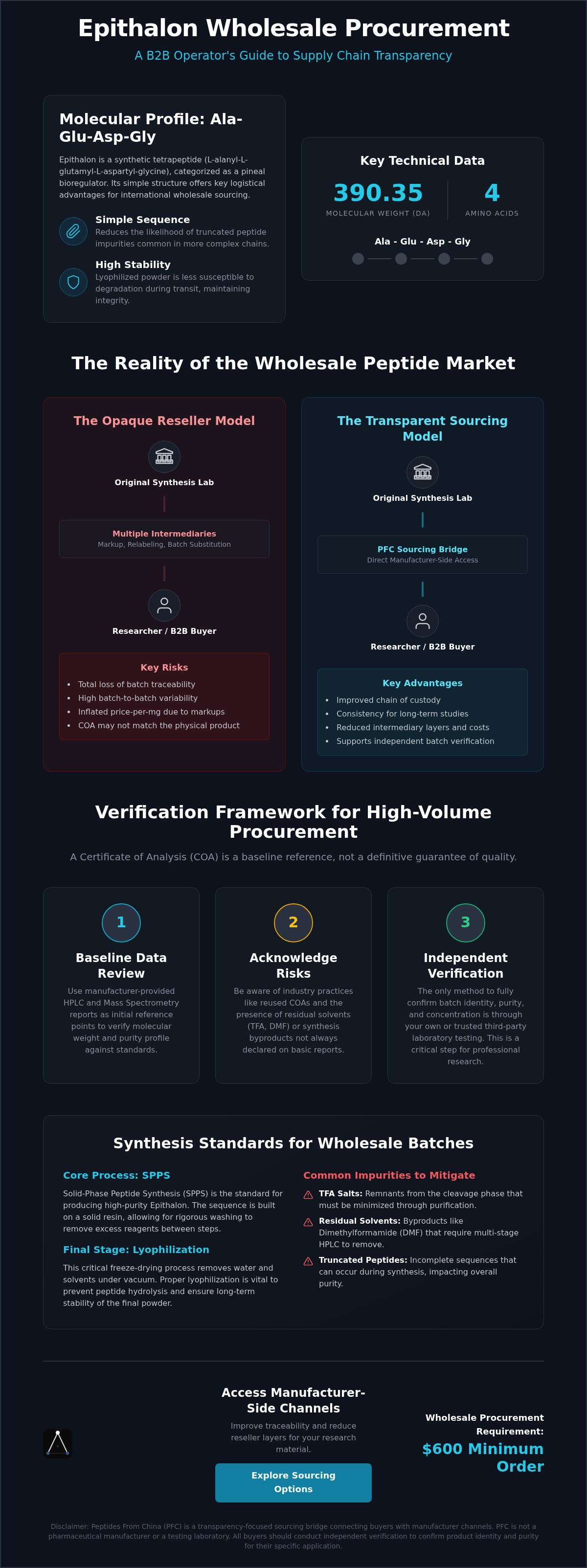
Epithalon (Ala-Glu-Asp-Gly) is a synthetic tetrapeptide consisting of L-alanyl-L-glutamyl-L-aspartyl-glycine. Within the B2B research sector, it's categorized as a pineal gland bioregulator and a telomerase activator. Procurement professionals often focus on epithalon wholesale sourcing to support long-term studies on cellular senescence, DNA methylation, and circadian rhythm regulation. The peptide's structural simplicity offers a significant logistical edge. Its short chain ensures high stability during international transit, making it less susceptible to the degradation risks common with more complex sequences. This stability is a primary reason why it's favored for international manufacturer-side procurement.
The Molecular Profile of Ala-Glu-Asp-Gly
With a molecular weight of 390.35 Da, Epithalon is one of the more straightforward peptides to produce via solid-phase peptide synthesis (SPPS). This sequence simplicity reduces the likelihood of truncated peptide impurities, which are a common flaw in longer peptide chains. While this simplicity helps reduce supply chain uncertainty, buyers must still analyze reference analytical data for residual solvents or TFA salts. The lyophilized powder remains stable across various environmental conditions. This durability is a key reason why it's a staple in manufacturer-side supply channels, as it maintains integrity without the extreme temperature sensitivity of larger proteins.
Research Applications and Synergies
Epithalon is a primary candidate in large-scale longevity research, where it's often compared against other bioregulators to measure its effect on biological aging markers. Some laboratories investigate synergistic protocols, such as pairing it with bulk BPC-157 wholesale to study tissue regeneration and systemic homeostasis. Professional researchers prioritize high-volume batch procurement to avoid the data noise caused by batch-to-batch variability. Accessing these batches through a transparency-focused bridge like Peptides From China, which requires a $600 minimum order for wholesale procurement, helps ensure that the material used in month one matches the material used in month twelve. This approach supports independent verification and provides the consistency needed for high-level technical reporting. By reducing the number of reseller layers, labs can better track the chain of custody for their specific synthesis run.
Synthesis Standards for Wholesale Epithalon Batches
Achieving a high-purity output for epithalon wholesale orders requires a methodical adherence to Solid-Phase Peptide Synthesis (SPPS). This process involves assembling the tetrapeptide sequence on a solid resin support, allowing for rigorous washing between amino acid additions. While SPPS is efficient, it inherently introduces specific byproducts that must be managed. Trifluoroacetic acid (TFA) salts and residual solvents like dimethylformamide (DMF) are common residues from the cleavage and synthesis phases. Professional procurement requires a deep-dive into how these impurities are mitigated. Multi-stage purification, typically via preparative High-Performance Liquid Chromatography (HPLC), is the only way to reach the research-grade benchmarks required for sensitive bio-assays.
The final stage of production is lyophilization. This freeze-drying process removes water and solvents under vacuum, resulting in a stable powder. Proper lyophilization is vital because residual moisture can lead to peptide hydrolysis, effectively ruining a high-volume order before it reaches the lab. If you're concerned about the technical nuances of these processes, you can explore manufacturer-side sourcing options that prioritize batch-specific transparency. Accessing manufacturer-side sourcing through PFC requires a $600 minimum, but it helps ensure that you're receiving material from a single, documented synthesis run.
Quality Control in Large-Scale Synthesis
Maintaining consistency across large-scale synthesis runs is a logistical challenge. As batch sizes increase, the risk of sequence truncation or uneven reaction rates grows. Buyers shouldn't accept a generic or representative Certificate of Analysis. Every individual batch must be accompanied by its own HPLC and Mass Spectrometry report. We often see GMP-compliant labels used as a marketing shield, but in the peptide gray market, these claims are often unsubstantiated. Without a third-party audit or a transparent chain of custody, such labels offer little protection against the public health risks of unapproved peptides that lack rigorous oversight. Verification must be active, not passive.
Storage and Handling for Research Institutions
For research institutions managing epithalon wholesale inventory, storage protocols are non-negotiable. To maintain a purity level of ≥99% over a 24-month period, lyophilized vials should be stored at -20°C. While Epithalon is more stable than many longer-chain peptides, it remains sensitive to light and moisture. Reconstitution should only occur immediately before use, utilizing sterile, buffered solutions to prevent rapid degradation. When handling high-throughput screening, laboratories must account for the impact of repeated freeze-thaw cycles on the Ala-Glu-Asp-Gly sequence. Maintaining a dry, dark environment is the best way to ensure that your reference analytical data remains accurate throughout the duration of your study.
Supply Chain Risks in the Wholesale Peptide Market
The global supply chain for research peptides is notoriously opaque, often characterized by a series of intermediaries that obscure a product's origin. When procuring epithalon wholesale, the primary risk isn't just the price markup; it's the dilution of technical accountability. Resellers frequently purchase in bulk from various synthesis facilities, consolidate the stock, and relabel it under a domestic brand. This process adds significant cost without providing technical value or additional quality control. It also creates a relabeling trap where the buyer cannot verify the original manufacturing source, making it impossible to address synthesis flaws at the root.
Batch substitution is another prevalent issue in high-volume orders. Suppliers may mix newer synthesis runs with older, degraded stock to clear inventory. This variability is often masked by documentation fraud. Reused or digitally altered HPLC reports are common in the industry, where a single clean report is used to represent multiple distinct batches. Professional buyers must understand that a COA is merely reference analytical data and not definitive proof of a specific vial's contents. Relying solely on supplier-provided papers without a plan for independent verification is an operational vulnerability.
Evaluating Sourcing Agents vs. Direct Platforms
Choosing between a peptide sourcing agent vs platform is a critical decision for B2B procurement. Traditional sourcing agents often operate on commission and may prioritize suppliers with the highest margins rather than those with the best synthesis standards. In contrast, a transparency-focused platform provides direct manufacturer-side batch numbers and shipping logs. Transparency regarding the synthesis facility is non-negotiable for labs that require consistent signaling results. Red flags include a supplier's refusal to disclose manufacturing dates or provide verifiable tracking that originates from the production region.
Reducing Supply Chain Uncertainty
Direct-to-manufacturer routing helps reduce supply chain uncertainty by minimizing the number of hand-offs between production and the laboratory. Every additional intermediary increases the risk of mishandling, temperature excursions, or intentional batch tampering. PFC prioritizes these direct manufacturer-side channels over domestic warehousing because it preserves the chain of custody. By facilitating a direct bridge, we ensure that the epithalon wholesale material arrives in neutral packaging with tracked international logistics. This methodical approach requires a $600 minimum order, but it provides the operational consistency that sophisticated researchers demand. It supports independent verification by ensuring the buyer knows exactly which facility produced their material.
Verification Frameworks for High-Volume Procurement
High-volume procurement requires a transition from retail-style trust to a verification-heavy framework. Baseline documentation for any epithalon wholesale order must include HPLC chromatograms and Mass Spectrometry. HPLC provides a visual profile of the peptide's purity, while Mass Spectrometry confirms the molecular weight of 390.35 Da, ensuring the batch is indeed Ala-Glu-Asp-Gly. However, a significant documentation gap exists in the current market. A supplier-issued COA should be viewed as reference analytical data rather than absolute proof of identity. In an industry where reports are often reused across different synthesis runs, the only way to establish a reliable chain of custody is to track the material from the synthesis reactor to the final analytical lab.
Relying on a static image on a website is an operational risk that can compromise months of research. Professional buyers recognize that one clean report doesn't guarantee the quality of 1,000 vials. To mitigate this, we facilitate a direct bridge to manufacturer-side channels, allowing researchers to access the primary data associated with their specific synthesis run. This model supports independent verification by providing the transparency needed to audit the supply chain effectively and reduce the risks associated with batch substitution.
Independent Testing Protocols for Labs
For research institutions, peptide testing conducted by the buyer is the only definitive quality check. Standard SOPs for large orders involve random batch sampling, particularly for shipments exceeding 100 vials. Labs must develop their own internal benchmarks for purity, concentration, and sequence identity. This internal data acts as a protective filter, ensuring that the material used in high-throughput screening remains consistent with the original study parameters. This level of diligence is what separates professional procurement from speculative purchasing.
Analyzing Analytical Reports
Spotting fraudulent documentation is a critical part of the verification process. Procurement officers should look for "recycled" HPLC reports, which often contain date mismatches or digital artifacts within the PDF. Verifying the main peak area against the integration table is the only way to determine true purity from the chromatogram. Beyond HPLC, nitrogen analysis serves as a secondary check for peptide concentration. This helps confirm that the mass of the peptide in the vial matches the label, preventing issues with under-dosed research materials. To access these manufacturer-side channels and reduce reseller layers, you can start your procurement process through the PFC bridge with a $600 minimum order.
Strategic Procurement: Sourcing Epithalon Wholesale via PFC
Domestic resellers often purchase from the same synthesis facilities but apply significant premiums to cover their own overhead and marketing. For epithalon wholesale, these markups can drain a research budget without providing any additional technical security. Peptides From China (PFC) functions as a transparency-focused B2B sourcing bridge. We help professional buyers bypass these reseller layers to access manufacturer-side pricing and direct data. Our operational model requires a $600 minimum order. This minimum isn't arbitrary; it represents the threshold where the efficiencies of direct international logistics begin to outweigh the costs of domestic sourcing.
To start the process, we use a $10 processing deposit. This fee triggers a direct manufacturer stock verification. It's a methodical way to ensure that the batch meeting your specific requirements is currently in the synthesis facility's inventory. This step helps reduce supply chain uncertainty by confirming the material's existence before you commit to a full purchase. It acts as a protective filter against the common industry practice of selling "ghost stock" that doesn't actually exist in a reseller's local warehouse. We prioritize factual verification over speculative sales tactics.
The PFC B2B Sourcing Flow
Navigating the peptides production landscape requires an insider's understanding of facility-side operations. The PFC sourcing flow begins with a manufacturer audit. We evaluate the facility's technical compliance and their ability to produce consistent batches of the Ala-Glu-Asp-Gly sequence. This process ensures batch traceability for laboratories conducting multi-year studies. When you source through this direct channel, you improve the likelihood that the material used in the final phase of research matches the material used at the start. This consistency is essential for maintaining the integrity of your signaling results and technical reporting.
Maximizing Procurement Efficiency
Large-scale international orders for wholesale peptides require a sophisticated approach to logistics. PFC manages the complexities of shipping and customs clearance, utilizing neutral packaging and tracked routes to minimize the risk of interception or degradation. By auditing Chinese synthesis facilities and facilitating direct manufacturer relationships, we help researchers access high-volume epithalon wholesale batches without the typical reseller delays. This strategy doesn't just lower the price-per-mg; it provides a transparent chain of custody that supports independent verification at the laboratory level. Strategic procurement means moving beyond retail trust and establishing a direct, data-driven supply line.
Transitioning to a Data-Driven Sourcing Model
Procuring epithalon wholesale shouldn't be a matter of faith in domestic reseller branding. It requires a methodical approach that prioritizes batch traceability and direct access to synthesis data. The peptide industry's inherent lack of transparency often leads to risks like batch substitution and documentation fraud. By shifting your procurement strategy toward manufacturer-side channels, you significantly reduce supply chain uncertainty and help ensure your research is supported by consistent material. Relying on baseline technical reference material is just the first step; the ultimate goal is a transparent chain of custody.
Peptides From China (PFC) serves as a strategic bridge in this transition. We help you bypass the intermediary problem by offering direct manufacturer-side batch verification and the elimination of unnecessary reseller markups. For professional orders meeting our $600 minimum, we provide a pathway to COA-verified batch traceability directly from the synthesis facility. You don't have to navigate these logistical complexities alone.
Secure Direct-to-Manufacturer Wholesale Epithalon Pricing today to optimize your research budget and improve your supply chain integrity. Establishing a reliable, direct relationship with production facilities is the most effective way to ensure long-term operational consistency.
Frequently Asked Questions
What is the exact peptide sequence for Epithalon?
Epithalon is a synthetic tetrapeptide with the amino acid sequence L-alanyl-L-glutamyl-L-aspartyl-glycine (Ala-Glu-Asp-Gly). This specific sequence is critical for research involving pineal gland bioregulation and telomerase activation. Wholesale buyers must confirm the sequence identity via Mass Spectrometry. This verification helps reduce the risk of receiving truncated or incorrect sequences that often occur in lower-tier manufacturing runs.
Why is there such a large price gap between retail and wholesale Epithalon?
Retail pricing for peptides typically includes markups of 500% to 1000% to account for domestic warehousing, marketing, and the overhead of single-vial sales. Procuring epithalon wholesale direct from the manufacturer eliminates these intermediary layers. Peptides From China facilitates this direct connection, requiring a $600 minimum to ensure the economic viability of manufacturer-side price points for research institutions.
How can I verify the purity of a bulk Epithalon order?
Buyer-led independent testing of random batch samples is the only way to definitively verify purity. While manufacturer-provided HPLC and Mass Spectrometry reports are necessary, they serve only as baseline technical references. PFC recommends that procurement professionals conduct their own laboratory analysis to ensure the delivered vials match the reference analytical data provided during the initial sourcing phase.
Is Epithalon stable for international shipping from China?
Epithalon is inherently stable during international transit because of its short tetrapeptide structure. In its lyophilized state, it can withstand room-temperature shipping for several weeks without significant degradation of the Ala-Glu-Asp-Gly sequence. For long-term laboratory storage, however, institutes should maintain temperatures of -20°C to preserve maximum sequence integrity over 24 months or more.
What are the risks of buying "USA-made" peptides from resellers?
"USA-made" labels often mask the fact that raw peptide synthesis occurred in China, with only the final vial filling or labeling performed domestically. Sourcing through PFC provides transparency regarding the original synthesis origin. This improves traceability and allows researchers to audit the actual production facility's standards rather than relying on a domestic reseller’s branding and potentially reused documentation.
What is the minimum order for Epithalon wholesale through PFC?
Peptides From China requires a $600 minimum order for all epithalon wholesale procurement. This threshold supports the logistics of tracked international shipping and the rigorous manufacturer-side documentation checks we perform. A $10 processing deposit initiates the sourcing process and ensures the specific batch meets your technical requirements before the final procurement is finalized.