
Relying on a domestic reseller’s "verified" HPLC report is often the quickest way to compromise the integrity of your research supply chain. If you are managing a laboratory or a professional procurement desk, you already know that the secondary market is saturated with reused COAs and significant price markups that rarely reflect actual synthesis costs. For those seeking Thymosin Alpha-1 wholesale channels, the challenge isn't just finding a supplier; it's managing the opacity of international logistics and the variable consistency of batch-to-batch production.
We agree that the traditional middleman model is broken, often offering little more than a domestic label on an unverified product. This guide provides a technical roadmap for direct-to-manufacturer sourcing, focusing on operational realities rather than marketing hype. You'll learn how to implement independent verification protocols and leverage the Peptides From China (PFC) $600 minimum order threshold to secure transparent pricing. We also preview the logistics of the $10 deposit system and how the 2026 FDA reclassification of Thymosin Alpha-1 into Category 1 has shifted the regulatory landscape for professional buyers. Transparency is the only hedge against supply chain risk.
Key Takeaways
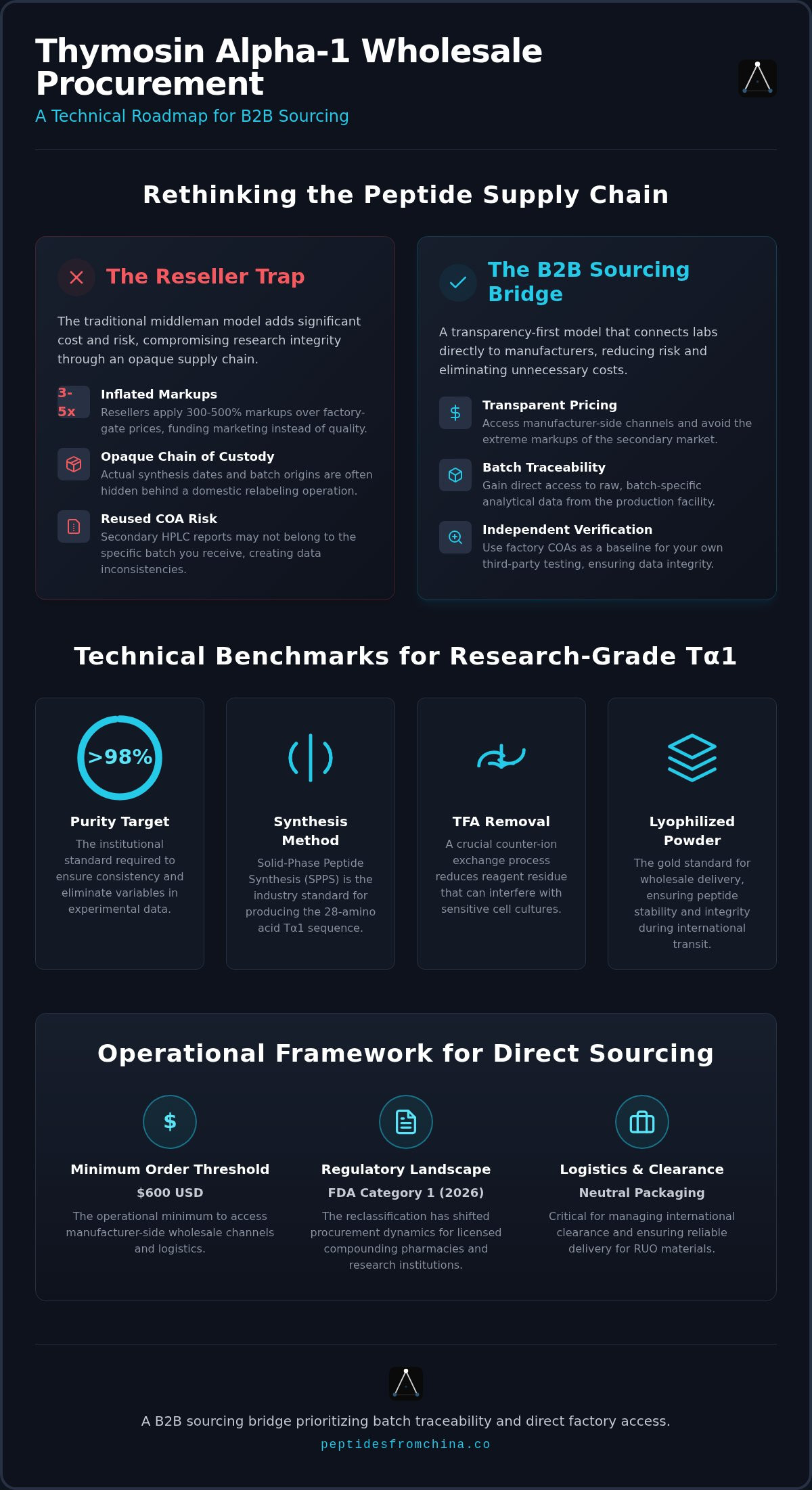
Establish a technical baseline by understanding why Solid-Phase Peptide Synthesis (SPPS) and a 98% purity target are critical for research consistency.
Optimize your procurement strategy for Thymosin Alpha-1 wholesale by accessing manufacturer-side channels that eliminate unnecessary reseller markups.
Protect your laboratory from the "COA Trap" by learning how to identify reused documentation and implementing independent verification protocols.
Manage operational logistics effectively with an understanding of the $600 minimum order requirements and the role of neutral packaging in international clearance.
Reduce supply chain uncertainty by utilizing a B2B sourcing bridge that prioritizes batch traceability and direct factory access over superficial marketing.
Table of Contents
The Landscape of Thymosin Alpha-1 Wholesale Sourcing in 2026
Synthesis Standards and Analytical Markers for Bulk Tα1
Evaluating Manufacturer-Direct Channels in the Chinese Market
Operational Logistics: Managing Bulk Sourcing and Payments
The PFC Sourcing Model: Transparency-First Procurement for Labs
The Landscape of Thymosin Alpha-1 Wholesale Sourcing in 2026
The peptide Thymosin α1 (Tα1) is a 28-amino acid sequence that plays a critical role in modulating T-cell function and cytokine production. In a professional B2B context, procurement of this compound has changed significantly. While the retail market remains focused on individual vials for small-scale use, 2026 has seen a decisive shift toward institutional procurement. High-volume laboratories and research facilities are increasingly bypassing domestic retailers in favor of Thymosin Alpha-1 wholesale channels. This shift is driven by the need for batch consistency and the realization that the domestic supply chain is often a series of opaque re-labeling operations that add cost without adding value.
Research-Grade vs. Pharmaceutical-Grade: Clarifying the Market
Standard wholesale contracts for Tα1 are typically structured under a "research use only" (RUO) designation. This isn't a commentary on purity; it's a regulatory boundary. Large-scale studies often require purity levels exceeding 98 percent to eliminate variables in experimental data. While the FDA's early 2026 reclassification of Tα1 to Category 1 has improved access for licensed compounding pharmacies, B2B buyers must distinguish between materials intended for clinical compounding and those intended for synthetic research. High-purity synthetic Tα1 remains the preferred reference material for modern trials investigating immune senescence and viral response protocols.
The Downside of the Domestic Reseller Model
The primary motivation for moving to a direct-to-manufacturer model is economic and operational. Domestic resellers in the US and EU frequently apply markups ranging from 300 to 500 percent over factory-gate prices. These intermediaries rarely synthesize their own products. Instead, they purchase in bulk from overseas facilities, relabel the vials, and provide secondary HPLC reports that may not belong to that specific batch. This lack of transparency creates several risks:
Opaque chain-of-custody that hides the actual date of synthesis and shelf-life.
Difficulty in resolving quality disputes when the reseller doesn't control the production line.
Inconsistent batch-to-batch potency that can skew long-term research results.
Limited access to raw analytical data, as resellers often provide "summary" reports.
Establishing a direct sourcing bridge helps reduce supply chain uncertainty. By cutting out these layers, procurement professionals gain better traceability and avoid the inflated costs that fund reseller marketing budgets rather than product quality. This direct approach is the only logical path for organizations managing budgets over $600 per order. It ensures that the technical specifications of the peptide are the primary focus of the transaction, rather than the branding of a domestic middleman.
Synthesis Standards and Analytical Markers for Bulk Tα1
Solid-Phase Peptide Synthesis (SPPS) is the industry standard for producing the 28-amino acid chain that constitutes Thymosin Alpha-1. For B2B buyers, the primary goal of this process is achieving a baseline purity of at least 98 percent. This threshold isn't arbitrary; it's necessary to ensure that research outcomes remain consistent across different study phases. Lower purity levels often indicate incomplete peptide chains or residual reagents that can interfere with sensitive biological assays. When sourcing Thymosin Alpha-1 wholesale, the synthesis protocol must include a rigorous purification stage to reach these institutional standards.
A critical but often overlooked technical detail is the removal of Trifluoroacetic acid (TFA). TFA is a common reagent used during the cleavage stage of SPPS, but its presence in high concentrations can be problematic for certain cell cultures. Professional-grade batches should undergo a counter-ion exchange process to reduce TFA levels. Additionally, bulk orders are almost exclusively delivered as lyophilized (freeze-dried) powder. This format is the gold standard for wholesale stability because it significantly reduces the risk of peptide degradation during international transit. It's far more resilient than liquid formulations, which are prone to rapid denaturing when exposed to temperature fluctuations.
Critical Analytical Reports: HPLC and MS
High-Performance Liquid Chromatography (HPLC) is the primary tool used to verify the purity of a specific batch. It measures the percentage of the target peptide relative to impurities. However, HPLC alone doesn't confirm that the substance is actually Tα1. For that, Mass Spectrometry (MS) is required to verify the molecular weight and sequence identity. A Comprehensive review of Thymosin alpha 1 highlights the peptide's sophisticated immune-modulating properties, which makes accurate identity verification essential for any lab. You should treat these documents as reference analytical data rather than an absolute guarantee of batch uniformity. Smart procurement involves using these reports as a baseline while planning for independent, third-party verification upon receipt.
Batch Stability and Storage Protocols
Maintaining the integrity of bulk Tα1 during shipping is a logistical challenge. While lyophilized powder is stable at room temperature for short durations, long-term storage requires a temperature-controlled environment. Once a wholesale order arrives at a facility, it should be moved to a -20°C freezer to preserve its shelf life. Exposure to moisture is the secondary enemy of bulk peptides. Vials must remain sealed in a desiccated environment to prevent hydrolysis. If your lab handles high-volume procurement, establishing a strict cold-chain protocol is non-negotiable for maintaining operational consistency.
Professional labs looking to access direct manufacturer-side channels often find that bridging the gap to factory-direct synthesis helps reduce supply chain uncertainty, provided they can meet the $600 minimum order requirement for wholesale status.
Evaluating Manufacturer-Direct Channels in the Chinese Market
China's dominance in the peptide sector is a function of industrial scale. Most global supply originates here because the infrastructure for Solid-Phase Peptide Synthesis is highly concentrated. Accessing these channels for Thymosin Alpha-1 wholesale procurement requires a high degree of skepticism. The primary risk isn't the manufacturing capability itself. Instead, it's the lack of transparency in the sales layer. Many entities presenting themselves as factories are actually small-scale trading firms with no control over the production line. Moving toward a direct-to-manufacturer model is the only way to avoid the hidden pitfalls of the global market.
Establishing a direct sourcing bridge helps reduce supply chain uncertainty by removing the reseller layers that often obscure the true origin of a batch. When you deal directly with a facility, you gain access to more detailed manufacturing data and a clearer understanding of the synthesis timeline. This directness is particularly important for complex 28-amino acid sequences like Tα1, where batch-to-batch consistency is the primary marker of a reliable supplier. Professional procurement desks prioritize these direct channels to ensure that the technical specifications of the product aren't lost in translation between multiple intermediaries.
The Verification Process for Chinese Facilities
Distinguishing between a trading company and an actual synthesis laboratory is the first step in manufacturer verification. Trading companies often list hundreds of unrelated compounds. In contrast, actual laboratories focus on specific chemical families and maintain dedicated synthesis equipment. You should prioritize facilities that demonstrate batch traceability and provide raw data from their internal quality control departments. Evaluating a facility's capacity for consistent production requires a methodical approach. It involves verifying their manufacturing standard adherence and ensuring they have the technical expertise to handle the complexity of Tα1 synthesis. Trading companies rarely have the depth of knowledge to discuss synthesis markers or impurity profiles in detail.
Independent Testing: The Final Layer of Security
Professional buyers shouldn't accept a manufacturer-issued Certificate of Analysis (COA) as definitive proof of purity. The "COA Trap" is a widespread issue where documentation is reused across multiple batches or falsified entirely. You should treat these documents only as baseline technical reference material. The only reliable method for securing your supply chain is through peptide testing conducted by an independent laboratory. This third-party verification provides the data needed to hold a manufacturer accountable. If a batch discrepancy occurs, your own analytical reports serve as the factual basis for resolution. This level of rigor is standard for professional orders exceeding the $600 minimum, ensuring that operational consistency is maintained through independent verification protocols rather than relying on manufacturer claims alone.
Operational Logistics: Managing Bulk Sourcing and Payments
Transitioning from facility verification to the actual movement of goods requires a shift in operational focus. Professional procurement isn't just about finding a laboratory; it's about managing the friction of international trade. For those managing Thymosin Alpha-1 wholesale orders, the baseline requirement is a $600 minimum order. This threshold ensures that the transaction remains in the B2B sphere, allowing for the logistical attention that bulk shipments require. It's not just a price point; it's a filter that separates serious research entities from retail-level buyers who aren't equipped for manufacturer-side logistics.
Managing the financial risks of large-scale international peptide transfers is a core competency of any professional sourcing bridge. When you bypass domestic resellers, you assume more direct responsibility for the transaction, but you also gain control over the pricing and batch selection. This directness helps reduce supply chain uncertainty by ensuring your capital isn't passing through multiple unverified hands before reaching the synthesis facility. Tracking a shipment from the synthesis floor to your laboratory requires a methodical approach to documentation, ensuring that every hand-off is recorded and every customs declaration is accurate.
Payment Security and the Deposit Model
The financial arc of a professional B2B transaction begins with a $10 sourcing deposit. This small commitment serves as a verification step, signaling to the manufacturer that the buyer is ready to initiate a wholesale-level order. Once the specific batch is identified and the synthesis timeline is confirmed, the deposit is applied toward the final invoice. This model avoids the typical anxieties of international sourcing by providing a structured, step-by-step billing process. It allows research institutions to align their procurement with internal accounting protocols while maintaining a direct financial link to the production source.
Customs and International Compliance
Shipping bulk peptides involves navigating a complex web of customs regulations. All materials must be documented as "Research Use Only" to satisfy international trade requirements. The use of neutral, discreet packaging is a strategic choice for wholesale peptides. This practice reduces the likelihood of shipments being flagged for superficial reasons, ensuring more consistent delivery timelines. When handling high-value sequences like Tα1, ensuring that the documentation matches the physical contents exactly is the only way to maintain a reliable chain of custody across borders.
If your institution is ready to move beyond the limitations of domestic resellers, you can initiate a direct sourcing request to access manufacturer-side channels and secure transparent pricing for your next batch.
The PFC Sourcing Model: Transparency-First Procurement for Labs
The Peptides From China (PFC) model operates as an analytical filter for the global market. Unlike domestic resellers that maintain stagnant inventory in local warehouses, PFC functions as a strategic sourcing bridge. This approach is designed for labs that prioritize manufacturing transparency over the convenience of domestic shipping. When you source Thymosin Alpha-1 wholesale through this channel, you aren't buying from a middleman's stockpile. You're accessing a direct line to synthesis facilities, ensuring that the batch you receive is fresh and traceable to a specific production run.
Professional labs choose this model because it eliminates the hidden markups that fund domestic marketing campaigns. Instead of paying for a reseller's overhead, your capital goes toward the synthesis and verification of the peptide. This helps reduce supply chain uncertainty by providing a clear view of the facility's capacity and standards. By removing the layers between the synthesis floor and the research lab, PFC facilitates a level of traceability that is simply unavailable in the retail or secondary reseller markets. It's a shift from a retail-style transaction to a professional procurement protocol.
The Sourcing Agent vs. The Reseller
Understanding the difference between a peptide sourcing agent vs platform is critical for high-volume procurement. A reseller acts as a barrier, often providing only summary data and refusing to disclose the synthesis source. A sourcing bridge, however, opens the communication channel. This transparency reduces the 'black box' effect common in the industry, allowing your procurement team to evaluate reference analytical data directly from the source. It moves the relationship from a simple transaction to a strategic partnership focused on factual integrity and long-term reliability.
Initiating Your Tα1 Wholesale Order
The process for securing a Thymosin Alpha-1 wholesale quote is methodical. It begins with a request for synthesis, followed by a $10 sourcing deposit. This deposit is a functional tool used to verify current manufacturer stock and synthesis availability without committing to a full invoice prematurely. Once the facility and batch parameters are confirmed, the order moves to a formal invoice, provided the $600 minimum requirement is met. This structured approach ensures that every step is verified before significant capital is transferred. Institutions looking for a long-term peptide sourcing platform find that this model provides the operational consistency needed for multi-phase research projects. It ensures that the technical specifications of the peptide remain the primary focus of the procurement cycle.
Optimizing Your Research Supply Chain for 2026
Transitioning to a direct-to-manufacturer model is the only logical step for labs that prioritize factual integrity over the convenience of domestic warehousing. By bypassing the reseller layer, procurement professionals can eliminate the inflated markups and documentation risks inherent in the secondary market. It's critical to remember that manufacturer-issued reports serve only as baseline reference analytical data. The final layer of security always rests with independent, third-party testing conducted upon receipt of your batch.
Securing a reliable Thymosin Alpha-1 wholesale channel through a dedicated B2B sourcing bridge helps reduce supply chain uncertainty and improves overall batch traceability. This methodical approach ensures your institution accesses direct manufacturer pricing while utilizing a $10 verification deposit to confirm current stock availability. When managing orders over the $600 minimum, focus on facilities that adhere to rigorous synthesis standards and provide transparent communication throughout the fulfillment process. Establishing these direct channels today creates a more resilient and cost-effective operational foundation for your long-term research needs.
Next Step: Request a Wholesale Quote for Thymosin Alpha-1 ($600 Min) to initiate your next batch verification and secure direct manufacturer routing.
Frequently Asked Questions
What is the minimum order quantity for Thymosin Alpha-1 wholesale?
The minimum order requirement for professional wholesale procurement through Peptides From China is $600. This threshold ensures the transaction remains within the B2B sector, allowing for the specialized logistical attention and manufacturing transparency that institutional researchers require. It effectively separates high-volume procurement from retail-level sales, enabling direct manufacturer routing that avoids the significant markups typically associated with domestic resellers.
How do I verify the purity of a bulk Thymosin Alpha-1 batch?
You should treat manufacturer-issued HPLC and Mass Spectrometry reports only as baseline reference analytical data. The most reliable method to verify the purity and identity of a bulk batch is through independent, third-party laboratory testing once the shipment is received. Reused or forged COAs are a documented industry flaw; therefore, independent verification is a necessary step in any professional procurement protocol to ensure batch consistency.
Why is Thymosin Alpha-1 often more expensive than other research peptides?
The higher cost of Thymosin Alpha-1 wholesale batches compared to shorter sequences is due to its 28-amino acid chain. Synthesis of longer peptides requires more reagents, extended Solid-Phase Peptide Synthesis (SPPS) cycles, and more intensive purification stages to reach the 98% purity target. These technical requirements increase the overall synthesis costs at the factory level compared to simpler compounds with fewer amino acids.
Can I request a specific manufacturer for my Tα1 synthesis?
Professional buyers can utilize a sourcing bridge to identify and request specific synthesis facilities that meet their internal manufacturing standards. The $10 deposit system is used to verify the current capacity and stock levels of these specific laboratories before a full invoice is issued. This approach helps reduce supply chain uncertainty by ensuring you aren't simply purchasing from a generic reseller’s unverified inventory pool.
What is the typical lead time for custom peptide synthesis in China?
Typical lead times for custom synthesis and bulk fulfillment in the Chinese market range from 4 to 6 weeks. This timeline accounts for the SPPS process, purification, lyophilization, and internal quality control checks. Buyers should plan their procurement cycles around these manufacturing realities rather than expecting the immediate dispatch times common in the retail market, which usually indicates older, pre-stocked inventory.
How does PFC handle customs and international shipping for bulk orders?
Bulk shipments are managed using neutral, discreet packaging to facilitate smoother international customs clearance. All documentation identifies the contents as "Research Use Only" to comply with international trade regulations for synthetic peptides. This methodical approach to logistics supports more consistent delivery timelines and helps maintain a reliable chain of custody from the synthesis floor directly to the receiving research laboratory.
Is Thymosin Alpha-1 stable at room temperature during shipping?
Lyophilized Thymosin Alpha-1 powder is stable at room temperature during the typical international shipping window. This freeze-dried format is the industry standard for Thymosin Alpha-1 wholesale because it resists denaturing far better than liquid formulations. However, once the order is received at your facility, the vials should be moved to a -20°C freezer for long-term storage to preserve shelf life and sequence integrity.
What documents should I expect with a wholesale peptide order?
You should expect a Certificate of Analysis (COA) containing HPLC and Mass Spectrometry data for every batch. These documents provide the necessary reference analytical data for your institutional records and traceability. While these papers are essential, professional labs don't view them as a substitute for independent testing, which remains the only way to verify product identity and purity in an opaque global market.