
Relying on a domestic reseller's "verified" HPLC report is often the most expensive mistake a procurement officer can make. You've likely seen the same recycled COAs and opaque supply chains that define the current market for Thymosin Alpha-1 wholesale. It's a system built on high markups and variable batch consistency that often leaves researchers with more questions than answers. Even with the FDA's early 2026 reclassification of Thymosin Alpha-1 to Category 1, the burden of verification still rests entirely on the buyer.
This guide provides a technical look at how to secure direct-to-manufacturer access while managing the logistical hurdles of international sourcing. You'll learn how to implement realistic batch verification protocols and reduce supply chain uncertainty by removing unnecessary intermediaries. We'll outline the operational requirements for wholesale procurement, including the $600 minimum order logic and the necessity of independent testing to confirm the 3,108 Da molecular weight of bioactive Tα1. By shifting your strategy toward a transparency-first sourcing bridge, you can ensure that your research is backed by data rather than marketing claims.
Key Takeaways
Understand how to navigate the shift from retail markups to Thymosin Alpha-1 wholesale procurement by establishing direct connections with high-volume synthesis facilities.
Identify critical analytical markers, such as the 3,108 Da molecular weight, to verify batch consistency and avoid the common pitfalls of reused or forged HPLC reports.
Streamline your international supply chain by leveraging neutral packaging and understanding the operational logic behind the $600 minimum order requirement for B2B transactions.
Utilize a transparency-focused sourcing bridge to reduce intermediary layers and access manufacturer-side pricing without compromising on traceability.
Learn why reference analytical data should only serve as a baseline, necessitating independent third-party verification to ensure research integrity in a complex global market.
Table of Contents
The Landscape of Thymosin Alpha-1 Wholesale Sourcing in 2026
Synthesis Standards and Analytical Markers for Bulk Tα1
Evaluating Manufacturer-Direct Channels in the Chinese Market
Operational Logistics: Managing Bulk Sourcing and Payments
The PFC Sourcing Model: Transparency-First Procurement for Labs
The Landscape of Thymosin Alpha-1 Wholesale Sourcing in 2026
Thymosin Alpha-1, often referred to as Thymosin α1, is a synthetic 28-amino acid peptide that mirrors the naturally occurring immune-modulating substance produced by the thymus gland. In a B2B context, procurement has evolved beyond the experimental single-vial purchases typical of the early 2020s. Today, research institutions and private laboratories prioritize Thymosin Alpha-1 wholesale channels to ensure they have enough material for multi-phase longitudinal studies. This shift is driven by a need for consistency that retail resellers simply can't provide. When labs buy in bulk, they're looking for batch-to-batch uniformity that only a direct manufacturer relationship can support.
The regulatory environment has also shifted. In early 2026, the FDA reclassified several peptides, including Thymosin Alpha-1, from the restrictive Category 2 to Category 1. This change has opened the doors for licensed compounding pharmacies to prepare these therapies, but it's also increased the volume of inferior stock entering the gray market. For professional buyers, moving directly to the manufacturer isn't just about price; it's about eliminating the variables introduced by middlemen who prioritize turnover over technical traceability. Establishing a direct sourcing bridge helps reduce supply chain uncertainty in a market that's becoming increasingly crowded.
Research-Grade vs. Pharmaceutical-Grade: Clarifying the Market
Most bulk contracts for Thymosin Alpha-1 wholesale specify a "research use only" (RUO) designation. This isn't a comment on purity but a regulatory boundary. High-level research often demands 98% or 99% purity levels, which are baseline standards for synthetic Tα1. Achieving these markers consistently requires Solid-Phase Peptide Synthesis (SPPS) protocols that are difficult to verify when a domestic reseller stands between the lab and the production facility. Professional procurement teams recognize that "pharmaceutical grade" is often a marketing label used by retailers to justify higher costs, whereas "research grade" with verified analytical data is the industry standard for laboratory work.
The Downside of the Domestic Reseller Model
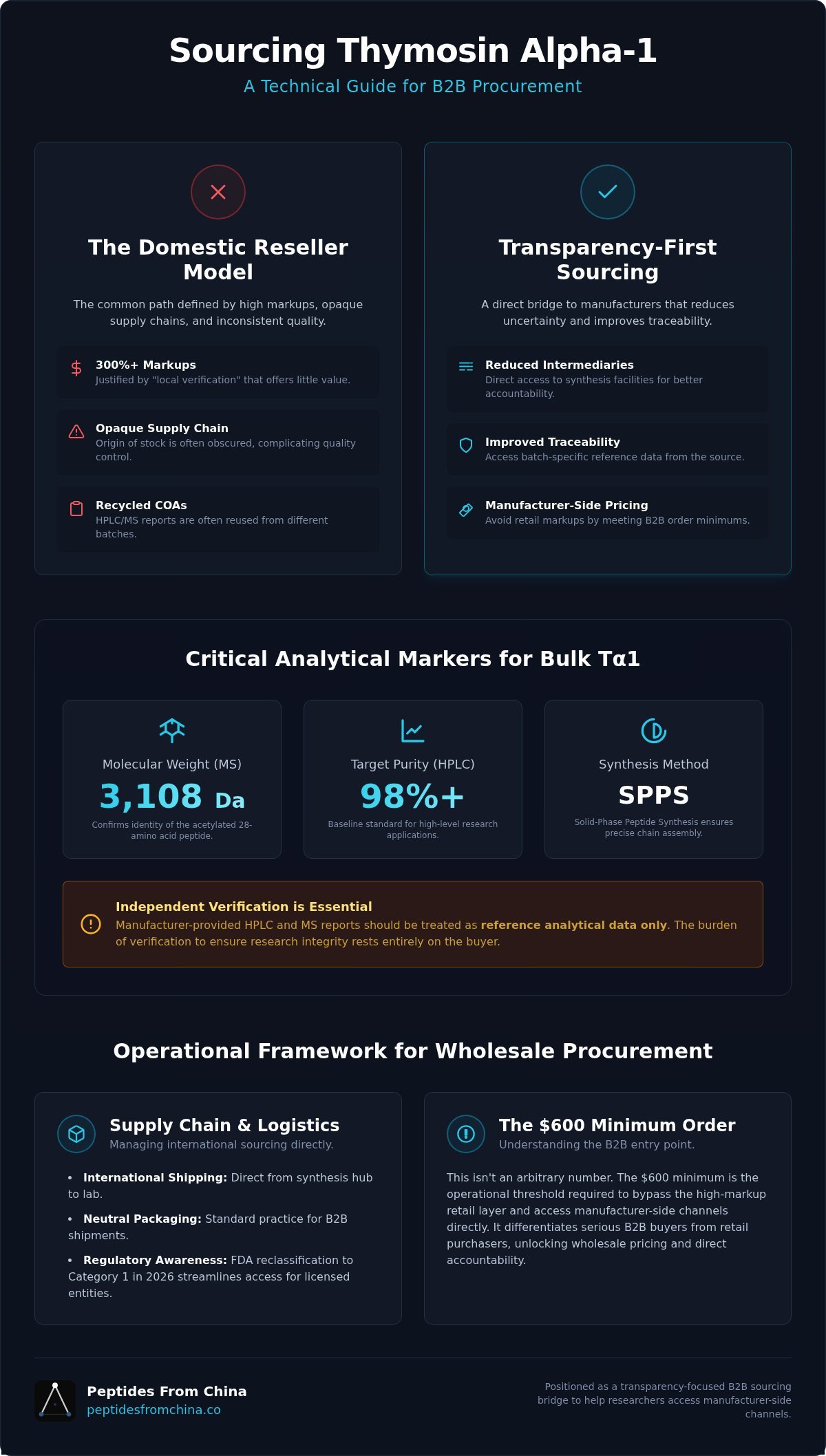
Domestic resellers in the US and EU frequently obscure the fact that their stock originates from large-scale Chinese synthesis hubs. They justify markups of 300% or more by claiming local "verification" that often amounts to little more than a photocopied HPLC report from a previous batch. These intermediaries complicate the resolution of quality disputes because they don't have direct control over the synthesis process. If a batch fails independent verification, the reseller often lacks the technical leverage or the inventory to provide an immediate, identical replacement. This lack of transparency is why professional buyers are increasingly looking for a $600 minimum entry point to bypass the retail layer and access manufacturer-side pricing and accountability.
Synthesis Standards and Analytical Markers for Bulk Tα1
Synthesis of Thymosin Alpha-1 for the wholesale market relies on Solid-Phase Peptide Synthesis (SPPS). This methodical approach allows for the precise assembly of the 28-amino acid chain by adding amino acids one by one to an insoluble resin. For Thymosin Alpha-1 wholesale procurement, labs typically target a baseline purity of 98% or higher. Lower purity levels often indicate truncated peptide chains or residual reagents that can skew research outcomes. One critical factor in high-purity batches is the removal of Trifluoroacetic acid (TFA). While TFA is used during the synthesis and cleavage process, its presence as a counter-ion can be toxic in certain biological assays. This makes TFA-free or low-TFA options a priority for labs conducting sensitive immunological research.
Critical Analytical Reports: HPLC and MS
High-Performance Liquid Chromatography (HPLC) is the standard for verifying peptide purity, while Mass Spectrometry (MS) confirms the identity of the molecule. According to a comprehensive review of Thymosin alpha 1, the precise molecular structure is vital for its immunological function. In a B2B context, buyers should look for a molecular weight of approximately 3,108.3 g/mol to confirm the acetylated form. However, it's vital to treat these documents as reference analytical data rather than absolute guarantees. Forged or reused reports are common in the gray market. Independent verification remains the only way to ensure the batch matches the documentation. Buyers should view a manufacturer's COA as a baseline technical reference that helps reduce supply chain uncertainty, not as a final proof of quality.
Batch Stability and Storage Protocols
Lyophilized (freeze-dried) powder is the industry standard for wholesale stability and transport. This state ensures the peptide remains stable during international transit, even if temperatures fluctuate during customs clearance. Lyophilization removes moisture, which prevents the hydrolysis and oxidation that would otherwise degrade the peptide in liquid form. Once it reaches the lab, long-term storage of bulk powder should be maintained at -20°C. This can extend viability for 36 to 60 months. After reconstitution, stability drops significantly, often requiring use within 24 to 48 hours when kept at 2-8°C. Labs can verify manufacturer-side documentation through a structured sourcing bridge to ensure they're receiving fresh batches rather than aged reseller stock. This direct approach ensures that storage protocols are maintained from the point of synthesis to the final delivery.
Evaluating Manufacturer-Direct Channels in the Chinese Market
China's dominance in the global peptide market is a matter of logistical reality. Most Thymosin Alpha-1 wholesale stock originates in Chinese synthesis hubs because the infrastructure for large-scale Solid-Phase Peptide Synthesis (SPPS) is unrivaled. However, this centralization creates a "COA Trap" where buyers receive reused or forged HPLC reports. These documents should be treated as baseline technical references rather than definitive proof of quality. Direct sourcing helps reduce supply chain uncertainty by establishing a clear line of communication with the actual production facility. This eliminates the "black box" effect created by domestic resellers who often obscure their sources to protect their high markups.
The Verification Process for Chinese Facilities
Distinguishing between a trading company and a legitimate synthesis laboratory is the first operational hurdle for B2B buyers. Trading companies often present themselves as manufacturers but function as high-markup resellers with no control over the synthesis process. Verification requires checking localized business licenses and evaluating a facility's capacity for consistent 28-amino acid sequence production. A genuine lab will have the technical staff to discuss specific synthesis challenges, such as the N-terminal acetylation required for bioactive Tα1. By focusing on direct manufacturer routing, researchers can improve traceability and ensure they aren't receiving aged stock from a trading company's warehouse.
Independent Testing: The Final Layer of Security
No matter how reputable a manufacturer appears, professional buyers must conduct third-party testing on every batch. Reliance on manufacturer-issued papers alone is a significant risk to research integrity. Sending samples for peptide testing at an independent lab provides the necessary data to verify molecular weight and purity. If a batch discrepancy occurs, having a direct relationship with the manufacturer allows for a methodical resolution process. Unlike domestic resellers who might relabel stock to hide defects, a direct factory can audit the specific synthesis run. Effective batch management involves setting aside a control sample from each shipment before beginning any large-scale application. This level of accountability is why professional labs accept the $600 minimum order requirement as a standard for bypassing the retail layer and securing reliable sourcing channels.
Operational Logistics: Managing Bulk Sourcing and Payments
Professional laboratories don't operate on a single-vial retail basis. Moving into Thymosin Alpha-1 wholesale requires an understanding of the $600 minimum order threshold. This floor isn't arbitrary; it reflects the fixed costs of international logistics, customs documentation, and factory-direct routing. It filters out retail-level noise and ensures the logistical effort is commensurate with the research volume. Managing these shipments involves more than just selecting a carrier; it requires a structured approach to financial risk and physical chain-of-custody tracking from the synthesis floor to the receiving dock.
Payment Security and the Deposit Model
Managing financial exposure in international peptide trade requires a methodical approach. The $10 sourcing deposit acts as a primary verification step. It signals professional intent and triggers the verification of current synthesis capacity at the production facility. Once the manufacturer confirms batch availability and lead times, this deposit is credited toward the final invoice. This staged financial arc helps reduce uncertainty for the buyer, ensuring funds aren't fully committed until the logistical path is cleared. Direct routing to manufacturers demands this professional approach to billing to maintain transparency and avoid the hidden fees often buried in reseller pricing models.
Customs and International Compliance
Bulk shipments of wholesale peptides face significant scrutiny during international transit. To navigate this, professional sourcing channels utilize "Research Use Only" documentation. This accurately reflects the intended use for laboratory study while complying with standard import regulations. Neutral, discreet packaging is equally important. It minimizes the risk of theft and reduces unnecessary delays during intensive customs inspections. High-value peptide shipments are tracked throughout the transit process, but buyers should anticipate variable timelines depending on regional port efficiency and customs workloads. Consistent delivery timelines are best achieved by removing the domestic reseller layer, which often adds unnecessary transit legs to the journey.
To secure these logistical advantages and begin the procurement process, researchers can initiate the sourcing deposit process to bridge the gap between the production facility and the lab.
The PFC Sourcing Model: Transparency-First Procurement for Labs
Traditional peptide procurement often resembles a black box, where domestic resellers act as a curtain between the researcher and the synthesis source. Peptides From China (PFC) functions as a strategic sourcing bridge, specifically designed to dismantle this opacity. By facilitating direct manufacturer routing, the model helps labs bypass the relabeling and markup cycles that define the retail market. This approach is particularly critical for Thymosin Alpha-1 wholesale procurement, where the 28-amino acid complexity of the peptide requires precise synthesis oversight rather than just bulk warehousing. Professional labs prioritize this model because it provides the closest possible proximity to the synthesis source, which is the only reliable way to reduce supply chain uncertainty in the global market.
The Sourcing Agent vs. The Reseller
Understanding the difference between a peptide sourcing agent vs platform is essential for professional procurement teams. A reseller buys stock and stores it domestically, often losing batch traceability in the process. In contrast, a sourcing bridge focuses on manufacturing transparency. It allows for direct communication regarding batch-specific HPLC and MS data, ensuring that the reference analytical data provided is actually linked to the specific synthesis run you receive. This model removes the incentive for batch substitution, a common practice among domestic sellers who need to move older stock to maintain their margins. By eliminating these intermediary layers, the PFC model improves traceability and ensures that your research material hasn't been sitting in a domestic warehouse for months.
Initiating Your Tα1 Wholesale Order
The process for securing Thymosin Alpha-1 wholesale through the PFC model is methodical and grounded in operational reality. It begins with a request for a quote, followed by a $10 sourcing deposit. This deposit is a verification tool used to confirm current manufacturer-side stock and synthesis capacity. Once the facility verifies the batch availability, the deposit is credited toward the final invoice. To maintain the efficiency of the direct-to-factory channel, all wholesale orders must meet a $600 minimum requirement. This ensures that the logistical effort of international shipping and neutral packaging is commensurate with the research volume.
For labs transitioning to a long-term peptide sourcing platform, this system provides a predictable, data-driven workflow. It moves away from the "expert" fluff of retail marketing and focuses on the technical realities of large-scale synthesis. By utilizing this sourcing bridge, researchers gain a strategic partner that acts as a filter for the global market, prioritizing factual integrity and manufacturing standards over superficial sales tactics. This structured approach is the most effective way to manage the risks inherent in the peptide industry while securing the volume needed for institutional research.
Establishing Operational Consistency in Tα1 Procurement
Establishing a reliable supply chain for Thymosin Alpha-1 wholesale requires moving beyond the "black box" of domestic reselling. Professional procurement teams prioritize direct manufacturer routing to eliminate the arbitrary markups and batch substitution risks common in the retail market. By treating manufacturer-issued COAs as baseline technical references rather than definitive proof, you can implement a more realistic verification protocol that includes independent third-party testing.
The PFC sourcing model provides the necessary bridge to these synthesis facilities, prioritizing manufacturing transparency over marketing flair. Utilizing the $10 verification deposit allows you to confirm current synthesis capacity before committing to the $600 minimum order. This methodical approach ensures you're receiving COA-verified batches directly from the source, maintaining the research integrity your laboratory requires. Reducing intermediary layers isn't just an economic decision; it's a strategic move to improve traceability and operational consistency in a complex global market.
Request a Wholesale Quote for Thymosin Alpha-1 ($600 Min)
Frequently Asked Questions
What is the minimum order quantity for Thymosin Alpha-1 wholesale?
The minimum order requirement for Thymosin Alpha-1 wholesale procurement through a B2B sourcing bridge is $600. This threshold ensures that the fixed costs of international logistics, customs documentation, and direct factory routing are economically viable for both the facility and the lab. Smaller retail orders don't allow for the same level of supply chain transparency or manufacturer-side accountability that professional institutions require for their research protocols.
How do I verify the purity of a bulk Thymosin Alpha-1 batch?
Verification requires a multi-step approach starting with reference analytical data like HPLC and Mass Spectrometry reports. While these documents provide a baseline for purity and identity, professional buyers must conduct independent, third-party testing on every batch. No single manufacturer-issued document can fully guarantee product identity. Independent lab verification helps reduce supply chain uncertainty and ensures the batch matches the required 3,108 Da molecular weight for bioactive Tα1.
Why is Thymosin Alpha-1 often more expensive than other research peptides?
The higher cost of Tα1 compared to simpler peptides is primarily due to its 28-amino acid sequence complexity. Synthesizing this specific chain requires more cycles in the Solid-Phase Peptide Synthesis (SPPS) process, which increases the margin for error and the cost of reagents. Additionally, the necessary N-terminal acetylation adds another technical layer to the production, requiring specialized laboratory equipment and more rigorous quality assurance protocols during the synthesis run.
Can I request a specific manufacturer for my Tα1 synthesis?
The sourcing bridge model is designed to facilitate direct manufacturer routing, allowing labs to bypass the black box of domestic resellers. You can use a $10 verification deposit to confirm current synthesis capacity and stock at specific Chinese facilities. This approach improves traceability by establishing a clear line of communication with the lab actually producing the peptide, rather than relying on a reseller who might substitute batches from multiple unknown sources.
What is the typical lead time for custom peptide synthesis in China?
Typical lead times for bulk synthesis in Chinese facilities range from 14 to 28 days depending on current laboratory capacity. This includes the time required for the SPPS process, purification, and lyophilization. International shipping and customs clearance generally add another 7 to 10 days to the timeline. Buyers should plan procurement cycles around a 5 to 6 week window to ensure consistent research continuity and avoid the risks associated with rush orders.
How does PFC handle customs and international shipping for bulk orders?
Bulk orders are managed using neutral, discreet packaging to minimize the risk of theft and reduce scrutiny during intensive customs inspections. All shipments include "Research Use Only" documentation to accurately reflect the contents and comply with international import regulations. By removing the domestic reseller layer, the sourcing bridge ensures a more direct transit path, which helps maintain the physical chain of custody and reduces the likelihood of logistical delays.
Is Thymosin Alpha-1 stable at room temperature during shipping?
Lyophilized Thymosin Alpha-1 is stable at room temperature for several weeks during transit, but long-term storage requires colder environments. Once the shipment arrives, the bulk powder should be transferred to -20°C for long-term stability, which can extend its viability for up to 60 months. It's important to keep the peptide in its freeze-dried state until the point of use, as stability drops significantly once the molecule is reconstituted in a liquid bacteriostatic medium.
What documents should I expect with a wholesale peptide order?
Professional wholesale orders typically include a Certificate of Analysis (COA) containing HPLC and Mass Spectrometry data as baseline technical references. These documents outline the purity percentage and molecular weight confirmed at the point of synthesis. While these papers support independent verification, they should not be viewed as definitive proof of quality. Buyers should also expect standard commercial invoices and packing lists that clearly state the research designation for all materials.