
Most research labs treat a third-party COA as a definitive seal of quality, yet in the current peptide market, that PDF is often the least reliable part of the procurement chain. You're likely already skeptical of the opaque supply chains and the frequent confusion between Thymosin Beta-4 and the TB-500 fragment. When evaluating thymosin alpha-1 vs tb-500 for your lab, the primary concern isn't just their functional divergence but the synthesis risks that lead to batch inconsistency. It's a common frustration to receive relabeled products that don't match the purity levels claimed by a reseller.
This article provides an operational deep-dive into the molecular differences and procurement protocols necessary for 2026. We'll outline a technical framework for selecting research compounds while reducing supply chain layers to help reduce uncertainty. By moving beyond baseline reference material and focusing on manufacturer-side channels, such as those facilitated by Peptides From China with a $600 minimum order, you can implement more rigorous verification standards. We'll preview the upcoming July 2026 PCAC review and explain how the recent move of these peptides to Category 1 changes your sourcing strategy.
Key Takeaways
Distinguish between the immune-modulating properties of Tα1 and the structural repair mechanisms of TB-500 to align compounds with specific research models.
Evaluate the synthesis complexities of thymosin alpha-1 vs tb-500, focusing on how molecular weight and amino acid sequences impact batch stability.
Recognize why manufacturer-issued documentation like HPLC reports should only serve as baseline reference data rather than definitive proof of identity.
Adopt the PFC Protocol to bypass intermediaries, helping to mitigate risks such as batch substitution and relabeling in the global peptide market.
Learn the operational requirements for manufacturer-side sourcing, including the $600 minimum order threshold for wholesale procurement.
Table of Contents
Functional Mechanisms: The Immune Governor vs. The Structural Mechanic
Synthesis Complexity and Molecular Stability in 2026
Comparative Research Applications and Synergistic Protocols
Procurement Risks: Industry Flaws and Verification Reality
Sourcing Direct: The PFC Protocol for Tα1 and TB-500
Functional Mechanisms: The Immune Governor vs. The Structural Mechanic
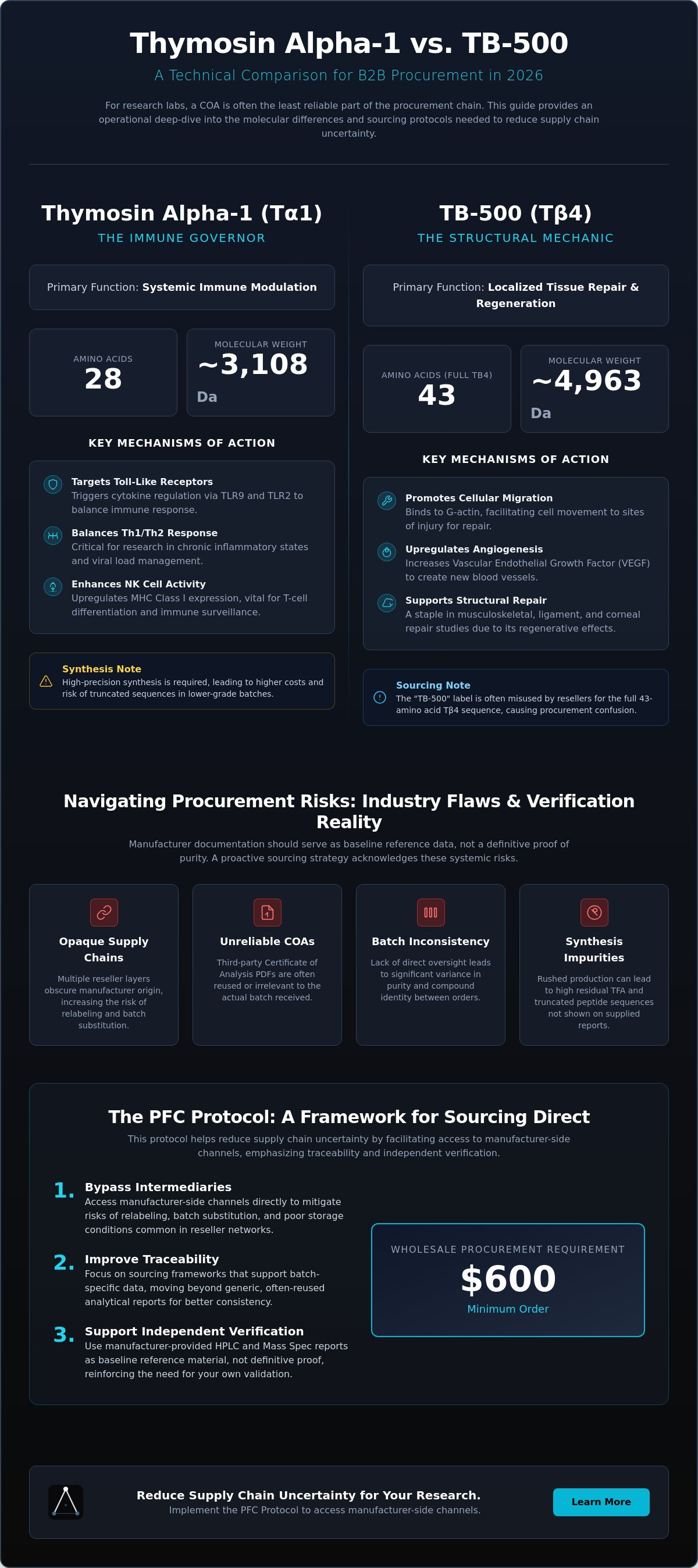
Understanding the distinction between thymosin alpha-1 vs tb-500 starts with their molecular origins. These aren't just different peptides; they operate in entirely different biological systems. Tα1 acts as a specific signaling peptide for the adaptive immune system. TB-500 functions as a synthetic agent for structural repair and cellular mobility. While they both originate from the thymus gland, their roles in research models are divergent. One regulates systemic signaling while the other drives physical reconstruction.
Tα1: Modulating the Adaptive Immune Response
Thymosin Alpha-1 is a 28-amino acid peptide derived from the larger protein Prothymosin Alpha. In research environments, it functions as an immune governor. It targets Toll-like receptors (TLRs), specifically TLR9 and TLR2, to trigger cytokine regulation. This process helps balance the Th1/Th2 response, which is critical for studying chronic inflammatory states or viral load management. It also enhances MHC Class I expression. This upregulation is vital for natural killer (NK) cell activity and T-cell differentiation. Researchers use Tα1 when the focus is on systemic immune surveillance. It doesn't build tissue; it optimizes the body's internal defense protocols.
TB-500: Upregulating Actin and Angiogenesis
While Tα1 manages the immune response, TB-500 focuses on the physical architecture of tissue. Technically, TB-500 (Thymosin Beta-4 fragment) is a synthetic version of the active region of Thymosin Beta-4 (Tβ4). Its primary mechanism involves G-actin sequestration. By binding to actin, it promotes cellular migration to sites of injury. This is why it's a staple in musculoskeletal, ligament, and corneal repair studies. It also upregulates vascular endothelial growth factor (VEGF). This promotes angiogenesis, creating new blood vessels to support damaged areas. It's a localized repair tool that drives the structural mechanics of wound healing.
The primary contrast for procurement professionals lies in the scale of the effect. Tα1 is a systemic modulator. It influences how the entire immune system recognizes and reacts to pathogens. TB-500 is a regenerative agent. It facilitates the movement of cells to specific locations for repair. When evaluating thymosin alpha-1 vs tb-500, researchers must decide if they are testing immune surveillance or tissue reconstruction. These mechanisms are distinct and require different analytical frameworks for verification. One governs the body's defense signals, while the other manages the physical reconstruction of its cells.
Synthesis Complexity and Molecular Stability in 2026
The manufacturing profile of thymosin alpha-1 vs tb-500 reveals why price points and batch consistency vary so widely between these two compounds. While both are synthesized via solid-phase methods, their molecular weights and sequence lengths dictate different production risks. Thymosin Alpha-1 has a molecular weight of approximately 3,108 Da. In contrast, full Thymosin Beta-4 sits at roughly 4,963 Da. The 28-amino acid sequence of Tα1 demands high-precision synthesis to avoid deletion sequences where an amino acid fails to attach during a cycle. This precision is what separates research-grade material from low-tier batches often found in the reseller market.
Manufacturing Challenges for High-Purity Tα1
Large-scale synthesis of Tα1 often results in significant yield loss during the purification stages. If a manufacturer rushes the process, the final product may contain truncated sequences that are difficult to filter out. Another critical factor is the removal of trifluoroacetic acid (TFA). TFA is a standard reagent in synthesis, but high residual levels can interfere with sensitive research models. Buyers should review this Thymosin Alpha-1 scientific review to understand the structural integrity required for effective immunomodulatory research. Because of these yield challenges, Tα1 typically carries a higher wholesale cost per milligram than shorter, less complex fragments.
TB-500 (Tβ4) Synthesis and Fragment Reliability
The research market suffers from a persistent naming flaw regarding TB-500. While many resellers label their vials as TB-500, the contents are often the full 1-43 amino acid sequence of Thymosin Beta-4. Others provide smaller active fragments. This ambiguity makes Mass Spectrometry (MS) verification essential. You can't rely on a label alone; you need to confirm the molecular weight matches the intended sequence. Low-tier manufacturing runs often show impurities in the 4,000 to 5,000 Da range. This usually indicates incomplete peptide chains or poor washing protocols during the final synthesis steps.
Stability is another operational concern for procurement officers. Both peptides are relatively stable as lyophilized powders at room temperature for short durations, but long-term storage requires -20°C to prevent degradation. During international transit, exposure to extreme heat can compromise the peptide's secondary structure before it even reaches your lab. To mitigate these risks, labs are increasingly using a transparency-focused sourcing bridge to access manufacturer-side data. By utilizing Peptides From China, which requires a $600 minimum order for wholesale procurement, researchers can reduce the number of intermediaries who might mishandle the product or reuse outdated analytical reports.
Comparative Research Applications and Synergistic Protocols
Research objectives dictate the primary selection between thymosin alpha-1 vs tb-500. While they share a biological origin in the thymus, their utility in experimental models is distinct. Tα1 is the preferred candidate for investigating systemic immune resilience. TB-500 remains the standard for studies involving localized structural regeneration. Labs often explore their synergistic potential to address both defense signaling and physical repair in complex recovery models where a single mechanism is insufficient.
Tα1 Research Metrics: Immune Resilience
In models of chronic inflammation or viral exposure, researchers prioritize CD4+ and CD8+ T-cell ratios as primary endpoints. Studies have shown that Tα1 can increase T-cell production by up to 40% in specific immunocompromised contexts. It's also used to analyze impact on oxidative stress markers in cellular models. These metrics make it a staple in oncology-related immune suppression research where the goal is restoring the body's internal surveillance protocols.
TB-500 Research Metrics: Regenerative Velocity
TB-500 is evaluated through the lens of regenerative velocity rather than signaling balance. In vitro studies measure dermal fibroblast migration speeds to quantify wound closure efficiency. Connective tissue research focuses on monitoring collagen deposition rates in ligament and tendon models. It's also utilized in skeletal muscle research to observe the reduction of myostatin. This protein typically inhibits muscle growth, so its suppression is a key metric for assessing recovery speed and tissue density.
Co-administration protocols aim to balance immune surveillance with rapid physical repair. This dual-action approach is common in post-surgical or traumatic injury recovery models. However, running multi-compound research increases the risk of experimental interference if batch purity is variable. Utilizing professional peptide testing is a non-negotiable step before initiating these synergistic protocols. Independent verification helps reduce supply chain uncertainty, especially when sourcing through manufacturer-side channels like Peptides From China. Accessing these direct channels requires a $600 minimum order for wholesale procurement, but it provides the transparency needed to support reliable research outcomes without the interference of reseller-relabeled batches.
Procurement Risks: Industry Flaws and Verification Reality
Sourcing thymosin alpha-1 vs tb-500 requires more than just comparing price lists. The peptide market is heavily saturated with resellers who prioritize turnover over batch integrity. Batch substitution is a systemic issue where a high-quality initial sample is used to obtain a COA, but subsequent shipments contain lower-purity material or entirely different sequences. When you're managing a research budget, you can't afford the data corruption that comes from variable synthesis quality.
Relying on a single HPLC report from a manufacturer is a baseline technical reference, not definitive proof of quality. These documents are easily forged or reused across multiple batches. Nomenclature confusion exacerbates this risk. Tα1 is frequently mislabeled, and the distinction between full-length Thymosin Beta-4 and the TB-500 fragment is often ignored by resellers to simplify their inventory. Independent, third-party testing is an operational necessity for any B2B buyer who values factual integrity.
Red Flags in Wholesale Peptide Sourcing
Identifying reused HPLC/MS reports is a critical skill for procurement officers. Discrepancies between report dates and batch numbers are immediate red flags. Domestic warehousing often serves as a veil to hide the true manufacturing origin, making it impossible to trace the synthesis conditions. If price-per-vial numbers are significant outliers, it usually signals compromised synthesis quality or a lack of proper TFA removal. Consistency isn't cheap; it's the result of methodical manufacturing and rigorous quality control.
Establishing a Chain of Custody for Research Compounds
Reducing supply chain layers is the most effective way to improve traceability. Understanding the difference between a peptide sourcing agent vs platform helps labs determine who is actually responsible for verification. Direct-to-manufacturer sourcing helps reduce reseller-introduced risks like relabeling or improper storage. Batch-specific documentation should always be requested, though independent testing remains the only way to support independent verification.
For labs seeking to minimize intermediaries, moving toward manufacturer-side channels is the logical step. You can access direct sourcing channels through Peptides From China, which operates as a transparency-focused bridge. This model requires a $600 minimum order for wholesale procurement, ensuring that the focus remains on professional-scale consistency rather than retail-level turnover. This approach helps reduce supply chain uncertainty by providing a clearer path from the synthesis lab to your facility.
Sourcing Direct: The PFC Protocol for Tα1 and TB-500
Procuring research compounds in 2026 requires a transition from retail-style purchasing to a methodical B2B framework. Peptides From China (PFC) operates as a transparency-focused bridge, connecting labs directly with manufacturer-side channels. This model is designed to minimize the reseller layers that historically introduce supply chain opacity. By establishing a direct connection to synthesis facilities, labs can significantly reduce supply chain uncertainty. A core component of this protocol is the $600 minimum order requirement. This threshold ensures the focus remains on wholesale procurement, filtering out the high-volume retail traffic that often leads to compromised batch tracking.
When evaluating thymosin alpha-1 vs tb-500 for high-volume research, the procurement protocol must prioritize traceability over convenience. Relying on intermediaries often results in receiving products with reused COAs or mismatched batch numbers. Utilizing a structured wholesale peptides guide helps procurement officers implement standardized verification steps before any capital is committed. This approach moves beyond the "trust-based" model of the retail market and into a "verification-first" B2B environment.
The PFC Sourcing Workflow
The $10 deposit initiates manual request processing and real-time stock verification and is credited toward the final invoice. Manufacturer-side analytical documentation may be available depending on the product and batch.
Logistics and Quality Control for Bulk Orders
PFC coordinates manufacturer-side sourcing and international logistics. Shipping methods, pricing, and estimated transit times vary by destination and are confirmed during order processing. Buyers requiring independent verification may arrange third-party testing.
Establishing a Verification-First Sourcing Standard
Navigating the technical differences of thymosin alpha-1 and TB-500 is only the first step. Manufacturer-side analytical documentation may be available depending on the product and batch, and buyers requiring independent verification may arrange third-party testing.
Implementing these standards requires a shift away from retail-style convenience and toward a methodical B2B framework. You can request a manufacturer-direct quote for Tα1 or TB-500 ($600 minimum) to begin accessing manufacturer-side channels through Peptides From China. This model provides the reference analytical data and supply chain transparency needed to support rigorous laboratory verification. Moving toward a transparency-focused procurement model helps ensure that your data remains consistent and your research remains focused on results rather than troubleshooting batch impurities. Reliable data starts with a grounded approach to sourcing.
Frequently Asked Questions
Is Thymosin Alpha-1 the same as Thymosin Beta-4?
No, Thymosin Alpha-1 and Thymosin Beta-4 are distinct peptides with different molecular structures and biological functions. Tα1 is a 28-amino acid sequence focused on T-cell differentiation and cytokine regulation. Tβ4 is a larger 43-amino acid protein primarily involved in actin sequestration and cell migration. When comparing thymosin alpha-1 vs tb-500, it's vital to recognize that they target separate physiological pathways, making them non-interchangeable in research models.
What is the difference between TB-500 and the full Thymosin Beta-4 protein?
Technically, TB-500 is a synthetic fragment representing the active region of the full 43-amino acid Thymosin Beta-4 protein. However, the research market often uses these terms interchangeably, which creates significant nomenclature confusion. Some vendors sell the full-length sequence under the TB-500 label, while others provide the smaller fragment. Procurement officers must use Mass Spectrometry to confirm the molecular weight and verify which sequence they are actually receiving.
Can Tα1 and TB-500 be used together in a research setting?
Researchers frequently use these compounds together to explore synergistic effects between systemic immune modulation and localized tissue repair. This dual-action approach is common in recovery models where the goal is to observe how optimized immune surveillance complements accelerated wound healing. While co-administration is a valid research protocol, it increases the necessity for high-purity batches to ensure that experimental results aren't skewed by cross-contamination or variable synthesis quality.
How do I verify the purity of a wholesale peptide batch from China?
Verification requires independent, third-party laboratory analysis using High-Performance Liquid Chromatography (HPLC) and Mass Spectrometry (MS). You shouldn't rely on manufacturer-issued COAs as definitive proof, as these documents are often reused or forged. By sourcing through a transparency-focused bridge like Peptides From China, you can access manufacturer-side documentation as a baseline. However, the final step should always be an independent test to support the factual integrity of your batch.
Why is Thymosin Alpha-1 often more expensive than other peptides?
The higher cost of Thymosin Alpha-1 is primarily due to its synthesis complexity and low yield during purification. As a 28-amino acid peptide, it requires more cycles of solid-phase synthesis than shorter fragments. Each additional cycle increases the risk of deletion sequences, leading to significant yield loss when filtering for high-purity samples. This manufacturing difficulty is a key differentiator when evaluating the market pricing of thymosin alpha-1 vs tb-500.
What are the common impurities found in synthetic TB-500?
Common impurities in TB-500 include truncated peptide sequences, residual trifluoroacetic acid (TFA), and salts from the synthesis process. In low-tier manufacturing runs, Mass Spectrometry often reveals peaks in the 4,000 to 5,000 Da range, indicating incomplete chains or poor washing protocols. These impurities can interfere with cellular migration studies, making it essential to verify that the batch has undergone rigorous purification before it reaches the laboratory.
What is the shelf life of lyophilized Tα1 and TB-500 powder?
Lyophilized powder is generally stable at room temperature for several weeks during transit, but long-term storage requires colder environments. For stability beyond 90 days, vials should be stored at -20°C or -80°C to prevent molecular degradation. Exposure to extreme heat or moisture during the sourcing process can compromise the peptide's secondary structure. Methodical logistics and direct routing from the synthesis facility help maintain the structural integrity of the compounds.
How does Peptides From China handle batch verification for B2B orders?
Peptides From China acts as a B2B sourcing bridge that provides researchers with access to manufacturer-side documentation and technical data when available. This model helps reduce supply chain uncertainty by minimizing the number of intermediaries who might relabel or mishandle products. With a $600 minimum order requirement, the protocol focuses on wholesale-scale transparency. Manufacturer-side analytical documentation may be available depending on the product and batch; buyers requiring independent verification may arrange third-party analytical testing.