
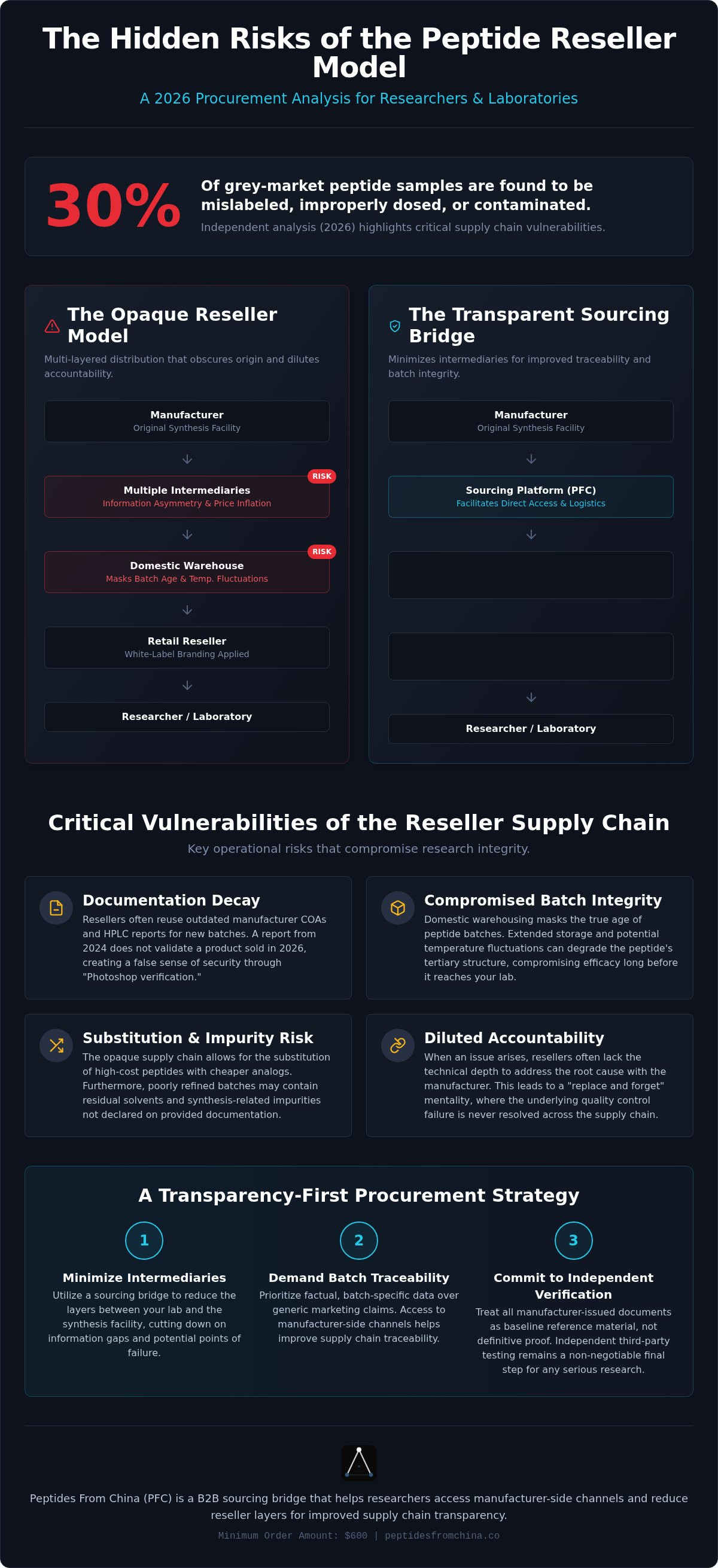
Independent analysis in 2026 reveals that approximately 30% of peptide samples from grey-market sources are mislabeled, improperly dosed, or contaminated. For procurement professionals and researchers, this statistic underscores the significant risks of using a peptide reseller instead of establishing a direct line to the source. You likely appreciate the perceived convenience of domestic shipping, yet you're probably also exhausted by the lack of transparency regarding batch identity and the inflated pricing that comes with multiple reseller layers.
It's time to acknowledge that a sleek website doesn't equate to a secure supply chain. This procurement analysis identifies the critical vulnerabilities, documentation flaws, and batch integrity risks inherent in the reseller model. We'll examine how "verified" COAs are often reused across different batches and why manufacturer-issued papers should only serve as baseline technical references rather than definitive proof of quality. This guide provides a strategic overview of the 2026 regulatory landscape, explaining how minimizing intermediaries helps reduce supply chain uncertainty and why independent verification remains a non-negotiable step for any serious laboratory or research operation.
Key Takeaways
Identify how multi-layered distribution models dilute accountability and increase the probability of receiving batches that don't match provided documentation.
Understand why manufacturer-issued COAs are merely reference data and how "documentation decay" leads to the use of outdated or fabricated reports in the reseller market.
Evaluate the specific risks of using a peptide reseller, including how domestic warehousing often masks batch age and exposes products to temperature fluctuations that compromise peptide structure.
Learn to recognize common operational vulnerabilities like the substitution of high-cost peptides with cheaper analogs and the persistence of residual solvents in poorly refined batches.
Move toward a transparency-first procurement model by utilizing a sourcing bridge to access manufacturer-side channels, helping to minimize the information asymmetry found in traditional retail setups.
Table of Contents
The Middleman Problem: Defining the Peptide Reseller Landscape
Documentation Decay: The Risk of Reused and Fabricated COAs
The 'Domestic Stock' Illusion: Why Warehousing Compromises Batch Integrity
Operational Vulnerabilities: Substitution, Relabeling, and Impurity Risks
Navigating the Supply Chain: Transitioning to Direct Manufacturer Sourcing
The Middleman Problem: Defining the Peptide Reseller Landscape
Most peptide brands visible on search engines don't actually manufacture the products they sell. They operate as retail resellers, purchasing bulk lyophilized powder from overseas facilities and applying their own branding. This white-labeling model is the standard in the industry, yet it introduces significant structural vulnerabilities. One of the primary risks of using a peptide reseller is the disconnect between marketing claims and actual manufacturing standards. Because these entities prioritize high turnover and profit margins, they often treat batch-specific testing as a secondary expense rather than a core requirement.
When multiple distribution layers exist, accountability for product integrity is diluted. Each intermediary adds a markup but rarely adds technical value. If a batch of BPC-157 or Semaglutide is found to be sub-standard, the reseller often lacks the technical depth to address the root cause with the synthesis facility. They simply aren't equipped to navigate the complexities of peptide synthesis, leading to a "replace and forget" mentality that fails to solve the underlying quality issue.
Reseller vs. Sourcing Platform
The distinction between a retail reseller and a sourcing platform is critical for procurement. Resellers are stockists; they buy in bulk and store inventory in domestic warehouses to offer rapid shipping. However, this convenience hides the risk of receiving stale batches. Peptides are chemically sensitive. Improper storage or extended time in a warehouse can lead to degradation of the tertiary structure. A sourcing platform, by contrast, facilitates direct access to manufacturer-side channels. This model reduces the time between synthesis and delivery, helping to ensure you receive the most recent production run rather than inventory that's been sitting on a shelf for months.
The Information Asymmetry Gap
Resellers survive on information asymmetry. They intentionally obscure the origin of their peptides to protect their business model, preventing you from knowing exactly where your Tirzepatide or Retatrutide was synthesized. This lack of transparency is one of the inherent risks of using a peptide reseller. Without knowing the specific facility, you can't verify if the manufacturer follows high-level quality assurance protocols or utilizes sub-standard reagents. Moving toward wholesale peptides through a transparent bridge allows researchers to bypass these layers of opacity. This approach prioritizes factual traceability over the curated marketing narratives used by retail middlemen.
Documentation Decay: The Risk of Reused and Fabricated COAs
Documentation decay occurs when the technical data meant to verify a product's identity becomes disconnected from the physical inventory. In the retail market, it's common for a reseller to present an HPLC report from 2024 for a batch sold in 2026. This practice creates one of the primary risks of using a peptide reseller; you're essentially buying based on historical data rather than current batch reality. Resellers often rely on "Photoshop verification" to update dates or batch numbers on manufacturer reports, creating a false sense of security for the buyer.
A single HPLC or Mass Spectrometry report should only be viewed as baseline reference material. It is not a permanent guarantee of purity. The National Consumers League issued a nationwide warning on peptides highlighting the lack of quality control and the presence of contaminants in unregulated supply chains. Relying solely on manufacturer-issued papers without cross-referencing through a third-party laboratory leaves your research vulnerable to batch substitution and variable synthesis quality.
Common COA Red Flags
Identifying manipulated documentation requires a methodical approach. Professional procurement officers look for specific anomalies that suggest a report has been altered or reused. Watch for these indicators:
Mismatched Batch Numbers: The number on the vial should match the report exactly. Any discrepancy suggests the documentation is for a different production run.
Baseline Anomalies: HPLC chromatograms with perfectly flat baselines or suspiciously symmetrical peaks often indicate digital manipulation. Real-world analytical data always contains minor noise.
Ghost Laboratories: Reports from laboratories with no verifiable physical address or digital presence are a significant red flag.
The Role of Independent Verification
Independent verification is the only way to mitigate the risks of using a peptide reseller. Resellers often discourage this by claiming their products are already "fully verified," yet they rarely provide the raw data files required for true auditability. Establishing robust peptide testing protocols is essential for any laboratory. This includes performing your own HPLC and Mass Spectrometry on random samples from every shipment.
Reliable sourcing requires a "trust but verify" mindset. While a sourcing bridge can facilitate direct manufacturer communication, the final responsibility for batch integrity always rests with the researcher. By bypassing the reseller layer, you gain access to original, unaltered manufacturer data that serves as a much more reliable starting point for your own laboratory verification.
The 'Domestic Stock' Illusion: Why Warehousing Compromises Batch Integrity
Domestic shipping is frequently marketed as a premium feature by retail brands. In reality, the presence of local inventory represents one of the significant risks of using a peptide reseller. When a reseller holds stock in a local warehouse, they effectively obscure the true age of the batch. Lyophilized peptides like Tirzepatide or Retatrutide are chemically sensitive. Typical small-scale reseller warehouses often lack the rigorous, constant climate controls found in professional synthesis facilities. Fluctuations in temperature during storage or transit between multiple intermediaries can compromise the peptide tertiary structure, leading to degradation before the product reaches your laboratory.
This lack of environmental oversight mirrors broader FDA concerns on unapproved drugs, where unknown storage conditions and handling practices contribute to product instability and safety issues. To maintain high liquidity, resellers often mix new inventory with older, unsold stock to clear their shelves. This "batch substitution" means a single order could contain vials from different production runs, each with varying purity levels and degradation profiles, making consistent research results impossible to achieve.
Chain of Custody Vulnerabilities
Every additional touchpoint in the supply chain is a potential point of failure. When a peptide passes from a manufacturer to a bulk buyer, then to a domestic reseller, and finally to a researcher, the risk of contamination or mislabeling increases at each step. Many resellers engage in relabeling practices, turning generic bulk powder into "branded" research compounds in environments that lack standardized hygiene protocols. These facilities rarely have the HEPA filtration or clean-room standards required to maintain the integrity of sensitive biological compounds during the relabeling process.
The Speed vs. Quality Trade-off
The convenience of a 48-hour delivery window often comes at the expense of batch freshness. A 2-day domestic arrival frequently means you're receiving a batch that was synthesized six months ago and has been sitting in suboptimal conditions. Direct-from-manufacturer shipping ensures the shortest possible time from synthesis to delivery. While international lead times in 2026 generally range from 7 to 14 days, the trade-off is a fresher product with a verified chain of custody. By utilizing a sourcing bridge for wholesale procurement (minimum $600), researchers can bypass the "domestic stock" trap and access manufacturer-side channels that prioritize batch-specific transparency over retail convenience.
Operational Vulnerabilities: Substitution, Relabeling, and Impurity Risks
The financial structure of retail reselling creates a significant incentive for product substitution. High-demand, high-cost compounds like Tirzepatide are frequently targeted for "blending" or outright substitution with cheaper analogs. This is one of the most severe risks of using a peptide reseller; the intermediary may swap a premium batch for a lower-purity variant to maintain their profit margins during market fluctuations. These operational shortcuts often extend to fill volumes. Researchers frequently report concentration variances across a single order, where one vial contains the stated milligrams while others in the same box are significantly under-dosed due to poor batch homogeneity or manual capping errors.
When a reseller identifies a "bad batch" through customer complaints or internal checks, the lack of a formal regulatory framework means there are rarely recall protocols. In the grey market, the economic cost of discarding $50,000 in inventory is often too high for a small reseller to absorb. Instead of destroying compromised stock, some entities continue to sell through the inventory, relying on the fact that researchers might attribute inconsistent data to experimental variance rather than product impurity. This lack of accountability is a fundamental flaw in the reseller model that direct manufacturer-side sourcing helps to mitigate.
Chemical Impurities and Research Noise
Minor impurities in a peptide batch can generate significant noise in your research data. Residual solvents, particularly Trifluoroacetic acid (TFA), are common in poorly refined batches. While TFA is a standard part of the synthesis process, high residual levels can alter the pH of your research environment or interfere with cellular assays. Identifying truncated peptide sequences-shorter, incomplete versions of the target molecule-is also difficult using the low-resolution Mass Spectrometry often provided by resellers. Reducing these variables requires sourcing from facilities that adhere to validated peptide production standards, where purification steps are documented and consistent.
The Relabeling Trap
Most resellers receive their inventory as generic, unlabelled vials. The labeling process is often a manual operation performed in non-sterile environments. This introduces the risk of misidentification; a reseller might accidentally label Selank as Semax or BPC-157 as TB-500 during high-volume fulfillment periods. Manual handling also increases the risk of cross-contamination from airborne particulates or skin contact. Direct sourcing from the factory floor minimizes these manual handling errors by ensuring that the chain of custody remains limited to the synthesis facility and the final buyer. To access these manufacturer-side channels and reduce intermediary risks, researchers can utilize a wholesale peptide sourcing bridge with a $600 minimum order requirement.
Navigating the Supply Chain: Transitioning to Direct Manufacturer Sourcing
Professional research requires a transition from the retail mindset to a structured B2B procurement model. The inherent risks of using a peptide reseller often stem from the lack of direct oversight and the dilution of accountability across multiple distribution layers. By shifting toward transparency-first wholesale peptides, procurement officers can bypass the information decay associated with traditional middlemen. Peptides From China acts as a sourcing bridge, facilitating direct manufacturer-side channels rather than functioning as a retail stockist. This model prioritizes batch traceability and helps reduce supply chain uncertainty by connecting you to the source of synthesis.
A critical component of this transition is the $600 wholesale minimum order requirement. This threshold isn't arbitrary; it ensures that the synthesis facility allocates a specific, consistent batch for the order rather than pulling miscellaneous vials from various outdated runs. To initiate this process, a $10 deposit system is utilized. This small commitment allows researchers to trigger manufacturer-side verification and review reference analytical data before committing to the full procurement cost. This safeguard ensures that the technical specifications meet your laboratory requirements before the product ever leaves the facility.
The Professional Sourcing Protocol
The process begins by initiating a sourcing request with precise purity and quantity specifications. Unlike retail platforms, this protocol involves reviewing original manufacturer-side documentation, such as HPLC and Mass Spectrometry reports, prior to final settlement. While these documents serve as baseline references, receiving them directly from the factory floor improves traceability. Once the data is reviewed, neutral international packaging is utilized for shipping. This ensures that logistical handling remains professional and consistent, reducing the risk of the environmental degradation often found in poorly managed domestic warehouses.
Building a Reliable Research Pipeline
Long-term replicability in research depends on a consistent and predictable supply chain. Moving away from one-off retail purchases toward strategic bulk BPC-157 wholesale sourcing allows laboratories to secure larger quantities from a single, audited synthesis run. A sourcing bridge helps audit these factory-side channels, filtering out facilities that fail to meet baseline production standards. Ultimately, direct sourcing is the most effective way to mitigate the risks of using a peptide reseller. It provides the technical transparency and batch integrity necessary for professional research environments where data accuracy is the primary objective.
Securing Your Research Supply Chain for 2026
Navigating the peptide market requires moving past the facade of retail branding. We've analyzed how documentation decay and suboptimal warehousing contribute to the risks of using a peptide reseller, ultimately compromising the replicability of your research data. By prioritizing batch-specific traceability and manufacturer-side verification, you can eliminate the information asymmetry that defines the current middleman model. Professional procurement is no longer about finding the fastest domestic shipment; it's about securing a direct line to the synthesis facility to ensure chemical integrity.
Establishing a direct sourcing pipeline helps reduce supply chain uncertainty and ensures you're receiving fresh batches rather than stale warehouse stock. Peptides From China serves as a dedicated B2B sourcing bridge, connecting professional researchers with COA-verified manufacturer batches. By maintaining a $600 minimum order requirement, we help ensure batch consistency and technical accountability for every shipment. This methodical approach to procurement protects your research from the substitutions and impurities common in retail channels.
Request a direct-to-manufacturer quote for your research lab today and take control of your procurement standards. Reliable research starts with a transparent, verifiable source.
Frequently Asked Questions
What is the biggest risk when buying from a peptide reseller?
The primary risk involves the dilution of accountability within a multi-layered supply chain. When you buy from a reseller, the true origin of synthesis is obscured to protect their profit margins. This lack of transparency is one of the core risks of using a peptide reseller, as it prevents you from verifying the manufacturer's quality standards or identifying the source if a batch fails analysis.
How can I tell if a peptide COA has been reused or faked?
Detecting manipulated documentation requires a technical review of the HPLC and Mass Spectrometry reports. Look for mismatched batch numbers between the vial and the certificate, or suspiciously symmetrical peaks in chromatograms that suggest digital editing. Reports issued by ghost laboratories without a verifiable physical presence are also a frequent indicator of documentation decay in the retail peptide market.
Why is domestic warehousing considered a risk for peptide stability?
Domestic warehouses frequently lack the rigorous environmental controls required to maintain the tertiary structure of sensitive biological compounds. Lyophilized peptides are susceptible to degradation if exposed to temperature fluctuations during long-term storage in small-scale facilities. Direct shipping from the synthesis floor helps ensure the shortest possible time between production and delivery, maintaining batch freshness and stability for your research.
What is batch substitution and how does it affect research?
Batch substitution occurs when a reseller mixes inventory from different production runs to fulfill a single order or clear old stock. This practice introduces significant variables into your research, as different batches may have varying purity levels or impurity profiles. Scientific consistency is impossible to achieve if your supply chain allows for the blending of disparate synthesis runs in the same shipment.
How does direct sourcing from China reduce supply chain uncertainty?
Direct sourcing reduces uncertainty by establishing a clear chain of custody between the synthesis facility and your laboratory. Utilizing a sourcing bridge helps you access manufacturer-side channels where batch data is more readily available. This approach effectively mitigates the risks of using a peptide reseller by prioritizing factual traceability over the curated marketing narratives used by domestic retail stockists.
What should I look for when auditing a peptide sourcing platform?
A professional sourcing platform should be audited based on its transparency regarding manufacturer-side channels. Look for providers that utilize a $10 deposit system to initiate verification and require a $600 minimum order for wholesale procurement. These operational standards suggest a B2B focus that prioritizes batch consistency over the one-off retail sales model typical of most online resellers.
Can I trust '99% purity' claims on retail peptide websites?
Claims of 99% purity should be treated as baseline technical reference material rather than a definitive guarantee. Purity varies between synthesis runs and can degrade over time due to improper handling or storage. Professional researchers don't rely on retail claims; they perform independent laboratory testing to verify product identity and purity before starting any critical assays or research protocols.
Why do professional laboratories prefer direct-to-manufacturer sourcing?
Direct-to-manufacturer sourcing is preferred because it provides the highest level of batch traceability and logistical transparency. Professional laboratories require consistent product identity to ensure research replicability, which is difficult to achieve through retail intermediaries. Bypassing the reseller layer also allows for more direct communication regarding specific purity requirements and volume-based procurement for long-term projects.