
Relying on a manufacturer-issued HPLC report as a definitive guarantee of purity is often the first step toward a compromised research project. It's a reality most procurement professionals acknowledge; the peptide industry remains plagued by reused COAs, batch substitution, and inflated reseller markups that obscure the true origin of the material. As the field moves toward more complex molecules, the technical gap between established single-agonists and newer triple-agonists creates fresh risks for sourcing consistency.
This report provides a technical comparison of retatrutide vs semaglutide, focusing on receptor affinity data and the specific synthesis hurdles that differentiate these two GLP-1 analogs in a 2026 research context. You'll gain a clear understanding of why triple-agonist structures demand more rigorous analytical verification than the mature semaglutide baseline. We will also outline a methodical sourcing framework for accessing manufacturer-side channels through Peptides From China. This approach prioritizes directness and independent verification for wholesale orders, which carry a $600 minimum. This helps you reduce supply chain uncertainty and bypass the typical layers of retail intermediaries while maintaining a realistic perspective on batch traceability.
Key Takeaways
Understand the technical shift in retatrutide vs semaglutide research as the industry moves from single GLP-1 receptor agonists to triple-agonist compounds targeting GLP-1, GIP, and Glucagon receptors.
Evaluate the increased manufacturing complexity of synthesizing a 39-amino acid triple agonist compared to the established, more mature production processes of semaglutide.
Learn why manufacturer-issued COAs should be treated as reference baseline data rather than definitive proof, necessitating independent HPLC and Mass Spectrometry testing by the buyer.
Identify strategies to reduce supply chain uncertainty by utilizing direct-to-manufacturer channels that minimize the risks associated with reseller batch substitution and relabeling.
PeptidesFromChina currently has a $600 total minimum order. Multiple catalog products can be combined to reach the minimum, with orders starting from one 10-vial kit per product.
Table of Contents
Retatrutide vs. Semaglutide: Understanding the Mechanism Shift in Metabolic Research
Comparative Research Metrics: Potency, Half-Life, and Receptor Affinity
Synthesis Complexity and Supply Chain Logistics for GLP-1 Analogs
Procurement Protocols: Verifying Purity and Batch Consistency
Direct Sourcing Strategies for Professional Research Labs
Retatrutide vs. Semaglutide: Understanding the Mechanism Shift in Metabolic Research
Metabolic research has moved past the era of single-target molecules. While semaglutide established the industry baseline for GLP-1 receptor agonism, retatrutide represents a transition toward multi-receptor synergy. The comparison of retatrutide vs semaglutide isn't just about weight loss percentages; it's about shifting from a mono-pathway approach to a complex triple-agonist model. Researchers are increasingly focusing on how these compounds interact with diverse hormonal pathways simultaneously to influence glucose homeostasis and lipid metabolism. This shift requires a more nuanced understanding of how each molecule binds to its respective targets.
Semaglutide: The GLP-1 Receptor Baseline
Semaglutide functions as a selective GLP-1 receptor agonist. It maintains a 94% sequence homology to human GLP-1(7-37), which provides a stable and predictable foundation for metabolic studies. Its most significant structural feature for research consistency is the albumin-binding side chain. This modification extends the half-life to approximately 165 hours, allowing for stable pharmacokinetic profiles in longitudinal studies. In most modern comparative research, semaglutide serves as the essential control variable against which newer, more complex analogs are measured. It’s the established standard for single-pathway metabolic regulation.
Retatrutide: The Triple-Agonist Frontier
Retatrutide expands the scope of metabolic inquiry by targeting three distinct receptors: GLP-1, GIP, and the glucagon receptor (GCGR). This Retatrutide's triple-agonist mechanism allows for a broader range of physiological interactions than semaglutide's single-target design. The molecule is engineered with specific structural modifications that facilitate high affinity across all three receptors without significant cross-reactivity. Unlike earlier dual-agonists, high-quality research batches of retatrutide exhibit an unbiased receptor activation profile. This means the compound doesn't favor one pathway to the detriment of others, providing a cleaner data set for researchers investigating synergistic metabolic effects across multiple systems.
The move toward triple agonists like retatrutide reflects a deeper understanding of metabolic regulation. Researchers aren't just looking for higher potency; they're looking for ways to influence energy expenditure through the glucagon receptor while managing insulin sensitivity via GLP-1 and GIP. Managing the procurement of these complex sequences requires moving away from opaque retail resellers who often lack technical depth. PeptidesFromChina currently has a $600 total minimum order. Multiple catalog products can be combined to reach the minimum, with orders starting from one 10-vial kit per product. This directness helps ensure that the technical profile of the compound matches the research objectives, reducing the uncertainty inherent in multi-layered supply chains.
Comparative Research Metrics: Potency, Half-Life, and Receptor Affinity
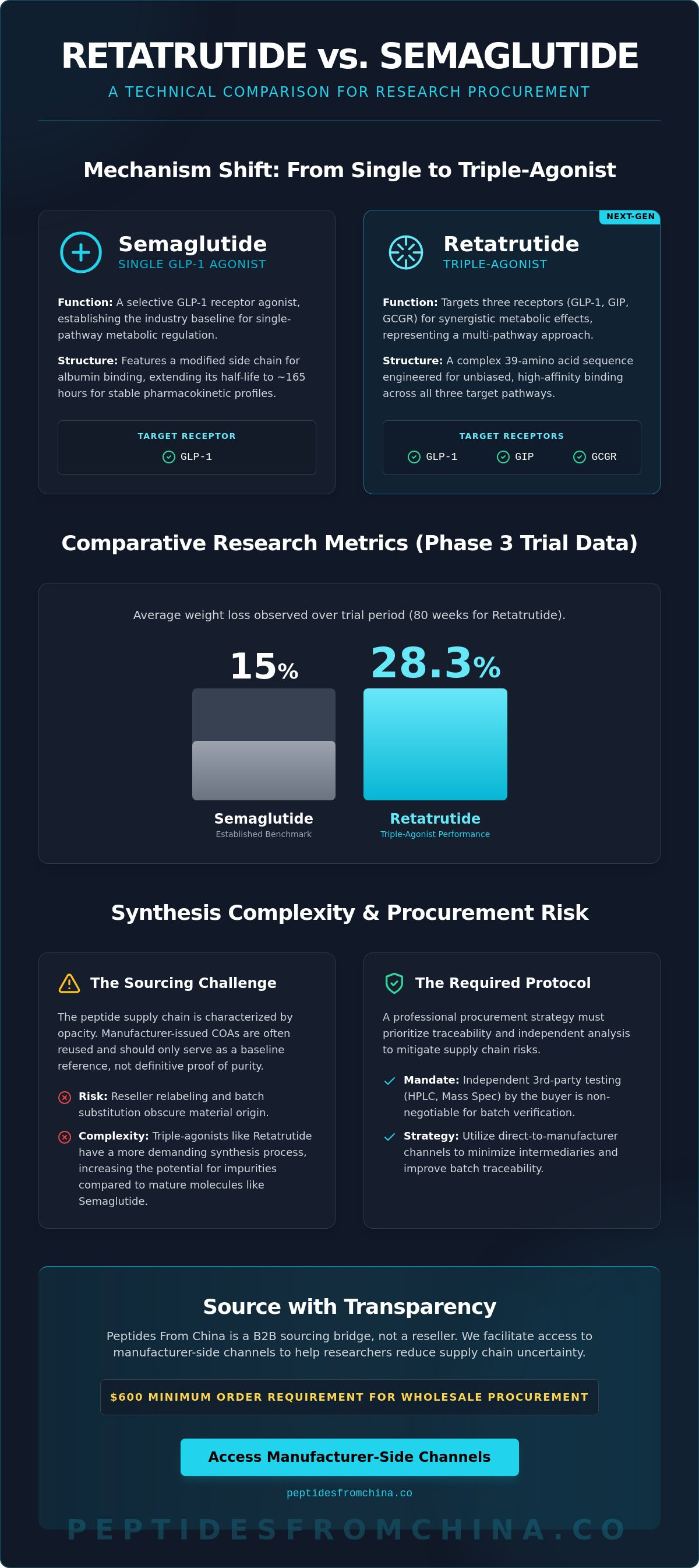
Analyzing the technical metrics of retatrutide vs semaglutide reveals why the research community is pivoting toward triple-agonist models. Phase 3 trial data from May 2026 shows retatrutide achieving an average weight loss of 28.3% over 80 weeks, nearly doubling the 15% benchmark established by semaglutide. This performance gap is rooted in receptor binding kinetics rather than just dosage. While semaglutide operates through a high-affinity interaction with the GLP-1 receptor, retatrutide introduces a multi-faceted profile that includes GIP and glucagon (GCGR) activation. This Forbes analysis of GLP-1 analogs highlights how these shifting benchmarks are redefining metabolic research expectations in a clinical setting.
Receptor Affinity and Binding Kinetics
The binding affinity (Ki) for these compounds determines their potency and physiological impact. Semaglutide is characterized by potent GLP-1 receptor activation, with EC50 values in the low nanomolar range, which effectively regulates insulin secretion and gastric emptying. Retatrutide maintains this GLP-1 potency but adds dominant GIP receptor activation. GIP receptor dominance is critical in glucose-dependent insulinotropic research because it helps modulate lipid metabolism in ways a single agonist cannot. The addition of glucagon receptor agonism is the most significant departure; it stimulates thermogenesis and increases resting energy expenditure. This metric is entirely absent in semaglutide models, which rely primarily on appetite suppression rather than metabolic rate acceleration.
Half-Life and Metabolic Stability in Lab Models
Both peptides utilize sophisticated acylation strategies to resist proteolytic degradation by DPP-4 enzymes. Semaglutide and retatrutide both exhibit a half-life of approximately 165 hours, supporting a once-weekly administration protocol in research models. Despite these similarities in duration, their stability during handling varies. Lyophilized powder remains the gold standard for maintaining structural integrity during international transit. Once reconstituted, both molecules are susceptible to temperature-induced degradation, though retatrutide's 39-amino acid sequence presents a slightly more complex folding profile that researchers must account for during agitation.
Maintaining batch consistency is the primary hurdle for professional labs. Inconsistent synthesis can lead to variable receptor activation, skewing thermogenesis measurements. To mitigate these risks, many researchers move toward direct-to-manufacturer sourcing to ensure better traceability. PeptidesFromChina currently has a $600 total minimum order. Multiple catalog products can be combined to reach the minimum, with orders starting from one 10-vial kit per product. This approach focuses on reducing intermediary layers, providing reference analytical data that helps labs maintain operational consistency across multiple batches.
Synthesis Complexity and Supply Chain Logistics for GLP-1 Analogs
The manufacturing maturity of semaglutide offers a level of supply chain stability that newer analogs haven't matched. While semaglutide production is standardized across established facilities, retatrutide represents an emerging compound with a steeper learning curve for synthesis labs. This discrepancy creates a volatile market where price and purity vary significantly between batches. Understanding the logistical realities of retatrutide vs semaglutide is vital for researchers who require consistent data sets for long-term metabolic studies.
The Sourcing Landscape for glp 1 peptides for sale
The current market for metabolic research peptides is saturated with retail resellers who lack technical oversight. These intermediaries introduce tiered markups and often obscure the batch's true origin, which makes it difficult to verify synthesis dates. For professional labs, manufacturer-side traceability for tirzepatide powder and other analogs is the only way to ensure the chain of custody remains intact. International logistics also rely on neutral packaging and methodical tracking to support research continuity. These measures minimize the risk of customs delays that can expose sensitive lyophilized powders to temperature fluctuations.
Retatrutide Synthesis Challenges
Synthesizing retatrutide involves significantly more hurdles than the established semaglutide baseline. Retatrutide is a 39-amino acid triple agonist. Its length alone increases the probability of synthesis errors. During Solid Phase Peptide Synthesis (SPPS), each additional amino acid coupling carries a risk of 'truncated sequences'; these are peptide chains that fail to reach their full length. Removing these impurities requires multiple rounds of High-Performance Liquid Chromatography (HPLC) purification. This intensive process results in lower final yields, explaining why retatrutide commands a higher wholesale price. A manufacturer's ability to minimize these truncated sequences is the primary differentiator in batch quality.
Batch substitution remains a critical risk. Because retatrutide is newer and more expensive to produce, some suppliers might mislabel semaglutide as retatrutide to capture higher margins. This practice can invalidate research findings. PFC coordinates sourcing from established Chinese manufacturing facilities together with international logistics. Wholesale procurement through these channels requires a $600 minimum, ensuring a professional transaction volume that supports better traceability and reference analytical data. This directness helps reduce supply chain uncertainty for labs managing complex projects.
Procurement Protocols: Verifying Purity and Batch Consistency
In the professional peptide market, a Certificate of Analysis (COA) is a baseline reference rather than a definitive guarantee. Relying solely on supplier-provided documentation is a primary point of failure for many research projects. When comparing retatrutide vs semaglutide, the complexity of the former makes verification even more critical. Documentation like HPLC reports and Mass Spectrometry should be viewed as reference analytical data that supports independent verification rather than replacing it. Domestic resellers frequently provide recycled COAs from older batches, which obscures the actual purity and identity of the current stock.
Interpreting HPLC and Mass Spectrometry Reports
High-Performance Liquid Chromatography (HPLC) profiles for semaglutide are typically straightforward due to its manufacturing maturity. You should expect a sharp, singular peak with minimal "impurity peaks" or baseline noise. Retatrutide HPLC chromatograms require closer inspection. Because of its 39-amino acid sequence, truncated chains often appear as small secondary peaks near the main signal. Mass Spectrometry (MS) is essential for confirming the identity of these complex triple agonists. Semaglutide shows a specific molecular weight signature around 4113.5 Da, while retatrutide's signature is approximately 4731.5 Da. Any significant deviation from these values suggests batch substitution or synthesis errors.
Economics of bulk retatrutide
Moving from retail single-vial sales to wholesale powder significantly shifts the price-per-milligram economics. This transition helps reduce supply chain uncertainty by allowing labs to secure a single, large batch that can be independently tested and then used for the duration of a study. Many manufacturer-side channels use a 'processing deposit' model. This involves a partial payment to verify stock availability and initiate the final purification of the raw powder before the remaining balance is settled. This model improves traceability and ensures the material is fresh rather than sitting in a reseller's warehouse for months.
Metric Semaglutide Retatrutide Receptor Targets Selective GLP-1 GLP-1, GIP, GCGR Half-Life ~165 Hours ~165 Hours Synthesis Difficulty Moderate (Mature) High (Emerging) Verification Priority Purity/Degradation Identity/Truncation
Establishing a consistent procurement protocol is the only way to maintain research integrity. PFC coordinates sourcing from established Chinese manufacturing facilities together with international logistics. Wholesale orders require a $600 minimum, providing a direct route for researchers who prioritize batch traceability and independent verification. You can access professional sourcing channels here to better manage your lab’s procurement logistics and reduce intermediary layers.
Direct Sourcing Strategies for Professional Research Labs
Professional metabolic studies require a level of batch consistency that retail resellers simply cannot provide. When evaluating retatrutide vs semaglutide, the synthesis complexity of the triple agonist makes direct-to-manufacturer sourcing the only viable path for minimizing intermediary risk. Moving closer to the production source helps reduce supply chain uncertainty and improves traceability for large-scale research projects. Labs that rely on retail vials often face significant data variance because each vial may originate from a different production run or even a different facility entirely.
Navigating Manufacturer-Side Channels
There is a fundamental difference between a dedicated synthesis facility and a 'peptide brand' reseller. Most online brands are simply marketing entities that buy surplus stock, relabel it, and sell it at a steep markup. They rarely have insight into the actual synthesis conditions or the age of the lyophilized powder. By engaging directly with manufacturer-side channels, procurement professionals can access the original reference analytical data and batch-specific documentation. This directness also simplifies the logistics of international shipping. Professional facilities utilize methodical tracking and neutral packaging to ensure research compounds clear customs without the delays common in the retail sector.
Strategic Procurement with Peptides From China
Peptides From China (PFC) operates as a transparency-focused B2B bridge, helping researchers navigate the complexities of manufacturer-side supply. For those managing institutional budgets, the operational requirements for wholesale peptides involve a $600 minimum order threshold. This volume ensures that the transaction remains in professional channels where batch traceability is a priority. The $10 deposit initiates manual request processing and real-time stock verification and is credited toward the final invoice. It’s a methodical approach that prioritizes factual integrity over marketing hype.
The decision between retatrutide vs semaglutide often comes down to the specific metabolic pathways being studied and the budget for synthesis verification. While semaglutide is the more mature and affordable baseline, retatrutide's triple-agonist profile offers a new frontier for energy expenditure research. Researchers can request custom quotes for either analog based on their specific milligram requirements and purity standards. This direct-to-manufacturer framework supports independent verification and helps labs maintain operational consistency across multi-year studies, bypassing the inconsistent quality and inflated costs of the domestic reseller market.
Advancing Your Metabolic Research Procurement
Navigating the technical differences between retatrutide vs semaglutide requires more than just a surface-level understanding of efficacy percentages. It demands a rigorous approach to synthesis verification and supply chain transparency. As metabolic research moves toward complex triple-agonist models, the risks associated with batch substitution and reused COAs become more pronounced. Successful procurement hinges on moving past retail intermediaries and establishing direct links to production facilities that provide reference analytical data as a starting point for independent verification.
Peptides From China helps you reduce supply chain uncertainty by acting as a transparency-focused bridge to manufacturer-side channels. Products are subject to the manufacturer’s applicable quality-control procedures and specifications. Manufacturer-side analytical documentation may be available depending on the product and batch. PeptidesFromChina is not an independent analytical testing laboratory. With B2B wholesale pricing starting at $600 minimums, you can secure the consistent material needed for long-term study success. Request a Wholesale Quote for Retatrutide or Semaglutide today to streamline your lab's logistics and ensure your research is built on a foundation of technical accuracy. We look forward to supporting your next project.
Research and Sourcing Frequently Asked Questions
What is the primary difference between Retatrutide and Semaglutide in research?
The primary difference lies in the receptor activation profile. Semaglutide is a selective GLP-1 receptor agonist that focuses on insulin regulation and appetite suppression. Retatrutide is a triple agonist that targets GLP-1, GIP, and the glucagon receptor (GCGR). This multi-pathway approach allows researchers to study energy expenditure and thermogenesis through the glucagon receptor, which is a mechanism entirely absent in semaglutide models.
Is Retatrutide more difficult to synthesize than Semaglutide?
Yes, retatrutide is significantly more complex to synthesize due to its 39-amino acid sequence. Longer peptide chains increase the probability of truncated sequences during solid-phase peptide synthesis (SPPS). Semaglutide has a more mature manufacturing history with standardized protocols that produce higher yields. Retatrutide is an emerging compound that requires more intensive purification rounds to reach acceptable research standards.
How can a lab verify the purity of a Retatrutide batch?
A lab should utilize independent High-Performance Liquid Chromatography (HPLC) and Mass Spectrometry (MS) instead of relying on supplier-provided paperwork. HPLC identifies the purity percentage and the presence of truncated impurities. MS confirms the molecular identity by verifying the expected molecular weight signature of approximately 4731.5 Da. This dual-verification process is essential when comparing retatrutide vs semaglutide to ensure no batch substitution has occurred.
What are the common impurities found in wholesale Semaglutide powder?
Common impurities in wholesale semaglutide include residual solvents, salts from the purification process, and degraded peptide fragments. In some cases, D-amino acid isomers can form if synthesis temperatures are not strictly managed. These impurities appear as secondary peaks or baseline noise on an HPLC chromatogram. Accessing reference analytical data through direct channels helps researchers identify these issues before the material is used in a study.
Why is there a significant price difference between these two peptides?
The price difference is a result of synthesis yield and manufacturing maturity. Retatrutide's complex triple-agonist structure results in lower final yields per batch and requires more expensive purification materials. Semaglutide is produced at a massive scale with optimized protocols that lower the per-milligram cost. The emerging nature of retatrutide technology means that synthesis facilities must charge a premium to account for the increased technical labor and lower success rates.
Can Retatrutide be sourced as a stable lyophilized powder?
Retatrutide is sourced as a stable lyophilized powder to ensure structural integrity during international transit. Lyophilization removes moisture, which helps prevent hydrolysis and proteolytic degradation. While the powder form is highly stable in climate-controlled storage, it remains sensitive to agitation and temperature spikes once reconstituted. This is why professional labs prioritize the procurement of raw powder over pre-filled vials for long-term research consistency.
What is the minimum order requirement for wholesale procurement through PFC?
PeptidesFromChina currently has a $600 total minimum order. Multiple catalog products can be combined to reach the minimum, with orders starting from one 10-vial kit per product. This threshold is necessary to maintain a professional B2B sourcing bridge and support the logistical requirements of manufacturer-side traceability. By focusing on wholesale volumes, the platform helps researchers reduce supply chain uncertainty and bypass the inconsistent batch quality and inflated markups typical of the retail reseller market.
Does a COA from a Chinese manufacturer guarantee 99% purity?
A manufacturer-issued COA does not guarantee 99% purity; it should be treated only as baseline technical reference material. The peptide industry is known for reused or recycled documentation that may not accurately reflect the current batch. No single document can fully guarantee product identity or purity. Independent laboratory testing by the buyer remains the only reliable method for establishing factual integrity and maintaining research standards.