
The era of relying on the $800 de minimis loophole for research peptide customs clearance ended on June 24, 2026, when the U.S. codified its permanent suspension. You've likely experienced the frustration of unpredictable seizures or documentation gaps that leave your lab empty and your budget depleted. It's a reality where many resellers provide nothing more than a reused COA as proof of compliance, offering little protection against modern enforcement. We understand that in the current regulatory environment, successful delivery isn't about luck; it's about a methodical, data-driven protocol that treats every shipment with the rigor of a formal customs entry.
This guide provides a professional framework to navigate the complexities of 2026 international logistics, moving beyond the opacity of the traditional middleman. You'll learn how to manage TSCA certifications and align SDS documentation to reduce supply chain uncertainty. We'll outline a repeatable protocol for documentation and labeling that facilitates the successful delivery of high-purity research compounds. By focusing on manufacturer-side channels and a $600 minimum order threshold, we help B2B buyers establish a more transparent, direct-to-source supply chain that prioritizes operational consistency over marketing hype.
Key Takeaways
Understand the 2026 regulatory shift, including the permanent suspension of de minimis exemptions, to ensure your research peptide customs clearance protocol remains compliant.
Learn how to align Commercial Invoices, Safety Data Sheets (SDS), and TSCA certifications to reduce manual inspections and shipment seizures.
Identify the correct HS codes, such as 2937.19, to accurately calculate VAT and import duties for laboratory procurement budgets.
Implement strategic labeling and neutral packaging standards that clearly distinguish "Research Use Only" compounds from pharmaceutical-grade products.
Leverage a direct-to-manufacturer sourcing bridge to eliminate reseller layers and access manufacturer-side documentation for improved traceability.
Table of Contents
Understanding the Regulatory Framework for Research Peptides
Essential Documentation for International Peptide Shipments
Packaging and Labeling: Minimizing Supply Chain Friction
Managing Duties, VAT, and Compliance Risks
The Direct-to-Manufacturer Advantage for Customs Reliability
Understanding the Regulatory Framework for Research Peptides
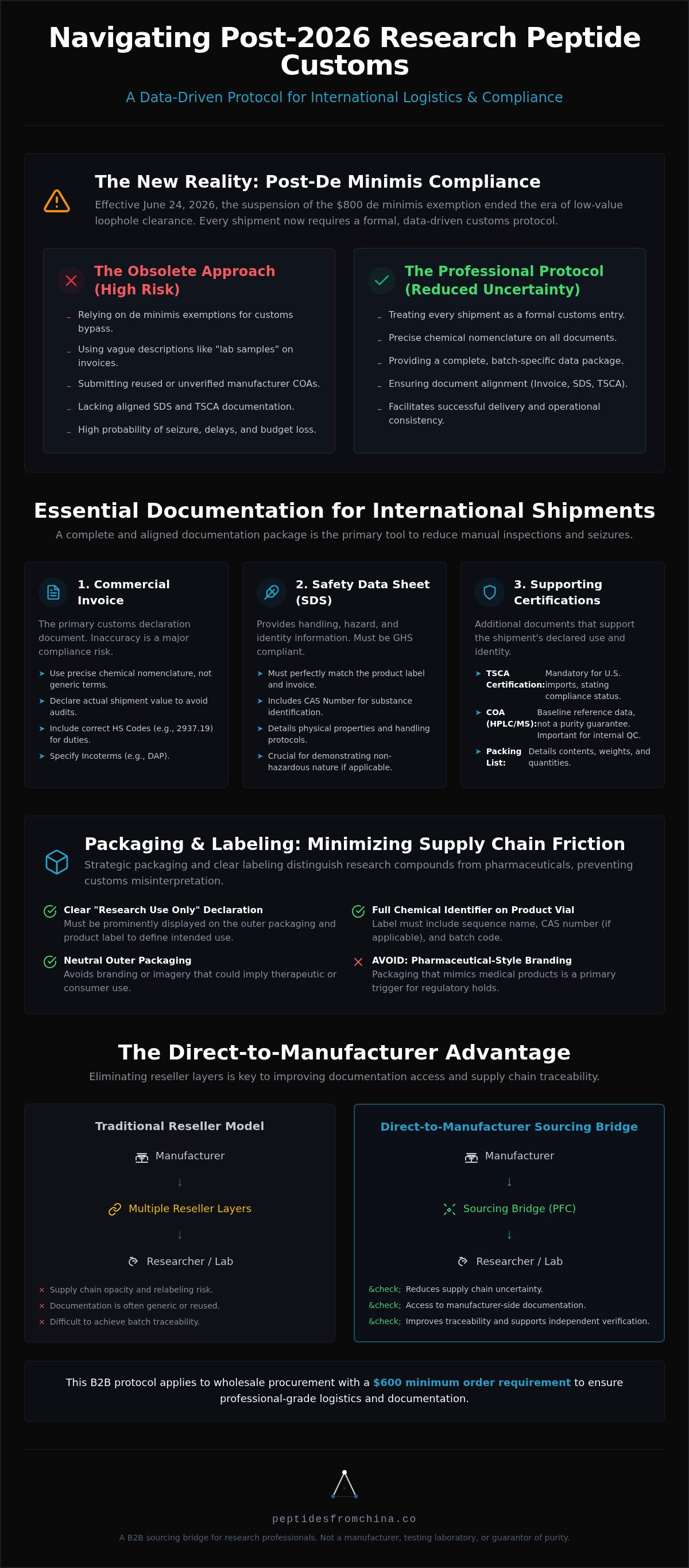
Customs authorities like the CBP or Zoll view lyophilized peptide powders through a strictly binary lens: they're either registered pharmaceuticals or "Research Use Only" (RUO) chemicals. Since the permanent suspension of the U.S. de minimis rule on June 24, 2026, every commercial shipment requires formal or informal entry procedures. This shift has eliminated the low-value loophole, making research peptide customs clearance a technical documentation protocol rather than a game of chance. Because professional sourcing often lacks domestic US/EU warehousing, the burden of regulatory compliance falls entirely on the international logistics framework.
The RUO Designation and Laboratory Compliance
RUO materials are restricted to in-vitro laboratory research or animal studies under approved institutional protocols. They aren't intended for human consumption or therapeutic applications. Institutional procurement requires a clear end-use declaration to satisfy customs. A frequent regulatory pitfall is the use of vague descriptions on commercial invoices that trigger manual inspections. When sourcing through a B2B bridge like Peptides From China, documentation must explicitly state the non-clinical nature of the compound. This helps reduce supply chain uncertainty by providing a clear paper trail for customs officers who prioritize "intended use" as an enforcement trigger.
International Substance Scheduling and Restrictions
Substance scheduling varies significantly by jurisdiction. While compounds like BPC-157, GHK-Cu, or TB-500 are standard in research environments, certain national health agencies may flag specific sequences for additional scrutiny. It's the buyer's responsibility to verify the legal status of a sequence within their specific region.
CAS Number Verification: Cross-reference the CAS number against local chemical substance control laws, such as Japan's METI CSCL updates from June 2026.
TSCA Certification: For U.S. imports, a Toxic Substances Control Act certification is mandatory to state that the shipment is either compliant or not subject to TSCA regulations.
SDS Alignment: The Safety Data Sheet must perfectly match the chemical identity on the product label and the commercial invoice.
Transparency in chemical identity supports independent verification and prevents the delays associated with mislabeled ingredients. For professional buyers, the $600 minimum order requirement ensures that shipments are handled with professional-grade logistics. This methodical approach provides the reference analytical data needed to maintain operational consistency without the risks associated with retail-level sourcing.
Essential Documentation for International Peptide Shipments
Documentation serves as the first line of defense in research peptide customs clearance. Because customs agents lack the equipment to verify a substance’s identity in the field, they rely entirely on the digital and physical data accompanying the parcel. Incomplete paperwork is the most common trigger for manual inspections and subsequent seizures. Professional sourcing requires a documentation package that includes a Commercial Invoice, a detailed Packing List, and a Safety Data Sheet (SDS) compliant with GHS standards.
Structuring the Commercial Invoice for Transparency
The invoice must use precise chemical nomenclature rather than generic descriptions like "protein powder" or "lab samples." Vague terminology is a red flag for undervaluation or misclassification. It’s essential to declare the actual value of the shipment; artificial price suppression often leads to audits that delay entire supply chains. When selecting Incoterms, DAP (Delivered at Place) is common, but it places the responsibility for import duties on the buyer. For those navigating complex jurisdictions, consulting the NIDA Import Guidelines can provide clarity on the documentation required for specific research categories.
Technical Reporting as Reference Material
A Certificate of Analysis (COA) containing HPLC and Mass Spectrometry data should be treated as baseline technical reference material. It’s a common industry flaw to view a manufacturer-issued COA as a definitive guarantee of purity. In reality, these documents can be reused across multiple batches or substituted entirely. Professional buyers use these papers as a starting point for peptide testing and independent verification. Every packing list should include batch-specific lot numbers that correspond exactly to the labels on the vials and the exterior of the shipping container.
By using a B2B sourcing bridge like Peptides From China, researchers gain access to manufacturer-side documentation that improves traceability. The $600 minimum order requirement ensures that your shipment receives the professional-grade logistics attention necessary for consistent research peptide customs clearance. This methodical approach helps reduce supply chain uncertainty and ensures that laboratory operations aren't disrupted by preventable administrative errors.
Packaging and Labeling: Minimizing Supply Chain Friction
The physical presentation of a shipment is just as critical as its digital documentation. While many retail-focused guides emphasize complex cold chain logistics, lyophilized research peptides are generally stable at ambient temperatures for the duration of standard international transit. This stability allows for more flexible packaging options that prioritize security and regulatory compliance. Effective research peptide customs clearance depends on a packaging strategy that balances technical transparency with the discretion required for professional B2B logistics.
Neutral Packaging and Discretionary Protocols
Standard retail packaging, often characterized by vibrant branding and marketing claims, acts as a magnet for customs scrutiny. For professional labs, neutral packaging is a strategic choice that helps reduce supply chain uncertainty. By using plain, industrial-grade materials, manufacturers can improve traceability without inviting unnecessary delays from agents who might misinterpret retail-style branding as a sign of pharmaceutical-grade products intended for consumers. Best practices for multi-vial wholesale shipments involve secure, vibration-resistant internal structures that protect vial integrity while maintaining a low-profile exterior.
Labeling for Regulatory Clarity
Labeling isn't just about identification; it's a legal declaration of intended use. Every vial and secondary container must carry clear "For Research Use Only" and "Not for Human Consumption" disclaimers. When managing bulk peptides orders, standardizing these labels across the entire batch is essential for institutional compliance. This consistency prevents the administrative friction that occurs when labels differ from the accompanying Safety Data Sheet (SDS) or commercial invoice.
A significant risk in the traditional reseller market is relabeling or batch substitution during transit. Intermediaries often strip original manufacturer labels to apply their own branding, which obscures the compound's origin and increases the chance of documentation mismatches. Sourcing through a B2B bridge like Peptides From China ensures that manufacturer-side packaging protocols remain intact. With a $600 minimum order requirement, shipments are handled with the professional-grade logistics necessary for consistent research peptide customs clearance. This direct-to-manufacturer approach minimizes the layers of handling, ensuring that the physical labels on your vials match the reference analytical data provided at the point of synthesis.
Managing Duties, VAT, and Compliance Risks
Financial predictability in laboratory procurement depends on accurate tariff classification and an understanding of regional tax obligations. Since the U.S. suspended the de minimis exemption in mid-2026, every commercial parcel is now subject to formal or informal entry. This means research peptide customs clearance costs must be factored into the initial procurement budget. Failure to classify compounds correctly doesn't just lead to unexpected duties; it triggers customs audits that can flag your institution for future inspections.
HS Code Classification and Tariff Engineering
The Harmonized System (HS) is the universal language of global trade. For most synthetic research peptides, the standard classification is HS Code 2937.19, which covers "polypeptides, glycosylated proteins and glycoproteins." Using a generic or incorrect code to lower duty rates is a high-risk practice known as "tariff engineering" that often leads to shipment seizures. When utilizing a peptide sourcing platform, ensure the manufacturer provides the specific HS code on the commercial invoice. This helps reduce supply chain uncertainty by aligning the declared value with the technical nature of the compound.
VAT rates vary significantly by jurisdiction, such as the 19% MwSt in Germany or similar import taxes across the EU. Managing these costs requires precise documentation of the transaction value. The $600 minimum order requirement at Peptides From China is an operational safeguard. It ensures that the shipment volume justifies the administrative overhead of professional-grade logistics, making the per-unit cost of compliance more manageable for serious researchers.
Mitigating Seizure and Delay Risks
Shipment delays often stem from "red flag" shipping routes or transit hubs known for high-risk activity. Professional logistics involves selecting carriers that provide robust digital tracking and integrated customs data. If a shipment is held, the response must be methodical. Don't rely on vague promises from a reseller; instead, provide customs with the specific Safety Data Sheet (SDS) and the end-use declaration immediately. Understanding the difference between a peptide sourcing agent vs platform is critical here. A platform provides direct manufacturer-side communication, which is essential when customs officials demand technical clarification on chemical identities.
To maintain your institutional research schedule, always have a contingency plan that accounts for a 5-7 day customs buffer. You can access manufacturer-side channels through our B2B bridge to ensure your documentation is prepared according to 2026 regulatory standards. This transparency-first approach improves traceability and helps labs navigate the complexities of international logistics without the typical anxieties of the reseller market.
The Direct-to-Manufacturer Advantage for Customs Reliability
Intermediaries are the primary source of friction in the international supply chain. Every reseller layer added between the synthesis lab and your facility increases the likelihood of a documentation mismatch. When a shipment passes through multiple warehouses for consolidation, the original manufacturer-issued papers are often replaced with generic or reused documents. This opacity makes research peptide customs clearance significantly more difficult, as customs agents prioritize the consistency and origin of chemical data over marketing claims.
Eliminating Intermediary Documentation Errors
Resellers frequently provide reused HPLC reports or generic COAs that don't correspond to the specific batch in transit. This practice is a major liability; if customs requests a specific synthesis record and the provided document is flagged as a duplicate from a previous year, the entire shipment is compromised. Direct-to-manufacturer sourcing improves the accuracy of the commercial invoice by ensuring that the chemical nomenclature and batch numbers are synchronized from the point of origin. This reduces the risk of batch substitution, a common issue where lower-quality synthesis runs are swapped into orders during the reseller's consolidation process.
Professional Procurement with PFC
Peptides From China (PFC) operates as a transparency-focused B2B sourcing bridge, connecting institutional buyers directly to manufacturer-side channels. We don't portray ourselves as a manufacturer or a testing laboratory. Instead, we act as an analytical filter that helps researchers bypass reseller layers. Our model utilizes a $10 processing deposit to initiate manufacturer verification, ensuring that the facility has the capacity and documentation ready before you commit to a full order.
This direct routing improves traceability for complex sequences, such as the tb-500 peptide or other specialized research compounds. By maintaining a wholesale minimum order of $600, we ensure that every shipment is handled with the professional-grade logistics required for 2026 regulatory compliance. This approach doesn't offer a "guaranteed" outcome, but it provides the reference analytical data and manufacturer-issued papers necessary to support independent verification by your own lab. Successful delivery depends on this methodical protocol, moving your procurement away from the uncertainties of the retail market and toward a structured, manufacturer-side supply chain.
Securing Your Research Supply Chain for 2026
The 2026 regulatory landscape has shifted the focus from logistical loopholes to technical documentation and manufacturer-side transparency. Successfully managing research peptide customs clearance now requires a rigorous alignment of commercial invoices, Safety Data Sheets, and specific HS codes like 2937.19. By transitioning from the fragmented reseller market to a direct-to-manufacturer sourcing model, labs can significantly improve traceability and reduce the risk of batch substitution.
Peptides From China (PFC) serves as a dedicated B2B sourcing bridge, providing institutional researchers with manufacturer-direct COA verification and neutral packaging protocols. While no single document fully guarantees product purity, our methodical approach helps reduce supply chain uncertainty and supports your own independent laboratory verification. We provide the professional-grade tracking and documentation necessary for consistent delivery.
When you're ready to bypass intermediary layers and stabilize your procurement schedule, start your professional sourcing process with a $600 wholesale order. Establishing a transparent, direct supply line is the most effective way to ensure your research remains on schedule. We look forward to supporting your institutional goals with factual integrity and reliable logistics.
Frequently Asked Questions
Is it legal to import research peptides from China for laboratory use?
It is legal to import these compounds provided they are strictly intended for in-vitro laboratory research and not for human or clinical use. Compliance relies on accurate labeling and documentation that matches the product's intended application. Since the suspension of the $800 de minimis rule in 2026, every shipment must undergo formal entry procedures. This shift ensures that all imports are fully declared, which helps reduce supply chain uncertainty for professional institutions.
What happens if my peptide shipment is seized by customs?
If a shipment is held, customs authorities typically issue a formal notice of seizure or a request for information. You'll need to provide a Safety Data Sheet (SDS) and an end-use declaration immediately. In the 2026 regulatory environment, authorities prioritize chemical disclosure and intended use. Professional labs should have these documents prepared in advance. Sourcing through a B2B bridge helps ensure you have access to manufacturer-side papers to resolve these inquiries efficiently.
Which HS codes should be used for importing lyophilized peptides?
The standard Harmonized System code for many synthetic research peptides is 2937.19, covering polypeptides and glycoproteins. Using the correct HS code is a critical component of research peptide customs clearance to avoid audits and penalties. Incorrect classification is often viewed as tariff engineering, which can lead to permanent shipment flags. Professional procurement platforms ensure that manufacturer-issued commercial invoices utilize these specific, technically accurate codes to maintain operational consistency and transparency.
How much are the typical import duties and VAT for peptides in the US and EU?
Import duties vary significantly by jurisdiction and specific chemical classification. In the U.S., the permanent suspension of the de minimis exemption means all commercial shipments are subject to duties regardless of value. In the EU, you should expect to pay the standard VAT rate, such as Germany's 19% MwSt, plus applicable customs duties. Managing these costs requires an accurate transaction value on the commercial invoice to ensure laboratory procurement budgets remain predictable and compliant.
Does 'neutral packaging' mean the shipment is not declared correctly?
No, neutral packaging refers to the use of plain, industrial-grade materials that avoid retail-style marketing claims or vibrant branding. The shipment remains fully and accurately declared on all customs documents, including the commercial invoice and TSCA certification. This strategy improves traceability and reduces unnecessary transit delays caused by agents who might misinterpret retail branding as a sign of pharmaceutical-grade products. It's a professional B2B protocol designed to prioritize factual integrity over superficial flair.
Do I need a special license to import research-grade peptides?
Most jurisdictions don't require a specific peptide license for compounds designated for Research Use Only (RUO). However, you must comply with standard chemical import regulations, such as the mandatory TSCA certification in the United States. Institutional buyers must also provide an end-use declaration to confirm the materials won't be used for clinical or human applications. Professional logistics handling, supported by a $600 minimum order, ensures that these administrative requirements are met before the shipment reaches the border.
How does direct-to-manufacturer sourcing improve customs clearance rates?
Direct-to-manufacturer sourcing improves clearance rates by eliminating the documentation errors common in the reseller market. Intermediaries often provide reused COAs or generic invoices that don't match the specific batch in transit. By accessing manufacturer-side channels, you ensure that the HPLC reports and Safety Data Sheets are batch-specific and technically accurate. This transparency-first approach provides customs officials with the consistent data they require, significantly reducing the likelihood of manual inspections or documentation-related holds.
Can I import peptides for personal research use, or is it only for businesses?
Customs authorities in 2026 have increased scrutiny on shipments that appear to be for personal use rather than institutional research. The $600 minimum order at Peptides From China is specifically designed for B2B buyers and professional laboratories who require operational consistency. Importing under a business or institutional name with a clear research protocol is the most reliable way to navigate international logistics. Personal use imports often lack the robust documentation required to satisfy modern chemical disclosure standards.