
Relying on a single domestic reseller for high-purity research materials was always a fragile procurement strategy. As the industry evolves in 2026, finding a viable peptide sciences alternative asia requires looking past the polished retail front-ends and moving directly toward the manufacturing layer. You've likely dealt with supply chain opacity, recycled HPLC reports that don't match your current batch, and the steep markups that come with domestic middleman structures. It's a frustrating cycle of uncertainty that often leads to inconsistent results and inflated research budgets.
We'll show you how to establish a direct line to Asian synthesis facilities, allowing you to bypass unnecessary layers while implementing a rigorous, repeatable verification protocol. This guide covers the latest 2026 export regulations, including China's expanded export control catalogue and Singapore's new CMC dossier requirements. You'll learn how to treat manufacturer-issued papers as baseline technical data rather than definitive proof, necessitating independent testing for true quality assurance. We also outline the logistics of professional-grade procurement, such as the $600 minimum order requirement for Peptides From China wholesale channels, to help you reduce costs and improve batch traceability.
Key Takeaways
Understand why the 2026 market shift makes identifying a reliable peptide sciences alternative asia essential for researchers seeking to bypass high reseller markups and supply chain opacity.
Learn to treat manufacturer-issued HPLC and Mass Spectrometry reports as baseline technical reference material rather than definitive proof of quality, necessitating independent batch verification.
Distinguish between liquid phase and solid phase peptide synthesis (SPPS) capabilities when vetting facilities to ensure the manufacturing infrastructure aligns with your specific purity requirements.
Implement a repeatable verification protocol by requesting current batch-specific analytical data and utilizing small processing deposits before committing to full production runs.
Access manufacturer-side channels through Peptides From China (PFC) by utilizing a $10 processing deposit to initiate verification on orders meeting the $600 wholesale minimum.
Table of Contents
The 2026 Peptide Landscape: Why Researchers are Shifting to Asian Sources
Evaluating Synthesis Facilities: Beyond the Retail Website
Domestic Resellers vs. Direct Asian Sourcing: A Procurement Comparison
Verification Protocols for Asian Peptide Batches
Peptides From China: Your B2B Bridge to Verified Synthesis
The 2026 Peptide Landscape: Why Researchers are Shifting to Asian Sources
The March 6, 2026, closure of Peptide Sciences triggered an immediate supply vacuum for laboratories across North America. This event exposed a fundamental vulnerability in the research market: the over-reliance on domestic resellers who function as black boxes. For many, finding a viable peptide sciences alternative asia isn't just about cost; it's about establishing direct-to-manufacturer visibility. The reality is that the vast majority of research-grade peptides have always originated in Asian synthesis facilities. Domestic resellers often act as relabeling hubs, adding significant markups while providing limited data on the actual batch history. By moving closer to the point of production, researchers can eliminate these unnecessary layers and gain better control over their procurement timelines.
The Rise of Direct-to-Manufacturer Channels
Bypassing domestic warehouses requires a transition from the retail "add-to-cart" mindset toward a structured B2B procurement protocol. This shift is driven by the need for transparency that domestic stores rarely provide. Professional researchers now seek out a peptide sourcing platform that facilitates direct communication with synthesis facilities. These platforms help reduce supply chain uncertainty by allowing buyers to verify the manufacturer's actual capacity and operational standards. Instead of relying on a middleman's inventory, labs can secure material that hasn't been sitting in a third-party warehouse for months, potentially degrading in sub-optimal conditions. It's a more methodical approach that prioritizes factual integrity over marketing convenience.
Understanding Synthesis Standards in 2026
In 2026, purity benchmarks for research-grade materials remain high, but the method of verification has become more critical. Understanding the technical nuances of the peptide synthesis process is essential for vetting a facility's true capacity. Many "US-made" claims mask a complex international synthesis path where the bulk product is synthesized abroad and merely finished or bottled domestically. B2B buyers now prioritize batch-specific traceability over regional marketing claims. They recognize that a manufacturer-issued COA is only a baseline reference. Reliable sourcing involves verifying the facility's ability to provide consistent HPLC and Mass Spectrometry data for the specific batch being purchased. This data supports independent verification and ensures that the material meets the specific requirements of the research protocol. As customs oversight in regions like Japan and South Korea tightens, having a direct link to the manufacturer ensures that all necessary export documentation is accurate and compliant with the latest 2026 regulations.
Evaluating Synthesis Facilities: Beyond the Retail Website
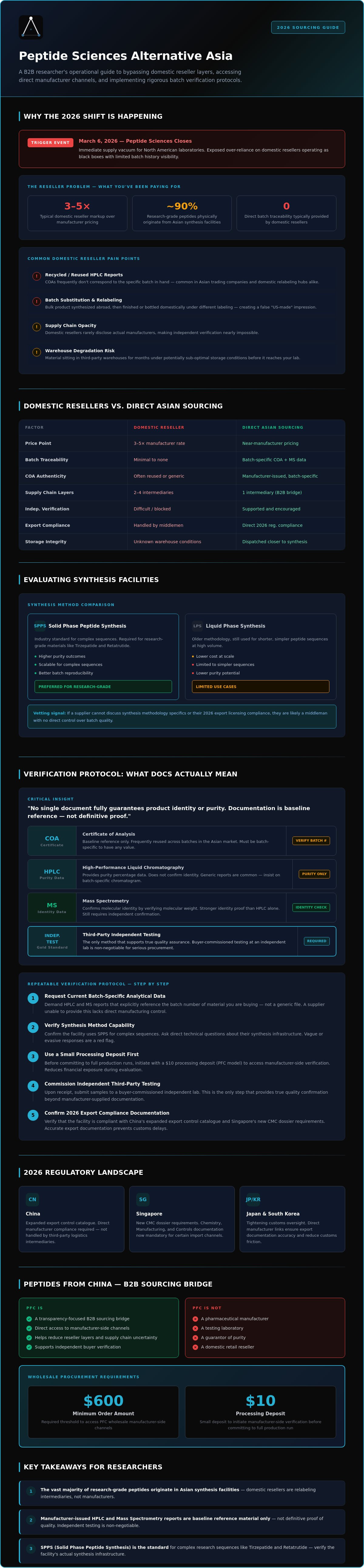
Vetting a peptide sciences alternative asia requires a move away from aesthetic trust and toward technical verification. A professional website does not equate to a synthesis facility. Most Asian manufacturing hubs consist of either dedicated synthesis plants or high-volume trading companies. To ensure consistency, buyers must verify whether a facility primarily utilizes Solid Phase Peptide Synthesis (SPPS) or liquid-phase methods. SPPS is generally the standard for the complex sequences found in research materials like Tirzepatide or Retatrutide. If a supplier can't discuss these operational specifics or provide details on their 2026 export licensing compliance, they're likely a middleman with no direct control over batch quality.
Technical Documentation: HPLC and Mass Spec
Documentation like a Certificate of Analysis (COA) should be viewed only as baseline reference material. In the Asian market, it's common to encounter reused HPLC reports or generic papers that don't correspond to the specific batch in hand. High-performance liquid chromatography (HPLC) provides data on purity, while Mass Spectrometry (MS) confirms the product's identity by verifying its molecular weight. Without both, the risk of batch substitution or relabeling increases significantly. For those sourcing peptides from China, relying on manufacturer-issued data alone is insufficient. True quality assurance requires independent peptide testing conducted by a third-party lab to validate the manufacturer's claims. This independent step is the only way to confirm that the material received matches the reference analytical data provided during the procurement phase.
Operational Transparency in Asia
Distinguishing between a true synthesis plant and a trading company is vital for long-term supply chain security. Trading companies often source from multiple small labs, leading to variable synthesis quality between orders. Direct facilities offer better traceability and are more likely to accommodate specific requests for neutral packaging or discreet logistics. These measures help minimize customs friction, especially following the 2026 updates to China's Dual-Use Items and Technologies export catalogue. Direct sourcing supports improved traceability for large-volume orders, which is a priority for professional labs. Working with a partner that facilitates direct communication with synthesis facilities helps reduce supply chain uncertainty. For those ready to move beyond retail layers, professional procurement typically requires a $600 minimum order to maintain operational efficiency and batch consistency.
Domestic Resellers vs. Direct Asian Sourcing: A Procurement Comparison
Choosing a peptide sciences alternative asia involves weighing the immediate availability of domestic stock against the transparency and lower price-per-mg of manufacturer-direct channels. Domestic resellers often justify their high markups by highlighting same-day shipping or local customer service. However, this convenience masks a "middleman tax" that can double or triple your research costs. Beyond the price, the chain of custody is often obscured. When you buy from a reseller, the material has likely passed from a manufacturer to a trading company before reaching a domestic warehouse. This creates multiple points where storage conditions are unmonitored and batch traceability can be lost.
Inventory freshness is another critical factor. Resellers buy in bulk to maximize their own margins, which means the vials you receive might have been sitting in a warehouse for months. Direct sourcing ensures you're accessing material from recent synthesis runs. This direct access also provides the flexibility needed for custom synthesis, allowing researchers to request specific salt forms or concentrations that retail stores simply don't carry. To maintain professional standards, buyers should reference the European Medicines Agency (EMA) guideline on the manufacture of synthetic peptides to understand the quality benchmarks that direct-to-manufacturer channels should meet.
The Economics of Wholesale Procurement
For institutions conducting long-term studies, the ROI of wholesale peptides is undeniable. By eliminating the reseller layer, labs can reallocate significant portions of their budget toward more frequent independent testing. In the Asian B2B sector, a $600 minimum order is the standard threshold for professional-grade procurement. This minimum ensures that the synthesis facility can maintain operational efficiency while providing the necessary batch-specific analytical data. Small-scale retail purchases rarely include the level of documentation required for rigorous research, as the costs of providing current HPLC and MS reports for single vials are prohibitive for most manufacturers.
Logistical Realities of International Sourcing
Transitioning to international sourcing requires managing longer lead times compared to off-the-shelf domestic availability. While a domestic reseller might ship in 24 hours, a direct synthesis run and international transit can take 10 to 14 days. Navigating 2026 customs protocols also requires a more sophisticated approach. Following the updated export controls in China and Japan, professional sourcing platforms utilize neutral packaging and accurate documentation to minimize friction. To address the inherent anxieties of international payments, many manufacturers now accept small verification deposits. This allows buyers to initiate the verification of a batch's analytical data before committing the full balance of a wholesale order, which helps reduce supply chain uncertainty and builds a more methodical procurement relationship.
Verification Protocols for Asian Peptide Batches
Establishing a repeatable verification protocol is the only way to manage a peptide sciences alternative asia with the necessary scientific rigor. You shouldn't treat manufacturer-issued papers as definitive proof of quality. Instead, they serve as baseline technical reference material that must be validated through a structured, multi-step process. This methodical approach helps reduce supply chain uncertainty by shifting the burden of proof from the seller's marketing claims to independent analytical data.
The first step in a professional procurement cycle is requesting current batch-specific HPLC and MS reports before any major funds transfer. Ensure the molecular weight on the MS report aligns perfectly with the theoretical value of the peptide sequence. Once this baseline is established, utilize a small processing deposit, such as the $10 fee used by professional platforms, to initiate the manufacturer verification phase for your specific batch. This small commitment allows you to lock in the batch while performing due diligence. Upon receipt of the shipment, implement blind third-party testing at an independent laboratory. Cross-referencing these independent results with the manufacturer's reference analytical data is the only way to support independent verification. Finally, establish a feedback loop with the synthesis facility. Consistent data over multiple batches improves traceability and builds a more reliable procurement history for your lab.
Interpreting HPLC Data Correcty
When reviewing HPLC chromatograms, look beyond the reported purity percentage. Analyze the baseline noise and the presence of any "ghost peaks" or secondary signals that might indicate incomplete synthesis or degradation. Many suppliers claim "99% pure" as a generic marketing baseline, but true research-grade quality requires a clean baseline with minimal impurities. Another critical factor is the documentation of TFA (Trifluoroacetic acid) removal. TFA is a common byproduct of the peptide synthesis process that can be toxic in certain research models. Professional sourcing ensures that TFA content is minimized and documented in the final report.
The Role of the Sourcing Intermediary
Understanding how a peptide sourcing agent vs platform differs in their verification approach is essential for large-scale procurement. While an agent might simply act as a broker, a platform like PFC provides the logistical infrastructure to bridge the gap between labs and synthesis facilities. It's important to recognize that PFC acts as a transparency-focused bridge rather than a guarantor of purity. The platform helps researchers access manufacturer-side channels while maintaining the $600 minimum order requirement necessary for wholesale efficiency. Ready to implement a more transparent procurement strategy? You can access manufacturer-side channels through our professional B2B platform and begin building your own library of reference analytical data.
Peptides From China: Your B2B Bridge to Verified Synthesis
Implementing the rigorous verification protocols discussed in previous sections requires a partner that understands the operational realities of the Asian manufacturing sector. Peptides From China (PFC) functions as a transparency-focused B2B sourcing bridge, specifically designed to help researchers move beyond the limitations of domestic resellers. By connecting labs directly to synthesis facilities, PFC helps reduce supply chain uncertainty and eliminates the significant markups typically found in retail channels. This model provides a practical peptide sciences alternative asia for those who prioritize factual accuracy and batch traceability over marketing convenience.
The PFC operational model is built on a "transparency-first" approach. For professional buyers, this involves a $600 minimum order requirement, which ensures that the synthesis facility can maintain the efficiency needed for wholesale procurement. To initiate the verification of current manufacturer stock, buyers utilize a $10 processing deposit. This small commitment allows the platform to secure reference analytical data for specific batches of compounds such as BPC-157 and Semaglutide before the full procurement cycle begins. It's a methodical way to verify that the manufacturer's current inventory aligns with your research requirements before significant capital is committed.
Logistical consistency is managed through discreet, neutral packaging and end-to-end tracking. This helps minimize friction with international customs authorities, particularly as the 2026 export regulations in China and Japan continue to evolve. By maintaining a direct line to the synthesis facilities, PFC provides a higher level of oversight regarding storage conditions and transit protocols than is possible with domestic black-box resellers.
Accessing the Wholesale Sourcing Channel
Requesting specific research compounds like Tirzepatide, Retatrutide, or GHK-Cu through PFC involves a structured inquiry process. Researchers can request current batch-specific HPLC and Mass Spectrometry data to serve as a technical baseline. The $10 deposit supports this verification phase, allowing labs to review the manufacturer's reference analytical data for the exact batch they intend to purchase. This system is particularly effective for managing large-scale procurement for institutional research projects, where batch consistency is non-negotiable and supply chain opacity is a primary risk factor.
Commitment to Transparency-First Sourcing
PFC prioritizes technical integrity over the hyperbolic claims common in the retail market. We don't position ourselves as a pharmaceutical manufacturer or a testing laboratory; instead, we act as a strategic filter that helps you navigate the complexities of the global market. While we provide manufacturer-verified batches, we emphasize that no single document fully guarantees product identity. We encourage all buyers to implement independent third-party testing to support operational consistency and validate the reference data provided by the facility. This balanced approach helps improve traceability and supports a more realistic understanding of international sourcing dynamics. Ready to optimize your procurement? Initiate your B2B sourcing request with Peptides From China today.
Securing a Methodical Sourcing Channel
Navigating the post-2026 market requires moving beyond the convenience of retail websites and adopting a professional B2B procurement protocol. By identifying a reliable peptide sciences alternative asia, laboratories can establish direct-to-manufacturer pricing structures while gaining better visibility into the synthesis process. Success in this market depends on treating manufacturer-issued documentation as a technical baseline and prioritizing independent verification to manage batch consistency. This methodical approach helps reduce supply chain uncertainty and ensures your research is supported by recent synthesis runs rather than aged reseller stock.
Peptides From China provides the logistical framework necessary to access these manufacturer-side channels. Our platform facilitates COA-verified batches and utilizes neutral packaging for global shipping to minimize customs friction. By eliminating the middleman tax, you can reallocate your budget toward more frequent third-party testing and higher-volume procurement. If you're ready to implement a more transparent and cost-effective sourcing strategy, we're here to bridge the gap. We look forward to helping you stabilize your research supply chain.
Start your direct-to-manufacturer sourcing request ($600 minimum)
Frequently Asked Questions
Is it legal to source research peptides directly from Asia in 2026?
Sourcing peptides for laboratory research is legal when conducted under the Research Use Only (RUO) classification. In 2026, you must navigate updated export catalogues in China and the new licensing regimes in Singapore. Buyers are responsible for ensuring their procurement aligns with local regulations. Direct sourcing as a peptide sciences alternative asia requires maintaining a clear distinction between research materials and therapeutic products to avoid regulatory friction.
What is the minimum order requirement for Peptides From China?
The minimum order requirement for all wholesale procurement through Peptides From China is $600. This threshold is established to ensure that the synthesis facilities can operate at a professional B2B scale. It allows for the inclusion of batch-specific documentation and supports the logistical costs of international shipping. Smaller retail orders don't allow for the same level of batch traceability or manufacturer-side verification.
How can I verify that a Chinese manufacturer is actually synthesising the peptides?
Verification requires a combination of technical documentation and operational transparency. You should request batch-specific HPLC and Mass Spectrometry reports as a baseline. A true manufacturer will be able to discuss synthesis methods, such as Solid Phase Peptide Synthesis (SPPS), and provide current reference analytical data. Working through a transparency-focused platform helps you bypass trading companies that often lack direct control over the synthesis environment.
What happens if a batch does not meet the purity standards in my independent test?
Independent test results serve as the objective basis for any batch resolution with the synthesis facility. If your third-party laboratory finds that a batch doesn't meet the reference analytical data provided, you should present these findings to the manufacturer immediately. Establishing this feedback loop is a core part of professional procurement. It helps reduce supply chain uncertainty and ensures that future batches align more closely with your laboratory's specific metrics.
Does Peptides From China provide HPLC and MS reports for every batch?
Yes, manufacturer-issued HPLC and MS reports are provided for every batch as baseline technical reference material. It's vital to remember that these documents are not definitive proof of purity or identity. We provide them to support independent verification by the buyer. You should always conduct your own blind testing to validate these reports and ensure the material meets your research protocol standards.
How long does shipping typically take from China to a US-based laboratory?
International shipping from Chinese synthesis facilities to US-based laboratories typically takes between 10 and 14 days. This timeline accounts for neutral packaging preparation and customs clearance. Following the expansion of China's export control catalogue in May 2026, documentation requirements have become more stringent. This can occasionally lead to minor transit delays; however, end-to-end tracking is provided to maintain visibility throughout the process.
Why is there a $10 deposit required for sourcing requests?
The $10 deposit is a processing fee used to initiate the verification of current manufacturer stock for your specific request. This small commitment allows the platform to secure current HPLC and MS data for a batch before you commit to the full $600 minimum. It's a methodical step that protects the buyer by ensuring the desired material is available and documented before the full funds transfer occurs.
Can I request custom peptide synthesis through the PFC platform?
Custom synthesis is available through our direct-to-manufacturer channels for researchers with specific sequence requirements. Unlike retail stores that only offer off-the-shelf vials, direct access allows you to request tailored salt forms, specific concentrations, or unique peptide sequences. This flexibility is a significant advantage for labs looking for a peptide sciences alternative asia that can adapt to evolving research protocols and long-term institutional studies.