
A Certificate of Analysis is no longer a badge of quality. In 2026, it's often just a piece of digital fiction used to mask supply chain gaps and batch substitutions. You’ve likely experienced the frustration of domestic resellers who demand high markups while offering nothing more than a reused HPLC report from a different production run. This opacity makes it nearly impossible to confirm if your peptidefacility is actually maintaining the synthesis standards they claim. It’s a systemic issue that leaves researchers and B2B buyers carrying all the risk while intermediaries take all the profit.
We're going to change that by providing an operational deep-dive into how these facilities function and how you can navigate manufacturer-direct sourcing to reduce supply chain uncertainty. This article outlines the reality of batch traceability and explains the impact of the 2026 FDA regulatory shifts on procurement. PeptidesFromChina currently has a $600 total minimum order. Multiple catalog products can be combined to reach the minimum, with orders starting from one 10-vial kit per product. We will cover why independent verification is your only real safeguard and how to move beyond baseline technical papers to establish a reliable, manufacturer-side supply channel.
Key Takeaways
Distinguish between true synthesis laboratories and domestic resellers to identify where supply chain opacity and markups begin.
Evaluate the technical limitations of HPLC and MS reports to understand why manufacturer-issued papers serve only as baseline reference material.
Examine the Solid-Phase Peptide Synthesis (SPPS) process to recognize how manufacturing stages like cleavage impact final batch consistency.
Reduce supply chain uncertainty by sourcing directly through a verified peptidefacility to eliminate the risks of relabeling and batch substitution.
Master the logistics of professional wholesale procurement, including the $600 minimum order threshold required for manufacturer-side access.
Table of Contents
Defining the Peptide Facility: Manufacturer vs. Reseller Realities
The Anatomy of Peptide Production: Synthesis to Lyophilization
Assessing Facility Documentation: HPLC, MS, and the Verification Gap
Risks of Indirect Sourcing: Relabeling and Batch Substitution
Direct Sourcing Logistics: Optimizing Laboratory Procurement
Defining the Peptide Facility: Manufacturer vs. Reseller Realities
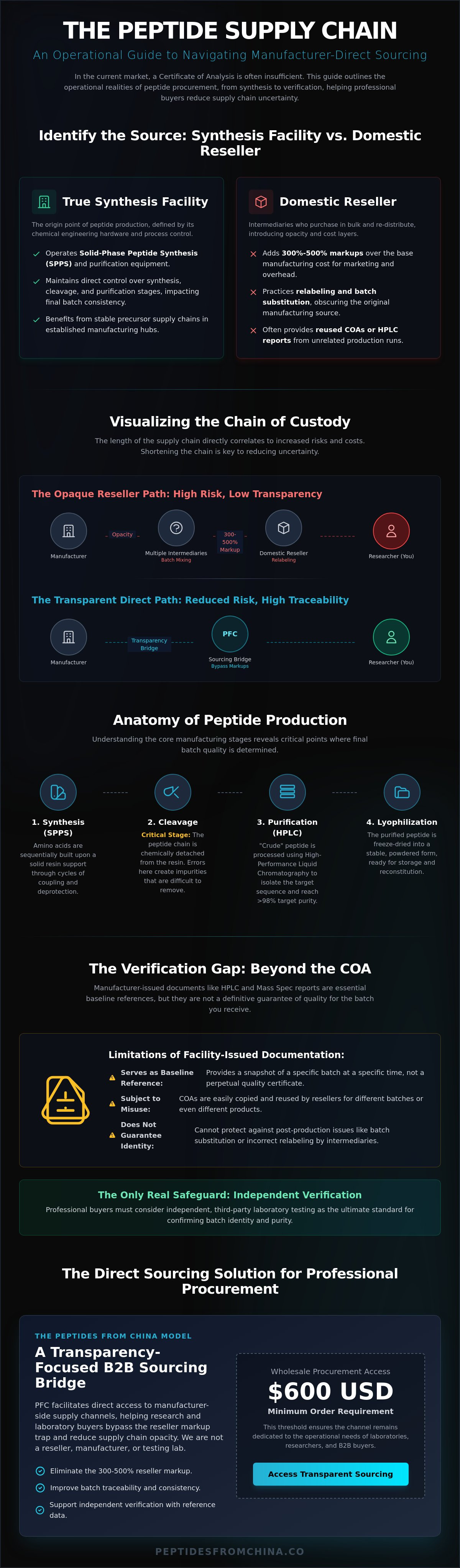
A legitimate peptidefacility is defined by its hardware and chemical engineering capacity, not its digital marketing presence. In the current 2026 market, a fundamental distinction exists between a synthesis laboratory and a domestic reseller. A true facility is an industrial environment dedicated to Peptide synthesis, specifically utilizing Solid-Phase Peptide Synthesis (SPPS) protocols. These laboratories house the reactors, filtration systems, and lyophilization equipment necessary to build amino acid chains from scratch. Most entities branding themselves as "peptide companies" are actually secondary or tertiary distributors who never touch the raw synthesis process. They operate out of small warehouses or fulfillment centers, purchasing bulk batches from international manufacturers and relabeling them for the retail market.
Manufacturer-side sourcing can reduce some intermediary risk, but it does not eliminate batch-substitution, relabeling, traceability, or supply-continuity risks. Buyers should define specifications, review available information, and arrange independent verification where required.
The Role of the Synthesis Laboratory
Core operations within a synthesis lab revolve around amino acid sequencing, purification, and the final lyophilization stage. These facilities don't just "make peptides"; they manage complex chemical reactions that require precise temperature controls and high-grade solvents. Production scales vary significantly. Some labs focus on small-scale research batches for custom sequences, while others operate at an industrial wholesale level. It's common for a peptidefacility to specialize in specific sequences like BPC-157, Semaglutide, or Tirzepatide. This specialization allows them to optimize their purification columns for higher yields and more consistent crude purity levels across large production runs.
The Reseller Markup Trap
Domestic distributors often add substantial markups to the base manufacturing cost. This price hike rarely reflects an improvement in quality; instead, it covers the reseller's marketing budget, domestic warehousing overhead, and profit margins. A significant risk in this model is "relabeling," where resellers intentionally obscure the original facility's identity to prevent buyers from price-shopping. Peptides From China (PFC) operates differently, acting as a transparency-focused B2B sourcing bridge. By facilitating direct access to manufacturer-side channels, PFC helps researchers avoid the reseller markup trap. This professional wholesale procurement model requires a $600 minimum order, ensuring the channel remains dedicated to serious research and laboratory needs rather than retail single-vial sales.
The Anatomy of Peptide Production: Synthesis to Lyophilization
The transition from raw amino acids to a stable, lyophilized product is a rigorous chemical progression. A professional peptidefacility utilizes Solid-Phase Peptide Synthesis (SPPS) as its primary manufacturing engine. This process involves anchoring the first amino acid to a solid resin and sequentially building the chain through repeated cycles of coupling and deprotection. Once the desired sequence is complete, the "cleavage" stage occurs. This is a high-stakes chemical reaction where the peptide is detached from the resin and its side-chain protecting groups are removed. Errors during cleavage lead to truncated sequences or permanent impurities that are nearly impossible to filter out later, directly impacting the quality of the final batch.
Once cleaved, the resulting material is known as "crude" peptide. It's far from research-grade at this point. To reach target purity levels of 98% or higher, the facility employs Preparative High-Performance Liquid Chromatography (Prep-HPLC). This stage separates the target peptide from synthesis byproducts and deleted sequences. While many retail sites claim "99% purity," professional buyers recognize these as theoretical targets rather than absolute guarantees. Real-world analytical data often shows variance between batches. Referencing FDA guidance on synthetic peptides provides a necessary framework for understanding how impurities are categorized and why strict manufacturing controls are essential to maintain consistency across large-scale production runs.
Purification and Quality Benchmarks
High-Performance Liquid Chromatography (HPLC) is the industry standard for assessing batch quality during and after production. It's important to distinguish between "crude" peptides, which might only be 60 to 70% pure, and the final purified product. A reputable peptidefacility will run multiple purification cycles to isolate the correct molecular weight. However, even with advanced Prep-HPLC, absolute purity is a moving target. Professional procurement requires looking at the actual chromatograms rather than just a summary percentage on a PDF. For those seeking to reduce supply chain uncertainty, accessing manufacturer-side data directly is the only way to verify these benchmarks. This level of transparency is a core feature of the wholesale procurement model, which requires a minimum order of $600 to access direct facility channels.
Lyophilization and Storage Standards
Lyophilization, or freeze-drying, is the final critical step in the production workflow. It removes solvents through sublimation under a vacuum, turning a liquid solution into a stable, cake-like powder. This process is vital for shelf-life and structural integrity during international transit. If the vacuum seal in the vial is compromised, the peptide becomes susceptible to moisture and rapid degradation. A facility must maintain strict temperature-controlled storage for bulk powder before vialing to prevent the breakdown of sensitive sequences. Proper sealing ensures that the product remains stable until it reaches the laboratory, supporting independent verification efforts by the end-user.
Assessing Facility Documentation: HPLC, MS, and the Verification Gap
Relying on a Certificate of Analysis (COA) as definitive proof of quality is a common procurement error. In the current market, these documents should be viewed as baseline technical reference material rather than a guarantee. When you receive paperwork from a peptidefacility, it represents the manufacturer's internal assessment of a specific production run. However, the industry is plagued by supply chain opacity where documentation is often disconnected from the physical product. Professional buyers must look past the matching batch numbers to identify the operational reality of the synthesis laboratory.
The "Verification Gap" refers to the space between what a manufacturer reports and what an independent laboratory confirms. Even a legitimate peptidefacility can experience batch substitution during the vialing or logistical stages. Because these documents are self-reported, they don't replace the need for third-party testing. Peptides From China (PFC) acts as a transparency-focused B2B bridge, providing original manufacturer-side data to help you reduce this uncertainty. PeptidesFromChina currently has a $600 total minimum order. Multiple catalog products can be combined to reach the minimum, with orders starting from one 10-vial kit per product.
How to Read an HPLC Report
High-Performance Liquid Chromatography (HPLC) is the primary method for quantifying purity levels. HPLC is a tool for measuring purity through light absorption. In a standard report, the "Peak Area" indicates the percentage of the target peptide relative to synthesis byproducts or truncated sequences. However, the prevalence of peptide manufacturing challenges often leads to documentation shortcuts. You should scrutinize reports for digital artifacts, such as inconsistent fonts or blurred timestamps, which suggest a report has been reused across multiple batches. A single HPLC chromatogram doesn't prove the identity of the substance; it only shows how pure that substance is.
Mass Spectrometry: Confirming Molecular Weight
Purity is irrelevant if the substance identity is incorrect. Mass Spectrometry (MS) is required to confirm that the synthesized chain actually matches the intended sequence. This process measures the molecular weight of the peptide, creating a unique "fingerprint" for the batch. If the measured result deviates from the theoretical molecular weight, the batch is either the wrong sequence or has suffered significant degradation. For a detailed breakdown of these protocols, consult our guide on Peptide Testing and Analysis. Comparing the facility's measured result against the known theoretical weight is a baseline requirement for any professional procurement process.
Risks of Indirect Sourcing: Relabeling and Batch Substitution
The domestic peptide market operates largely as a "Black Box" where the chain of custody is frequently lost the moment a shipment enters a local fulfillment center. When you buy from a domestic reseller, you're often purchasing stock that has passed through multiple intermediaries, each adding a layer of opacity. This indirect sourcing model creates an environment where batch substitution and relabeling become common operational shortcuts. A reseller holding excess inventory of a lower-purity batch may be tempted to relabel it to fulfill a high-purity order, especially when they know the end-user lacks the equipment for immediate verification. Sourcing directly from a verified peptidefacility helps reduce supply chain uncertainty by maintaining a straight line from the synthesis laboratory to your facility.
Batch substitution isn't the only concern; the physical handling of the product poses significant risks. Some resellers purchase bulk, unvialed powder to save on shipping costs and then "re-vial" the material in domestic environments that lack industrial-grade sterilization and vacuum-sealing equipment. This process exposes the peptide to atmospheric moisture and potential contaminants, which can lead to rapid degradation before the product even reaches your lab. By the time you receive the shipment, the reference analytical data provided may no longer reflect the actual state of the degraded material. Professional procurement teams prioritize direct-from-synthesis channels to ensure the product remains in its original, manufacturer-sealed state throughout the entire logistical journey.
The Problem with Domestic Warehousing
PFC provides commercial access to manufacturer-side channels and coordinates international logistics. Inventory age, batch traceability, packaging, and delivery routes vary and must be confirmed for the specific product and order; PFC does not guarantee fresh stock or universal traceability.
Ensuring Batch Integrity
Maintaining batch integrity requires obtaining manufacturer-issued papers that are unique to every specific production run. Professional laboratories don't accept generic, non-dated reports because they understand that synthesis quality fluctuates. Every unique batch should be accompanied by its own HPLC and MS data, which serves as the baseline for your own independent testing. If a supplier cannot provide documentation that matches the specific vial labels and production dates, the risk of receiving substituted material increases significantly. You can use our evaluating peptide research supply checklist to audit your current procurement protocols. PeptidesFromChina currently has a $600 total minimum order. Multiple catalog products can be combined to reach the minimum, with orders starting from one 10-vial kit per product.
Direct Sourcing Logistics: Optimizing Laboratory Procurement
Transitioning to a manufacturer-direct model requires a shift in procurement strategy. Accessing a peptidefacility directly is often restricted by high volume requirements, logistical complexities, or language barriers. Peptides From China (PFC) functions as a transparency-focused B2B sourcing bridge designed to navigate these hurdles. Unlike domestic resellers, PFC doesn't hold stock in local warehouses or relabel products. Instead, it provides a direct channel to production facilities, allowing researchers to bypass the markups and opacity associated with middlemen. This model supports independent verification by ensuring the reference analytical data you receive is directly tied to the manufacturer’s current production run.
By shortening the supply chain, you minimize the number of hands that touch the product, which helps reduce supply chain uncertainty. Professional procurement in 2026 is no longer about finding the lowest price but about securing the most transparent route to the synthesis laboratory. This approach allows for better batch-to-batch consistency and ensures that the technical documentation provided serves as a reliable baseline for your own internal quality control protocols. When the "black box" of domestic warehousing is removed, the path from synthesis to the laboratory becomes a clear, traceable line.
The Peptides From China (PFC) Model
PFC is positioned specifically as a logistical bridge, not as a pharmaceutical manufacturer or a testing laboratory. Its primary utility is the removal of reseller layers, which inherently improves traceability. By facilitating direct communication with synthesis labs, the model allows professional buyers to source high quality peptides without the risks of batch substitution found in the retail market. Products are subject to the manufacturer’s applicable quality-control procedures and specifications. Manufacturer-side analytical documentation may be available depending on the product and batch. PeptidesFromChina is not an independent analytical testing laboratory. Instead, it provides the necessary transparency and manufacturer-side access for you to conduct your own independent laboratory verification.
Executing the Wholesale Order
Professional procurement begins with a $10 processing deposit. This small fee initiates the manufacturer verification process and confirms the current availability of specific batches within the peptidefacility. Once the stock is approved and the technical papers are reviewed as a baseline reference, the deposit is credited toward the final wholesale invoice. PeptidesFromChina currently has a $600 total minimum order. Multiple catalog products can be combined to reach the minimum, with orders starting from one 10-vial kit per product. This threshold ensures the supply chain remains dedicated to professional researchers and B2B buyers rather than retail single-vial consumers.
International logistics for research compounds demand specialized handling. Neutral packaging and comprehensive tracking are standard protocols to ensure the secure transit of materials from the production site to the laboratory. These measures help manage the complexities of global shipping and ensure that the vacuum-sealed vials reach their destination without structural damage. Once the shipment arrives, the buyer assumes the responsibility for independent testing to confirm the identity and purity of the batch, completing the cycle of a transparency-first procurement model.
Implementing a Transparency-First Sourcing Strategy
Professional procurement requires looking past the surface level of digital marketing and domestic markups. You now understand that a true peptidefacility is a synthesis engine where chemical precision matters more than a polished reseller website. We’ve established that while HPLC and MS reports provide necessary reference analytical data, they don't replace the need for independent laboratory verification. By removing the reseller layers that lead to batch substitution and relabeling, you can significantly improve traceability and reduce supply chain uncertainty.
PFC coordinates sourcing from established Chinese manufacturing facilities together with international logistics. PeptidesFromChina currently has a $600 total minimum order. Multiple catalog products can be combined to reach the minimum, with orders starting from one 10-vial kit per product. You're invited to request a direct manufacturer quote with a $10 deposit to begin securing your laboratory's future supply. Establishing a direct, verifiable channel is the most effective way to ensure operational consistency in an increasingly complex market.
Frequently Asked Questions
What is the difference between a peptide facility and a reseller?
A peptide synthesis facility performs manufacturing operations, while a reseller distributes inventory sourced from elsewhere. Understanding that distinction can help buyers evaluate supply-chain risk, but it does not by itself prove chain of custody or eliminate intermediary risk.
How can I verify if a peptide facility in China is legitimate?
Verifying a Chinese facility requires looking beyond website photos and generic certifications. Products are subject to the manufacturer’s applicable quality-control procedures and specifications. Manufacturer-side analytical documentation may be available depending on the product and batch. PeptidesFromChina is not an independent analytical testing laboratory. Using a transparency-focused bridge like Peptides From China (PFC) helps you navigate this process by filtering out trading companies that pose as labs. Real legitimacy is demonstrated through consistent technical documentation and the ability to maintain direct-from-synthesis supply lines.
Are HPLC reports from a peptide facility 100% accurate?
HPLC reports from a peptidefacility should be viewed as baseline technical reference material rather than absolute proof of quality. While these documents show the facility's internal purity assessment, they're self-reported and can be subject to digital manipulation or reuse. Independent laboratory testing is the only way to verify if the physical product matches the provided data. You shouldn't rely on facility papers as a final guarantee of batch consistency or purity.
Why is there a $600 minimum order for wholesale peptides?
The $600 threshold ensures that the supply chain remains optimized for professional B2B procurement and laboratory research. Manufacturer-side sourcing involves complex international logistics and administrative overhead that aren't sustainable for retail single-vial sales. This minimum helps maintain a streamlined channel for serious buyers while ensuring that the synthesis facility can focus on high-volume production runs rather than small-scale consumer fulfillment.
What is batch substitution and how can researchers avoid it?
Batch substitution is an industry flaw where a supplier ships older or lower-purity stock under the label of a newer batch. It often happens in domestic warehouses where the original chain of custody is lost. You can avoid this by sourcing directly from the synthesis source and requesting date-stamped HPLC and MS data. Minimizing the number of intermediaries is the most effective way to improve traceability and ensure batch integrity.
Can I trust ISO certifications from international peptide facilities?
ISO certifications are administrative benchmarks that indicate a facility follows standardized management protocols, but they aren't a guarantee of batch-specific purity. They show that the organization is methodical; however, they don't replace the need for analytical testing of the actual peptides. Professional buyers view these certifications as a baseline indicator of facility organization rather than definitive proof of synthesis quality or product identity for a unique production run.
How do I ensure the peptide I buy is actually the sequence I ordered?
Sequence identity is confirmed through Mass Spectrometry (MS), which measures the molecular weight of the peptide chain. While HPLC measures purity, it doesn't prove that you've received the correct sequence. You must compare the theoretical molecular weight to the facility's measured MS result to confirm identity. Independent verification by a third-party lab is the final necessary step to ensure the physical product matches your order specifications.
What happens to the $10 deposit if I don't approve the manufacturer?
The $10 processing deposit is credited toward your final wholesale invoice once you approve the manufacturer's stock and proceed with procurement. This fee covers the administrative labor required to initiate manufacturer verification and review batch-specific technical papers. If the inquiry doesn't result in an order, the deposit is retained as a processing fee for the logistical work performed. It ensures the channel remains dedicated to serious research inquiries.