
A standard Certificate of Analysis is often just a reused document that offers no real insight into the specific vial sitting on your lab bench. In a market where batch substitution and relabeling are standard practice, identifying high quality peptides requires moving beyond surface-level marketing and into the technical realities of the supply chain. You're likely tired of the opacity found in the reseller market, where the distance between the synthesis lab and the end user creates significant risks for purity and dosage consistency.
It's a common frustration for procurement professionals who need more than just marketing promises. This guide provides a clear framework for technical verification and supply chain protocols that help reduce uncertainty through direct manufacturer sourcing. You'll learn how to evaluate the 2026 regulatory shifts regarding peptides like BPC-157 and TB-500, interpret analytical data as a baseline for independent testing, and implement a direct-to-factory strategy that lowers costs while improving batch traceability.
Key Takeaways
Learn to decode HPLC and Mass Spectrometry reports to move beyond surface-level claims and verify the specific chemical identity of your compounds.
Identify common reseller tactics, such as the use of "representative" testing and reused COAs, that obscure actual batch quality.
Define high quality peptides through the technical benchmarks of identity, purity, and consistency, establishing 98% purity as an essential baseline.
Apply a methodical verification protocol that includes reviewing manufacturer-issued documentation and conducting visual inspections of vacuum-sealed vials.
Navigate the complexities of the Chinese manufacturing market by minimizing intermediary layers to improve batch consistency and traceability.
Table of Contents
Defining High Quality Peptides: Beyond Marketing Labels
Technical Benchmarks of Peptide Purity and Identity
The Supply Chain Trap: Why Certificates of Analysis (COA) Can Be Misleading
Step-by-Step: A Professional Protocol for Verifying Peptide Quality
Strategic Sourcing: Accessing Direct-to-Manufacturer Peptide Channels
Defining High Quality Peptides: Beyond Marketing Labels
In the professional procurement space, the term "quality" is often stripped of its technical meaning to serve as a marketing placeholder. For those sourcing high quality peptides, the definition must be grounded in three verifiable metrics: identity, purity, and consistency. While retail vendors often frame 98% purity as a premium tier, it's actually the baseline requirement for legitimate laboratory research. Anything lower suggests a lack of precision during the chemical peptide synthesis process, potentially introducing truncated sequences or residual reagents into your study.
The "research-grade" label is a broad spectrum that masks significant variance in manufacturing standards. Real concentration isn't just about the peptide itself; it's also about what's left over. Most synthesized peptides exist as trifluoroacetic acid (TFA) salts. If a manufacturer doesn't perform proper salt exchange or if they leave excessive residual moisture, the actual mass of the peptide in the vial will be significantly lower than the label suggests. This discrepancy leads to under-dosing even if the purity percentage appears high. High quality is not a static label, but a measurable data set that requires constant verification.
The Identity Metric: Is it the Right Sequence?
Identity verification confirms that the substance in the vial is actually what you ordered. Mass Spectrometry (MS) is the standard tool here, providing a molecular weight that should match the theoretical mass of the peptide. However, MS alone doesn't prove the sequence is correct. For complex chains like Semaglutide or Tirzepatide, "close-enough" synthesis can occur where amino acids are out of order or missing. Amino acid analysis remains the gold standard for full sequence verification. It ensures the structural integrity of the compound hasn't been compromised, which is a critical factor for researchers who cannot afford the variables introduced by incorrect sequences.
The Purity Metric: Understanding HPLC Reports
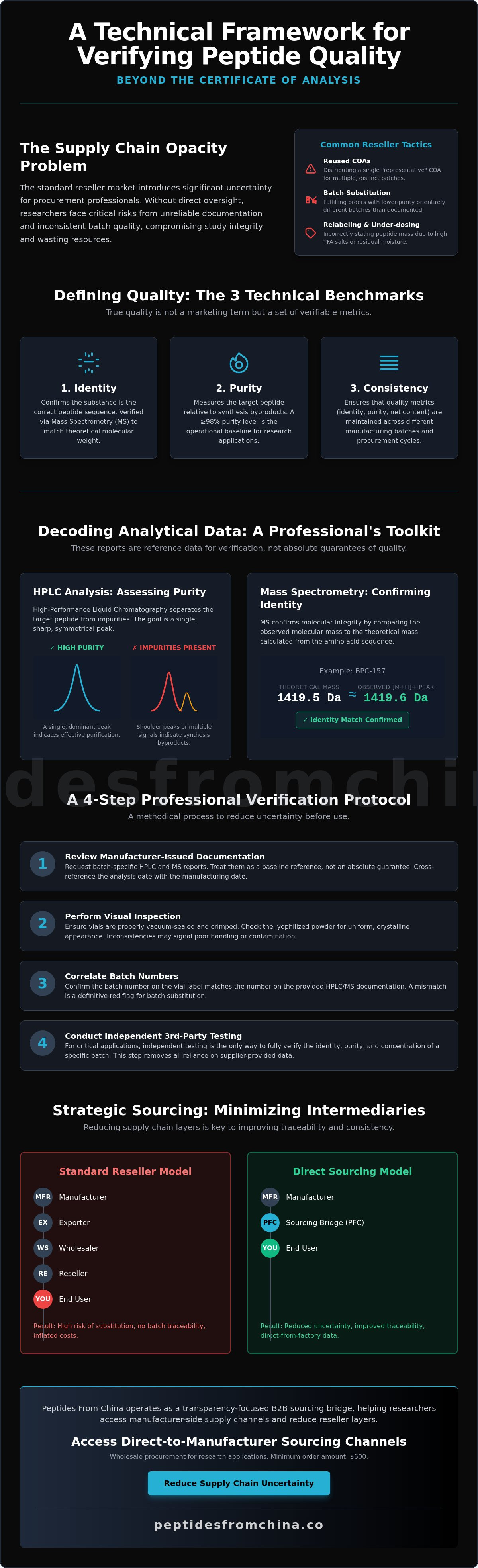
High-Performance Liquid Chromatography (HPLC) measures the amount of the target peptide relative to impurities. When you look at an HPLC chromatogram, you're looking for a single, sharp peak. Broad peaks or "shoulders" indicate the presence of synthesis byproducts, such as diastereomers or protected intermediates. It's vital to distinguish between purity and net peptide content. A report might show 99% purity, but if the vial contains 30% salts and water, your net peptide content is only 70%. Reliable sourcing requires understanding these nuances to ensure your data remains consistent across different batches and procurement cycles.
Technical Benchmarks of Peptide Purity and Identity
Securing high quality peptides depends on moving beyond PDF trust and toward a rigorous understanding of analytical data. While many vendors use a Certificate of Analysis (COA) as a marketing tool, procurement professionals treat it as a baseline for independent verification. Technical benchmarks like HPLC and Mass Spectrometry are the only ways to quantify synthesis success and purification effectiveness. These reports don't guarantee quality on their own, but they provide the necessary data points for a buyer to conduct their own laboratory scrutiny.
HPLC Analysis: Reading the Peaks
High-Performance Liquid Chromatography (HPLC) is the primary method used to determine batch purity. When reviewing a chromatogram, you're looking for a single, sharp, and symmetrical peak. Shoulder peaks or trailing signals are clear indicators of impurities like truncated sequences or diastereomers that weren't removed during purification. It's vital to remember that a single HPLC report is merely a snapshot of a specific batch. Accessing direct-to-manufacturer channels helps researchers secure more consistent reference analytical data for their verification protocols, reducing reseller interference.
Mass Spectrometry: Confirming Molecular Integrity
HPLC tells you how pure a substance is, but Mass Spectrometry (MS) confirms what that substance actually is. The MS report provides the observed molecular mass, which must align with the theoretical mass calculated from the amino acid sequence. You're looking for the [M+H]+ peak, representing the peptide plus one hydrogen ion. If the observed mass is off by even a few Daltons, the synthesis is likely incomplete. This is critical for complex molecules like Tirzepatide, where a missing amino acid drastically alters properties. Demand clear reports; blurry data is often a tactic used to hide truncated sequences or incomplete synthesis.
The physical state of the product offers clues to its stability. Proper lyophilization, or freeze-drying, is essential for long-term purity. High-quality batches should appear as a uniform, cake-like powder rather than a loose, crystalline substance. This process removes moisture that would otherwise lead to peptide degradation. Professional sourcing protocols must also account for common contaminants that don't always show up on a standard purity report, such as residual solvents and bacterial endotoxins. For those managing wholesale procurement with a minimum order of $600, implementing a routine of independent laboratory testing remains the only way to minimize supply chain uncertainty and confirm manufacturer-side data.
The Supply Chain Trap: Why Certificates of Analysis (COA) Can Be Misleading
A Certificate of Analysis is often presented as the final word on purity, but in the global market, it's frequently just a piece of digital paper with no connection to the actual product in the vial. Many vendors rely on "representative" testing, where a single high-performing batch is used to generate documentation for months of subsequent production. This practice obscures the reality of batch-to-batch variability and leaves researchers in the dark. For those seeking high quality peptides, a COA should be viewed as reference analytical data rather than a definitive guarantee of contents.
The "Domestic Warehouse" paradox often complicates this further. While local shipping sounds safer and faster, it frequently breaks the chain of custody. Many domestic resellers buy bulk quantities from various manufacturers, mix different synthesis runs, and relabel them under their own brand. By the time the vial reaches your lab, the original manufacturer-issued papers are long gone or have been replaced by generic, brand-heavy reports. This opacity makes independent laboratory testing by the buyer the only reliable method to support independent verification of batch integrity and purity.
Identifying Reused and Fake Documentation
Spotting fraudulent documentation requires a methodical eye for technical detail. Common red flags include mismatched dates where the test date precedes the manufacturing date, or blurry fonts that suggest a PDF was edited to change a batch number or purity percentage. Generic headers that lack specific laboratory contact information or report IDs are another warning sign. You should always attempt to verify the testing laboratory listed on the COA. Legitimate labs maintain records of their reports; if a supplier can't provide a report ID that's searchable or verifiable with the lab, the document's validity is compromised. Batch numbers on the report must match the physical product labeling exactly to ensure any level of traceability.
The Reseller Problem: Diluting Quality Control
Every intermediary layer between the synthesis lab and your facility increases the risk of batch substitution or degradation. Retail-style vendors often prioritize "brand name" marketing over technical transparency, marking up bulk products without adding any real value to the quality control process. Transitioning from retail-style trust to B2B-style verification means looking past the label and the marketing hype. It involves accessing manufacturer-side channels directly to minimize these layers and improve traceability. PeptidesFromChina currently has a $600 total minimum order. Multiple catalog products can be combined to reach the minimum, with orders starting from one 10-vial kit per product.
Step-by-Step: A Professional Protocol for Verifying Peptide Quality
Procuring high quality peptides isn't a passive event; it's an active verification cycle that begins before the order is placed and ends only after independent data confirms the batch identity. Relying solely on a supplier's word is an operational risk that can compromise research data. A professional protocol requires a systematic approach to filter out the noise of the reseller market and focus on technical benchmarks to secure high quality peptides for long-term study.
The process starts with establishing a technical baseline. You should request manufacturer-issued papers for the specific batch before committing capital. While these documents don't replace independent testing, they provide the reference analytical data needed for comparison later. Once the shipment arrives, perform a visual inspection of the lyophilized powder. A uniform, cake-like structure suggests a successful lyophilization process and an intact vacuum seal. If you observe a collapsed or crystalline texture, it often indicates moisture ingress or poor temperature control during transit.
Selecting a Third-Party Testing Laboratory
Identifying a laboratory with specific experience in peptide testing is a critical step. Not all analytical labs have the correct columns or solvent gradients to properly resolve complex peptide peaks. For those managing wholesale procurement with a minimum order of $600, the cost of independent verification is a necessary insurance policy against supply chain uncertainty. When submitting samples, ensure they're sent in their original, sealed vials to maintain an unbiased testing environment and a clear chain of custody.
Interpreting Discrepancies in Test Results
PFC coordinates manufacturer-side sourcing and international logistics. Products are subject to the manufacturer’s applicable quality-control procedures and product-specific specifications. Manufacturer-side analytical documentation may be available depending on the product and batch, but PFC is not an independent analytical testing laboratory and does not guarantee a universal documentation package. Buyers requiring independent verification may arrange third-party analytical testing.
Finally, document every step from the synthesis facility to your lab. Maintaining a record of shipping logs, batch numbers, and laboratory reports creates a traceable history that supports long-term consistency. This methodical approach ensures that your procurement strategy is built on data rather than reseller marketing fluff.
Strategic Sourcing: Accessing Direct-to-Manufacturer Peptide Channels
Sourcing high quality peptides is as much a logistical challenge as it is a technical one. Every intermediary layer between the synthesis facility and your laboratory increases the risk of batch substitution, relabeling, and degraded chain of custody. By the time a product reaches a retail reseller, the original manufacturer data is often obscured or replaced by generic marketing materials. Transitioning to a direct-to-manufacturer sourcing model helps reduce supply chain uncertainty by providing a clearer path to the original production data and synthesis logs.
PFC coordinates sourcing from established Chinese manufacturing facilities together with international logistics. This model prioritizes factual integrity over marketing flair, focusing on providing access to manufacturer-side channels where batch traceability is easier to maintain. For laboratories and procurement professionals, this approach shifts the focus from trusting a brand name to verifying the actual data produced at the point of synthesis. Professional research supply requires this level of operational realism to ensure that the compounds used in long-term studies remain consistent across multiple procurement cycles.
The B2B Advantage: Eliminating Reseller Mark-ups
Routing orders straight to production facilities ensures that the reference analytical data you receive is tied directly to the batch being shipped. This eliminates the "black box" of domestic warehousing where different synthesis runs are often commingled. The economic logic of bulk sourcing is also clear; by meeting professional wholesale requirements, laboratories can significantly lower procurement costs without sacrificing the ability to perform independent verification. Before finalizing any vendor selection, referring to a peptide research supply checklist is essential for vetting the manufacturer’s technical capabilities and logistical protocols.
Managing Logistics and Quality Assurance
Professional procurement through PFC involves a methodical approach to manufacturer verification. This starts with a $10 processing deposit, which allows the sourcing bridge to initiate the verification of manufacturer-issued papers and batch availability. For those managing wholesale requirements, a minimum order of $600 is standard to access these direct channels. This threshold ensures that the resources required for batch traceability and independent verification are economically viable for both the facility and the buyer.
Logistical consistency is maintained through neutral packaging and tracked shipping, which are standard for professional research supply. These protocols help protect the integrity of the compounds during transit while providing a clear record of the shipment’s journey. By prioritizing transparency and directness, researchers can secure high quality peptides that are supported by baseline technical data, allowing for a more robust independent testing phase. This strategic shift from retail-style purchasing to B2B-style sourcing is the most effective way to minimize the inherent risks of the global peptide market.
Securing Data Integrity Through Direct Sourcing Protocols
Navigating the complex peptide market in 2026 requires a shift from retail-style trust to methodical, B2B-style verification. Identifying high quality peptides isn't about finding the best marketing label; it's about establishing a rigorous chain of custody and supporting independent verification with every batch. By utilizing manufacturer-issued papers as baseline reference analytical data and conducting your own HPLC and Mass Spectrometry testing, you effectively filter out the risks of batch substitution and relabeling inherent in the reseller market.
Strategic procurement is about minimizing the layers between the laboratory and the synthesis facility. Accessing manufacturer-side channels helps reduce supply chain uncertainty and ensures that your research results aren't compromised by inconsistent compounds. For those ready to implement professional wholesale procurement with a $600 minimum order, moving toward a direct-to-manufacturer model is the most reliable way to maintain batch traceability and operational consistency.
Take control of your research supply by requesting manufacturer-side sourcing through Peptides From China. Establishing a transparent, data-driven supply chain can support research planning and buyer-arranged independent verification.
Sourcing and Verification: Frequently Asked Questions
How can I tell if a peptide COA is legitimate or fake?
Legitimate documentation always includes a verifiable report ID and specific laboratory contact information. You should look for technical inconsistencies such as mismatched dates, blurry fonts, or generic headers that suggest a PDF has been edited. If a supplier cannot provide a report ID that is searchable or verifiable directly with the testing facility, the document's validity is compromised. Batch numbers on the report must also match the physical product labeling to ensure any level of traceability.
What is the difference between purity and net peptide content?
Purity measures the percentage of the target peptide relative to other peptide impurities detected during HPLC analysis. Net peptide content is the actual mass of the peptide in the vial after subtracting non-peptide components like residual moisture and salts, such as trifluoroacetic acid. It's common for a vial to show 99% purity but only 70% to 80% net peptide content. Understanding this distinction is vital for accurate dosing in a laboratory environment.
Why do different labs show different purity results for the same batch?
Analytical variance occurs because different laboratories use varying HPLC equipment, solvent gradients, and column types. A margin of error between 1% and 2% is standard in professional peptide analysis. If the discrepancy is larger, it often indicates batch degradation during transit or improper sample preparation. This is why it's essential to use a lab with specific experience in peptide chromatography to support independent verification.
Is 99% purity always better than 95% for research purposes?
Higher purity is generally preferred because 95% purity indicates a higher concentration of synthesis byproducts or truncated sequences that can interfere with research data. However, a 99% purity claim is secondary to identity verification. For high quality peptides, the compound must first be confirmed via Mass Spectrometry to ensure the amino acid sequence is correct. A pure vial of the wrong sequence is useless for professional study.
How does direct sourcing from China improve peptide quality?
Direct sourcing helps reduce supply chain uncertainty by eliminating the reseller layers that often commingle batches or relabel bulk products. It allows researchers to access manufacturer-side channels where batch traceability is easier to maintain. By receiving manufacturer-issued papers directly, you establish a more reliable technical baseline for your own independent testing protocols, ensuring the compounds remain consistent across procurement cycles.
What are the red flags when evaluating a new peptide company?
Red flags include retail-style marketing, "guaranteed" purity claims, and the absence of specific batch numbers on product packaging. Companies that refuse to provide manufacturer-issued documentation or those that don't have a clear B2B procurement protocol are often prioritizing sales over technical transparency. If a vendor lacks a methodical approach to batch traceability, they're likely a reseller with limited insight into the synthesis process.
Can I trust the HPLC report provided by a domestic reseller?
You should treat domestic reseller reports only as baseline reference analytical data rather than definitive proof. Resellers frequently use "representative" testing, where a single high-quality report is used to market multiple batches over several months. This practice obscures batch-to-batch variability. Independent laboratory testing of the specific vials you receive is the only way to confirm that the product matches the provided documentation.
Why is there a minimum order amount for high quality peptides?
PeptidesFromChina currently has a $600 total minimum order. Multiple catalog products can be combined to reach the minimum, with orders starting from one 10-vial kit per product. This threshold ensures that the process of manufacturer verification and direct, tracked shipping is economically viable. It reflects a commitment to B2B procurement standards, prioritizing researchers and laboratories that require consistent, high-purity compounds for long-term projects over retail-style single-vial sales.