
A Certificate of Analysis is no longer a definitive proof of quality in the peptide industry; it's merely a baseline reference document that requires independent validation. For research institutions, the traditional model of purchasing GHK-Cu wholesale through domestic resellers often results in inflated costs and a complete lack of batch-to-batch traceability. You understand the frustration of receiving recycled HPLC reports that offer little insight into the actual synthesis conditions or the true chain of custody of your materials.
This guide provides a professional framework to navigate these complexities by establishing direct-to-manufacturer supply lines and reducing reliance on opaque intermediaries. We'll outline how to implement rigorous verification protocols and use transparency-focused bridges like Peptides From China to access production-level pricing. We will also detail the operational realities of 2026 procurement, including the $600 minimum order requirement for wholesale channels and the specific analytical data required to ensure your research remains grounded in factual integrity. By shifting your focus from buying a product to verifying a supply chain, you can significantly reduce procurement overhead while improving the reliability of your research data.
Key Takeaways
Differentiate between Solid-Phase and Liquid-Phase synthesis to understand how residual impurities like TFA can alter your laboratory outcomes.
Learn to bypass the reseller trap where domestic warehousing often masks significant markups; it's a practice that inflates GHK-Cu wholesale costs without providing additional transparency.
Implement a two-step verification protocol that starts with defining technical specifications and ends with independent batch testing.
Access manufacturer-side channels through a B2B sourcing bridge to reduce procurement costs while maintaining a professional $600 minimum order threshold.
Don't treat manufacturer-issued documentation as definitive proof; these papers are baseline references that require secondary validation for operational consistency.
Table of Contents
What is GHK-Cu Wholesale? Beyond the Glow Peptide Trend
Synthesis Methods and Purity Metrics in Bulk Production
The Reseller Trap: Why Supply Chain Opacity Costs Your Lab
Wholesale Procurement Protocols: A Step-by-Step Guide
Accessing Direct Sourcing with Peptides From China (PFC)
What is GHK-Cu Wholesale? Beyond the Glow Peptide Trend
GHK-Cu, technically known as Glycyl-L-Histidyl-L-Lysine copper, is a naturally occurring tripeptide complex that has transitioned from a niche laboratory curiosity to a high-demand industrial reagent. While retail markets frequently label it as the "glow peptide" due to its prevalence in anti-aging cosmetic formulations, professional procurement requires a more rigorous technical definition. True Copper peptide GHK-Cu is identified by the CAS number 89030-95-5. It's a specific chemical entity where the tripeptide sequence GHK binds with a high affinity to Copper(II) ions. In 2026, the surge in GHK-Cu wholesale demand is driven by both clinical research into tissue regeneration and the massive scaling of the science-coded skincare sector, creating a market flooded with varying grades of material.
Distinguishing between research-grade lyophilized powder and cosmetic-grade additives is the first hurdle for institutional buyers. Many wholesale suppliers offer "cosmetic grade" solutions that are often pre-diluted or contain stabilizers that can interfere with sensitive analytical assays. Research institutions must prioritize high-purity lyophilized powder, which offers superior stability and allows for precise concentration control in a laboratory setting. Without verifying the chemical identity beyond the "blue powder" appearance, researchers risk introducing uncontrolled variables into their studies.
The Chemistry of Copper Tripeptide-1
The efficacy of GHK-Cu depends entirely on its 1:1 binding ratio. If the copper content is insufficient or the peptide sequence is fractured during synthesis, the resulting compound won't exhibit the expected biological activity. Procurement professionals should require reference analytical data that includes Mass Spectrometry to confirm the exact molecular weight and amino acid sequence. Lyophilization is the industry standard for bulk storage; it helps reduce supply chain uncertainty by maintaining the peptide's structural integrity against heat and moisture during international transit.
Wholesale vs. Retail-Bulk: Defining the Scale
The term "wholesale" is often misused by domestic vendors selling 1g to 10g quantities. In reality, these are retail-bulk transactions that include significant middleman markups. True GHK-Cu wholesale procurement happens at the multi-gram to kilogram scale, where buyers interface directly with synthesis facilities. This direct-to-manufacturer approach becomes economically viable once a lab's requirements exceed the retail threshold. For organizations using sourcing bridges like Peptides From China, the process moves toward transparency through a $600 minimum order requirement. This baseline ensures that the logistical costs of international shipping and independent verification are amortized across a volume that justifies the professional sourcing protocol.
Synthesis Methods and Purity Metrics in Bulk Production
Standard synthesis for GHK-Cu wholesale lots typically relies on Solid-Phase Peptide Synthesis (SPPS), though liquid-phase protocols are increasingly utilized for massive industrial scales to reduce costs. While liquid-phase can be more efficient for the tripeptide sequence, it often presents unique purification challenges compared to the more controlled SPPS method. Regardless of the protocol, the presence of residual solvents and Trifluoroacetic acid (TFA) remains a critical concern for researchers. High TFA concentrations can significantly alter the pH of a research solution, potentially skewing results in cellular assays or tissue studies. These manufacturing by-products don't just occupy volume; they interact with your experimental environment.
Verifying Peptide Identity
HPLC reports are frequently presented as absolute proof, but they should be treated as baseline reference analytical data. A standard HPLC report can be manipulated or recycled from previous batches, making it a poor sole indicator of quality. Independent Mass Spectrometry is necessary to verify the actual copper complex and ensure the molecular weight aligns with the GHK-Cu identity. Additionally, procurement professionals must distinguish between "total weight" and "net peptide content" in wholesale quotes. Many vendors include the weight of counter-ions and residual water in their totals, effectively charging for salt rather than the active peptide complex.
Batch Consistency in Large-Scale Sourcing
Managing batch consistency becomes exponentially more difficult as order volumes reach the kilogram scale. Some facilities may substitute or blend batches of varying quality to fulfill high-volume orders, a practice that introduces unacceptable variables into institutional research. As synthesis scale increases, the complexity of maintaining a uniform impurity profile intensifies, often leading to greater variance in residual solvent concentrations between production runs. To help reduce supply chain uncertainty, researchers should work through channels that prioritize direct manufacturer communication. Utilizing a transparency-focused sourcing bridge helps ensure that technical specifications are maintained from the initial synthesis run through to the final delivery.
The Reseller Trap: Why Supply Chain Opacity Costs Your Lab
Domestic warehousing is frequently used as a strategic mask for relabeled imports in the peptide market. Many research institutions pay a premium for the perceived security of a local supplier, unaware that the material is often sourced from the same international synthesis facilities they are trying to avoid. This creates a significant "reseller trap" where the chain of custody is intentionally obscured to justify markups. When sourcing GHK-Cu wholesale, relying on a domestic middleman often means inheriting a supply chain with zero transparency and no direct line to the original chemist. Supply chain opacity is a choice made by vendors to protect their margins, not your research integrity.
The financial impact of these intermediary layers is substantial. Resellers typically add 200% to 500% markups to bulk powders without providing any additional quality control value. These vendors often provide "borrowed" or recycled Certificates of Analysis (COAs) that don't correspond to the specific batch in their possession. In some cases, a single HPLC report is used for months across multiple different production runs. Direct-to-manufacturer access helps reduce supply chain uncertainty by ensuring that the reference analytical data you receive actually originates from the facility that performed the synthesis.
Relabeling and Batch Opacity
The process of domestic relabeling is a common industry practice where bulk shipments from China are repackaged and sold as "USA Made" or "Domestic Grade." This practice fundamentally breaks the chain of custody for sensitive research compounds. Without a direct link to the synthesis logs, it's impossible to verify if a batch has been subjected to proper purification or if it has been blended with older stock to move inventory. To understand how these different business models impact your laboratory, you can read our detailed comparison on a Peptide Sourcing Agent vs. Platform.
The Economic Logic of Direct Sourcing
Removing the middleman changes the fundamental economics of your procurement. By bypassing the reseller, the budget previously lost to markups can be reallocated toward high-frequency, independent batch testing at a laboratory of your choice. This shift allows for a more rigorous verification protocol without increasing the total cost-per-gram. For institutions handling high-volume GHK-Cu wholesale orders, the direct-to-manufacturer model provides the only realistic path to operational consistency. Utilizing a sourcing bridge like Peptides From China requires a $600 minimum order, a threshold that filters out retail-level noise and focuses on professional-scale procurement where transparency and factual accuracy are the primary metrics of success.
Wholesale Procurement Protocols: A Step-by-Step Guide
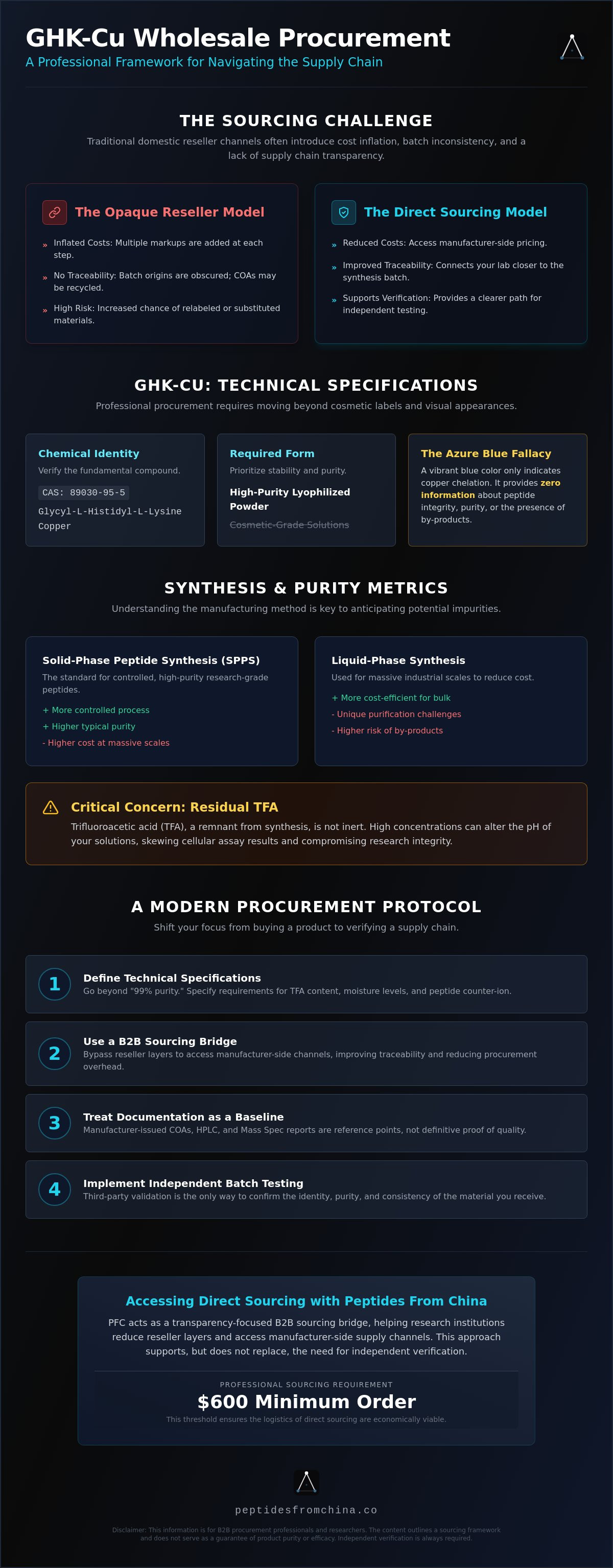
Institutional procurement of GHK-Cu wholesale requires a systematic departure from retail-style transactions. A professional protocol ensures that every batch is scrutinized before it enters your laboratory inventory. This methodical approach is designed to improve traceability and supports independent verification at every stage of the supply chain. By formalizing these steps, you minimize the risk of receiving materials that don't align with your internal standards.
Step 1: Define technical specifications. Clearly state your required purity thresholds, acceptable residual solvent levels, and specific TFA limits.
Step 2: Initiate manufacturer verification. Use a sourcing bridge to identify facilities capable of meeting these technical requirements.
Step 3: Review baseline documentation. Examine manufacturer-issued HPLC and Mass Spectrometry reports as reference analytical data, not as absolute proof of quality.
Step 5: Independent verification. Execute third-party testing upon receipt to confirm the identity and purity of the compound before use in research.
Navigating International Logistics
In 2026, the logistical landscape for research compounds has shifted significantly. All bulk imports now require formal customs entry and are subject to Section 301 tariffs. Professional shipments utilize neutral packaging and robust tracking protocols to ensure the security of the material during transit. Maintaining batch traceability from the synthesis facility to your lab is essential for operational consistency. This process helps reduce supply chain uncertainty by ensuring that the material hasn't been swapped or blended at a domestic warehouse before reaching you.
Verification and Independent Testing
You shouldn't accept a manufacturer's COA at face value. These documents are often recycled or reflect a "best-of" batch rather than the specific material in your shipment. Selecting a qualified third-party lab for independent HPLC and Mass Spectrometry analysis is the only way to confirm you've received what was promised. Reading a COA requires a skeptical eye; you must look for inconsistencies in the integration tables and timestamps that might suggest data manipulation. For a deeper look at these standards, refer to our guide on Peptide Testing and Analysis. Following these verification protocols ensures your research is built on a foundation of factual accuracy.
If you're ready to establish a direct supply line that prioritizes transparency, you can access our B2B sourcing bridge to begin the manufacturer verification process for your next project. Remember that professional wholesale procurement through these channels requires a minimum order of $600 to ensure logistical efficiency.
Accessing Direct Sourcing with Peptides From China (PFC)
Peptides From China (PFC) functions as a transparency-focused B2B sourcing bridge, specifically designed to connect research institutions with verified synthesis facilities. We don't operate as a pharmaceutical manufacturer or a testing laboratory. Instead, our role is to act as an analytical filter that helps you navigate the logistical and quality-control hurdles of the global market. By facilitating GHK-Cu wholesale procurement directly from manufacturing-side channels, we help eliminate the reseller layers that traditionally inflate costs without adding technical value. This model prioritizes factual integrity and batch traceability over the marketing-heavy claims of domestic vendors.
To maintain a methodical approach to manufacturer verification, we utilize a $10 processing deposit for all new inquiries. This small fee isn't a profit center; it's a procedural step that ensures we're dedicating resources to serious procurement requests. This deposit initiates the process of verifying current batch availability and reviewing manufacturer-issued reference analytical data. It allows us to provide you with the most current logistical information and synthesis logs before you commit to a full order. This transparency-first positioning is essential for laboratories that require a realistic understanding of their sourcing dynamics.
The PFC Sourcing Model
Our model prioritizes manufacturing-side channels because they offer the most direct path to batch consistency. Domestic warehousing often obscures the origin of a compound, making it nearly impossible to verify the synthesis conditions or the true age of the material. By focusing on direct-to-manufacturer routing, we improve traceability and support your ability to conduct independent verification. We understand the complexities of international logistics, including the 2026 customs requirements and Section 301 tariffs. Our role is to provide the logistical framework that allows your procurement team to focus on research rather than supply chain troubleshooting.
Initiating Your Wholesale Order
The process for requesting a quote for high-volume GHK-Cu is designed for efficiency and clarity. Every GHK-Cu wholesale transaction through PFC requires a minimum order amount of $600. This threshold is necessary to optimize laboratory budgets by spreading the fixed costs of international shipping and formal customs entry across a viable volume of material. It also ensures that the batches being sourced are large enough to justify the rigorous independent testing protocols we've discussed. For a comprehensive overview of how to manage these transactions, you can consult our Wholesale Peptides guide. This document details the specific logistics required to maintain a consistent supply line for institutional research.
Stabilizing Your Research Supply Chain for 2026
Effective GHK-Cu wholesale sourcing requires a commitment to independent verification and a healthy skepticism toward unverified domestic claims. We provide the logistical bridge and analytical filter needed to access manufacturing-side channels with confidence. Our model includes COA-verified batch sourcing and neutral global shipping with tracking to help reduce supply chain uncertainty at every stage of the process.
Request a wholesale GHK-Cu sourcing quote ($600 minimum) to begin the manufacturer verification process today. Establishing a direct supply line is a methodical step toward long-term operational consistency and research success.
Frequently Asked Questions
Is GHK-Cu wholesale purity guaranteed by the manufacturer?
No single document or manufacturer statement should be accepted as an absolute guarantee of purity. While synthesis facilities provide HPLC and Mass Spectrometry reports, these are baseline technical references that require secondary validation. Independent third party testing is the only way to confirm that a batch of GHK-Cu wholesale material aligns with your laboratory's specific purity thresholds and research requirements.
What is the minimum order amount for GHK-Cu through Peptides From China?
The minimum order amount for wholesale procurement through Peptides From China is $600. This threshold ensures that the logistical costs associated with international shipping, neutral packaging, and formal customs entry are efficiently managed. It also filters out retail level transactions; this allows us to focus resources on professional scale research requirements where supply chain transparency is the priority.
Why is GHK-Cu often referred to as the "glow peptide" in research?
Can I trust the HPLC reports provided by Chinese manufacturing facilities?
HPLC reports from manufacturing facilities should be viewed as reference analytical data rather than definitive proof of quality. The peptide industry frequently struggles with recycled COAs and batch substitution; sometimes a single report is used for multiple production runs. You should always perform independent testing on a representative sample of your shipment to verify the identity and purity of the compound before starting your research.
What is the difference between research-grade and cosmetic-grade GHK-Cu?
Research grade GHK-Cu is typically provided as a high purity, lyophilized powder that is free from stabilizers or additives. Cosmetic grade versions are often pre-diluted in liquid solutions or contain preservatives that can interfere with sensitive laboratory assays. For institutional research, the stability and concentration control of lyophilized powder are essential for maintaining experimental consistency and preventing uncontrolled variables.
How does PFC handle international shipping for wholesale orders?
PFC utilizes neutral global shipping protocols that include robust tracking for all wholesale orders. We help navigate the complexities of 2026 international logistics, including the requirement for formal customs entry and the application of Section 301 tariffs on Chinese imports. This methodical approach helps ensure that your materials arrive securely and that the chain of custody remains as transparent as possible during transit.
Why should I source GHK-Cu direct instead of from a domestic warehouse?
Sourcing GHK-Cu wholesale directly helps reduce supply chain uncertainty by removing domestic resellers who often add 200 percent to 500 percent markups. Domestic warehouses frequently relabel international imports as domestic products, which breaks the chain of custody and obscures the original synthesis logs. Direct access to manufacturer side channels improves traceability and allows your budget to be spent on independent verification rather than middleman profits.
What happens if a batch does not meet my independent purity requirements?
If an independent lab report contradicts the manufacturer's data, having a direct line to the synthesis facility is critical for resolution. As a sourcing bridge, PFC facilitates the communication between the researcher and the manufacturer to address batch inconsistencies and synthesis flaws. This direct accountability is nearly impossible when buying through opaque domestic resellers who lack technical insight into the original production process.