
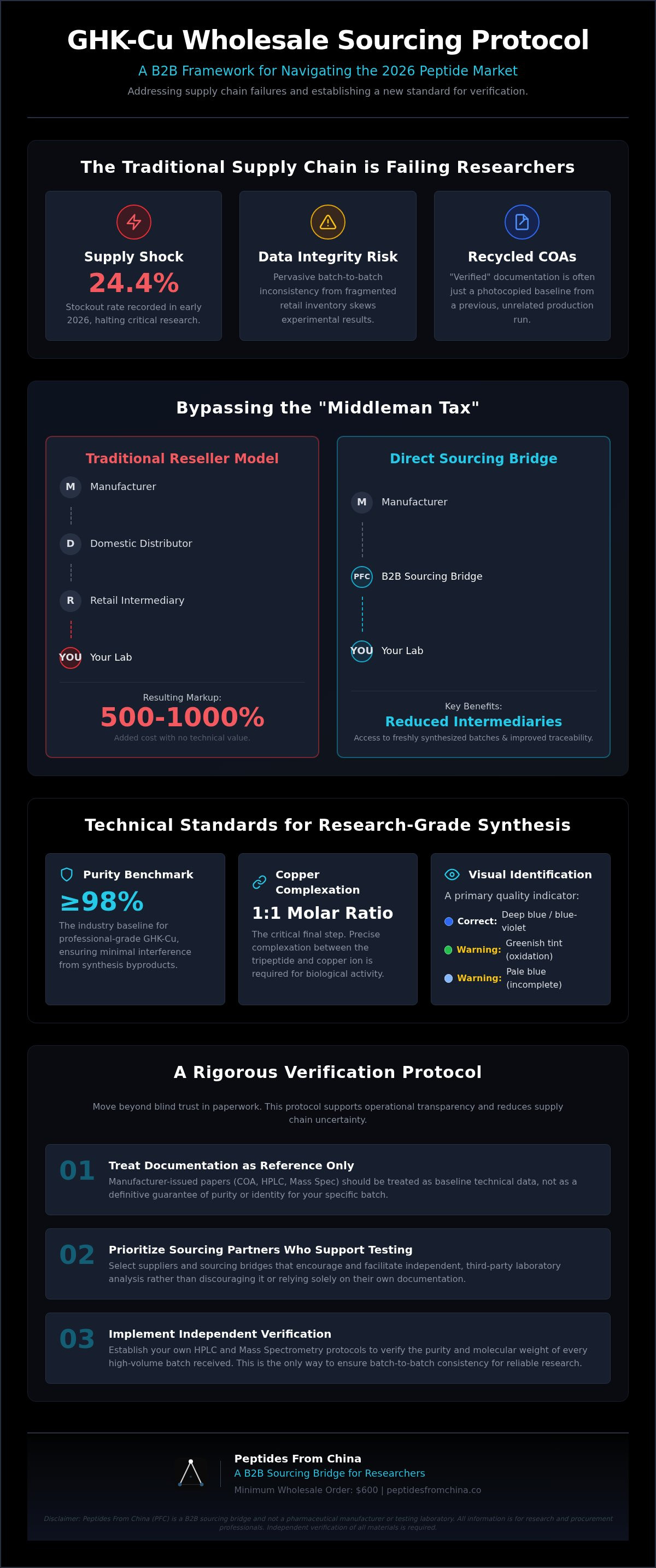
With GHK-Cu search volume surging over 1,000% year-over-year, the 24.4% stockout rate recorded in early 2026 isn't just a logistical hurdle; it's a signal that the traditional supply chain is failing. Most professional buyers are tired of the retail-plus model where domestic intermediaries add significant markups while providing nothing more than a recycled HPLC report. You've likely encountered the frustration of batch-to-batch inconsistency and the realization that a "verified" COA is often just a photocopied baseline from a previous production run. Finding a reliable GHK-Cu wholesale supplier shouldn't feel like a gamble on synthesis quality.
We agree that the current lack of transparency in peptide procurement is unsustainable for serious research operations. This guide provides a direct sourcing protocol to help you bypass reseller markups and implement rigorous verification standards that go beyond surface-level paperwork. We'll examine how to audit manufacturer-side channels, verify copper complexation, and manage the logistics of a $600 minimum wholesale order through a transparency-first lens. By positioning Peptides From China (PFC) as a B2B sourcing bridge, we help you reduce supply chain uncertainty by prioritizing independent verification over blind trust.
Key Takeaways
Understand the technical transition from retail vials to raw powder procurement, where a 98% purity benchmark serves as the baseline for professional research-grade synthesis.
Identify the middleman tax that leads to 500-1000% markups by domestic distributors and learn how to reduce these costs through direct manufacturer routing.
Develop a rigorous verification protocol that treats manufacturer-issued papers as reference data, helping you select a GHK-Cu wholesale supplier that supports independent third-party testing.
Leverage Peptides From China as a transparency-focused B2B bridge to access freshly synthesized batches with a $600 wholesale minimum order requirement.
Mitigate supply chain uncertainty by implementing independent HPLC and Mass Spectrometry protocols rather than relying on potentially reused or falsified documentation.
Table of Contents
Navigating the GHK-Cu Wholesale Market in 2026
Technical Standards for High-Volume GHK-Cu Synthesis
Direct Sourcing vs. Domestic Reseller Models
Verification Protocols: Beyond the Certificate of Analysis
Strategic Procurement: Sourcing GHK-Cu via Peptides From China
Navigating the GHK-Cu Wholesale Market in 2026
The Copper peptide GHK-Cu (glycyl-L-histidyl-L-lysine) is a tripeptide known for its high affinity for copper ions. By 2026, the global market for this molecule is projected to reach $15.87 billion, driven by a surge in research applications. This growth has created a significant shift in procurement strategies. Professional laboratories are moving away from small-scale retail vials toward high-volume raw powder. This transition isn't just about cost; it's about securing the batch consistency required for longitudinal studies. Retail sources often pull from fragmented inventory, while a dedicated GHK-Cu wholesale supplier provides access to single-batch synthesis runs that minimize variables in experimental data.
Regulatory shifts in 2026 have accelerated this trend. The FDA's reclassification of GHK-Cu as a Category 2 bulk drug substance has complicated the domestic compounding landscape. These restrictions make it harder for researchers to rely on local intermediaries. As a result, procurement professionals are looking toward direct manufacturer channels to ensure a steady supply. This is particularly vital given the 24.4% stockout rate observed in the first quarter of 2026. Managing these supply chain pressures requires a move toward more transparent, high-volume sourcing models.
Raw Powder vs. Finished Vials
Handling lyophilized raw powder requires different operational protocols than ready-to-use vials. Large-scale studies benefit from the significant cost-per-milligram advantages found in bulk sourcing. While retail pricing often hovers between $80 and $150 per gram, direct factory sourcing can reduce these costs substantially. From a technical standpoint, bulk powder offers better long-term stability when stored correctly under vacuum seal. It allows labs to prepare exact concentrations in-house, ensuring that the peptide remains properly complexed with copper ions without the risk of oxidation often seen in pre-formulated products.
The Rise of Direct-to-Manufacturer Sourcing
Traditional domestic reseller models are becoming economically unviable due to the "middleman tax." These distributors frequently apply markups of 500% to 1000% without adding technical value to the product. Transparency-focused platforms are now replacing these opaque intermediaries. Selecting a direct GHK-Cu wholesale supplier through a platform like Peptides From China (PFC) allows labs to bypass these costs. PFC acts as a B2B sourcing bridge, connecting researchers directly to synthesis facilities. By requiring a $600 minimum wholesale order, PFC helps labs eliminate unnecessary reseller layers. This model prioritizes batch traceability and ensures that researchers receive freshly synthesized material rather than aged inventory from a domestic warehouse.
Technical Standards for High-Volume GHK-Cu Synthesis
Synthesis methods for GHK-Cu vary significantly between manufacturers, impacting both the stability and the purity of the final product. Most high-end production facilities utilize Solid-Phase Peptide Synthesis (SPPS) because it allows for precise control over the amino acid sequence. This method reduces the occurrence of truncated sequences compared to older liquid-phase methods. For a professional GHK-Cu wholesale supplier, maintaining a purity benchmark of 98% or higher is the industry baseline. Peptide purity is the ratio of target peptide to total peptide content. High purity is essential because even minor contaminants can interfere with the biological signaling pathways detailed in this scientific review of GHK-Cu's actions.
Copper complexation is the final and perhaps most critical step in the manufacturing process. Genuine GHK-Cu must achieve a precise 1:1 molar ratio between the tripeptide and the copper ion. You'll recognize successful complexation by the deep blue to blue-violet hue of the lyophilized powder. A greenish tint often indicates oxidation or an improper ratio, while a pale blue suggests the peptide hasn't been fully complexed. Common impurities in low-grade batches include residual solvents like Trifluoroacetic acid (TFA) and unreacted amino acids. These contaminants don't just lower the purity percentage; they can alter the pH of your research medium and produce skewed results in sensitive biological assays.
Synthesis Quality Indicators
HPLC chromatograms are the primary tool for assessing purity levels in a wholesale environment. You're looking for a single, sharp peak with minimal "shoulders" that indicate closely related impurities. Mass Spectrometry (MS) then verifies the identity by confirming the exact molecular weight of the tripeptide complex. It's vital to treat manufacturer-issued papers only as reference analytical data rather than absolute proof. Independent verification ensures that the material you receive matches the technical specifications required for your specific research goals.
Batch Consistency in Large Orders
Scaling synthesis from grams to kilograms introduces the risk of batch-to-batch variation. Large-scale buyers must demand batch-specific documentation to avoid "batch substitution," a practice where a supplier uses an old HPLC report for a new, untested production run. This is a common flaw in the high-volume market that leads to inconsistent research outcomes. Reducing these risks involves working with a transparency-focused bridge rather than a blind reseller. If you're looking to stabilize your supply chain, you can access manufacturer-side channels through Peptides From China. This B2B bridge facilitates wholesale procurement with a $600 minimum order, helping you minimize the layers between the laboratory and the synthesis facility.
Direct Sourcing vs. Domestic Reseller Models
Domestic distributors often position themselves as essential quality-control filters. In reality, most function as simple logistics hubs that apply a middleman tax ranging from 500% to 1000% over factory-direct pricing. This markup rarely reflects added technical value; instead, it covers domestic overhead, marketing costs, and platform fees. When you choose a GHK-Cu wholesale supplier through a direct-to-manufacturer channel, you aren't just reducing costs. You're shortening the chain of custody. Every additional hand that touches a peptide batch increases the risk of relabeling, batch substitution, or cross-contamination. Reducing these layers helps reduce supply chain uncertainty and improves traceability for institutional labs.
Inventory age is another critical factor that separates direct sourcing from the reseller model. Domestic resellers often buy in bulk and store products in localized warehouses for months at a time. This leads to the distribution of aged inventory that may have experienced temperature fluctuations during transit or storage. Direct sourcing facilitates the delivery of freshly synthesized batches, ensuring the material retains the biological integrity described in the Regenerative and Protective Actions of GHK-Cu. Fresh synthesis is particularly vital for GHK-Cu because the copper complexation must remain stable to produce reliable research outcomes.
Economic Analysis of Wholesale Procurement
Transitioning from retail unit pricing to wholesale procurement requires a shift in budgeting logic. While retail vials offer low entry costs, the price-per-milligram is unsustainable for high-volume studies. A $600 minimum order through a transparency-focused bridge like Peptides From China allows labs to maximize their research budgets by accessing manufacturer-side rates. This approach shifts the focus from vial cost to batch cost, providing a more realistic economic framework for long-term projects. See our Wholesale Peptides Guide for a deeper breakdown of bulk economics and logistical planning.
Transparency and Accountability
The white label problem is pervasive in the domestic market. Many resellers don't actually know the specific synthesis facility that produced their stock. They rely on third-party traders, creating an opaque supply chain where accountability is non-existent. Choosing a reliable GHK-Cu wholesale supplier involves auditing their manufacturing partners rather than trusting a domestic brand name. Direct manufacturer access serves as a tool for supply chain auditability. By using Peptides From China as a B2B sourcing bridge, researchers gain a clear view of the production source. This directness supports independent verification and ensures that manufacturer-issued papers are treated as reference analytical data rather than unquestioned proof. Direct communication with the sourcing bridge helps labs navigate the complexities of international logistics without the obfuscation common in the retail sector.
Verification Protocols: Beyond the Certificate of Analysis
Relying solely on a manufacturer-issued Certificate of Analysis (COA) is a high-risk strategy in the current peptide market. While these documents provide a baseline reference, they're often treated as definitive proof of quality by inexperienced buyers. A professional GHK-Cu wholesale supplier should provide these papers, but you must recognize that COAs are easily manipulated. We frequently see "Ghost COAs" where previous lab results are photoshopped with new dates or batch numbers. Look for inconsistent fonts, blurred pixels around the purity percentage, or HPLC chromatograms that lack a timestamp. These are red flags that the documentation doesn't match the physical material.
Establishing a rigorous sampling protocol is the only way to ensure the integrity of a high-volume order. When your shipment arrives, don't sample from just one container. Use a sterile spatula to take small amounts from the top, middle, and bottom of the bulk powder to create a composite sample. This helps account for potential batch substitution or uneven mixing during the synthesis process. If you're managing a $600 wholesale minimum order, this extra step protects your research investment from the inconsistencies common in international supply chains. Independent verification is the only method to confirm that the material meets your technical requirements.
The Independent Testing Framework
Selecting a third-party laboratory for independent HPLC and Mass Spectrometry is essential for professional verification. You should opt for laboratories that specialize in peptide analysis and maintain their own reference standards. Blind testing is the most effective strategy; don't tell the lab the expected purity or the name of your GHK-Cu wholesale supplier. This ensures the results are unbiased and purely data-driven. For a deeper look at specific laboratory procedures, read our guide on Peptide Testing and Analysis.
Physical Inspection of Bulk Powder
Physical cues offer an immediate, albeit preliminary, assessment of synthesis quality. High-quality GHK-Cu should present as a uniform, fine powder with a distinct deep blue to blue-violet color. GHK-Cu's characteristic blue color comes from the copper ion complexation. If the powder appears white or pale blue, the copper binding may be incomplete. Solubility is another quick field test; genuine GHK-Cu is highly soluble in water, producing a clear, blue solution without sediment. If you encounter clumping or persistent particles, the batch likely contains unreacted amino acids or residual solvents. To reduce these risks and access manufacturer-side quality, you can request current manufacturer stock data through our B2B bridge.
Strategic Procurement: Sourcing GHK-Cu via Peptides From China
Peptides From China (PFC) functions as a transparency-focused B2B sourcing bridge. It connects research institutions and laboratories directly to Chinese synthesis facilities, effectively removing the reseller layers that inflate costs and obscure batch history. By operating as an analytical filter, PFC helps you select a GHK-Cu wholesale supplier based on technical merit rather than domestic marketing presence. The procurement process is built around a $600 wholesale minimum order. This threshold ensures operational efficiency for the manufacturer while allowing labs to access direct factory pricing that is often unavailable to retail-level buyers.
Logistical expertise is a core component of the PFC model. International shipping of bulk peptides requires specific protocols to maintain stability and ensure successful delivery. We facilitate international tracking and utilize neutral packaging to minimize customs delays and improve traceability throughout the transit phase. Additionally, the deposit-and-verification model helps reduce buyer risk. You can confirm current manufacturer stock for GHK-Cu during the deposit phase, ensuring the material is ready for dispatch before you commit to the final payment.
The PFC Sourcing Workflow
Step 1: Requesting a quote and manufacturer stock verification to ensure immediate availability.
Step 2: Reviewing manufacturer-side HPLC and MS documentation as reference analytical data.
Step 3: Finalizing the $600+ order after batch confirmation and logistical coordination.
Why Direct China-to-Lab Sourcing Wins
Accessing manufacturer-side channels provides more than just significant cost savings. It allows you to source from the same high-capacity synthesis facilities used by major global brands. This directness supports independent verification because you receive material that hasn't been sitting in a domestic warehouse for months. Direct sourcing helps reduce supply chain uncertainty by providing a clearer view of the production source. For more technical details on how these facilities manage large-scale orders, explore our Peptide Production Guide.
Getting Started with Wholesale GHK-Cu
Initiating a sourcing request through the PFC platform is the first step toward stabilizing your research supply chain. Before placing an order, ensure your laboratory is prepared for high-volume peptide intake. This includes having proper vacuum storage solutions and the necessary equipment for independent sampling and analysis. By moving away from the reseller model, you gain better control over your procurement timeline and batch consistency. Source GHK-Cu direct from the manufacturer today.
Securing Your GHK-Cu Research Supply Chain
Transitioning to a direct sourcing model is an operational necessity for laboratories facing the rising costs and supply pressures of 2026. By bypassing domestic intermediaries, you eliminate the middleman tax and gain access to freshly synthesized batches that haven't been sitting in unverified warehouses. Success in this market depends on your ability to treat manufacturer papers as reference analytical data while maintaining a strict protocol for independent third-party testing rather than relying on potentially reused documentation.
Selecting a GHK-Cu wholesale supplier that operates through a transparent B2B bridge helps you prioritize batch traceability over blind trust. Peptides From China facilitates this transition by providing direct-to-manufacturer pricing and global tracking on all orders. Our model focuses on reducing supply chain uncertainty through verified synthesis facilities and a methodical deposit-and-verification workflow. If you're ready to optimize your procurement and maximize your research budget with a $600 wholesale minimum order, we're prepared to manage the logistical complexities on your behalf.
Start your GHK-Cu wholesale sourcing request with a $10 deposit and secure the consistency your research requires.
Frequently Asked Questions
Is GHK-Cu wholesale sourcing from China safe for research labs?
Sourcing from China is the industry standard, as the region houses the majority of global synthesis capacity. Its safety for your lab depends entirely on your verification protocols. Using a B2B bridge like PFC helps reduce supply chain uncertainty by connecting you to audited facilities. However, no source is safe without independent testing; you must verify every batch to ensure it meets your specific research requirements.
Can I verify the purity of GHK-Cu powder without a mass spectrometer?
Visual inspection and solubility tests are useful field indicators but cannot replace analytical chemistry. The characteristic blue hue suggests copper complexation, but it doesn't reveal purity levels or the presence of residual solvents like TFA. To obtain a definitive profile, labs must perform HPLC and Mass Spectrometry. We provide manufacturer-side reports as reference analytical data, but these shouldn't be the sole basis for your quality assurance.
How much is the minimum order for GHK-Cu wholesale at Peptides From China?
The minimum order amount for wholesale procurement through Peptides From China is $600. This requirement is designed to optimize logistics and ensure you receive direct-to-manufacturer pricing. By meeting this threshold, labs can secure batch consistency that retail sources don't provide. If you're looking for a GHK-Cu wholesale supplier that prioritizes transparency over reseller markups, this volume serves as the entry point for institutional-grade procurement.
What happens if a batch of GHK-Cu fails independent purity testing?
If independent verification shows a batch doesn't meet your technical standards, you should immediately document the discrepancy. PFC acts as a sourcing bridge to help facilitate communication between your lab and the synthesis facility. We utilize a deposit-and-verification model to help mitigate buyer risk. This process allows you to review manufacturer-side HPLC data during the deposit phase before the final order is dispatched, improving your overall supply chain traceability.
How long does international shipping take for bulk peptide orders?
International shipping for bulk peptide orders typically takes 7 to 14 business days. This window accounts for neutral packaging protocols and international customs clearance. We provide global tracking on all orders so you can monitor the transit status in real time. Our logistics expertise helps minimize potential delays, ensuring your lab receives its material within a predictable timeframe for your scheduled research projects.
Is GHK-Cu powder stable during transit from China to the US or EU?
Lyophilized GHK-Cu powder is remarkably stable during international transit at ambient temperatures. The material is vacuum-sealed in professional-grade packaging to protect against moisture and oxidation. While the peptide doesn't require cold-chain shipping for standard transit durations, we recommend transferring the powder to long-term cold storage once it arrives at your facility. This practice helps maintain the integrity of the copper complexation for future use.
Can Peptides From China provide batch-specific HPLC reports?
We provide manufacturer-issued HPLC and Mass Spectrometry reports for every batch as a baseline reference. These documents help improve traceability by showing the synthesis facility's internal results. However, we don't present these as a final guarantee of purity. In an industry where reused reports are common, we encourage researchers to use this documentation as reference analytical data while performing their own independent laboratory verification for every order.
What is the difference between GHK-Cu and GHK Basic in wholesale terms?
GHK Basic is the raw tripeptide sequence without the copper ion, appearing as a white powder. GHK-Cu is the complexed version, which is easily identified by its deep blue color. In a wholesale context, GHK-Cu is the more common requirement for regenerative research. The complexation process adds a layer of manufacturing cost, but it's essential for achieving the biological signaling pathways explored in most modern studies.