
The $600 minimum order threshold isn't a barrier to entry; it's a strategic filter designed to protect your research from the inherent volatility of the retail reseller market. Most professional buyers have felt the frustration of paying a 500% markup to domestic middleman sites only to receive vials with questionable batch consistency and reused COAs. Relying on these fragmented sources makes it impossible to maintain a stable B2B peptide supply chain, as every small-scale order introduces new variables into your laboratory environment.
By shifting toward wholesale procurement, you can eliminate the opacity of traditional reselling and establish a more direct line to manufacturing facilities. This guide will help you navigate the logistical realities of bulk sourcing in 2026, including the recent FDA policy shifts regarding peptide compounding. You'll learn how to optimize order minimums to lower your cost-per-vial while ensuring long-term batch-to-batch consistency. We will break down the structural reasons for MOQs, the role of Peptides From China (PFC) as a transparency-focused sourcing bridge, and the specific protocols required to transition from retail dependence to a streamlined, manufacturer-side model.
Key Takeaways
Learn why retail sites offering no order minimums are almost always high-margin resellers and how this business model introduces unnecessary variables into your research.
Understand the technical economics of the B2B peptide supply chain, where synthesis scale and analytical verification costs dictate wholesale order thresholds.
Identify the hidden risks of domestic warehousing and relabeling that can obscure original batch IDs and synthesis dates in the reseller market.
Discover how to optimize your procurement budget by grouping multiple peptide sequences to meet the $600 wholesale threshold and calculating your break-even point.
Follow the specific Peptides From China (PFC) protocol for manufacturer-side access, including the $10 processing deposit used to initiate the verification process.
Table of Contents
Understanding Minimum Order Quantities (MOQs) in the B2B Peptide Supply Chain
Technical Factors Influencing Bulk Order Minimums and Synthesis Scale
Direct-to-Manufacturer vs. Reseller Sourcing: A Chain of Custody Analysis
Strategic Procurement: Optimizing Your Research Budget for 2026
Navigating PFC's $600 Wholesale Threshold and Protocol
Understanding Minimum Order Quantities (MOQs) in the B2B Peptide Supply Chain
In the professional B2B peptide supply chain, a Minimum Order Quantity (MOQ) is more than a sales target. It represents the structural baseline required to justify a dedicated synthesis run or a specific batch allocation from a manufacturing facility. For research laboratories, the MOQ is a critical indicator of where a supplier sits in the chain of custody. High-volume synthesis requires substantial upfront costs in reagents, labor, and equipment calibration. When a supplier mandates a minimum, they're typically aligning their operations with these manufacturing realities rather than catering to the fragmented needs of the retail market.
The Gap Between Retail Vials and Bulk Synthesis
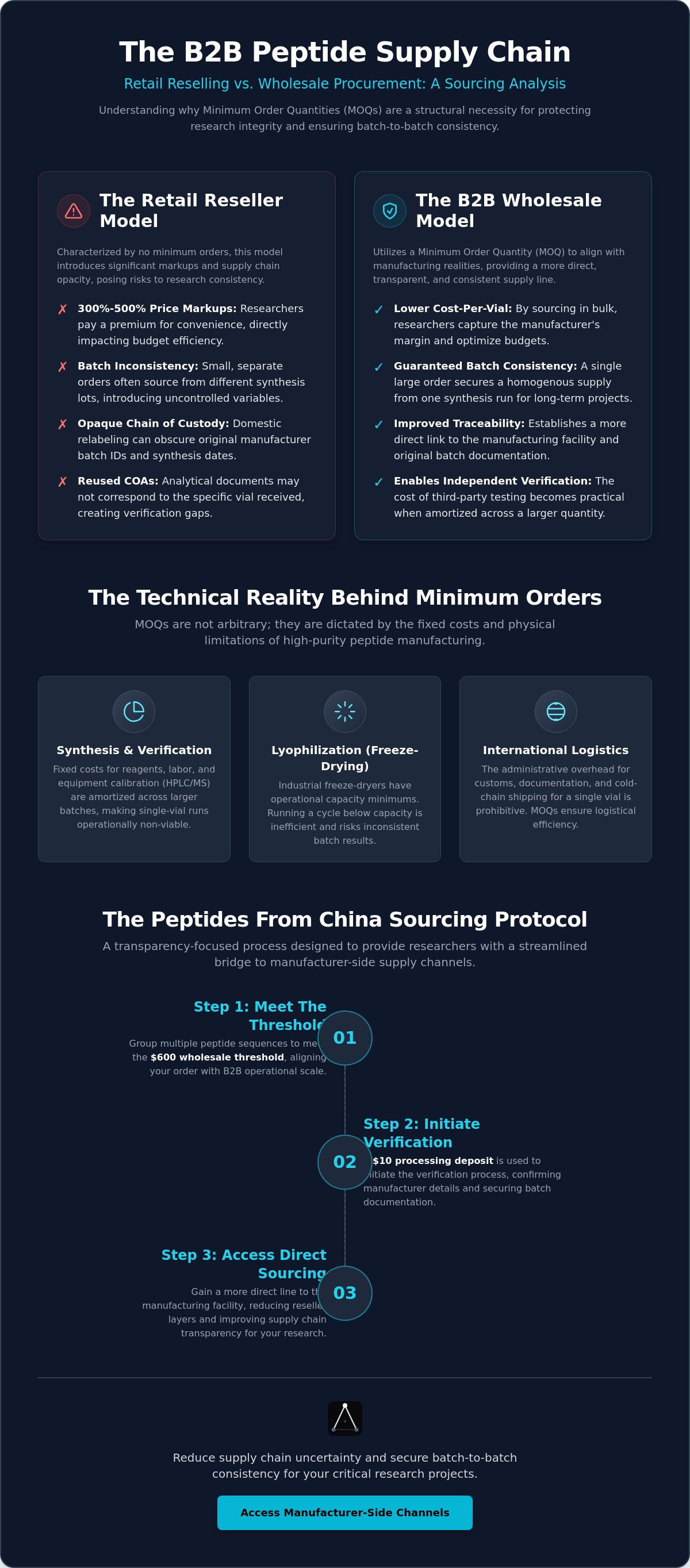
Retail sites that offer "no-minimum" ordering are almost exclusively high-margin resellers. These entities purchase large quantities from manufacturers, break the batches down, and relabel the vials for individual sale. This intermediary layer often adds 300% to 500% markups to the base cost. Beyond the financial drain, this model introduces significant risks to research integrity. When a lab buys small quantities from a reseller, there's no guarantee that vials from two different orders belong to the same synthesis lot. Mixing batches in a single study introduces uncontrolled variables that can compromise your data. Bulk sourcing allows researchers to capture the manufacturer's margin while securing a single, consistent batch for long-term projects.
Why MOQs Signal Professional Sourcing Channels
Legitimate manufacturing labs operate on cycles that demand specific reagent volumes and precise solvent ratios. Understanding the Technical Factors in Peptide Synthesis helps clarify why producing just one or two vials isn't operationally viable at the factory level. The setup costs for High-Performance Liquid Chromatography (HPLC) and Mass Spectrometry (MS) are fixed regardless of whether the batch is ten vials or five hundred.
High order minimums also serve as a logistical necessity. The administrative burden of international shipping, customs documentation, and cold-chain management for a single vial is prohibitive. By maintaining a $600 threshold, sourcing bridges like Peptides From China (PFC) ensure that the logistics remain efficient and that the supply chain remains accessible to serious researchers. These minimums filter out low-intent buyers, allowing the provider to focus on the rigorous documentation and batch traceability that professional laboratories require. Larger orders also make independent verification more practical; the cost of third-party testing is easily amortized across a 50-vial order, whereas it's cost-prohibitive for a single retail purchase.
Technical Factors Influencing Bulk Order Minimums and Synthesis Scale
High-purity peptide manufacturing is a resource-heavy process where fixed costs dominate the operational equation. Every batch requires a specific setup for High-Performance Liquid Chromatography (HPLC) and Mass Spectrometry to verify that the target sequence matches the reference analytical data. These machines require rigorous calibration and high-grade solvents that are consumed regardless of the final yield. In a professional B2B peptide supply chain, the objective is to amortize these technical overheads across a larger number of units. Manufacturers simply don't entertain single-vial requests because the labor and material cost of preparing a run for 10mg of a peptide is nearly identical to a run for 500mg. Setting a minimum order threshold is the only way to keep the cost-per-mg within a range that's viable for research institutions.
Lyophilization, or freeze-drying, serves as a primary physical bottleneck for batch sizing. Industrial freeze dryers operate with specific shelf capacities and cycle times that can last several days. Running a lyophilizer at 10% capacity is an operational failure. It wastes energy and increases the risk of batch-to-batch variability due to inconsistent pressure stabilization across the chamber. Consequently, minimum order quantities are often set to match the physical dimensions of the manufacturer's smallest viable drying tray. This ensures that every vial in that batch undergoes identical environmental conditions, which is essential for maintaining consistency across your research samples.
Synthesis Scale and Purification Overhead
Purification is the most expensive stage of the production cycle. While raw solid-phase synthesis creates the crude peptide, the subsequent purification steps required to reach 98% or 99% purity involve significant solvent waste and expert labor. Custom sequences like Tirzepatide or BPC-157 have different MOQ profiles because their amino acid chains vary in complexity and hydrophobic properties. More complex sequences require more aggressive purification cycles and higher volumes of acetonitrile or trifluoroacetic acid. These chemical requirements naturally push the minimum threshold higher to maintain economic viability. By purchasing at the synthesis scale, you're effectively capturing the manufacturer's efficiency rather than paying for a reseller's waste.
Packaging and International Logistics Compliance
Beyond the lab bench, global logistics dictate the $600 wholesale floor. Shipping research-grade materials internationally involves navigating complex regulatory frameworks and a thorough Chain of Custody Analysis to ensure traceability. Bulk shipping reduces the per-unit footprint of customs processing, administrative fees, and specialized handling requirements. It's more efficient to process one large, compliant shipment than dozens of small parcels that are prone to seizure or labeling errors. If you're looking to bypass the inefficiencies of domestic resellers and stabilize your procurement, you can explore the direct manufacturer-side channels offered through our sourcing bridge. Neutral packaging and standardized tracking aren't just preferences; they're requirements for maintaining a stable supply line in 2026.
Direct-to-Manufacturer vs. Reseller Sourcing: A Chain of Custody Analysis
The allure of "fast shipping" and domestic availability often masks a fractured B2B peptide supply chain. For a procurement officer, the choice between a domestic reseller and a manufacturer-side sourcing bridge is essentially a choice between convenience and traceability. Resellers prioritize speed to market, but this speed comes at the expense of a transparent chain of custody. When a product changes hands multiple times before reaching your facility, the risk of batch substitution or relabeling increases. Each intermediary represents a potential point of failure where the original synthesis data can be lost or intentionally obscured to protect a reseller's source.
Analyzing the chain of custody from a Chinese manufacturing facility to a global research lab reveals the structural flaws of the retail model. In a direct-to-manufacturer scenario, the documentation follows the physical product. In the reseller model, the link between the vial and the reference analytical data is often broken. You aren't just paying for the peptide; you're paying for the certainty that the substance in the vial matches the report on your desk. Wholesale procurement helps reduce supply chain uncertainty by shortening the distance between the synthesis oven and the laboratory bench.
The Reality of Domestic Peptide Warehousing
Resellers typically maintain small, rotating stocks in non-specialized storage environments to facilitate "no minimum" retail orders. This practice is problematic for several reasons. The relabeling process frequently replaces the original manufacturer's batch ID with a generic retail code, making it impossible to cross-reference the vial with original HPLC or Mass Spectrometry reports. Furthermore, the environmental conditions in domestic warehouses are rarely as strictly monitored as those in a dedicated manufacturing facility. Sourcing directly from manufacturer-side channels ensures you receive the freshest possible batches that haven't sat on a reseller's shelf for months, potentially degrading under improper light or temperature conditions.
Transparency vs. Convenience in Procurement
Choosing a $50 retail vial might seem convenient for a pilot study, but the lack of verifiable batch data represents a significant long-term risk. In contrast, opting for wholesale peptides allows a lab to secure a direct line to the production floor. This transition requires a higher upfront commitment, such as the $600 minimum required by Peptides From China (PFC), but the return on investment is found in the reliability of the research data. Professional laboratories don't buy from retail brands; they buy from manufacturing sources. By minimizing the number of intermediaries, you establish a more robust chain of custody that supports independent verification and ensures batch-to-batch consistency for the duration of your study.
Strategic Procurement: Optimizing Your Research Budget for 2026
Procurement within the B2B peptide supply chain requires a transition from reactive, single-vial purchasing to calculated batch acquisition. For many labs, the $600 wholesale threshold serves as a logical pivot point for financial efficiency. While retail resellers offer the illusion of lower entry costs through single-vial sales, the per-milligram price is often quadruple the manufacturer-side rate. Calculating your break-even point involves more than just comparing vial prices. You must factor in the cost of domestic markups against the one-time logistics fee and the necessity of independent verification. In most high-volume research environments, the savings from a single wholesale order of 50 vials can fully offset the cost of third-party HPLC analysis, which is an essential step in any professional sourcing protocol.
Managing a 12-month supply of lyophilized powders is an operationally sound strategy for stabilizing a research budget. When stored correctly at -20°C or -80°C, most freeze-dried peptides maintain their stability and structural integrity for one to two years. This longevity allows labs to move away from the "just-in-time" delivery model, which is prone to customs delays and reseller stockouts. By securing a year's worth of material in a single procurement cycle, you lock in batch consistency and protect your study from the price fluctuations and supply chain opacity common in the retail market.
Batch Consistency and Research Integrity
The primary scientific benefit of bulk procurement is the elimination of batch-to-batch variability. Using a single, large synthesis run for an entire multi-month study ensures that every sample has an identical chemical profile, helping reduce supply chain uncertainty. It's critical to remember that manufacturer-issued papers are baseline technical references rather than definitive proof of identity. Professional labs prioritize peptide testing through independent facilities to confirm that the reference analytical data aligns with the actual contents of the shipment. This verification process is only financially viable when spread across a bulk order, as the testing fee remains the same whether you're verifying one vial or one hundred.
Consolidating Orders for Maximum Efficiency
Meeting the $600 wholesale minimum is most effectively achieved by grouping high-demand compounds like BPC-157 or Tirzepatide with more specialized sequences required for secondary research. Planning your procurement cycles around 4-6 month windows allows you to consolidate these needs into a single manufacturer-side shipment. Choosing between a peptide sourcing agent vs platform will dictate how much transparency you have into the manufacturing origin of these consolidated batches. If you're ready to move beyond retail limitations and secure your laboratory's long-term supply, you can access our manufacturer-side sourcing bridge to begin the verification process.
Navigating PFC's $600 Wholesale Threshold and Protocol
The $600 Minimum: Balancing Logistics and Quality
Maintaining a $600 order floor helps filter out the noise of the retail market and preserves the integrity of a B2B-only operation. When orders fall below this amount, the per-unit cost of international compliance, customs documentation, and secure packaging becomes disproportionately high. By focusing on higher volumes of essential research compounds like Semaglutide, Tirzepatide, and Retatrutide, PFC can streamline the transition from Chinese synthesis labs to global research facilities. This focus ensures that the procurement process remains methodical and that every shipment is large enough to justify the rigorous batch documentation required by professional institutions. It allows the manufacturer to treat the buyer as a strategic partner rather than a retail customer.
The PFC Sourcing Workflow: From Deposit to Delivery
The process of accessing manufacturer-side channels through PFC is built on a transparency-first protocol. It moves away from the "buy now" button common on retail sites toward a structured verification sequence. This sequence is designed to reduce supply chain uncertainty before the full transaction occurs.
Step 1: Request and Deposit. You begin by submitting a specific procurement request along with a $10 processing deposit. This deposit is a functional tool used to initiate the manufacturer verification process, confirming current stock availability and synthesis schedules for your requested compounds.
Step 2: Data Review. Once verification is complete, you receive the factory-issued HPLC and Mass Spectrometry reports for the current batch. These documents serve as your baseline reference analytical data.
Step 3: Fulfillment. After reviewing the batch documentation, you finalize the wholesale invoice (minimum $600). PFC then coordinates the neutral packaging and international tracking to your facility.
This methodical workflow is particularly effective for those seeking bulk BPC-157 wholesale or other high-demand sequences. It's important to remember that PFC acts as a bridge, not a guarantor of purity. While we provide the manufacturer's documentation, we consistently emphasize that no single paper fully guarantees product identity. The protocol is designed to improve traceability and provide the transparency needed for labs to conduct their own independent verification. This structured approach ensures that you aren't just buying a product; you're securing a verifiable link to the production source.
Optimizing Your Laboratory Procurement Strategy
Peptides From China (PFC) functions as a transparent bridge to verified synthesis facilities, maintaining a $600 minimum to ensure professional-grade logistics and direct-to-manufacturer pricing. This structural floor helps reduce supply chain uncertainty while improving batch traceability for every order. It's a methodical approach that values factual integrity over retail marketing hype. You can initiate a wholesale sourcing request with a $10 deposit to begin verifying manufacturer stock and documentation for your specific research needs. Securing a direct, transparent supply line today will help stabilize your laboratory operations for the year ahead.
Frequently Asked Questions
What is the standard minimum order amount for wholesale peptides?
While industry averages vary, Peptides From China (PFC) mandates a $600 minimum for all wholesale procurement. This threshold ensures the order is large enough to justify manufacturer-side attention and professional-grade logistics. It helps labs bypass the inflated markups of retail resellers who often break down bulk batches into single vials for a 300% to 500% premium.
Why do direct-from-manufacturer sources have higher MOQs than retail sites?
Manufacturers set higher minimums because synthesis and purification overheads are fixed costs regardless of yield. Preparing a run for High-Performance Liquid Chromatography (HPLC) or Mass Spectrometry requires significant labor and solvent consumption. Higher MOQs allow these technical costs to be amortized across a larger number of vials, making the price-per-milligram viable for both the producer and the research institution.
Can I mix different peptides like BPC-157 and Semaglutide to reach the $600 minimum?
Yes, you can group multiple sequences to meet the $600 threshold when using the PFC bridge. This strategy is an effective way to optimize your B2B peptide supply chain while securing a diverse inventory for a 4-6 month research window. Consolidation allows you to meet the wholesale floor without over-ordering a single compound, provided the manufacturer has concurrent stock available for the requested items.
Does a higher order minimum guarantee better peptide purity?
No, a higher order minimum does not guarantee purity; it only signals a more direct connection to the manufacturing scale. While bulk orders often come with reference analytical data like HPLC reports, these documents are baseline technical references rather than definitive proof. Quality is maintained through independent third-party testing, which is more cost-effective when performed on a single large batch rather than multiple small retail orders.
How do bulk order minimums affect international shipping and customs?
Bulk minimums improve shipping efficiency by consolidating materials into a single, compliant logistics footprint. Processing one large shipment with standardized tracking and neutral packaging is more reliable than sending dozens of small retail parcels. This consolidation helps reduce the per-unit administrative burden and supports better traceability through the customs process, minimizing the risk of seizures or labeling errors common with fragmented retail shipments.
What happens to my $10 deposit if the manufacturer's stock is not approved?
The $10 deposit is a functional fee used to initiate the manufacturer verification process and confirm current stock availability. If the requested batch documentation doesn't meet your research requirements or if the manufacturer cannot fulfill the sequence, the deposit serves as the cost for the verification labor performed. This protocol ensures that only serious procurement requests reach the production floor, maintaining a streamlined operation for professional laboratories.
Is it more cost-effective to buy 10 vials retail or 50 vials wholesale?
Wholesale procurement is significantly more cost-effective despite the higher upfront investment. Retailers often apply significant markups to offset their domestic warehousing and marketing costs. By purchasing 50 vials at the manufacturer-side rate, you lower the cost-per-vial and secure batch consistency. The savings from one wholesale order often exceed the cost of the independent testing required to verify the B2B peptide supply chain integrity.
How do MOQs differ for custom synthesis versus catalog research peptides?
Catalog peptides often have lower MOQs because they're produced in large, recurring batches for inventory. In contrast, custom synthesis sequences require a dedicated run, which involves specific reagent volumes and machine calibration. The minimum for custom work is dictated by the physical capacity of the manufacturer's lyophilization trays and the complexity of the amino acid chain, which often results in higher thresholds to ensure economic viability.